TRAVEL
How to Use OMNY on iPhone for the NYC Subway and Bus
OMNY on iPhone means a bank card saved in Apple Wallet. Set one card as Express Transit so the $35 fare cap and the free transfer stay on that phone.

You ride New York City subways and buses with OMNY on iPhone by tapping a bank card saved in Apple Wallet. Set that card as Express Transit, then hold the top of the phone on the reader until the screen says “GO.”
You will set up Wallet, tap at a turnstile or bus door, and then see how the seven-day cap, free transfers, and extra riders work, plus what to do when the reader refuses the phone. The fare follows one phone and one card, so a watch or a plastic card starts a new count.
What Does an iPhone Pay at an OMNY Reader?
OMNY is the MTA’s tap-and-ride fare on subways and buses, and on an iPhone that fare runs through Apple Pay. You add a debit, credit, or reloadable prepaid card in Wallet, and the reader charges that card. You can tap on the day you arrive. An account is optional, and you only need one if you want a record of the trips later.
In Wallet, choose Debit or Credit Card. The Transit Card button is for city passes in other systems, and an OMNY pass does not show up on that list. Apple Pay for transit in New York walks through adding the bank card and then tapping.
Cards on the Visa, Mastercard, American Express, Discover, UnionPay, and JCB networks are accepted. A chip card with no contactless symbol on the plastic can still pay once it sits in Wallet, because the phone makes the tap. You do not need a second plastic card if the phone is your only way in.
That tap works at subway turnstiles and AutoGates, on local, limited, and Select Bus Service buses, and on express buses. The weekly cap also covers the Staten Island Railway, the Roosevelt Island Tram, the Hudson Rail Link, NICE buses, and the Westchester Bee-Line. Long Island Rail Road and Metro-North do not take an OMNY tap, so those trips need a railroad ticket.
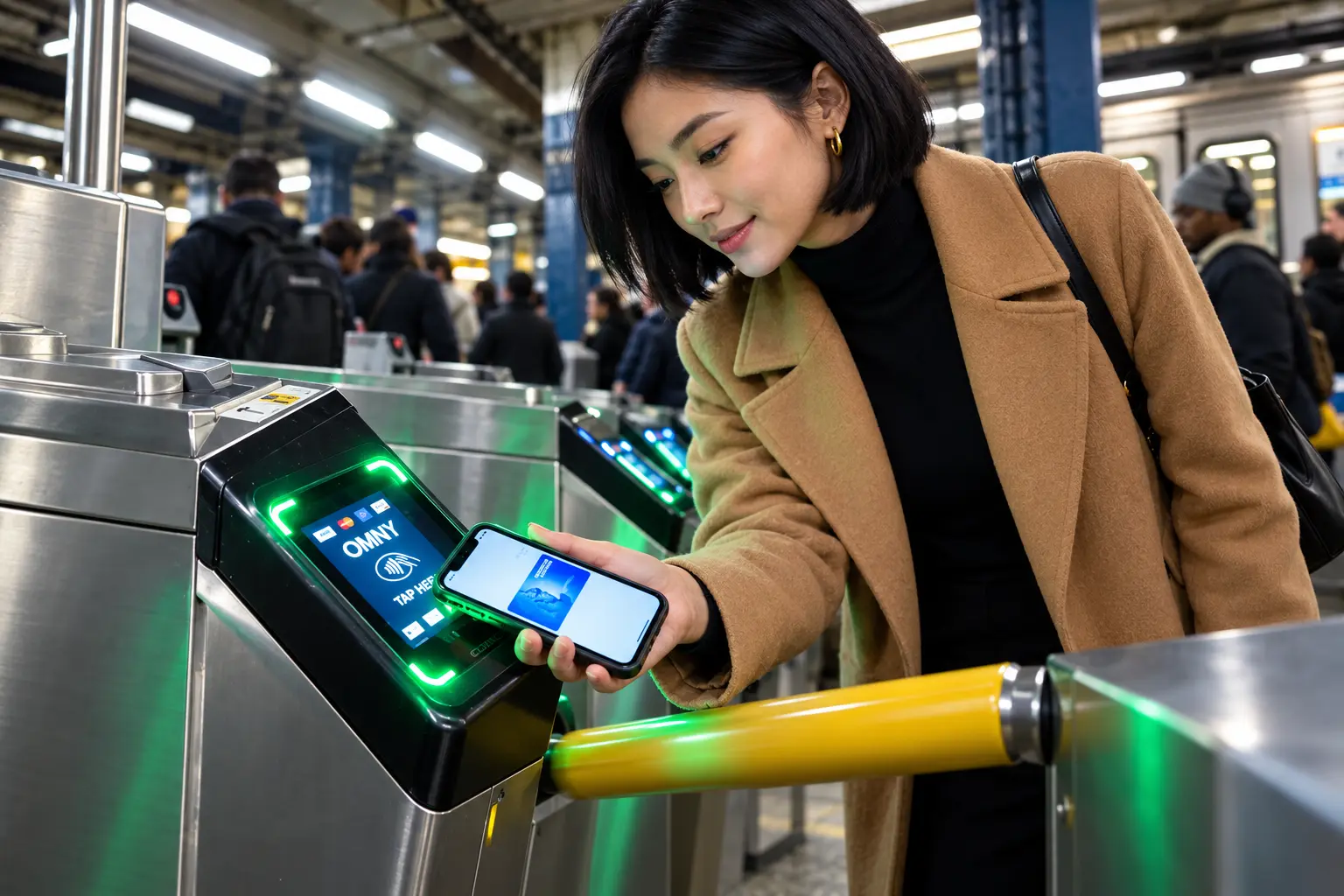
How to Set Up OMNY on iPhone in Wallet
Express Transit lets the phone pay at an OMNY reader without Face ID, Touch ID, or a passcode, and without waking the screen. An iPhone 8 or later on iOS 13.6 or later can use it, and so can an Apple Watch Series 3 or later on watchOS 6.2.8 or later. The phone does not need a cell signal or Wi-Fi at the gate. It does need to be turned on. A shop payment still asks you to confirm, because Express Transit stays limited to OMNY readers.
- Open the Wallet app, tap the plus button, choose Debit or Credit Card, and follow the prompts. The bank confirms the card by text, email, or a call before it can pay.
- Open Settings, tap Wallet & Apple Pay, then tap Express Transit Card. Select the card you want on every ride, then confirm with Face ID, Touch ID, or your passcode.
- Leave that card selected. A second card in the same Wallet keeps its own ride record, even though both cards are yours.
Apple turns Express Transit on when you add an eligible card. Open the setting once and read the card name anyway. A card you used for transit in another city can be the one that taps in New York, and that card would collect the rides.
An Apple Watch needs the card added on its own. In the Watch app on the iPhone, add the card to the watch and turn on Express Mode there. Taps on the watch do not join taps on the phone, even when both draw on the same bank account. Pick one device and stay with it if you want one fare record.
How to Tap an OMNY Reader With an iPhone
With Express Transit on, leave the phone locked. Hold the top of the iPhone near the middle of the reader until you feel a short vibration. The phone shows a checkmark and “Done.” The reader turns green and shows “GO,” and you walk through.
If Express Transit is off, double-click the side button, confirm with Face ID, Touch ID, or your passcode, and then hold the top of the phone to the reader. Pull the phone away before the vibration and the reader can ask you to try again even when the card is fine. Keep the top edge steady on the target for a moment, and wait for the green screen before you push the turnstile bar.
KEEP ONE THING ON THE READER
- One device: Present only the iPhone, only the watch, or only one plastic card.
- Card clash: A contactless card in the same hand as the phone can take a second charge at that reader.
- The top edge: Aim the top of the phone at the target, because a wallet pressed flat against the screen can block the tap.
On a bus, including Select Bus Service, the reader is on board, and you tap it as you board. Each person needs a tap. The reader does not let a group through on a single tap.
The OMNY Fare Cap on One iPhone and Card
Free rides follow one payment method: this iPhone and this card in Wallet, used together. A plastic card with the same number, an Apple Watch with that card loaded, and a second card in Wallet each start a separate count. Your phone and a plastic card do not share a cap, even when both charges land on one bank account.
| What you tap next | Shares the cap and the transfer? |
|---|---|
| Same iPhone, same Express Transit card | Yes |
| Same bank card on an Apple Watch | No |
| The plastic version of that bank card | No |
| A different card in the same Wallet | No |
| A joint card, even with the same number | No |
The window runs seven days from your first tap, and the next tap after it ends opens a new one. Spend under the cap and you pay only for the rides you took. Reach the cap and later rides on that same method are free until the window ends.
The MTA caps weekly subway and local bus fares at $35 when every tap uses that same card or device. Take an express bus in that window and the cap that applies is $67 for subway, local, and express trips together.
Fare Prices and Caps From January 2026
Match the ride to the row below. The dollar cap is the ceiling for that payment method during the seven days that began with your first tap. The prices come from the fare changes that took effect on January 4, 2026.
| Ride | Full fare | Reduced fare | Seven-day cap |
|---|---|---|---|
| Subway, local bus, and Select Bus Service | $3 | $1.50 | $35 full fare, or $17.50 reduced |
| Express bus with subway and local bus | $7.25 | $3.60 | $67 on full fare |
The MTA also describes the benefit as free rides after you pay for 12 trips in that window. Twelve subway fares at $3 add to $36, which is $1 over the $35 ceiling, so the dollar cap is the number to follow when a bank line and a ride count disagree. Transfer taps and extra taps for friends do not count among those 12 trips.
A Week of Taps on the Same iPhone
A FIVE-DAY SUBWAY COMMUTE
- The rides: One subway trip to work and one subway trip home, five days, all on one iPhone and one Express Transit card.
- The total: Those ten paid trips cost $30, which is still under the cap.
- The next ride: Another subway or local bus trip on that same phone and card is still charged.
Charges on that method stop once they reach the cap, and rides after that are free until the seven days end. A bus leg inside the transfer window is free and does not add a paid trip, so a two-seat commute builds the cap more slowly than a count of every tap on the reader.
Free OMNY Transfers With the Same iPhone
Once the cap is tied to one phone and card, that same pairing decides whether the second leg is free. A free transfer needs the same payment method on both legs, within two hours of the first tap. The MTA allows it from subway to bus, from bus to subway, or from bus to bus. The second tap is free, and it does not count toward the fare cap.
Two station pairs let you transfer outside the gates by tapping again: Lexington Av/59 St with Lexington Av/63 St, and Junius St with Livonia Av. A move from the subway or a local bus onto an express bus charges the difference between those fares.
Change the device between legs and the second tap is a new fare. The iPhone at the subway and the plastic card on the bus bill twice, even when both charges hit the same bank account. The same split happens when the morning tap is the watch and the bus tap is the phone. Riders who count every beep, including the free transfer, also reach a false 12 while the paid total is still short.
Other Riders, a Reduced Fare, and a Cash Card
One phone can pay for you and up to three other people on the same trip. Only the first tap counts toward your cap. The extra taps are charged the full fare, and only that first tap is free after you reach the cap.
On the first trip that card or phone has ever made, you cannot pay for the extra riders yet. The bank has to approve the first charge, which generally takes only a few minutes. Use a separate card or phone for each person on that first entry. On the next trip, one method can cover the group. Separate methods still suit a week of travel, because each person then builds a cap.
Reduced-Fare customers pay the reduced fares in the table, and the discount sticks to the card registered for the program. On a joint account, only the registered card gets the reduced fare. The other card is blocked from OMNY. Put the registered card in Wallet if the iPhone is how you ride, and leave it as Express Transit for the whole window.
Riders who would rather not use a bank card can buy a reloadable OMNY card at a subway vending machine or at a retail shop that sells them. The MTA’s intro price for a new card is $1, and you can load it with cash.
- Card life: The card is built to last for up to five years.
- Stored value: You can pre-load $35 for seven days of subway and local bus rides, and unused money stays on the card.
- Single ride: A $3.50 ticket lasts two hours, includes a bus-to-bus transfer, and does not cover a trip that uses both subway and bus.
The approved fare plan raises that new-card fee to $2 when MetroCard fare payment ends, which the MTA scheduled for later in 2026. The MTA no longer sells unlimited-ride MetroCards. A MetroCard you still hold is a separate fare medium from the iPhone until acceptance ends.
iPhone Taps That Do Not Say GO
When the reader refuses the phone, check the card, the Wallet setting, and the reader before you pay another way.
- The reader: If a second turnstile or the bus reader takes the same phone, the first reader is the problem.
- The express card: Open Express Transit and confirm the card name, because a different card chosen by hand starts a new fare record.
- Card clash: Step back, pocket any plastic contactless card, and tap the phone alone.
- A bank block: The issuer can refuse the charge, and OMNY can block a method after a fare it could not collect. Call 877-789-6669, which the MTA answers 24/7 for tap-and-ride payments.
- A missing setting: If Express Transit has disappeared from Wallet, remove the card, add it again, and reselect it.
Stacking several phones, watches, and cards on one reader can post a charge for each attempt. In July 2026, MTA Chair and CEO Janno Lieber told riders with a bad charge to bring the fare medium they used, whether Apple Pay or a card, so staff can trace those taps.
How to Check OMNY Trips From an iPhone
After a week of taps, the account is where you see whether those rides landed on one cap. Create a free OMNY account and link the card you tap with. Cap progress updates on its own, and the account keeps up to one year of trip and charge history.
OMNY also describes a Trip History page that shows seven days of taps with no account if you enter the card details. Use the account when you want the longer record and the cap tracker together.
A charge can show on the bank line after you have left the station. A pending hold is a different line from a posted fare. Compare the OMNY history with the statement before you dispute the ride. If that history shows the cap was already met on one phone and card and a later ride still posted, call OMNY customer service with that phone in hand.
Frequently Asked Questions
Can You Tap OMNY on iPhone With No Signal?
Yes. With Express Transit on, the iPhone can pay at an OMNY reader with no cell signal and no Wi-Fi. The phone still has to be turned on. Add the card and choose the Express Transit card before you lose signal, because that part of setup has to reach your bank.
Will a Dead iPhone Still Pay an OMNY Fare?
You might, for a short time. Apple says an Express Transit card can still pay when the iPhone needs a charge, if Express Transit was already on. When the phone will not wake at all, use a plastic bank card or an OMNY card for the gate.
Can You Add an OMNY Card to Apple Wallet?
No. Apple Wallet in New York stores the bank card you tap with, and it does not store the MTA’s reloadable OMNY card. The plastic OMNY card taps on its own. Buying that card with a bank card does not move its balance onto the phone.
Does the OMNY Fare Cap Reset on Monday?
No. The seven days start at your first tap, not on Monday morning. A window that opens Wednesday afternoon ends the next Wednesday afternoon, and the tap after that starts a new seven days. Directions that run the cap Monday through Sunday describe the older rule.
What Should You Do If OMNY Charges You After the Cap?
Check your OMNY account and confirm every paid trip in the window used the same iPhone and the same card. A watch, a plastic card, a second Wallet card, or a tap for a friend sits outside that cap. If one method still shows a charge after the cap, call 877-789-6669 and have that phone with you.
Set one card as Express Transit, tap that same iPhone for every leg, and the transfer and the cap stay on that method. Switch to a watch or a plastic card and those rides start a separate seven-day count.


A CubeSat Will Age Whisky That Never Comes Home

A Charity Quote Cost Shia LaBeouf the FKA twigs NDA

Looker Turned a Model’s Body Into Ad Inventory

Infinity Ward Bets a Paid DMZ Will Stick This Time

Disney Sidesteps a Kimmel Renewal as Failla Cites Losses

Southwest Preboarding: Who Qualifies and What to Do

False AI Intel Nearly Put US Crews on a Chinese Ship

How Often Do You Have to Change a Monkey’s Diaper?

Tim Cook’s $4.6 Trillion Apple Still Runs on One Phone

Dunes Air Sues Nora Fatehi Over Its Luxury Jet
-
 TRAVEL3 years ago
Southwest Preboarding: Who Qualifies and What to Do
-
 NEWS2 months ago
False AI Intel Nearly Put US Crews on a Chinese Ship
-
 LIFESTYLE3 years ago
How Often Do You Have to Change a Monkey’s Diaper?
-
 BUSINESS2 months ago
Tim Cook’s $4.6 Trillion Apple Still Runs on One Phone
-
 ENTERTAINMENT2 months ago
Dunes Air Sues Nora Fatehi Over Its Luxury Jet
-

 LIFESTYLE3 years ago
How Long Does It Take for Armpit Hair to Grow?
-

 NEWS2 months ago
OpenAI Posts a Navier-Stokes Proof Clay Has Not Touched
-

 SPORTS3 years ago
Is Marching Band a Sport?