
LIFESTYLE
How to Use Hair Chopsticks: A Styling Guide for Every Hair Type
Hair chopsticks stay in when you twist the roots, slide the stick along your scalp to catch hair under the bun, and match the stick to your hair type.

You bought hair chopsticks, twisted a bun, pushed them through, and the whole thing slid out before lunch. A hair stick holds a bun or a twist by locking hair against your scalp. Twist the roots, slide the stick along your scalp so the tip catches hair under the style, and the bun stays. This guide covers which stick fits your hair, the one-stick method, styles past a basic bun, and the mistakes that make a stick fall out.
What Is a Hair Stick?
A hair stick is a long, thin pin, straight or tapered, with a point so it can slide into a bun or a similar style. Chopstick-shaped versions are what people mean by hair chopsticks. In Chinese the same tool is a fazan (发簪) or a zanzi (簪子). The usual length runs from 5 to 9 inches (12.7 cm to 22.9 cm).
Pens, pencils, and eating chopsticks get used as stand-ins. A stick made for hair is smooth and sturdy enough to stay in a twist. Thin takeout chopsticks can split, and rough wood can snag strands. If chopsticks are all you have, use a smooth sturdy pair to learn the motion, then move to a finished hair stick on days the style has to last.
A hair fork is a different tool. It has two or more prongs, and it goes into a bun you have already shaped. A single stick can carry the hair around as you turn it, or it can pass through a coil you made first. A two-prong kanzashi goes in after the bun exists. The fork can bend if you force it, and you cannot turn it to a new angle once it is seated.
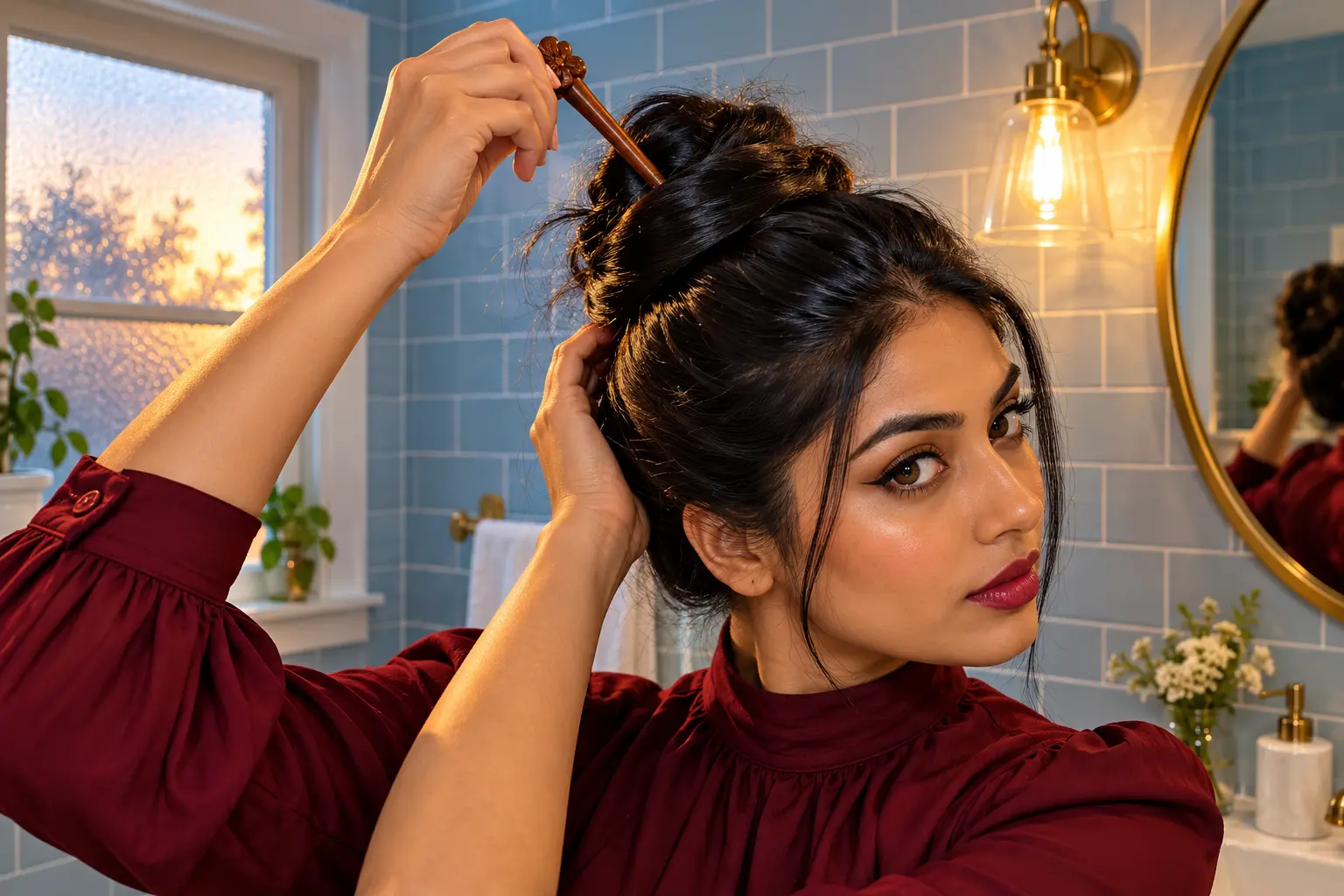
Which Hair Stick Fits Your Hair?
Match the stick to how much hair you are pinning, not to the ornament in the product photo. A heavy carved top on fine hair drags the twist down. A short light stick in a thick coil never reaches the hair underneath, so the style is only decorated, not locked.
| Your hair | Stick that holds | Why it holds |
|---|---|---|
| Fine and straight | Lightweight bare wood, plain top | Smooth metal, plastic, and lacquer slip, and a heavy top drags a fine coil down |
| Only enough for a half-up | A shorter stick through the top section | You need hair above the ears, twisted, with two fingers’ width left at the roots |
| A normal amount, shoulder length or longer | Wood or brass of about 12 cm | That length ties long hair when there is not a lot of it |
| Thick, very long, or dense | Longer, heavier wood | Wood grips better than brass, and extremely long or thick hair needs a stick longer than 8 inches |
| Curly or wavy | Wood, curls left as they are | The bends in the hair give the shaft something to hold |
Wood and brass both work on a normal amount of hair. When there is a lot of hair, wood is less slippery than brass. Flat brass shafts bend if you lever them, and acrylic snaps, so let a thicker shaft do the holding and keep a thin pin as a second accent. A slim metal stick is a smaller option once a short coil is already secure, not a fix for hair that slips.
Hold the stick a little above the middle of the stem, just under the ornament, so you are not shoving on the decoration. Plastic pairs can cost less than a dollar, and one stick made by hand can cost over $200. Pay for a smooth shaft in the right length before you pay for the top.
How to Put Your Hair up With One Stick
Start with dry, detangled hair, and keep oil, serum, and heavy cream off the lengths you will twist. Those products make the shaft slide. Curly or wavy hair should stay as it is, because brushing it smooth and then adding a slick cream removes the texture the stick uses. You need one stick and a mirror you can turn. A second stick and a small tie are backups, not part of the basic hold.
- Gather your hair into one bundle where you want the coil to sit, at the nape, the crown, or off to one side.
- Twist it clockwise and make the roots firm. Two or three turns are enough. If you are left-handed, reverse every direction in these steps.
- Hold the stick just above the middle of the stem. Point it down into the center of the twisted hair, two fingers’ width from your scalp.
- Keep the tip against your scalp and turn the stick so it scoops the bundle. Flip the ornament up as the tip swings down, still tracing the scalp.
- Push the stick into the lower side of the twist and seat it along the curve of your head. The ornament sits outside the hair, not buried in it.
- Tug the coil gently. If the whole bun lifts off, the stick never caught the hair underneath. Pull it out and scoop again.
A kanzashi shop in Japan films this same motion for long and medium-long hair, from the bundle through the flip to the scalp trace.
Some guides tell you to lay the sticks under a ponytail, wrap the hair around them, and push the thin ends back in. That wrap is a fair way to build the coil, as long as the tips still travel along the scalp on the way back through. A wrap that only parks the sticks inside the coil is the version that falls out on the way to the car. The first tries feel clumsy. Once your hand knows the flip, the same motion works high, low, or off to the side.
Hair Chopstick Styles Past a Basic Bun
Once the scoop is in your hand, the style is mostly where you place the coil and how tight you twist before the stick goes in. The lock does not change from one shape to the next.
How to Make a French Twist With Two Sticks
A French twist is a vertical fold up the back of the head, and two sticks keep the rope from unwinding.
- Brush your hair to the nape and hold it there in one hand.
- Pull the length to one side and twist it the opposite way, so the rope tightens as it climbs the head.
- Bring that rope up the back, fold the end down, and tuck it into the pocket of hair under the twist.
- Put the first stick through the top of the fold until the tip meets your scalp, flip it, trace the scalp, and push it out the other side.
- Put a second stick lower on the fold, crossing the first, with the same flip.
The two sticks share the weight of the rope, so neither one has to clamp the hair by itself. If the fold feels like it wants to spin open, the roots were not twisted firmly before you folded the end down.
A Half-Up Style for Shorter Hair
TRY THE TWO-FINGER TEST
- The pickup: Lift only the hair from above your ears and leave the lower layer down.
- The space: Twist that top section and look for two fingers’ width between the coil and your scalp.
- The pin: Slide the stick through with the same scalp scoop, and add a small hair tie under the twist when the hair will not hold on length alone.
Shoulder-length hair can go all the way up when you can twist it and still leave that space at the roots. A buzz cut will not take a stick. Between those lengths, a half-up is the style that still uses one without a fake-long wrap. The stick still has to catch hair under the half-up, or the top section flops forward.
High, Low, Messy, and Side Buns
- High bun: Gather at the crown so the coil sits on top, and use a longer stick if the coil is large.
- Low bun: Gather at the nape for a chignon line that stays off your collar.
- Messy bun: Twist more loosely and leave a few ends out, while the stick still scoops hair under the coil.
- Side bun: Sweep everything over one ear, coil it there, and run the stick toward the back of the head.
A knot bun is the long-hair cousin of the low coil. Twist the rope, tie it once, then pin through the knot. It needs length, because the tie uses up some of the hair before the stick ever goes in. A loose messy coil fails for the same reason a tight one fails when the stick never reaches the hair against your scalp.
A Braid or a Wrapped Ponytail
Braid the hair to the ends, coil the tail against your head, and slide one stick under the braid near the nape. A second stick on a diagonal through the coil keeps the tail from flipping out. For a ponytail, pull a small strand from the underside, wrap that strand around the base until the ends disappear, and push a thinner stick through the wrapped base. The strand is doing the job of an elastic, so the stick only has to lock the wrap.
A THINNER STICK FOR A PONYTAIL
The base of a ponytail is narrow, so a thick carved stick fights the wrap. A slim shaft goes through the wrapped strand and the gathered hair without opening a hole the tail can slip out of.
Check the wrap with a small head shake. If the tail droops, the stick missed the wrapped strand and is only sitting in the loose hair above it.
Why Do Hair Chopsticks Slip Out?
Most sticks that fall out were put in on a straight line. The shaft entered one side of the bun and left the other without dipping under the hair at the scalp, so moving your head walks it free.
WHY A HAIR STICK SLIPS
- The path: A stick pushed straight through the middle of the bun has little hair to grip, and it walks out as you move.
- The wash: Hair shampooed the same day is slick, and day-old hair holds the shaft better.
- The shaft: Smooth metal, plastic, and lacquer slip more than bare wood, especially in a heavy twist.
- The force: Levering a thin brass shaft or an acrylic pin to make it tighter bends or snaps the stick.
If the stick slides, change one thing and retry, starting with the path. A second stick from the opposite direction, crossing the first, braces a coil that one shaft cannot hold. Skip the second stick when the first one already survives a tug and a short walk around the room.
When Should You Loosen a Hair Stick Bun?
A stick is gentler than a tight elastic because the hold comes from the weave, but a hard twist still pulls. You should be able to slide a fingertip between the coil and your scalp. If the spot aches, or the style gives you a headache, take it down and redo it looser.
Tight hairstyles can cause traction alopecia from repeated pulling, and that hair loss can be permanent. Move the coil higher, lower, or to the side from one day to the next so the same area does not take the pull every time. Pain is the signal to loosen the twist, not a reason to add another pin on top of a style that already hurts.
Where Do Hair Sticks Come From?
Hair sticks have been used for thousands of years in Egypt, Rome, Greece, India, and China. Egypt left gold examples, and Rome left wooden ones, which shows the tool was in wide use and not limited to jewelry buyers. Modern shop sticks take their look from Japanese kanzashi more than from any other tradition. Kanzashi made for geisha are often floral, and the flowers change with the season.
Chinese hairpins include ji and chai, plus buyao pieces that dangle. Korea uses the binyeo. The Met’s 18th-century Chinese hairpin runs 10 3/8 inches (26.4 cm), with amber, pearl, and feathers on metal, longer than a stick you would hide in a weekday bun. A painted donor wears sticks set with gold and jade, the dressed-up end of the same pin.
Frequently Asked Questions
How Do You Take a Hair Stick Out?
Push the tip back in the direction it came from until the stick lifts, then hold the stem and draw it out. Pulling on the ornament snaps glass beads and carved tops off the shaft. Some glass-bead pins can be repaired, and the cost depends on how the shaft and the top broke, so keep the pieces.
Can Men Wear Hair Sticks?
Yes. A plain wood or metal stick in a bun is the ordinary way to wear one. Makers also point men toward antique pins, water-buffalo horn, and silver, and the same pin can hold a stole or sit in a jacket pocket as a handkerchief pin.
Do Hair Sticks Leave a Crease in Your Hair?
No. A stick does not cinch one spot the way an elastic band does, so your hair does not keep that dent when you take the style down. With very long or heavy hair, the twist also spreads the weight across your head instead of hanging it from one band.
Can You Put Hair Chopsticks in Wet Hair?
No. Wait until your hair is fully dry before you put a stick in. A wet twist can snap strands as it dries, and water left on a wooden stick can warp or stain the wood.
Seat the stick, then lift the coil with one hand. If it comes away from your head in one piece, the shaft never caught the hair underneath, so take it out and trace the scalp again before you leave the mirror.
Disclaimer: This guide is for general education about hair sticks and styling, and it is not personal advice. It is not a substitute for care from a hairstylist or a board-certified dermatologist, especially if a style hurts or you notice thinning where the hair is pulled. Ask a qualified professional before you change how you wear your hair if you already have hair loss or a scalp condition. Lengths, materials, and care notes reflect the sources reviewed for this guide and can change.

A CubeSat Will Age Whisky That Never Comes Home

A Charity Quote Cost Shia LaBeouf the FKA twigs NDA

Looker Turned a Model’s Body Into Ad Inventory

Infinity Ward Bets a Paid DMZ Will Stick This Time

Disney Sidesteps a Kimmel Renewal as Failla Cites Losses

Southwest Preboarding: Who Qualifies and What to Do

False AI Intel Nearly Put US Crews on a Chinese Ship

How Often Do You Have to Change a Monkey’s Diaper?

Dunes Air Sues Nora Fatehi Over Its Luxury Jet

Tim Cook’s $4.6 Trillion Apple Still Runs on One Phone
-
 TRAVEL3 years ago
Southwest Preboarding: Who Qualifies and What to Do
-
 NEWS2 months ago
False AI Intel Nearly Put US Crews on a Chinese Ship
-
 LIFESTYLE3 years ago
How Often Do You Have to Change a Monkey’s Diaper?
-
 ENTERTAINMENT2 months ago
Dunes Air Sues Nora Fatehi Over Its Luxury Jet
-
 BUSINESS3 months ago
Tim Cook’s $4.6 Trillion Apple Still Runs on One Phone
-
 LIFESTYLE3 years ago
How Long Does It Take for Armpit Hair to Grow?
-

 NEWS2 months ago
OpenAI Posts a Navier-Stokes Proof Clay Has Not Touched
-

 TRAVEL2 years ago
Smallest Airlines in the US: Niche Carriers and Unique Flights