
TRAVEL
Oldest Roman Catholic Church in the World: Trier Cathedral Guide
The oldest Roman Catholic church in the world splits by test: the Lateran is Rome’s cathedral from 324, and Trier keeps fourth-century walls in daily use.

You came looking for the oldest Roman Catholic church in the world, and the honest answer depends on the test you use. Rome’s own cathedral, St. John Lateran, holds the title for the oldest public church of the Roman church. Trier Cathedral, on the Moselle in Germany, is the oldest bishop’s church in Germany, and Roman brick still stands in its walls.
Those two claims measure different things, which is why both keep landing on the same lists. This guide sorts the tests, then covers the Trier building, the Holy Tunic, and the hours on the door.
A Working Church With Roman Walls in Trier
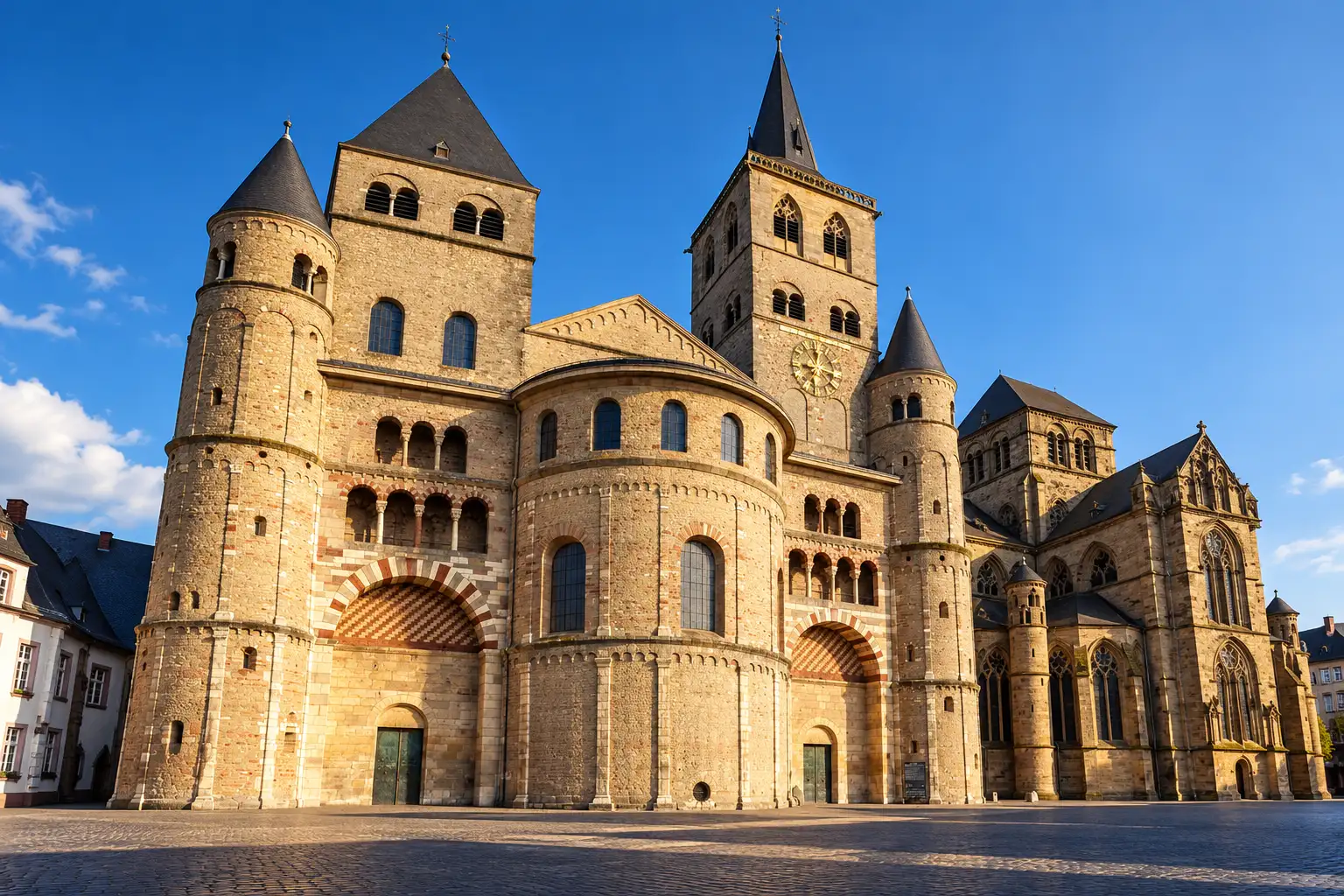
Trier Cathedral, the High Cathedral of St. Peter, is still the seat of a Catholic bishop, not a museum that waits for a ticket desk. People have gathered here for 1,700 years to pray, to celebrate services, and to venerate the Holy Tunic, the relic tradition calls the seamless robe of Christ.
The cathedral shares a World Heritage listing with the Church of Our Lady next door and with the Roman monuments of the city. UNESCO’s entry for the Trier monuments calls the cathedral one of the oldest church buildings in the Western world, and it ties the church to the years when Christianity became a faith the empire would tolerate.
By the late Roman period Trier was one of the capitals of the Tetrarchy, a city treated as a second Rome north of the Alps. The recognition of Christianity in 313 sits behind the decision to build a great church on this ground. The building you enter has been ruined and rebuilt more than once since that decision.
Four Tests for the Oldest Roman Catholic Church in the World
Lists argue because they date different events and then treat those dates as the same kind of fact. A church can be old as a congregation, old as a consecrated public building, old as standing masonry, or old as a Roman shell later handed to Christian worship. Pick the test before you pick a winner.
| Test | What it measures | Church that fits |
|---|---|---|
| Oldest public church of the Roman church | Consecration as a public basilica that is still the pope’s cathedral | St. John Lateran, consecrated in 324 |
| Roman walls still in a working Catholic cathedral | Masonry from the first large church still forming the building in use | Trier Cathedral, square building from 340 |
| Earliest known Christian meeting place | A building shown to have been used for Christian assembly | The Christian building at Dura-Europos, third century, now ruins |
| Oldest large Roman building later used as a church | A temple converted to worship centuries afterward | The Pantheon in Rome, a church only from the seventh century |
The cathedral’s own welcome uses a narrower title, the oldest bishop’s church in Germany, and that sentence matches the second row of the table. The Lateran is the church that fits the first row. Dura-Europos and the Pantheon answer different questions, and neither is a bishop’s church founded as a church and still used as one.
Why Does St. John Lateran Keep Rome’s Claim?
St. John Lateran was consecrated in 324 by Pope Sylvester I. Britannica’s account of the Lateran calls it the oldest public church in Rome and the highest ranking of the great papal basilicas. From that consecration, the basilica and the adjoining Lateran Palace were the pope’s cathedral and the center of Christian life in the city.
Constantine held the old Laterani family property from around 311 and gave it to the bishop of Rome. In 313 a council of bishops met there and rejected the Donatists. The first dedication was to Christ the Savior. Later dedications to John the Baptist and John the Evangelist are why the everyday name is not the original one. An inscription on the church still addresses it as mother and head of all the churches of the city and the world.
Two fires during the Avignon years gutted the medieval building, and later popes rebuilt it more than once. Pope Sixtus V ordered a new church under Domenico Fontana. The facade you photograph was completed in 1735. St. Peter’s now hosts most great papal ceremonies because of its size and its place inside Vatican City, but the pope’s cathedral, as bishop of Rome, is still the Lateran.
How Did Trier Cathedral Grow From Roman Walls?
The congregation is older than the square of masonry you can still see, and each later century kept that square as the piece worth saving. The cathedral’s late antique building history is the sequence behind the north wall.
The Fourth-Century Church in Roman Trier
The Roman work on this ground runs from a named community to a square building whose outer walls still form the core of the cathedral.
THE ROMAN BUILDING SEQUENCE
- About 270: A Christian community is already in Trier, with Eucharius, Valerius, and Maternus named as the first bishops. Their meeting place is described as a house church inside the city walls.
- 311 and 313: An edict of toleration, then the agreements of Constantine and Licinius at Milan, gives Christians the legal room to build in public.
- 310 to 320: Bishop Agritius, first mentioned in 314, builds a large basilica over a house. Remains of that basilica lie under the Dom-Information office.
- 329 to 346: Bishop Maximin extends the site into four basilicas, a baptistery, and side buildings, one of the largest church complexes of that century.
- From 340: The square building, the Quadratbau, rises on the cathedral ground, and its outer walls still form the core of the church.
Under the old north basilica, a painted ceiling shows members of the imperial family, most probably Helena and Fausta. That ceiling is one reason the complex is tied to the palace quarter, even though the story that Helena handed over her own house stays a tradition rather than a document.
The Medieval Rebuild After the Norman Raid
Unrest in the first half of the fifth century destroyed the ancient complex. Bishop Nicetius, who died in 561, had the square building and parts of the north church repaired by builders from Italy. The Normans destroyed the church again in 882, so the Romanesque interior you mostly see is a repair of a ruin.
WHAT THE MEDIEVAL REBUILD ADDED
- The Salian west front: After a start under Archbishop Egbert, who died in 993, Archbishop Poppo of Babenberg, who died in 1047, and his successors renewed the church, the crypts, and the west facade.
- The east choir: The late Romanesque choir, with its own crypt, was consecrated in 1196 against the east wall of the square building, and the nave was then vaulted.
- The Church of Our Lady: In the thirteenth century a new church rose on the ruins of the ancient south church, and the cloister was built in the same period.
- The towers: Archbishop Balduin, who died in 1354, raised both slim east towers, and the south tower on the west front was heightened around 1515.
Choir screens, tombs, and carved stone from the Middle Ages are still in the room. The tombs mark the cathedral as the burial place of Trier’s bishops from the medieval period on. The heavy west front in most photographs belongs to this Salian rebuilding, not to Constantine’s masons.
The Baroque Layer and the Fire of 1717
After the Thirty Years’ War the archbishops began a baroque refit, and a fire in 1717 forced a second round of changes to the fabric itself.
- Archbishop Carl Caspar von der Leyen, who died in 1676, started the refit after the war.
- Archbishop Johann Hugo von Orsbeck, who died in 1711, added the altar structure in the Romanesque east choir and the relic chamber on its outer wall, the room that holds the Holy Tunic.
- New altars, baroque tombs, a wrought-iron choir screen, and a swallow’s nest organ carried the baroque layer through the eighteenth century.
Restorers in the nineteenth century then tried to bring back a medieval look. The room you walk through is that stack: a Roman core, a Romanesque body, Gothic vaults, baroque fittings, and a nineteenth-century reading of the Middle Ages laid over them.
Where Do Roman Walls Still Show in Trier?
You do not need a badge to see the Roman brick. On Windstraße, along the north side, long stretches of the square building’s outer wall are still the face of the cathedral. A fragment of an ancient granite column, the Domstein, lies by the west portal as another piece of the same Roman site.
The basilica from before the square building is underground. Excavations beneath the Dom-Information office show what is left of it, and a booked visit is the way in. The diocese film walks the same ground, from the square building and the Domstein to the Church of Our Lady, the organ, the Holy Tunic chapel, and the treasury.
The Church of Our Lady stands on the footprint of the ancient south church. It is its own building, described by UNESCO as the earliest church built in French High Gothic style outside France. The cathedral, that church, and the Roman monuments were inscribed together in 1986.
What Is the Holy Tunic of Trier?
The Holy Tunic is the relic pilgrims come for, identified in tradition with the seamless garment soldiers cast lots for at the crucifixion rather than tearing, the scene the Gospel of John records. Tradition says Helena brought that cloth from the Holy Land. The cathedral’s account of the Holy Tunic treats the journey as tradition and dates the secure record to a later move inside the church.
On 1 May 1196 the tunic was carried from the west choir into the new altar of the east choir. That move is the first fixed point in the cathedral’s own history of the relic. The first mention sits in the eleventh century, and the file is treated as secure only from the twelfth.
The first public pilgrimage came in 1512, when the high altar was opened before Emperor Maximilian under Archbishop Richard von Greiffenklau. The cathedral then lists these later showings.
- 1513, 1514, 1515, 1516, 1517, 1524, 1531, 1538, and 1545, in the decades after the first opening.
- 1655, 1810, 1844, and 1891, with long quiet stretches between them.
- 1933, 1959, 1996, and 2012, the showings in the twentieth and twenty-first centuries.
From 13 April to 13 May 2012 the tunic was placed in a glass shrine, and the cathedral counts about 550,000 pilgrims. The motto was “Bring Together What Is Divided.” Between showings the cloth stays in the relic chamber, so an ordinary visit does not include a view of it.
Benedict XVI’s message to the bishop of Trier is dated 6 April 2012, Good Friday, and it is addressed to Bishop Stephan Ackermann for the opening of that pilgrimage. No later showing appears on the cathedral’s list.
How to Visit Trier Cathedral
The church is a place of worship first. Doors open early because the day starts with prayer, and they close earlier in the winter months. The treasury and the information office keep their own desks, and those desks do not match the church door.
| Place | When the doors are open |
|---|---|
| Cathedral, April through October | Daily, 6:30 a.m. to 6:00 p.m. |
| Cathedral, November through March | Daily, 6:30 a.m. to 5:30 p.m. |
| Treasury, Monday to Saturday | 11:00 a.m. to 5:00 p.m. |
| Treasury, Sundays and holidays | 12:30 p.m. to 5:00 p.m., last entry 15 minutes before closing |
As of the schedule running to 3 January 2027, the Dom-Information office is open Monday to Saturday from 10:30 a.m. to 5:15 p.m., closed on Sunday, and open on holidays from noon to 3:00 p.m. Closures fall on 1 November, from 24 to 26 December, on 31 December, on 1 January, and for a staff break from 7 to 20 January 2027. The treasury also posts the odd shorter day, so a holiday visit should confirm the desk before you cross town for it.
An hour on foot covers the parts that answer the age question, if a service is not in the way.
- Start on Windstraße and look at the Roman brick in the north wall.
- Come around to the west front and the granite column fragment by the portal.
- Walk the nave toward the east choir, where the relic chamber sits on the outside of the old choir.
- Step next door into the Church of Our Lady, on the ground of the old south church.
- If the treasury is open and you want the medieval objects, leave time for that room on its own ticket.
The nave has no entry fee. Sightseeing stops while a service is going on, so a morning arrival can mean waiting out Mass before you walk the aisles.
Which Buildings Get Mixed Up With Trier Cathedral?
The Basilica of Constantine, also called the Aula Palatina, is the imperial audience hall and the largest known interior from classical times. It is a separate monument in the same World Heritage listing, not the bishop’s church, and it does not hold the Holy Tunic. UNESCO records wartime fire and bomb damage to that hall and to the Church of Our Lady, with the hall restored from 1954 to 1956 and the church from 1946 to 1949. The cathedral is not named in that damage note.
The Christian building at Dura-Europos, on the Euphrates in Syria, is the meeting place older than either cathedral. The city was abandoned in 257, and the ruins are the earliest structure that can be shown to have hosted Christian assembly before Constantine. They are an archaeological site, not a Roman Catholic church with a Sunday Mass.
The Pantheon in Rome is the other mix-up. The standing rotunda was built as a temple for the Roman gods, and it became a church only in the seventh century. The age of that shell and the age of Christian use are different numbers, which is the same split you meet in Trier, only with the altar arriving centuries after the brick.
Frequently Asked Questions
How Much Does the Trier Cathedral Treasury Cost?
Adults pay 3 euros, children from the age of six pay 1 euro, a family of two adults and up to four children pays 7 euros, and a reduced ticket is 2 euros.
Which Parts of Trier Cathedral Have Steps?
The nave, the side aisles, the cloister, and the Dom-Information office can be reached without steps. The Holy Tunic chapel, the treasury, and the crypts are reached only by stairs, and there is no staff service to carry a visitor up those stairs. Assistance dogs are allowed in the cathedral.
What Languages Are Treasury Tours Offered In?
Treasury tours are offered in German, English, French, and Italian during treasury hours. The Dom-Information desk on Liebfrauenstraße, opposite the Church of Our Lady, also books the crypt tour, which visits the Blasius crypt, the Maternus crypt, and the Helena crypt.
Why Do the Cathedral Doors Open So Early?
The doors open early because this is still the bishop’s church of the Diocese of Trier, and the first commitment of the day is prayer and Mass. A visit fits around that schedule. The cathedral publishes the service list, and sightseeing waits until the liturgy ends.
What Does the Trier Cathedral Treasury Display?
The treasury holds pieces from the long life of the diocese, with the portable altar of St. Andrew, made around 980, among the best known, along with goldsmith work, ivory carvings, and medieval manuscripts. The Holy Tunic is not part of that everyday display. It stays in the relic chamber off the east choir except during a pilgrimage.
On Windstraße the Roman brick of the square building is still the outer wall, and the church above it is open for Mass. The Lateran, consecrated in 324, remains the pope’s cathedral in Rome even though its walls were rebuilt. At Trier you can stand beside masonry from 340 on an ordinary afternoon, which is the part of the oldest Roman Catholic church in the world question a list of dates cannot settle for you.

A CubeSat Will Age Whisky That Never Comes Home

A Charity Quote Cost Shia LaBeouf the FKA twigs NDA

Looker Turned a Model’s Body Into Ad Inventory

Infinity Ward Bets a Paid DMZ Will Stick This Time

Disney Sidesteps a Kimmel Renewal as Failla Cites Losses

Southwest Preboarding: Who Qualifies and What to Do

False AI Intel Nearly Put US Crews on a Chinese Ship

How Often Do You Have to Change a Monkey’s Diaper?

Tim Cook’s $4.6 Trillion Apple Still Runs on One Phone

Dunes Air Sues Nora Fatehi Over Its Luxury Jet
-
 TRAVEL3 years ago
Southwest Preboarding: Who Qualifies and What to Do
-
 NEWS2 months ago
False AI Intel Nearly Put US Crews on a Chinese Ship
-
 LIFESTYLE3 years ago
How Often Do You Have to Change a Monkey’s Diaper?
-
 BUSINESS2 months ago
Tim Cook’s $4.6 Trillion Apple Still Runs on One Phone
-
 ENTERTAINMENT2 months ago
Dunes Air Sues Nora Fatehi Over Its Luxury Jet
-

 NEWS2 months ago
OpenAI Posts a Navier-Stokes Proof Clay Has Not Touched
-

 LIFESTYLE3 years ago
How Long Does It Take for Armpit Hair to Grow?
-

 SPORTS3 years ago
Is Marching Band a Sport?