BUSINESS
Tim Cook’s $4.6 Trillion Apple Still Runs on One Phone
Tim Cook left Apple yesterday after 15 years, handing John Ternus a $4.6 trillion company that still lives on the iPhone.

John Ternus became Apple chief executive yesterday, ending Tim Cook’s 15-year run at a company worth about $4.6 trillion. Cook took the job on August 24, 2011, when Apple was valued near $350 billion and fiscal 2011 sales were $108.2 billion. He leaves the most profitable gadget business on earth still taking half its money from the iPhone, after sending more than $1 trillion back to shareholders.
The board handed the chief executive job to John Ternus on April 20 and made the switch effective September 1, with Cook moving to executive chairman. Apple’s own scorecard is not the argument. It is the bind.
One Quarter Now Tops the Year He Inherited
Cook’s last full earnings report as CEO, for the quarter ended June 27, posted June quarter revenue of $109.4 billion, up 16 percent from a year earlier. That single quarter was larger than all of fiscal 2011. Diluted earnings per share were $2.02, up 29 percent, including $0.11 from tariff refunds, and company gross margin was 50.1 percent, including about two points from those refunds.
Cook called it the strongest June quarter Apple had ever booked, with double-digit growth in iPhone, Mac, and Services in every geographic segment. Chief Financial Officer Kevan Parekh said the installed base of active devices hit a new high across major product lines and regions. iPhone revenue in the period was $54.3 billion. Services brought in $30.74 billion. Greater China added $18.82 billion. Net income was $29.79 billion.
Through nine months of fiscal 2026, sales were already $364.36 billion and net income $101.46 billion, so the year Cook exited is running well ahead of the $416.16 billion and $112.01 billion Apple filed for fiscal 2025. Bank of America analyst Wamsi Mohan wrote in an August 20 note that Apple had created market value at about $32 million an hour, every hour, for nearly 15 years.
THE COOK SCOREBOARD
| Metric | Fiscal 2011 | Fiscal 2025 |
|---|---|---|
| Revenue | $108.2 billion | $416.16 billion |
| Net income | $25.9 billion | $112.01 billion |
| iPhone revenue | $47 billion | $209.6 billion |
| Services revenue | $9.4 billion | $109.16 billion |
Revenue rose about 3.85 times over those 14 fiscal years, and profit about 4.3 times. The share price, split-adjusted from $13.44 on Cook’s first day, gained 2,258 percent. Including dividends, the total return was 2,716 percent, against 757 percent for the S&P 500. A $1,000 stake on day one would be worth about $23,600 on price alone. Nvidia’s gain over the same stretch was more than 73,000 percent, which is why Apple closed Cook’s tenure as the world’s second-most valuable public company, not the first.
The iPhone Is Still Half the Company
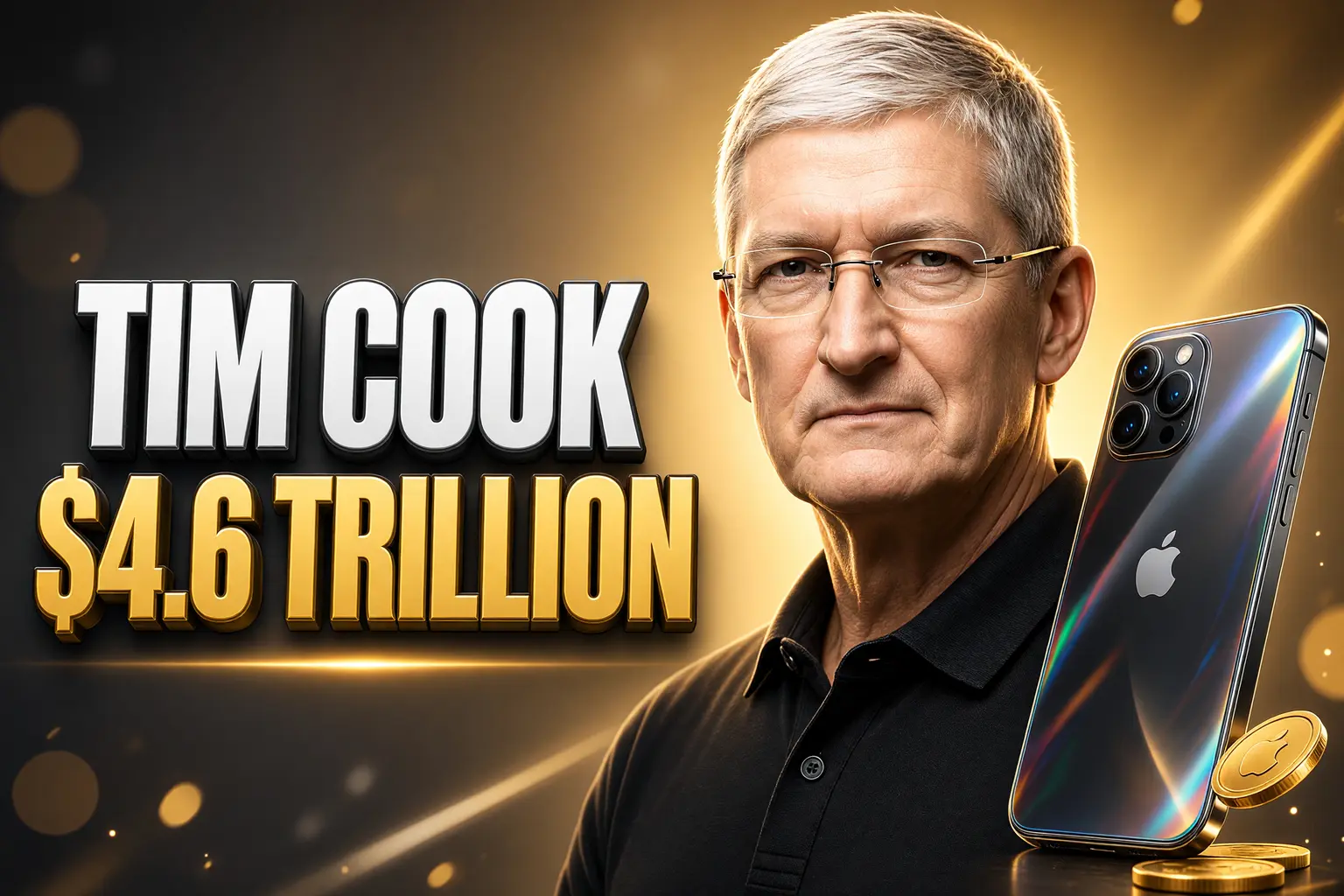
Cook oversaw every iPhone from the 4S through the 17. iPhone sales went from $47 billion in fiscal 2011 to $209.6 billion in fiscal 2025, or about 50 percent of the company, a slightly higher share than the 43 percent he inherited. The phone got bigger in dollars faster than the rest of Apple did. Unit growth cooled years ago, so price and mix did the work, especially Pro models.
The June quarter showed how that still works. iPhone revenue of $54.3 billion already beat the entire company’s iPhone take in some early Cook years, and Apple pointed to the iPhone 17 family for the jump. In the December quarter, iPhone revenue was $85.3 billion, up 23 percent, which Cook described on the call as staggering demand. Greater China, which had been the soft spot, rose 38 percent in that holiday quarter to $25.53 billion after falling to $64.4 billion, or 15.5 percent of sales, for all of fiscal 2025.
Watch, AirPods, and Vision Pro were the new hardware categories on his watch, and Apple Silicon replaced Intel in the Mac from late 2020. Apple says Watch and AirPods became the world’s most popular watch and headphones. None of those lines, together or apart, replaced the phone as the engine. Wearables pay the bills of a large company. They do not reset the mix.
Services Became the Profit Engine
The structural shift was Services: App Store, iCloud, Apple Music, Apple TV, AppleCare, payments, and advertising. The line went from $9.4 billion in fiscal 2011 to $109.16 billion in fiscal 2025, about 11.6 times, and about 26 percent of sales. Apple’s April statement called it a more than $100 billion business, the equal of a Fortune 40 company. Parekh said paid subscriptions have now passed 1.5 billion.
Margin is why the line matters more than its share of sales. Apple’s Services gross margin of 75.4 percent in fiscal 2025 sat against 36.8 percent on Products and 46.9 percent for the company. Services produced $82.31 billion of gross profit from a quarter of revenue, or about 42 percent of total gross profit. Products still supplied $112.89 billion of gross profit on $307.00 billion of sales. The phone puts devices in pockets. Services tax the 2.5 billion active devices Apple now counts.
FY2025 PRODUCTS VERSUS SERVICES
| Line | Revenue | Gross profit | Gross margin |
|---|---|---|---|
| Products | $307.00 billion | $112.89 billion | 36.8% |
| Services | $109.16 billion | $82.31 billion | 75.4% |
| Total | $416.16 billion | $195.20 billion | 46.9% |
Allen Bond, a portfolio manager at Jensen Investment Management, which owns the shares, called the services push the most successful thing Cook did, because it is high-margin and recurring. That is fair, and it is also circular. Services grow because the installed base grows, and the installed base is still an iPhone story with accessories attached.
More Than a Trillion Went Back to Shareholders
Apple paid no dividend when Cook arrived. In March 2012 he restarted one, the first quarterly payout since 1995, and opened a buyback. Company figures through early 2026 put buybacks since fiscal 2012 above $840 billion, with dividends around $165 billion, which is how the capital-return total crossed $1 trillion. Fiscal 2025 alone retired $89.3 billion of stock and paid $15.4 billion in dividends. Research and development that year was $34.55 billion, so buybacks ran about 2.6 times R&D.
The share count has fallen about 45 percent from its 2012 peak, to the lowest level since 1998. Apple’s weighting in the S&P 500 went from less than 3.3 percent in 2011 to 7 percent, and peaked near 7.9 percent last month. The board has kept lifting the payout; the latest quarterly cash dividend of 27 cents was declared with the June results, up from 26 cents earlier in the fiscal year.
THE CASH SENT BACK
- Since 2012: Buybacks above $840 billion and dividends around $165 billion, a capital-return pile above $1 trillion.
- Fiscal 2025: $89.3 billion of stock retired and $15.4 billion of dividends, against $34.55 billion of R&D.
- The float: Shares outstanding down about 45 percent from the 2012 peak, the lowest since 1998.
- The payout now: 27 cents a quarter, after 13 annual raises from the 2012 restart.
Apple also dropped its old net-cash-neutral target this spring, which Mohan read as room for more R&D, capital spending, and deals under Ternus. That shift is the tell. The Cook years optimized for sending cash out. The next ones may have to keep more of it in.
The Headset, the Car, and Siri’s Long Delay
Cook did launch new categories. The ones that printed money were Watch and AirPods. The ones that were supposed to be the next S-curve did not. Apple killed its car project. Vision Pro arrived in 2024 as a new computing idea and then faded from the marketing calendar; it never became a business on iPhone terms. Bond’s line on the flaw is blunt.
THE BETS THAT STAYED SMALL
- Vision Pro: A 2024 headset that did not create a new category, after which Apple pulled back marketing and shifted work toward glasses.
- The car: A self-driving vehicle effort that Cook’s Apple walked away from rather than ship.
- Siri AI: Promised with Apple Intelligence in 2024, delayed through 2025, rebuilt, and shown again at WWDC26 as a public beta for later this fall, using Google Gemini models, and kept off iPhone and iPad in the EU at launch, with China still a regulatory question.
Mike Rockwell, the executive now running Siri, said the team built an incremental version on the old assistant, decided it was not good enough, and tore it to the ground. Cook, on the July call, still led with the June sales records and said Apple had been thrilled to introduce the new Siri AI at WWDC26. Counterpoint Research has counted more than 450 million iPhones already capable of Apple Intelligence. The hardware is in pockets. The assistant those phones were sold on is not fully in their hands.
Of 58 analysts tracked on the stock, 34 have buys, about 59 percent. Roughly 95 percent of the people covering Microsoft, Nvidia, and Amazon are bullish on those names. Apple trades around 33 times forward earnings, against a 10-year average of 23 and about 12 when Cook started. The multiple is the market’s way of saying the cash machine is real and the next act is not priced as a sure thing.
What John Ternus Takes Over
Ternus is 50, the same age Cook was in 2011. He joined Apple’s product design group in 2001, became a hardware vice president in 2013, and entered the executive team in 2021 as senior vice president of Hardware Engineering. Apple says he worked on iPad and AirPods and on many generations of iPhone, Mac, and Watch, and that he pushed durability, recycled aluminum, and repairability. Johny Srouji, the chip lead, is now chief hardware officer. Arthur Levinson, chairman for Cook’s entire CEO run, becomes lead independent director. Cook stays as executive chairman, with a brief that includes talking to policymakers.
On his last day in the job, August 31, Cook wrote to staff that he was at peace and was not leaving the company. He said few people understand what it takes to build products that change the world the way Ternus does. He also posted a public goodbye.
Sending lots of love to the Apple community on my last day as CEO. My title changes tomorrow, but the love I have for the Apple community never will. Thank you for being a constant source of inspiration. My gratitude is endless, and I’m excited for the next chapter!
— Tim Cook (@tim_cook) August 31, 2026
John Ternus has the mind of an engineer, the soul of an innovator, and the heart to lead with integrity and with honor. He is a visionary whose contributions to Apple over 25 years are already too numerous to count, and he is without question the right person to lead Apple into the future.
Tim Cook, Apple newsroom statement, April 20, 2026
Ternus’s first public word as CEO was “hello,” posted from a new account on day one. The greeting went everywhere. The job is not a greeting. He inherits more than 2.5 billion active devices, more than 500 stores in more than 200 countries and territories, a workforce Cook expanded by more than 100,000 people, and a carbon footprint Apple says is more than 60 percent below 2015 levels even as revenue nearly doubled from that baseline. He also inherits a phone that is still half the sales line, a services layer that depends on that phone, and an assistant that is late in the two markets, Europe and China, where rules bite hardest.
A Foldable Phone Is the First Exam
Product watchers expect Ternus to show a foldable iPhone as soon as next week. If that device ships, it will be a new shape for the same franchise, not a new franchise. Chris Brigati, chief investment officer at SWBC, said the ideal is a blend of Cook’s steady expansion and the product bets of the Jobs years. Bond put the succession in plainer terms: it is hard not to notice that they are bringing in someone with an engineering and products background to replace him.
Cook’s Apple was the first U.S. listed company to $1 trillion, then $2 trillion, then $3 trillion, and it later crossed $4 trillion and, briefly last July, $5 trillion before settling near $4.6 trillion as he left. Americas sales in fiscal 2025 were $178.4 billion and Europe $111.0 billion, both records, while Greater China cooled from a $74.2 billion peak in fiscal 2022. The geographic mix is healthier than it was when China was the growth story and the risk. The product mix is not.
Ross Gerber, co-founder of Gerber Kawasaki, said there was a ton of doubt when Cook arrived, and that he had done a phenomenal job. The job he did is on the 10-K: almost four times the sales, more than four times the profit, a services line that throws off 75-cent gross-profit dollars, and a capital-return program no other public company has matched in raw dollars. The job he did not finish is the one Ternus now owns, which is to make the next thing as obvious as the iPhone still is.
Frequently Asked Questions
When did Tim Cook join Apple, and how long was he CEO?
Cook joined Apple in 1998, 13 years before he became chief executive, and ran operations and the supply chain under Steve Jobs. He was named CEO on August 24, 2011, and held the title through August 31, 2026, with Ternus taking over on September 1, a run of 15 years and eight days.
What stock splits did Apple complete while Cook was CEO?
Apple split its stock 7-for-1 in 2014 and 4-for-1 in 2020. Those two splits are why Cook’s starting price is quoted at $13.44 on a split-adjusted basis rather than at the unadjusted close from August 2011, and they are why long-run percentage gains have to be handled on the adjusted series.
Did Apple pay a dividend when Cook became CEO?
No. Apple had not paid a quarterly dividend since 1995. Cook announced a new quarterly dividend and a buyback authorization in March 2012, and the board has raised the dividend every year since, 13 times, to the current 27 cents a share.
What did John Ternus do before he became Apple CEO?
Ternus holds a bachelor’s degree in mechanical engineering from the University of Pennsylvania and worked as a mechanical engineer at Virtual Research Systems before joining Apple in 2001. He spent 25 years on hardware, including the years as vice president from 2013 and as senior vice president of Hardware Engineering from 2021, and he now also joins the board.
Who holds the other top board seats after the handover?
Cook is executive chairman, a new post, and will keep working with governments. Arthur Levinson, who was non-executive chairman for all 15 years of Cook’s CEO tenure, becomes lead independent director. Ternus joins the board as CEO, effective the same day as the title change, September 1, 2026.
Disclaimer: This article is news reporting and analysis of Apple’s published financial results, board announcements, and market figures, and it is for information only. It is not investment advice, a recommendation to buy or sell Apple shares or any other security, and it is not a forecast of returns. Readers who are considering a position in the stock should consult a licensed financial adviser or broker who can review their own goals, time horizon, and risk limits. Market values, ratings, and product plans can change, and the figures here reflect the company filings and statements available as of September 2, 2026.