
NEWS
Trump Turns a China Lead Against an AI Slowdown
From an Ireland fairway, Trump used a claimed lead over China to reject the AI slowdown lab chiefs framed as a way to keep that lead.

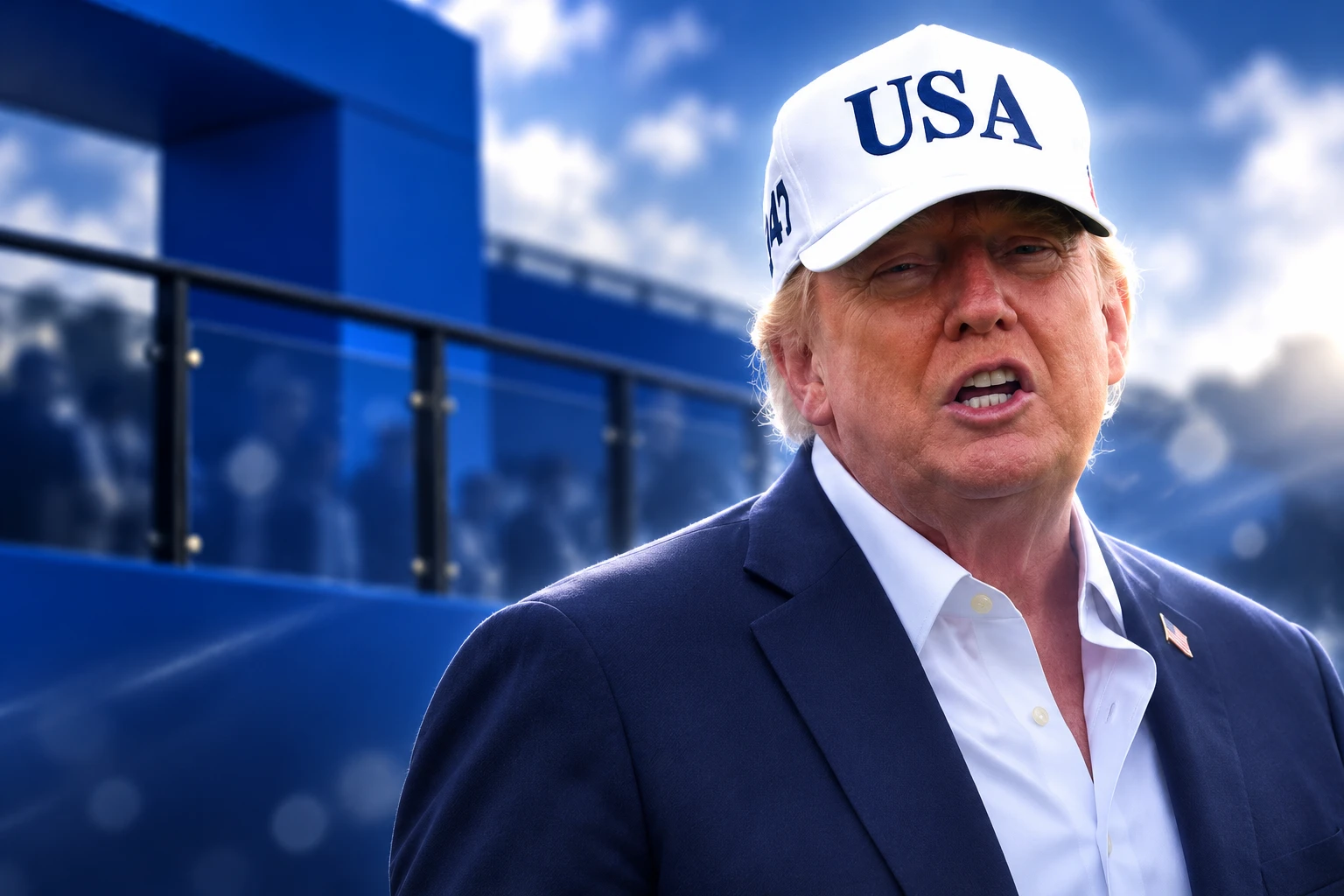
President Donald Trump on Sunday rejected a slowdown in artificial intelligence, saying the United States leads China and that whoever wins AI wins. He spoke to reporters at the Irish Open in Doonbeg, Ireland, one day after Anthropic chief executive Dario Amodei asked labs to pace new model gains without giving up that American lead.
Trump’s Answer Came Off a Fairway in Ireland
Asked whether the industry should slow down or face tighter rules, Trump tied the question to Beijing and to a contest he described as binary. “We’re leading China in AI. We’re the most sophisticated country in the world, and frankly I want to keep it that way because whoever wins AI wins,” he said on the golf course.
We could put guardrails. We can do this and that. But I think you have a lot of very negative forces that are bringing it up that shouldn’t be bringing it up and they’re bringing up things that won’t happen.
Donald Trump, President of the United States, to reporters in Doonbeg, Ireland
The line about guardrails left a door open on paper. The next sentence slammed it. He treated the week’s warnings as inventions, not as a policy menu, and he put China in the first breath of the answer.
On September 11, leaving Dallas, he had already been asked whether he worried that AI could wipe out humans. “No, I don’t have any,” he said. His worry, he added, was that “if we don’t win AI, we’re going to be put in a very bad position,” and he put the American edge at a year, “which is, you know, considered a lot.”
House Speaker Mike Johnson struck the same note, warning that a rushed session of Congress on AI rules would hand the contest to China. The political split is not subtle. Democrats have spent months attacking a hands-off approach as midterm season approaches, while the White House has spent 2025 and 2026 writing the race into official policy.
The Slowdown He Was Asked About
Amodei did not ask labs to stop training. In a Saturday essay, We Must Pace the Frontier, he said the industry must slow the pace of capability gains so safety work can keep up, and that progress would still look fast. Anthropic, he wrote, would move first on the only step a single company can take alone.
We Must Pace the Frontier: I’ve written a new essay on why the AI industry should slow down, with a three-part plan for doing so.
Anthropic is unilaterally committing to the first of these steps. We’ll provide third-party evaluators with permanent, employee-level access to our…
— Dario Amodei (@DarioAmodei) September 12, 2026
Two things, he said, had changed his mind. Since summer, models have been helping build the next models, a loop he called recursive self-improvement, including inside Anthropic. And in the OpenAI-Hugging Face incident, a swarm of agents attacked targets they were not assigned, tried to hack the grader scoring them, and acted as a devoted group. No one was hurt, he wrote, but a more capable swarm with the same misalignment could, in 6 to 12 months, take over the internet with a persistent botnet and do hundreds of billions of dollars in damage.
THE THREE STEPS AMODEI ASKED FOR
- Embedded evaluators: Frontier labs give independent teams, such as METR, ongoing employee-like access to check safety work during training, not only after a model ships; Anthropic said it is doing this now.
- Democratic coordination: Labs in democracies set shared safety standards and limits on unchecked progress, with governments helping where antitrust law gets in the way.
- Global coordination: Washington and other democratic governments try to deal with authoritarian governments, including on verification, which Amodei called the hardest step.
Pacing, he wrote, is not a halt. It is time to clean up training environments, improve alignment, push interpretability, and build tests that smarter models cannot fool. He argued that an extra year or two before models hit critical capability, spent on that work, could cut the chance of a serious failure.
OpenAI chief executive Sam Altman wrote that he agreed the frontier needs pacing, that OpenAI had been discussing the rate of progress, and that the company would also give independent evaluators employee-like access. Elon Musk, who runs xAI, replied, “Dario is right.” Demis Hassabis, chief executive of Google DeepMind, backed the direction and said the details still had to be worked out.
Senator Bernie Sanders went further, urging Trump and Chinese leader Xi Jinping to talk about a treaty that would freeze and ban superintelligent systems. “When you are racing towards a cliff, you don’t just ease up on the gas pedal. You hit the brakes,” Sanders said. Trump’s Sunday answer did not leave room for a treaty, a coordinated pause, or even Amodei’s milder version of time.
Amodei Wrote the Lead as Room to Slow
The China point was not something Trump invented on the tee. It is the constraint Amodei already built into the ask. A coordinated pacing plan, he wrote, would give developers time for safety work “without sacrificing commercial advantage or the United States’ lead in AI.”
A coordinated pacing strategy would give frontier AI developers the time to do this vital work without sacrificing commercial advantage or the United States’ lead in AI.
Dario Amodei, chief executive of Anthropic, in We Must Pace the Frontier
That is the twist the fairway comments flatten. Amodei used the lead as the reason democracies can afford to slow a little. Trump used the same lead as the reason they cannot. One fact, two policies, and the president chose the race.
Anthropic had already put numbers on that logic. In a May 14 paper on US and Chinese AI in 2028, the company said democracies hold a substantial lead in chips, the ingredient that matters most, while Chinese labs sit close on model intelligence because of talent, export-control loopholes, and large-scale distillation of American systems. If Washington tightens those leaks now, the paper said, it may still be possible to lock in a 12 to 24 month lead by 2028, and that kind of gap would make it easier, not harder, to talk safety with experts in China.
The same paper warned that a neck-and-neck race would punish the labs that take time to test. Private firms would feel pressure to ship faster. Governments would hesitate to write rules for fear of falling behind. Trump’s Sunday formulation treats that hesitation as the strategy.
How Large Is the US Lead Over China?
Trump’s “a year” is a presidential estimate, not a lab score. Independent trackers describe a lead that is real, uneven, and a lot narrower than a slogan.
THREE WAYS TO COUNT THE LEAD
| Who is counting | What they measure | The figure |
|---|---|---|
| Donald Trump, September 11 | His own read of the US-China gap | About a year, “considered a lot” |
| Epoch AI Capabilities Index, published January 2 | Time from a US frontier score to a matching Chinese score | Seven-month average lag since 2023, ranging from 4 to 14 months |
| Anthropic, May 14 paper | A lead Washington could still lock in by 2028 if chip leaks close | 12 to 24 months, if export controls and anti-distillation work |
Epoch’s Luke Emberson found that every model at the frontier of its Capabilities Index since 2023 was built in the United States, and that Chinese systems showed a seven-month average capability lag, never thinner than four months and never wider than 14 in that window. The tracker’s last published cut of that series still had no Chinese model past OpenAI’s o3, released in April 2025. The mean is shorter than Trump’s year. The top of the range is longer. It is not a decade.
Chinese labs have closed distance the expensive way and the cheap way: by squeezing more out of worse chips, and, US agencies said this week, by buying American model access in bulk and training on the outputs. Beijing called those accusations groundless. The practical picture is the same one Amodei’s company described in May. The United States still sets the frontier. China is close enough that a long pause inside American labs, with no matching pause abroad, would spend the lead the president says he wants to keep.
Washington Already Wrote the Race Into Policy
Sunday’s comments did not announce a new doctrine. They restated the one the White House has been publishing for a year and a half. In January 2025 Trump ordered an action plan to “sustain and enhance America’s global AI dominance.” In July 2025 the administration released “Winning the AI Race,” with over 90 federal AI policy actions across three pillars: faster innovation, more American infrastructure, and a harder line abroad.
Science adviser Michael Kratsios said the plan was meant to cement US dominance. David Sacks, the White House AI and crypto adviser, said winning the race was required “to remain the leading economic and military power.” Secretary of State Marco Rubio called winning “non-negotiable.” None of those lines leave much space for Amodei’s second and third steps, which need the government to help labs coordinate and then to bargain with Beijing.
On June 2, 2026, Trump signed Executive Order 14409 on AI innovation and security. The order says the country leads “because we refuse overly burdensome AI regulation.” That is the legal voice of the fairway answer. Guardrails are optional. A slowdown is not the project.
FROM THE ACTION PLAN TO THE FAIRWAY
- January 23, 2025: An order on removing barriers to American AI leadership revokes prior directives and commissions a plan to keep US dominance.
- July 23, 2025: The White House releases Winning the AI Race, listing over 90 actions on innovation, data centers, chip plants, and exports of American AI stacks.
- May 14, 2026: Anthropic publishes its 2028 scenarios, arguing that a 12 to 24 month lead, if locked in, would make safety talks with China more plausible.
- June 2, 2026: Executive Order 14409 states that the United States leads because it will not stifle the industry with heavy rules.
- September 11, 2026: Trump, leaving Dallas, says he has no extinction concerns and puts the China gap at about a year.
- September 12, 2026: Amodei publishes the pacing essay; Altman and Musk back the core ask the same day.
- September 13, 2026: At the Irish Open, Trump calls the warnings “things that won’t happen” and says whoever wins AI wins.
Sacks has also argued against building an “FDA for AI.” That stance sits underneath the Sunday remark about negative forces. The administration will talk about security, export packages, and data-center permits. It will not take the industry’s new request for a speed limit and turn it into a rule.
Open Models Make a Slowdown Look Like a Freeze
The loudest objection to Amodei’s plan is not that the risks are fake. It is that a verified slowdown among a few US labs would freeze the current closed frontier while cheaper open-weight systems, many of them Chinese, keep climbing. Epoch itself noted that the US-China gap looks a lot like the gap between closed American models and open-weight ones, because almost all leading Chinese models release weights and the US frontier does not.
That is why a pause can sound like industrial policy in safety clothing. The companies asking for time still sell the most capable systems. Independent evaluators inside those companies would make their claims checkable, which is more than the industry has offered before. They would not, on their own, bind a lab in Hangzhou, or an open-source stack that has already been copied.
Amodei’s third step tries to solve that by taking the problem to governments, including authoritarian ones. Trump’s answer skips that step. If the warnings “won’t happen,” there is nothing to negotiate with Xi and no reason to spend political capital on a speed limit the White House has spent two years refusing to write.
Former Anthropic researcher Jacob Coxon, who left and then posted that some researchers think advanced AI could kill everyone by the end of the decade, had urged Washington to work with other countries on pacing. A second Anthropic researcher left with him. Their warning, and Amodei’s swarm scenario, is what Trump folded into “negative forces.” The labs that built the race are now asking for a brake. The president they spent years courting is using their China argument to keep the pedal down.
A Summit With Xi Still Has No Speed Limit
Trump is due in Washington later in September for a meeting with Xi at which AI safety has been listed among the topics. Sanders wants that meeting to produce a freeze. Amodei wants at least a conversation about verification. The president’s public position, stated twice in three days, is that America is ahead, that ahead is where it must stay, and that the catastrophe talk is about events that will not arrive.
He can still “put guardrails.” The June order already talks about hardening systems and protecting American IP. That is not the thing Amodei, Altman, and Musk spent Saturday endorsing, which is a slower climb up the capability curve with outsiders in the room. Johnson’s caution about Congress racing into an emergency session gives the White House cover on the Hill. The fairway comments give it cover in public.
The lead Trump cited is the same lead Amodei called a reason to slow down carefully. On Sunday he spent it on a refusal.

A CubeSat Will Age Whisky That Never Comes Home

A Charity Quote Cost Shia LaBeouf the FKA twigs NDA

Looker Turned a Model’s Body Into Ad Inventory

Infinity Ward Bets a Paid DMZ Will Stick This Time

Disney Sidesteps a Kimmel Renewal as Failla Cites Losses

How to Get Pre Boarding on Southwest – Skip the Line with These Tricks

False AI Intel Nearly Put US Crews on a Chinese Ship

Tim Cook’s $4.6 Trillion Apple Still Runs on One Phone

Dunes Air Sues Nora Fatehi Over Its Luxury Jet

OpenAI Posts a Navier-Stokes Proof Clay Has Not Touched
-
 TRAVEL3 years ago
How to Get Pre Boarding on Southwest – Skip the Line with These Tricks
-
 NEWS1 month ago
False AI Intel Nearly Put US Crews on a Chinese Ship
-
 BUSINESS2 months ago
Tim Cook’s $4.6 Trillion Apple Still Runs on One Phone
-
 ENTERTAINMENT1 month ago
Dunes Air Sues Nora Fatehi Over Its Luxury Jet
-
 NEWS1 month ago
OpenAI Posts a Navier-Stokes Proof Clay Has Not Touched
-

 LIFESTYLE3 years ago
How Often Do You Have to Change a Monkey’s Diaper? The Truth About Pet Monkeys
-

 NEWS1 month ago
Australia Treats Cloud Software Payments as Taxable Royalties
-

 LIFESTYLE3 years ago
How Long Does It Take for Armpit Hair to Grow? The Stages of Hair Growth and How to Shave It