
NEWS
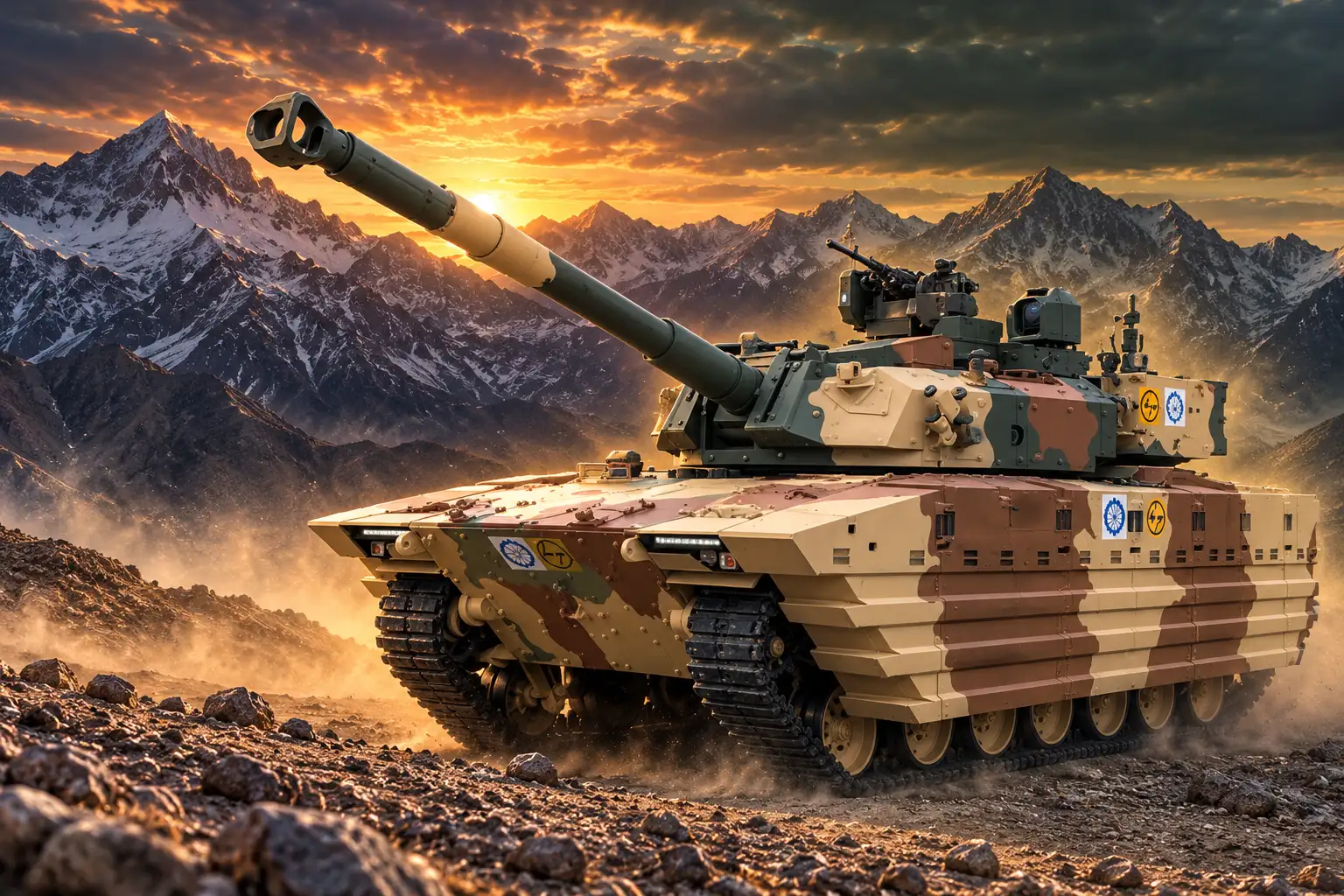
India Will Field 18 Zorawar Light Tanks With Less Armor
Defence Secretary RK Singh will start Zorawar with about 18 weaker Mark 1 tanks so L&T stays, while China’s Type 15 has been in service since 2018.

India will put about 18 Zorawar light tanks into service with less armor than the Army asked for, so Larsen & Toubro keeps building them. Defence Secretary RK Singh said on 27 September 2026 that the first Mark 1 hulls would carry “a slightly lower level of protection,” with the rest of L&T’s 59-tank order meant to follow thicker. The Army’s full need is about 354 light tanks for the high Himalaya.
The bargain is industrial, not tactical. Singh said he was mediating so the contractor “does not lose heart.” China’s Type 15, the tank this project was built to match, has been in People’s Liberation Army service since December 2018.
Singh Offers 18 Tanks So L&T Stays
Singh was speaking at a defence conclave in New Delhi, one day after the weekend sessions. He described a familiar loop. Planners start with one set of needs, then add more, and the in-service date slips.
So L&T doesn’t lose heart and, you know, stop working on this. So I think the Army has pretty much agreed to that, so we hope to take this forward in that manner.
RK Singh, Defence Secretary, defence conclave in New Delhi, 27 September 2026
The first cut is about 18 tanks. The other 41 in the L&T lot are supposed to come later with more protection. Fifty-nine hulls are 16.7% of 354, less than a fifth of what the Army says it wants. Eighteen is 5.1% of that total.
DRDO’s Combat Vehicles Research and Development Establishment designed the tank with L&T as lead integrator. Small firms in Vadodara, Rajkot and Surat built subsystems. The Ministry of Defence nominated that pair for the first 59. Singh said he expects L&T to get the opening order for those 18 soon. He did not give a date.
WHAT WE KNOW
- The first cut: About 18 Mark 1 tanks with less protection than the later L&T hulls.
- The L&T lot: 59 tanks in all, with the remaining 41 meant to be better protected.
- The Army total: About 354 light tanks, with 295 still in a separate Make-I contest.
- The builder’s brief: Singh said the Army has pretty much agreed to the split so L&T keeps working.
WHAT IS UNCONFIRMED
- The order date: No ministry notice has placed the 18-tank buy.
- The exact armor gap: Singh did not name the STANAG levels for Mark 1 versus the later batch.
- The combat weight: It is not public whether extra plates still fit inside the 25-tonne class.
A 59-tank run is already a thin diet for a production hall. Splitting it into two protection grades makes the first work order thinner still. That is the part sold as speed.
Armor That Stops a Heavy Machine Gun
The fight under Singh’s “middle way” is steel versus weight. In 2021 the Army wrote down two numbers for a new light tank: combat weight not to exceed 25 tons, and a power-to-weight ratio not less than 25 to 1. Those caps were there so the vehicle could move on Ladakh’s roads and bridges and still fly in.
The prototype sits at about 25 tonnes. Public spec sheets give it STANAG 4569 Level 4 on the front and Level 2 on the sides. Level 4 is built to stop Level 4 protection against 14.5 mm rounds at 200 metres. Level 2 is a 7.62 mm armor-piercing round at 30 metres. That is heavy machine-gun fire, mines in the 10 kg class, and shell splinters. It is not a 25 mm or 30 mm dart from an infantry fighting vehicle.
WHAT THE ARMOR GRADES STOP
| STANAG 4569 level | Main kinetic threat | Where Zorawar sits |
|---|---|---|
| Level 2 | 7.62 mm API at 30 m | Sides and other sections now |
| Level 4 | 14.5 mm API at 200 m | Front of the current prototype |
| Level 5 | 25 mm APDS at 500 m | The grade that matches a 25 mm IFV gun |
| Level 6 | 30 mm APFSDS at 500 m | The front upgrade the Army has been pushing |
The extra plates are aimed at Chinese IFVs, not at another tank’s main gun. The Type 04A tracked vehicle carries a 30 mm cannon. The Type 08 wheeled vehicle carries 25 mm. Those are the rounds the Army has wanted Zorawar to stop. DRDO’s Defence Metallurgical Research Laboratory has been working on Level 6 and Level 5B modules and has said the vehicle should stay in the same weight class. Fitting that kit still means going back to a Belgian turret maker and an American engine supplier.
Why the First Batch Carries Less Protection
Singh’s Mark 1 is the current hull, not the up-armored one. He said extra requirements had been added before the tank could be accepted, and that this is what delays induction. In June 2026, then Army Chief General Upendra Dwivedi said issues found in trials were being fixed and that the tank was expected in service in 2028-29, not 2027. Dwivedi handed over to General Dhiraj Seth on 30 June 2026. Singh is now trying to get metal into units before that later date by accepting less steel on the first 18.
The gun and the engine make the redesign painful. The turret is a Belgian Cockerill 3105 turret and 105 mm gun with an autoloader. John Cockerill lists 42 degrees of elevation, which is the angle you want in mountains. The company builds the kit for medium-weight vehicles. Thicker add-on armor is not a bolt-on afterthought on that ring.
The powerpack is a Cummins VTA903E-T760 diesel, 760 hp, with a Renk HMPT-800 transmission. That is about 30.4 hp per tonne at 25 tonnes, inside the Army’s 25-to-1 floor. The first plan used an MTU engine from Germany. Export rules blocked it, so L&T bought Cummins. More mass on the same 760 hp cuts the ratio that was the point of a light tank.
WHAT STILL COMES FROM ABROAD
- The turret: Cockerill 3105 with a 105 mm high-pressure gun and autoloader, now the subject of a Pune joint venture.
- The engine: Cummins VTA903E-T760, after the German MTU pack could not be delivered.
- The transmission: Renk HMPT-800, a hydrostatic-mechanical box also used on a U.S. Army vehicle family.
The 2021 weight cap allowed 25 tonnes plus 10%, or 27.5 tonnes. Nobody in public has said the heavier armor still lands inside that band. User trials that DRDO chief Samir V. Kamat had pointed to for early 2026 were still waiting, through August, on protection upgrades. Singh’s split is how New Delhi gets around that wait without telling L&T to stand down.
China Fielded the Type 15 in 2020
The Type 15, also called ZTQ-15 and nicknamed Black Panther, entered mass production in 2016 and was acknowledged in PLA service in December 2018. It was reported on the Tibetan plateau during the June 2020 Line of Actual Control crisis. PLA Ground Force holdings were put at 500 units as of 2022, with more in the navy marine corps and airborne force.
Open specs put the Chinese tank at 33 to 36 tonnes depending on the armor kit, still well below a 45 to 50 tonne T-72 or T-90. It carries a 105 mm rifled gun, the same calibre as Zorawar, and its APFSDS round is credited with 500 mm of steel at 2,000 metres. The hull has composite panels and explosive reactive armor, with a heavier ERA set for open-country fighting. Crews get onboard oxygen generators. A Xi’an Y-20 can lift two Type 15s, the same two-per-lift idea India wants from the C-17 with Zorawar.
At about 4,000 metres a heavy diesel loses a fifth to a quarter of its power because there is less oxygen for combustion. Indian T-90s sent to Ladakh have had to be run for up to 30 minutes every two to three hours so the engines do not freeze. By 2023 India had more than 90 tanks and 330 BMP-2s in the region. They are the wrong weight class for those roads, which is why a 25-tonne tank was ordered in the first place.
A Type 15 that has been in units since 2018 is a finished design with a finished supply chain. An 18-tank Mark 1 with Level 4 fronts is a first cut. They may share a 105 mm gun on paper. They will not share years of plateau time.
A 295-Tank Race With a 130-Week Clock
India is buying light tanks on two tracks at once. Track one is the DRDO-L&T Zorawar, 59 hulls, now split. Track two is a Make-I contest for the other 295, under which the government funds up to 70% of prototype costs. In early September 2026, Tata Advanced Systems came in as the lowest bidder on that work, a program put at about Rs 20,000 crore. Mahindra Defence, the second-lowest, will also build a prototype. Five firms spent three years in the contest. A rival’s objections delayed it further and were later held invalid.
Tata must show two prototypes in 130 weeks, about two and a half years, which from September 2026 runs to early 2029. Then come trials, a production choice, and the long grind of 295 hulls. That is a different tank from Zorawar, with a different factory and, if Tata’s bid holds, an Indian turret. The border would then hold L&T Mark 1s, later L&T hulls with more armor, and a Tata or Mahindra vehicle that does not yet exist.
THE TWO LIGHT TANK TRACKS
| Track | Builder | Hulls | Where it stands |
|---|---|---|---|
| DRDO-L&T Zorawar | Larsen & Toubro | 18 Mark 1, then 41, of 59 | Singh wants the first 18 with less protection |
| Make-I AFV-ILT | Tata lowest, Mahindra second | 295 | Two Tata prototypes due in 130 weeks |
| Army total | – | 354 | 59 is 16.7% of the need |
Private firms in this country can now cut a prototype in a couple of years when the requirement is frozen. The missing piece is a large, on-time production order after the prototype works. Zorawar’s first metal arrived fast. The live order is 18 tanks, with a second design still on a 130-week clock.
The Last Light Tanks Left in 1989
The Indian Army has done this terrain in light metal before. Stuarts and Shermans fought at Kohima in 1944 and at Zoji La in 1948. In 1962, AMX-13 tanks were flown to Chushul and fought at Gurung Hill by Pangong Tso, a short distance from where Indian and Chinese tanks faced each other in 2020. AMX-13s and PT-76s were used again in 1971. The AMX-13 left active service by 1989. The PT-76 left reserve in 2009. After that, the inventory was T-72s, T-90s and Arjuns, 43 to 68 tonnes, in a theatre that rewards 25.
Several light-tank attempts after 1982 failed. A 2009 request for 200 wheeled and 100 tracked light tanks went nowhere. The 23 April 2021 request for information asked for about 350 tanks around 25 tonnes, air-transportable, for anti-armor, anti-air and anti-ground work. In-principle approval came in March 2022. Lt Gen K.S. Brar, then Director General of Armoured Corps, locked the staff requirements that September and stayed inside the design loop, a break from how Arjun was run.
HOW THE LIGHT TANK CAME BACK
- June 2020: Type 15 tanks are reported on the Tibetan plateau during the LAC crisis.
- 23 April 2021: The Defence Ministry issues a request for about 350 light tanks near 25 tonnes.
- March 2022: The government clears indigenous design and development.
- April 2023: L&T gets the order to build the first prototype at Hazira.
- 6 July 2024: The first Zorawar is unveiled at L&T’s Hazira plant, about 15 months after that order.
- 13 September 2024: DRDO completes desert firing trials in September 2024 and says the tank met its aims on accuracy.
- 12 December 2024: The tank fired a number of rounds above 4,200 metres at Nyoma, with the IAF in support. The ministry said design to high-altitude demo took three years.
- October 2025: Nag Mk2 missiles are fired from the side launcher in direct and top-attack modes.
- June 2026: General Dwivedi says induction is expected in 2028-29 after trial issues are fixed.
- September 2026: Tata is named lowest bidder for 295 tanks; Singh floats 18 Mark 1s so L&T does not walk away.
Minister of State for Defence Sanjay Seth told the Lok Sabha on 26 July 2024 that the sanctioned project cost of Rs 234.5 crore covered design, development and one prototype, with L&T at Hazira as lead integrator and MSMEs on subsystems. Two prototypes now exist. A C-17 can carry two of the 25-tonne vehicles. Road speed is listed at 70 km/h. The crew is three.
Eighteen Hulls Against a Finished Chinese Fleet
Singh’s middle way keeps a Hazira line in the tank business. It also puts a small Mark 1 squadron-scale batch, with Level 4 fronts, on a border where the other side already parks a 105 mm light tank that has been in service since 2018. The later 41 L&T hulls, if they get the 25 mm and 30 mm plates, will not match the first 18. The 295 Make-I tanks, if Tata or Mahindra clear 130 weeks of prototypes and then years of trials, will be a third configuration.
The Army wrote 25 tonnes into the 2021 request because a heavier hull would lose the airlift trick and the mountain roads that were the whole reason to stop using T-90s at those heights. Adding enough steel to stop a Type 04A’s 30 mm dart pulls the design back toward the weight it was created to escape. Shipping the thinner tank first pulls the other way. Both pulls are now official policy, on the same 59-tank order.
Singh said the Army has pretty much agreed. If the 18 tanks are placed, they will arrive as a keep-alive batch for L&T, years after Type 15s first rolled onto the plateau, and well short of 354.

A CubeSat Will Age Whisky That Never Comes Home

A Charity Quote Cost Shia LaBeouf the FKA twigs NDA

Looker Turned a Model’s Body Into Ad Inventory

Infinity Ward Bets a Paid DMZ Will Stick This Time

Disney Sidesteps a Kimmel Renewal as Failla Cites Losses

How to Get Pre Boarding on Southwest – Skip the Line with These Tricks

False AI Intel Nearly Put US Crews on a Chinese Ship

Tim Cook’s $4.6 Trillion Apple Still Runs on One Phone

Dunes Air Sues Nora Fatehi Over Its Luxury Jet

OpenAI Posts a Navier-Stokes Proof Clay Has Not Touched
-
 TRAVEL3 years ago
How to Get Pre Boarding on Southwest – Skip the Line with These Tricks
-
 NEWS1 month ago
False AI Intel Nearly Put US Crews on a Chinese Ship
-
 BUSINESS2 months ago
Tim Cook’s $4.6 Trillion Apple Still Runs on One Phone
-
 ENTERTAINMENT2 months ago
Dunes Air Sues Nora Fatehi Over Its Luxury Jet
-
 NEWS2 months ago
OpenAI Posts a Navier-Stokes Proof Clay Has Not Touched
-

 LIFESTYLE3 years ago
How Often Do You Have to Change a Monkey’s Diaper? The Truth About Pet Monkeys
-

 NEWS2 months ago
Australia Treats Cloud Software Payments as Taxable Royalties
-

 LIFESTYLE3 years ago
How Long Does It Take for Armpit Hair to Grow? The Stages of Hair Growth and How to Shave It