
NEWS
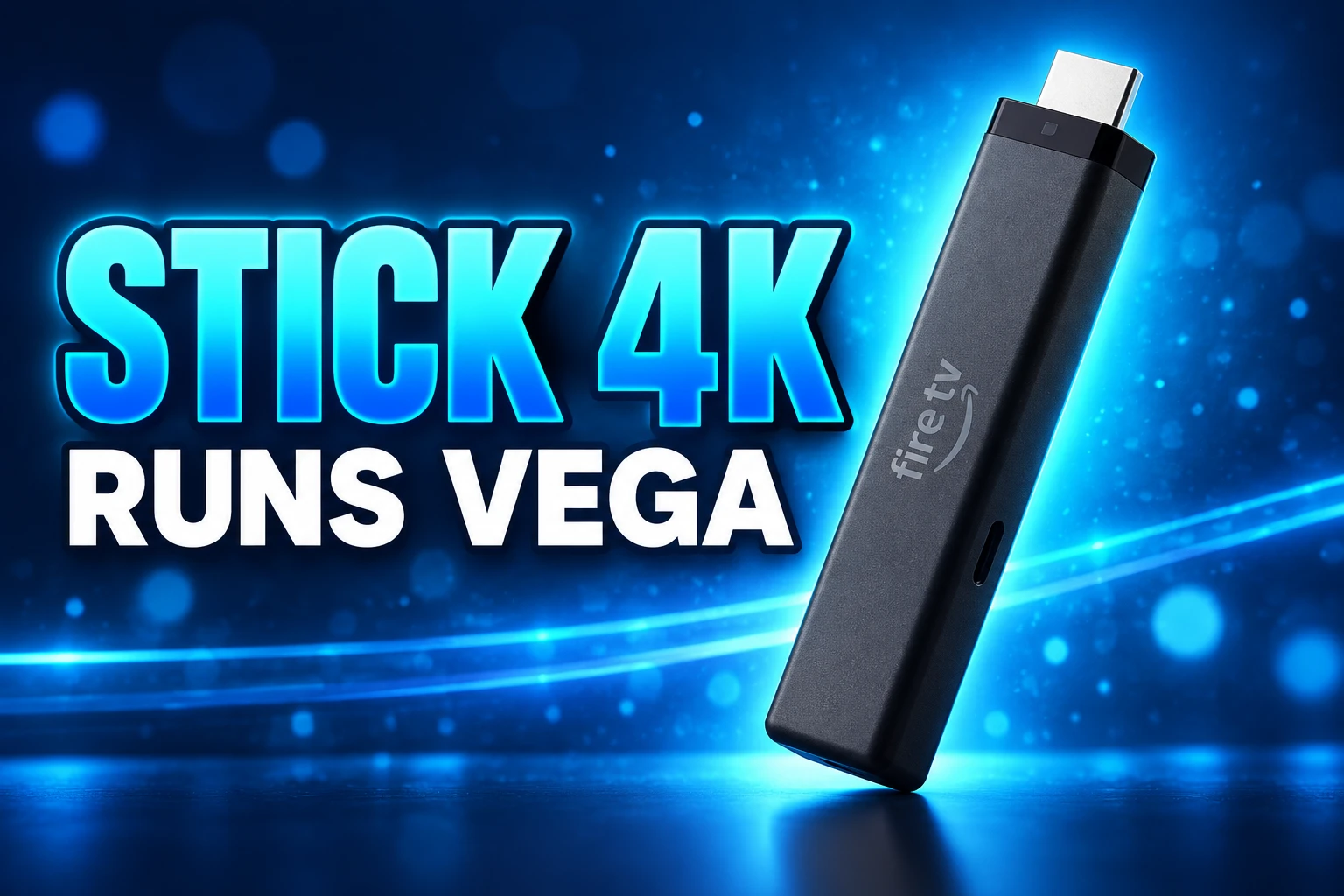
Amazon’s New Fire TV Stick 4K Puts Vega OS First
Amazon’s 2026 Fire TV Stick 4K runs Vega OS, not Fire OS, at $59.99, and drops to $29.99 for Prime Big Deal Days while the 4K Max stays on Android.

Amazon’s Fire TV Stick 4K started shipping on September 30, 2026 for $59.99, and it runs Vega OS rather than Fire OS. The 4K Max still uses Android-based Fire OS. Amazon is putting the new platform on the stick it expects to sell in bulk, then cutting that model to $29.99 for Prime members on October 6 and 7.
The press line is speed, a slimmer shell, and a remote you can find by touch. The quieter change is the operating system on the product still called Fire TV Stick 4K.
Amazon Moved Vega OS Onto the Volume 4K Stick
Amazon’s developer note on launch day said the new stick is built on Vega OS and ships with Alexa+ and the latest Fire TV software already installed. That is the same Linux-based platform that arrived a year earlier on the Fire TV Stick 4K Select, then moved onto the 2026 Fire TV Stick HD.
The 2026 4K model is the third-generation Stick 4K, build AFTCR001. It replaces both the Vega-based 4K Select and the Fire OS-based 4K Plus in the named lineup, which Amazon has trimmed to the Stick HD, this Stick 4K, the Stick 4K Max, and the Fire TV Cube. Older Select and Plus units remain on sale while stock lasts.
Amazon told developers in 2025 that Vega would not wipe out Fire OS. The company said it had always been a multi-OS shop and would continue to launch new devices on Fire OS. That line still holds for the Max, the Cube, and many Fire TV sets. It no longer holds for the default 4K stick.
We’ve always been a multi-OS company. We have launched and will continue to launch new devices on Fire OS.
Amazon Developer, Vega Developer Tools post, September 30, 2025
Keeping Fire OS on the Max lets Amazon say the older platform is alive. Putting Vega on the $59.99 stick, then selling it at half price, is how the new platform actually spreads.
What the New 4K Stick Leaves Out
The 2026 Fire TV Stick 4K outputs 4K at 60 frames per second with HDR10, HDR10+, and HLG. Dolby Vision is not on that HDR list. Amazon still reserves Dolby Vision, a 16 GB drive, and Wi-Fi 6E for the 4K Max, which lists at $84.99.
Amazon’s own spec sheet for the new stick lists 1 GB of RAM and Vega OS 2.0, a MediaTek MT8698E chip with four Cortex-A55 cores up to 1.7 GHz, and an ARM G310 V2 graphics core up to 500 MHz. Storage is 8 GB. The radio is Wi-Fi 6 on 2.4 GHz and 5 GHz, plus Bluetooth 5.3 and Bluetooth Low Energy. There is no 6 GHz band.
AMAZON’S SPEED CLAIMS
- App launches: Amazon says apps open more than 35% faster than on the unnamed gear in its tests.
- Playback start: Content begins nearly 20% faster than on a similarly priced 4K stick from another brand.
- Overall gap: Amazon also cites a 20-40% faster path to content against similarly priced 4K sticks.
- TV apps: In the same tests, the stick beat the built-in apps on three 4K smart TVs from top-selling brands Amazon did not name.
Those figures are Amazon’s, and the company did not identify the rival sticks or the three TVs. The hardware underneath is modest: 1 GB of memory, a 32-bit software interface, and H.264 decode that tops out at 4K and 30 frames, with H.265 and AV1 carrying 4K at 60. HDMI 2.1 and USB-C 2.0 are the ports. Dolby Atmos is listed as HDMI pass-through, not as on-device decoding.
FIRE TV STICK LINEUP, LAUNCH DAY
| Model | Operating system | Top HDR | Storage | Wi-Fi | Direct Power |
|---|---|---|---|---|---|
| Fire TV Stick HD (2026) | Vega OS 1.1 | HDR10+ | 8 GB | Wi-Fi 6 | Yes |
| Fire TV Stick 4K (2026) | Vega OS 2.0 | HDR10+ | 8 GB | Wi-Fi 6 | Yes |
| Fire TV Stick 4K Max | Fire OS 8 | Dolby Vision | 16 GB | Wi-Fi 6E | No |
The HD stick shares the same 1.7 GHz four-core layout and 8 GB drive, then stops at 1080p. The Max is the only stick in that set that still looks like the old Fire TV software stack, with extra storage and a 6 GHz radio. Amazon’s speed demo is the clip it wants sitting next to those rows.
The Appstore Wall on Vega OS
Vega OS does not run ordinary Android packages. Fire OS users have spent years dropping APK files onto sticks for players, live-TV tools, and apps Amazon never sold. That path is closed on the 2026 4K stick, as it was on the Select and the 2026 HD model.
Amazon’s launch note said that since the first Vega Fire TV product last year, it has added over 2,000 more apps, including Spotify, Xbox, VLC, and a range of VPNs. It also listed Netflix, Disney+, YouTube, Prime Video, HBO Max, Peacock, Tubi, Pluto, and Instagram. That is the catalog Amazon wants judged, not the old sideload library.
WHAT VEGA OS WILL AND WILL NOT RUN
- Big streaming apps: Amazon names Netflix, Disney+, YouTube, Prime Video, and HBO Max among the titles already on Vega.
- Free and social: Peacock, Tubi, Pluto, and Instagram are on the same list, so the stick is not limited to paid catalogs.
- Local files and games: VLC, Spotify, and Xbox are called out as adds from the past year, which matters for people who keep video on a drive or play in the cloud.
- Android APKs: Those do not install the way they did on Fire OS. Developer Mode can load Vega packages for testing, which is a lab workflow, not a living-room one.
The objection that keeps coming back is simple. If the apps you need live in Amazon’s store, Vega OS is a faster shell with fewer cables. If you relied on sideloading, this stick is the wrong buy, and the Max is the refuge Amazon left on the shelf.
Plug the Stick Into the TV’s USB Port
The 2026 4K stick uses the slim shell Amazon already put on the Stick HD. Direct Power is the setup change people will notice before they notice Vega. You plug the included USB-C cable into a USB port on the TV and skip the wall brick that older 4K sticks needed behind the cabinet.
Amazon’s pitch is fewer cables, easier travel, and a stick that tucks behind the set. It only works if that USB port actually supplies power, which many TVs do and some do not. If the port is data-only or too weak, you still need another source. Amazon does not publish a list of TVs that can feed the stick.
The same small board that makes USB power realistic is also why 1 GB of RAM and 8 GB of storage are the ceiling. Direct Power is a real comfort feature. It is not extra horsepower.
The Remote Gets a Metal Home Button
The stick ships with a new Fire TV Remote. Amazon is also selling that remote on its own for $14.99, with preorders open on September 30 and shipments starting in late October in the United States. It is meant to work with Fire TV streaming devices going back to 2019, and with Amazon Ember TVs.
Amazon said the Home button is pressed over 100 million times a day across Fire TV devices, which is why that key now has a metal face you can feel in the dark. The body is asymmetric, flat on top and rounded and weighted at the bottom, so orientation is obvious without looking. Other keys are indented or shaped so you can find them by touch.
THE $14.99 REMOTE, BUTTON BY BUTTON
- Star key: A customizable Star button, once limited to Amazon’s pricier remote, can jump to a favorite app or turn on tools such as closed captions and Screen Magnifier.
- Metal Home: The distinct metal surface is there so your thumb lands on Home without a glance.
- Shape: Flat top, curved weighted bottom, built so you can tell which way is up in a dark room.
- Plus model: Fire TV Remote Plus, with aluminum housing, backlit keys, and Find My Remote, is due in early 2027 and will replace the Alexa Voice Remote Pro.
Find My Remote is not on the $14.99 unit. That chime lives on the Plus, triggered by “Alexa, find my remote,” the Alexa app, or a Remote Finder control in the Fire TV mobile app. If you buy the standalone remote in October, you are paying for the new shape and the Star key, not the beeper.
$29.99 During Prime Big Deal Days
The Fire TV Stick 4K listing at $59.99 is the regular price. Amazon is selling it for $29.99 during Prime Big Deal Days on October 6 and 7, a 48-hour Prime member event. That half-price window is the distribution plan. A $29.99 4K stick is how Vega OS lands on TVs that would never buy an $84.99 Max.
Shipping on September 30 covered the United States, Canada, Japan, Mexico, the United Kingdom, Germany, France, Italy, Spain, Switzerland, and Australia. Amazon said more countries follow in late October. The HD stick still lists at $39.99. The Cube still lists at $199.99.
THE VEGA OS STICK TIMELINE
- September 30, 2025: Amazon ships the Fire TV Stick 4K Select, the first Fire TV product on Vega OS, and opens Vega tools for developers.
- 2026: The Fire TV Stick HD refresh moves to Vega OS 1.1 and picks up Direct Power and the slim shell.
- September 30, 2026: The third-generation Fire TV Stick 4K ships on Vega OS 2.0, folds Select and Plus into one 4K name, and leaves the Max on Fire OS 8.
One year after Vega’s first Fire TV stick, the platform is no longer a Select experiment. It is the software on the 4K model Amazon is willing to sell for $29.99.
Why the 4K Max Still Runs Fire OS
The 4K Max is now the last Fire TV Stick on Fire OS. It keeps Dolby Vision, Dolby Atmos on the device, 16 GB of storage, and Wi-Fi 6E. It also keeps the Android-based app path that Vega blocks. Amazon still sells it, which is the tell. The company could have refreshed the Max onto Vega on the same day. It did not.
Power users who sideload, run local servers, or want Dolby Vision have a product to buy, at a higher price, on hardware that first shipped in 2023. Everyone else is being offered a faster, slimmer stick that draws power from the TV, a remote with a metal Home key, and an app list Amazon says has grown by more than 2,000 titles in a year.
That split will not last forever. Amazon already told developers that future Fire TV Sticks run Vega. The Max is a holdout, not a second roadmap. Until that holdout ends, the living-room choice is blunt: Vega OS at $59.99, or $29.99 next week on the calendar, versus Fire OS on the Max at $84.99.
Frequently Asked Questions
Does the 2026 Fire TV Stick 4K Support Dolby Vision?
No. Amazon’s HDR list for the stick is HDR10, HDR10+, and HLG, so Dolby Vision stays on the 4K Max and the Fire TV Cube. The 2026 stick does list Dolby Atmos as HDMI pass-through on the spec sheet, which is not the same as decoding Atmos on the device the way the Max does.
Can You Sideload Android Apps on Vega OS?
Not the way Fire OS owners did with APK files and tools such as Downloader. Vega OS uses its own packages, and Amazon’s developer path can install those VPKG files in Developer Mode for testing. That is a registered-developer workflow, not a substitute for dropping an Android app onto the stick from a USB drive.
Will Older Fire TV Devices Update to Vega OS?
Amazon has not announced a conversion that turns existing Fire OS sticks, cubes, or Fire TV sets into Vega OS machines. Vega is shipping on new stick hardware, while Fire OS remains on the 4K Max, the Cube, and many televisions that still carry the Fire TV name.
What Chip Does the 2026 Fire TV Stick 4K Use?
Amazon’s device sheet names a MediaTek MT8698E with four Cortex-A55 cores up to 1.7 GHz, an ARM G310 V2 GPU up to 500 MHz, and a 32-bit application interface. Ethernet is possible only with an adapter, and the stick identifies itself to developers as build AFTCR001.
Amazon already has the remote in preorder, the stick in 11 countries, and a two-day $29.99 window on October 6 and 7. The Max remains the Fire OS door. After that sale, the cheap 4K stick in the living room is a Vega OS stick, whether the person who bought it wanted a new operating system or just a faster HDMI dongle.

Perseverance Maps Three Fluids Through Jezero’s Carbonate Rim

Verity Beats Tom Cruise as October Movies Crowd Theaters

Ulefone Omni Sentinel Puts Idle Armor Phones on Watch

Amazon’s New Fire TV Stick 4K Puts Vega OS First

Morocco’s Next World Cup Government Starts 101 Seats Short

How to Get Pre Boarding on Southwest – Skip the Line with These Tricks

Tim Cook’s $4.6 Trillion Apple Still Runs on One Phone

Dunes Air Sues Nora Fatehi Over Its Luxury Jet

Australia Treats Cloud Software Payments as Taxable Royalties

OpenAI Posts a Navier-Stokes Proof Clay Has Not Touched
-
 TRAVEL3 years ago
How to Get Pre Boarding on Southwest – Skip the Line with These Tricks
-
 BUSINESS1 month ago
Tim Cook’s $4.6 Trillion Apple Still Runs on One Phone
-
 ENTERTAINMENT4 weeks ago
Dunes Air Sues Nora Fatehi Over Its Luxury Jet
-
 NEWS4 weeks ago
Australia Treats Cloud Software Payments as Taxable Royalties
-
 NEWS4 weeks ago
OpenAI Posts a Navier-Stokes Proof Clay Has Not Touched
-

 LIFESTYLE3 years ago
How Often Do You Have to Change a Monkey’s Diaper? The Truth About Pet Monkeys
-

 LIFESTYLE3 years ago
How Long Does It Take for Armpit Hair to Grow? The Stages of Hair Growth and How to Shave It
-

 NEWS4 weeks ago
China’s Supreme People’s Court Gives AI Apps Safe Harbor