
BUSINESS
Trump Waves Off Gulf-Iran Talks the UAE Cannot Ignore
Trump shrugged at Gulf-Iran talks from an Irish golf course as Abu Dhabi sat down with Pezeshkian in Delhi and Hormuz diplomacy moved to Oman.

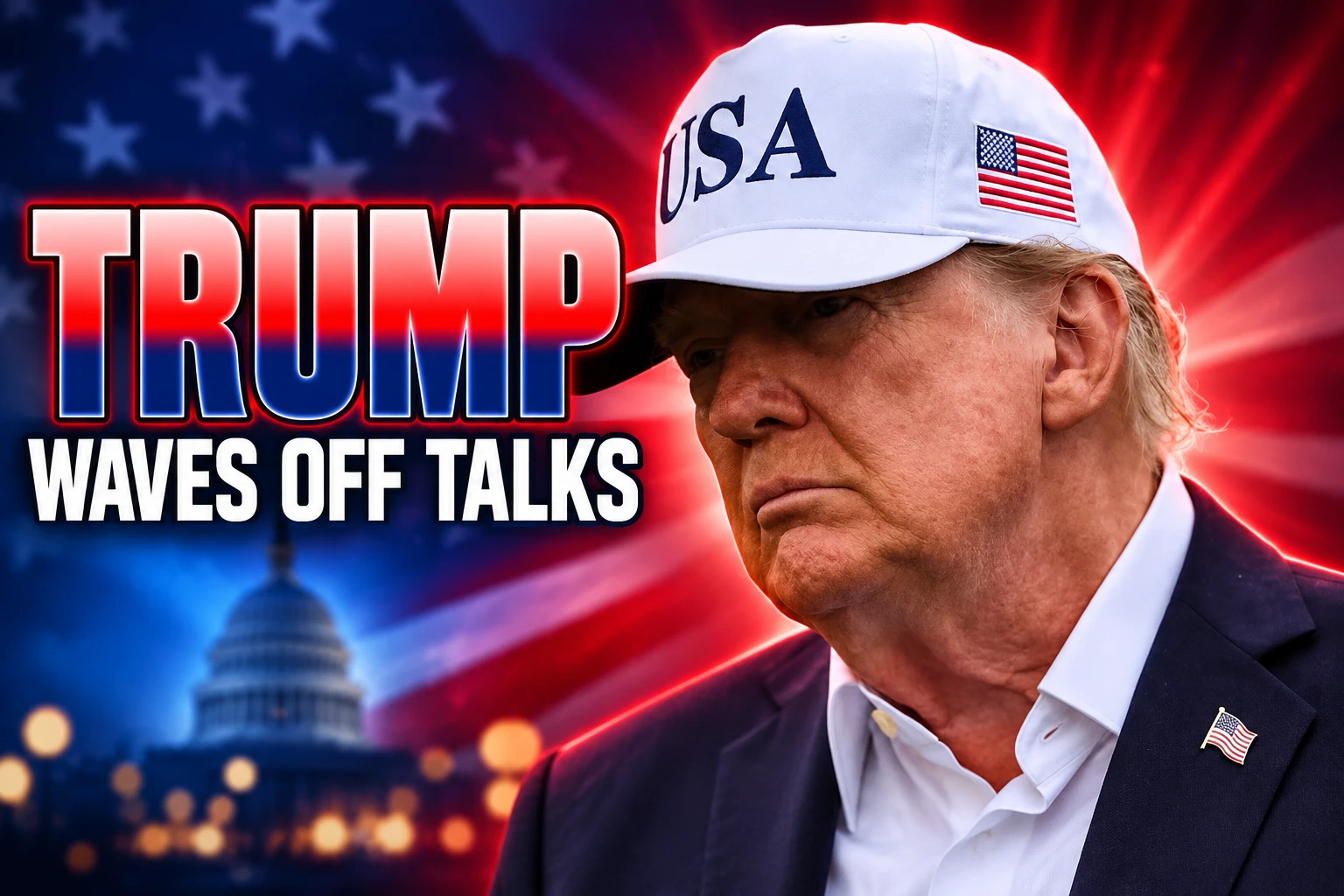
President Donald Trump said on Sunday that Gulf countries talking with Iran was “up to them” and “fine.” He was at the Irish Open in Doonbeg, County Clare, thousands of kilometres from the table that had just sat Iran down with Abu Dhabi.
Iranian President Masoud Pezeshkian had met Abu Dhabi Crown Prince Sheikh Khaled bin Mohamed bin Zayed Al Nahyan on Saturday at Bharat Mandapam in New Delhi, on the sidelines of the 18th BRICS Summit. It was their highest-level contact since the war that began on February 28, 2026. Trump’s shrug was the American line. The Gulf states are the ones with bases, tankers, and a blocked strait.
Trump Waves Gulf-Iran Talks Through From Doonbeg
Reporters caught Trump on the fairway at Trump International Golf Links, where the Amgen Irish Open is being played. Asked about Gulf governments meeting Iran, including a session set for Monday, September 14, in Oman on the Strait of Hormuz, he did not treat the diplomacy as a problem he needed to police.
I don’t care. That’s up to them. It’s fine.
Donald Trump, U.S. president, to reporters at the Irish Open in Doonbeg
He then tied the fighting to the U.S. election calendar. “Iran will end right after, maybe before, but it’ll end right after the midterms. Gasoline’s going to drop like a rock,” he said. The midterms fall on November 3, 2026.
He also repeated a claim Tehran has pushed back on before. “Iran wants to make a deal so bad. They are calling constantly. They want to make a deal. They’ve got to make the right deal. I’m not going to make a deal that’s no good,” he told the same pool.
That posture leaves the people who live next to the war to manage it in rooms Washington does not enter. BRICS is one of those rooms. Oman is about to be another. The president who launched the campaign from Gulf soil is not the one whose ports, pipelines, and air bases sit in the blast radius.
The Highest-Level Meeting Since the War Began
The war opened with U.S. and Israeli missile strikes that targeted Iran’s leadership. Iran then hit back at U.S. partners around the Persian Gulf, including the UAE. Previous BRICS ministerial meetings this year, including a gathering of foreign ministers in New Delhi in May, failed to produce a joint statement because Iran and the UAE would not accept the same language.
Indian negotiators worked through the night, with talks running until 4 a.m. on Saturday, before leaders adopted a 140-paragraph New Delhi Declaration. In the middle of that fight, Pezeshkian sat down with Sheikh Khaled. The Abu Dhabi Media Office said they discussed regional and international issues, de-escalation, stability, and efforts to advance regional peace and development. It did not announce a thaw.
Pezeshkian did. On Sunday, as he wrapped his visit, the Iranian embassy in India posted his account of the conversation.
President Pezeshkian, at the conclusion of his visit to India:
“We had a good conversation with the Crown Prince of Abu Dhabi, and agreed to put the past behind us and look to the future.
We also had discussions with the Presidents of Russia and China, which were mostly brief… pic.twitter.com/qxAhuUGDQb
— Iran in India (@Iran_in_India) September 13, 2026
“We had a good conversation with the Crown Prince of Abu Dhabi, and agreed to put the past behind us and look to the future,” he said. He later called it a constructive exchange, the first since the war and the incidents in the Persian Gulf. The UAE issued no matching public line. That silence is not a small detail. Abu Dhabi still has to live with U.S. forces on its territory and with Iranian missiles that have already come toward its waters.
FROM FEBRUARY STRIKES TO A DELHI SIDE ROOM
- February 28, 2026: The United States and Israel open the war with missile strikes on Iran.
- June 2026: A preliminary deal is touted and fighting eases, then the ceasefire collapses and the strait stays constrained.
- August 2026: The UAE freezes all trade and financial dealings with Iran after accusing Tehran of firing ballistic missiles toward it.
- August 18, 2026: The UAE Ministry of Defence says two ballistic missiles coming from Iran fall, one in Emirati territorial waters and one outside.
- August 31, 2026: The Iranian Army says it sent drones at U.S. helicopters and personnel at Al Minhad Air Base, south of Dubai. The UAE Ministry of Defence calls reports of a missile hit on the base false and says it intercepted a drone over territorial waters.
- September 12, 2026: Pezeshkian meets Sheikh Khaled in New Delhi and BRICS adopts the New Delhi Declaration.
- September 13, 2026: Pezeshkian says they will put the past behind them. Trump, in Doonbeg, says he does not care.
- September 14, 2026: Iran, Iraq, and most Gulf states are due in Oman to hear an Iran-Oman plan for Hormuz routes.
Eight BRICS leaders attended the closed session in person, among them Vladimir Putin, Xi Jinping, and Pezeshkian. Brazil and the UAE sent high-level representatives. Sheikh Khaled led the Emirati delegation. The 11-member grouping got a text because both sides climbed down, not because the shooting stopped.
What Pezeshkian Said About US Bases in the Gulf
The Iranian president used New Delhi to split his neighbors from the American facilities they host. In an interview with Geeta Mohan of India Today, he said Tehran does not treat the UAE or other regional countries as enemies and called on them not to let the United States use their land to attack Iran.
The Iranian embassy in India posted that he had no problem with the UAE, only with the American bases on Gulf soil.
We have no problems with the UAE. We have no problem with any of the regional countries. We have a problem with the American bases located in these countries and from which they are attacking our country.
Masoud Pezeshkian, president of Iran, in an interview in New Delhi
He went further. “The UAE, the Emiratis and other countries of the region are our brothers. We have been living together for a long time and we have had trade. We have supported each other,” he said. Then he named the mechanism he wants the Gulf to close.
“So this is the US that has come here and established bases, and from those bases they martyr our children, they attack our infrastructure and bomb, and they target our leaders, commanders and people,” he said. Friendly countries, he added, should not allow enemies to use their soil to hit a neighbor.
That is an offer and a warning in the same breath. The offer is a political off-ramp for Abu Dhabi: the quarrel is with Washington, not with the ruling family. The warning is that as long as U.S. aircraft and personnel sit at places such as Al Minhad, Iran will treat those sites as part of the war. The UAE has already said it intercepted Iranian hardware over its waters. It has also denied that Al Minhad itself was struck. Those two facts can sit together. They still leave Emirati airspace inside the fight.
Trade is already a casualty. After the August missile incident, which Iran denied, Abu Dhabi halted commercial exchanges and financial transactions with Iran. The UAE Ministry of Defence said two tankers were hit by Iranian cruise missiles in the southern shipping lane of the Strait of Hormuz, inside Omani waters. ADNOC L&S, the shipping arm of Abu Dhabi National Oil Company, said the vessels took significant damage. A handshake in Delhi does not refloat those hulls or restart those payments. It is an attempt to stop the next round from landing on Emirati ground.
India Got a Text That Named Nobody
Prime Minister Narendra Modi chaired the summit on the 20th anniversary of BRICS and told leaders the grouping should take everyone along rather than define itself against anyone. Sudhakar Dalela, India’s sherpa and secretary for economic relations in the Ministry of External Affairs, said members had been arguing over the West Asia language for months and that consensus had to be built inside a forum where experiences differ.
Iran wanted a condemnation of the United States and Israel for the opening strikes, in the spirit of a statement already issued by the Shanghai Cooperation Organisation, which does not include the UAE. The UAE wanted equal condemnation of Iranian attacks on its neighbors. Neither got a named villain. Both signed.
THE FIGHT OVER ONE PARAGRAPH
| Party | What it wanted in the text | What leaders adopted |
|---|---|---|
| Iran | A named condemnation of the United States and Israel for starting the war | Serious concern over attacks on civilian sites and IAEA-safeguarded nuclear facilities, with no country named |
| UAE | Equal condemnation of Iranian strikes on Gulf neighbors | A call for maximum restraint, protection of civilians, and respect for sovereignty, with no country named |
| India as chair | A unanimous declaration after the May foreign ministers’ failure | A 140-paragraph New Delhi Declaration, issued after overnight talks |
The official clauses are careful to the point of dryness. Leaders call for maximum restraint in West Asia, recall their own national positions, and urge parties to avoid actions that could make the situation worse. They ask for the protection of civilians and civilian infrastructure, respect for sovereignty and territorial integrity, and more work through dialogue and diplomacy. They also flag the need to keep global trade, supply chains, and energy moving under international law.
A second paragraph expresses serious concern over “deliberate attacks on civilian infrastructure and peaceful nuclear facilities under full safeguards of the International Atomic Energy Agency (IAEA).” Nuclear safety, it says, must be upheld even in armed conflict. That line is widely read as a reference to strikes on Iranian nuclear sites. It still does not say who fired. The same document records that India’s chairship ran more than 400 meetings in 30 cities. The diplomatic machine was large. The West Asia paragraph is small on purpose.
Monday in Oman Will Not Reopen Hormuz
The Delhi bilateral is a political signal. The meeting that can change oil flows is the one set for Monday, September 14, in Oman. Iranian Foreign Ministry spokesman Esmaeil Baghaei said Gulf states and Iraq would be briefed on Iran-Oman consultations on safe passage through the Strait of Hormuz. Iranian Foreign Minister Abbas Araghchi said the agenda is a new maritime route, that maps and a joint statement are ready, and that the papers would then go to the International Maritime Organization. Bahrain, a GCC member, said it would not attend.
WHAT MONDAY’S OMAN SESSION IS
- The hosts: Oman, which has mediated between Washington and Tehran for years, is convening Iran, Iraq, and most Gulf governments.
- The paper: Tehran and Muscat say they have agreed on new entry and exit routes, with the entry path described by Iranian briefers as lying inside Iranian territorial waters.
- The limit: Araghchi said the understanding does not reopen the strait. Pezeshkian said Iran will reopen it when the United States ends its blockade and attacks.
- The wider shock: Saudi Arabia shut its East-West Pipeline on Friday, September 11, after drones from Iraq, a backup route that had mattered once Hormuz seized up.
U.S.-Iran talks on reopening the waterway have stalled. Iran has kept firing on ships. A routing deal among littoral states, filed with the IMO, would be a regional attempt to write rules for a strait the U.S. Navy still treats as a war zone. It is also a way for Gulf governments to talk to Tehran about oil without sitting in the same room as Trump. His “I don’t care” removes an American veto they may not have been waiting for anyway.
The meeting video from Delhi has already been read, in the argument around it, as Abu Dhabi concluding that U.S. cover did not keep Iranian drones and missiles out of its waters. That reading overstates what a sideline conversation can do. It does not invent the incentive. The UAE froze trade with Iran last month. It is still walking into a BRICS text and an Oman briefing with the same Iranian president whose forces it accused of firing at its tankers. That is hedging under fire, not a conversion.
Gasoline and the Date Trump Just Named
Trump’s indifference is cheaper in Doonbeg than it is at a U.S. pump. AAA put the national average for regular gasoline at $4.22 a gallon on September 9, more than a dollar above the same point a year earlier, after a 7-cent jump overnight. Brent crude passed $100 a barrel the same day. The U.S. strategic petroleum reserve had already fallen below 300 million barrels in early August, down more than 100 million barrels since the start of 2026.
THE FUEL BILL ATTACHED TO THE WAR
- Pump price: AAA recorded $4.22 a gallon for regular gasoline on September 9, after the largest one-day rise since May.
- Crude: International Brent moved back through $100 a barrel the same day as U.S. and Iranian strikes on tankers and ships intensified.
- Reserve: The strategic petroleum reserve was below 300 million barrels in early August, after withdrawals of more than 100 million barrels in 2026.
- Trump’s date: He said the war, and then the drop in gasoline, would come right after the November 3 midterms, maybe before.
He has moved that horizon before. In June he talked up a deal that would let oil fall. Fighting resumed. In early September he told Republicans the war would end immediately after the election and that Iran was stretching the conflict to damage him at the polls. On Sunday he said again that Iran is calling constantly and that any deal still has to be the right one. Gulf ministers are not waiting for that standard. They are trying to get tankers through a strait Iran says it will keep closed until American attacks stop.
Pezeshkian left New Delhi for Tehran on Sunday after brief exchanges with the presidents of Russia and China and a claim of a promising outlook for economic cooperation. Trump left the Irish Open for Washington the same day. Between them sits a crown prince whose public statement never matched Iran’s warmth, and a Monday session in Oman that, by Tehran’s own account, will not reopen Hormuz. The president who said he does not care has given the war a date after November 3. The governments that host his bases are already talking to the other side.

Morocco’s Next World Cup Government Starts 101 Seats Short

TSA CT Scanners Catch Oversized Carry-On Bags at Security

False AI Intel Nearly Put US Crews on a Chinese Ship

Anthropic Will Pay Accenture to Grade Its Own Models

U.S. Crude Stocks Jump as WTI Ignores the Build

How to Get Pre Boarding on Southwest – Skip the Line with These Tricks

Tim Cook’s $4.6 Trillion Apple Still Runs on One Phone

Dunes Air Sues Nora Fatehi Over Its Luxury Jet

Australia Treats Cloud Software Payments as Taxable Royalties

OpenAI Posts a Navier-Stokes Proof Clay Has Not Touched
-
 TRAVEL3 years ago
How to Get Pre Boarding on Southwest – Skip the Line with These Tricks
-
 BUSINESS1 month ago
Tim Cook’s $4.6 Trillion Apple Still Runs on One Phone
-
 ENTERTAINMENT3 weeks ago
Dunes Air Sues Nora Fatehi Over Its Luxury Jet
-
 NEWS3 weeks ago
Australia Treats Cloud Software Payments as Taxable Royalties
-
 NEWS3 weeks ago
OpenAI Posts a Navier-Stokes Proof Clay Has Not Touched
-

 LIFESTYLE3 years ago
How Long Does It Take for Armpit Hair to Grow? The Stages of Hair Growth and How to Shave It
-

 NEWS3 weeks ago
China’s Supreme People’s Court Gives AI Apps Safe Harbor
-

 NEWS1 month ago
California Writes a Teen Version of Instagram and TikTok