
NEWS
OpenAI Posts a Navier-Stokes Proof Clay Has Not Touched
OpenAI says 10,000 agents proved a forced Navier-Stokes blowup in 88 hours, yet Clay still lists the problem unsolved and two mathematicians dispute the credit.

OpenAI said on September 8 that an unreleased model proved a finite-time blowup for the Navier-Stokes Millennium Prize problem. A swarm on the order of 10,000 agents reached the argument in 88 hours, then spent 17 more hours checking it in Lean.
The lab posted a paper and a machine-checked certificate, and said it will not claim the $1 million. The Clay Mathematics Institute still tags the problem unsolved, and two mathematicians who spent a year on the same forcing path say the sprint began after word of their work reached the lab.
OpenAI’s Agents Produced a Forced Blowup in 88 Hours
The writeup of the blowup proof comes from an internal model the company described as well above GPT-6 Astra. Training on that model started on August 28. On September 1, after rumors that two Millennium Prize problems had already fallen, OpenAI pointed coordinating agents at every open prize problem and a few nearby questions.
We’re sharing a solution to the Navier-Stokes Millennium Prize Problem, one of the deepest problems at the frontier of mathematics.
The proof was produced by a group of agents, using an OpenAI next-generation model significantly more capable than GPT-6 Astra.
The problem… pic.twitter.com/8zol3BPTL4
— OpenAI (@OpenAI) September 8, 2026
Agents could read a cached copy of the internet and run code. They sat in groups that talked among themselves. The group that closed Navier-Stokes used on the order of 10,000 agents at once, with the same monitoring and isolation the lab uses on other frontier tests. Separate groups got Clay’s options A and B, which would prove smoothness, and options C and D, which would show breakdown.
They also tried a supposedly easier cousin: blowup for the Euler equations, Navier-Stokes with the viscosity term stripped out. Nearly 100 agents worked about 50 hours and, to the team’s surprise, produced an unforced Euler breakdown. OpenAI then pulled agents off the other prize problems, fed them the Euler result, and updated them as a newer checkpoint of the internal model came online.
COMPUTE BEHIND THE CLAIM
- Navier-Stokes agents: On the order of 10,000 working at once on the prize problem.
- Clock: Resolution on Saturday, September 5, about 88 hours after the first agents launched, plus 17 hours of Lean work through GPT-6 Astra.
- Navier-Stokes traffic: 2.7 million messages and about 130 billion output tokens.
- Whole run: 4.9 million messages and about 300 billion output tokens across every problem the agents tried.
Mark Chen, OpenAI’s chief research officer, put the compute bill in the millions of dollars on a call with reporters. Sébastien Bubeck, who leads the lab’s math work, said he first assumed the argument was wrong. “I thought there must be a mistake somewhere,” he said. “And on Sunday morning we had the final solution, Lean-formalized and everything.”
Clay’s Two-Year Clock Has Not Started
Clay named seven problems in Paris on May 24, 2000, and set a $7 million fund with $1 million on each. The only prize it has awarded is for the Poincare conjecture. Grigori Perelman posted that proof in 2002 and 2003; Clay offered him the money in 2010, and he declined.
A proposed solution cannot be mailed to Clay. The rules require publication in a refereed mathematics journal of worldwide repute, then two years of general acceptance, after which the Scientific Advisory Board may form a special committee. Clay’s own page still lists the equation as unsolved.
OpenAI wrote that its goal was to report how fast the models are moving. “We do not intend to claim the Millennium Prize for this result.” That leaves the $1 million sitting where it sat on September 7: unclaimed, and not even in the two-year waiting room, because no journal of record has published the argument yet.
Ravi Vakil, president of the American Mathematical Society, and John Meier, the society’s chief executive, treated the week as a chain rather than a solo finish. They traced the line from Navier, Stokes, Jean Leray, and Olga Ladyzhenskaya through Diego Córdoba and Luis Martínez-Zoroa, then Levent Alpöge and Tristan Buckmaster, with OpenAI taking the last steps, and said the point of the subject is human understanding.
Córdoba and Martínez-Zoroa Opened the Door First
The Navier-Stokes equations, written in the nineteenth century by Claude-Louis Navier and George Gabriel Stokes, treat water or air as a continuous medium. In 1934 Leray showed that solutions exist in a weak sense. Clay later asked whether a smooth three-dimensional incompressible flow can stay smooth, or whether it can blow up in finite time. OpenAI dates that smoothness question to roughly 90 years.
Córdoba and Martínez-Zoroa spent years building forced blowups, first with rough forcing. Tristan Buckmaster, a professor at New York University’s Courant Institute, and Levent Alpöge, a mathematician employed at Anthropic, took that program as a starting point and, with heavy help from language models, pushed it to smooth forcing and to incompressible Euler. Buckmaster wrote that the basic idea was not theirs and not a model’s. He has told colleagues he believes Martínez-Zoroa deserves a Fields Medal.
The pair used Anthropic’s Claude and OpenAI’s Codex, especially with GPT-5.6 Sol, and later Astra only for writeups and audits. Buckmaster paid for the tools from his own research funds, “including footing a large bill to OpenAI.” He called the project a personal collaboration with no deal from NYU or Anthropic.
THREE BLOWUPS THEY POSTED ON SEPTEMBER 8
- Porous media: Finite-time blowup with smooth forcing for the incompressible porous media equation.
- Boussinesq: The same kind of breakdown for the two-dimensional Boussinesq system.
- 3D Euler: Finite-time blowup with smooth forcing for three-dimensional incompressible Euler, checked in Lean on August 22.
They think they also have blowup for hypo-dissipative Navier-Stokes, a close cousin of the prize problem, but they held that paper because the Lean check is unfinished. Progress was slow for most of a year. On August 15 they got the Boussinesq and Euler results. Buckmaster said the first model draft Alpöge sent him was the most horrendous proof he had ever read; they verified it in Lean a week later and have been rewriting since.
THE WEEK THE FORCING PATH WENT PUBLIC
- August 15, 2026: Buckmaster and Alpöge obtain smooth-forced blowup for Boussinesq and 3D Euler.
- August 22, 2026: Those arguments check in Lean.
- August 28, 2026: OpenAI starts training the new internal math model.
- September 1, 2026: After rumors that two prize problems have been solved, OpenAI launches agent groups at the remaining list.
- September 3, 2026: Buckmaster emails a mathematician at OpenAI to calm a rumor tying Alpöge and Anthropic to a major solve.
- September 5, 2026: OpenAI’s agents reach a Navier-Stokes resolution, about 88 hours after the first agents launched.
- September 6, 2026: Lean checking finishes; Bubeck joins two calls with Buckmaster. Alpöge is not on the line.
- September 8, 2026: The NYU papers and OpenAI’s prize-problem claim both go public.
OpenAI says its Euler result is the unforced problem, so the precise theorems differ even before Navier-Stokes. That distinction matters, and it does not erase the calendar. The lab’s own account dates the prize-problem push to rumors it later tied to Alpöge and Buckmaster.
Sunday Calls Tried to Cut an Anthropic Coauthor
Buckmaster’s four-page personal statement is the human record of those days. On September 3, with a rumor spreading that Anthropic had resolved a major open problem, he wrote privately that the work was not an institutional effort, that he would post paper and formalization together, and that he did not want a Lean certificate sitting in front of an unreadable preprint. The reply the same day asked for details “to avoid competing” and offered compute.
He asked to talk the following week. On Friday he was asked to meet that day and again said the following week. At 12:45 on Sunday, September 6, he was asked if he could meet at any point that day. Bubeck joined. They spoke twice that afternoon without Alpöge. Buckmaster was told an internal model had produced a proof of forced Navier-Stokes blowup on both R3 and the three-torus, Fefferman options C and D, about 100 pages long. He has not seen it.
He called the word “forced” a bright red flag, because that is the Córdoba-Martínez-Zoroa route he and Alpöge had quietly chosen, and almost nobody else he knew was on it. He was shown a prompt and told the model had simply been given the problem statement. Alpöge had been told there was very little human input. On the same call, as the OpenAI team sent Bubeck corrections over internal chat, that story came apart: a whole team had been on it, they had started on the unforced problem, they had warmed the model on easier equations including Euler, even the prompt on the table had been written by prompting Codex, and a huge amount of compute had been used.
He asked when the first prompt went out. The answer, after a delay, was that it had been sent in the past few days, after information about their work reached OpenAI. He asked whether the model had been trained on, or had access to, their Codex sessions, where they had put every draft of the project. He was told the model did not look up user data. He asked again about training and got no answer.
I have not seen OpenAI’s proof. I do not know what their model did, or how. I do not know whether our data was used. I am not accusing anyone of anything.
Tristan Buckmaster, professor of mathematics, New York University
Two offers followed, in his account. One: they post Euler, OpenAI posts Navier-Stokes the next day. Two: after Euler, Buckmaster alone writes the Navier-Stokes paper, crediting an internal OpenAI model. He wrote that Bubeck twice wanted Alpöge removed from authorship because it was annoying that Alpöge works at Anthropic, and that OpenAI said if it posted second it would call them the closest humans to the problem and say they deserved the Clay prize. He declined both. When he said he would go public if they released the result in the form proposed, he wrote that the reply was, “Why would you ruin your career?” and then, “If you don’t want me to be nice, then I don’t have to be nice.” Alpöge later got a text proposing a one-on-one, saying Buckmaster might not be fully rational. He declined.
OpenAI’s written account says that after Lean checking on September 6, believing from the rumor that the other team also had Navier-Stokes, it reached out to offer a concurrent release and to recognize their priority, then learned they had forced Euler. It says researchers and agents did not see the NYU-Anthropic work until it was public, and that no specific user data was accessed to solve the problem. “While unlikely, we cannot rule out that de-identified data derived from their usage of our products helped improve our models.” Chen said no people or AI systems searched through user data to solve this problem, and that he was a little disappointed with the allegations.
Sam Altman wrote that he spent much of the weekend with the team, that Bubeck and the others “acted with integrity and generosity throughout,” that OpenAI first believed the other team had also solved the prize problem and wanted a joint release, and that once it learned they had Euler but not Navier-Stokes it offered to let them go first and optionally to make Buckmaster lead author on a rewrite. He said it was hard to offer the same to Alpöge, an Anthropic employee who would not coordinate, that the other team threatened unfounded plagiarism claims, and that the approaches now look different. He also said OpenAI tried the problem because of internet rumors that Anthropic’s models had solved a millennium problem.
The main announcement post did not name Buckmaster or Alpöge. That omission is now part of the record the math community is reading alongside the Lean files.
What Statements C and D Allow
Clay’s problem is not a single yes-or-no line. Charles L. Fefferman’s official note sets out accepted alternatives on three-dimensional space and on the periodic torus. Options A and B are the regularity side, the picture most people have: every allowed smooth flow stays smooth. Options C and D are breakdown, including cases with a smooth external force.
OpenAI says its argument establishes the official statements C and D. The fluid starts smooth and at rest. A smooth force is applied. Energy stays finite all the way to the singularity. GitHub restates the same pair: for every positive viscosity, there are smooth initial data and forcing on R3 with no global smooth solution of uniformly bounded kinetic energy, and smooth periodic data and forcing on the torus with no global smooth solution.
That is Clay as written. It is not Clay as imagined by readers who picture an isolated blob of water with no hand on it. The force has to stay smooth, and the breakdown has to come from the motion itself rather than an infinite shove. OpenAI says the hard part is that acceleration, pressure, momentum transfer, and viscosity all get large and still cancel with enough care that the external force remains smooth while velocity blows up.
THREE PROOFS IN ONE WEEK
| Result | Who posted it | External force | Lean check |
|---|---|---|---|
| 3D Euler, Boussinesq, porous media blowup | Buckmaster and Alpöge | Smooth | August 22, 2026, for Boussinesq and Euler |
| 3D Euler blowup | OpenAI agents | None | Posted with the Navier-Stokes files |
| Navier-Stokes C and D | OpenAI agents | Smooth | September 6, 2026 |
OpenAI says even the Euler theorems differ, forced against unforced, and that the Navier-Stokes proofs are not the NYU drafts. Independent mathematicians still have to read both stacks. Until they do, the public fact is narrower than the headline: a lab has posted a forced breakdown on Clay’s C and D, and a two-person team has posted forced breakdowns on the equations that sit one step down the same ladder.
The Vortex That Stretches Like Spaghetti
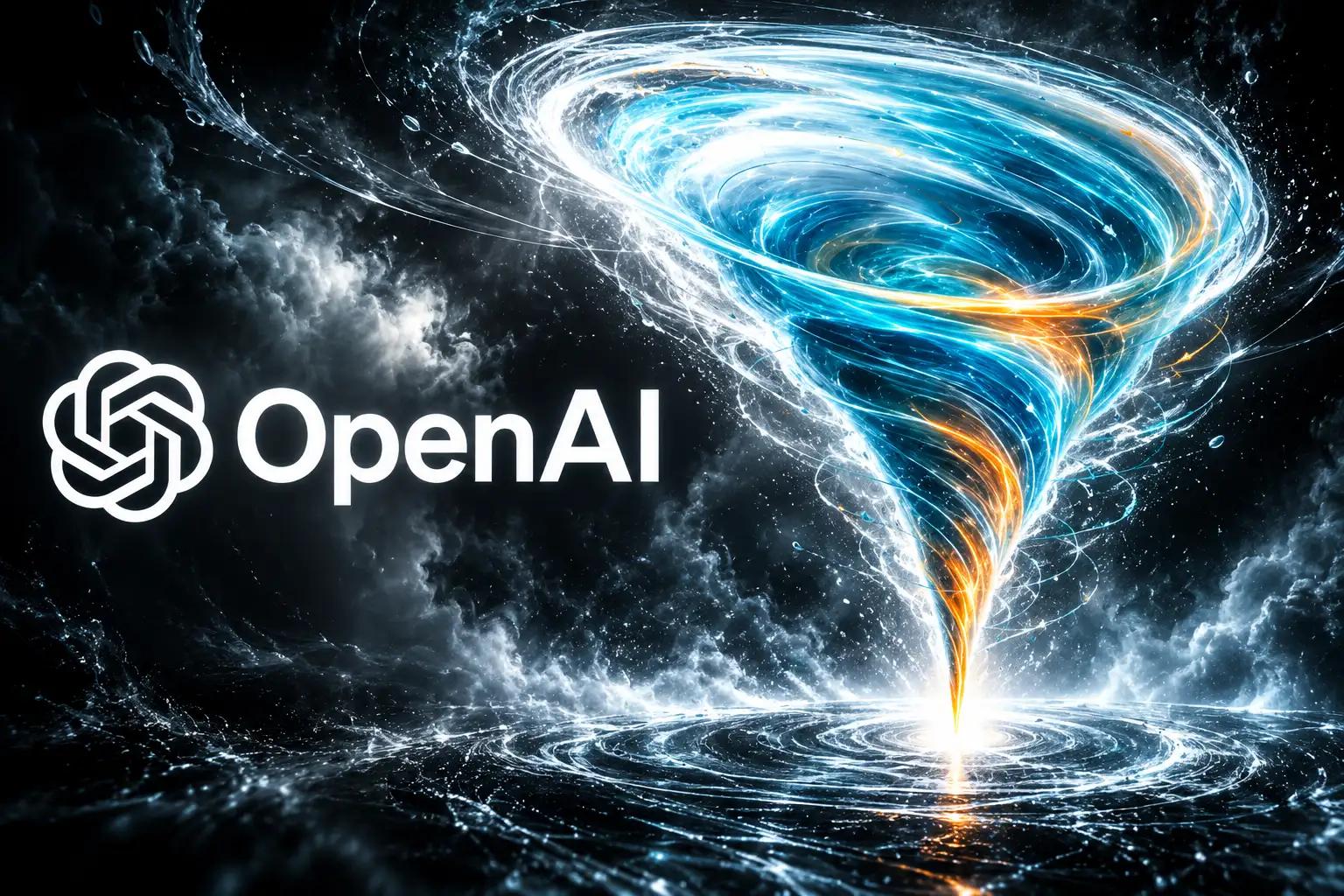
OpenAI’s picture of the solution is a vortex, a spinning swirl that spirals inward and stretches, “like spaghetti.” The core shrinks and speeds up while energy stays finite. Orange in the lab’s snapshot marks faster angular rotation, teal slower rotation, with paths that show the inward spiral and the stretch along the axis.
That image is the thing a reader can hold. If the argument is right, the continuum model of a fluid can fail in finite time even with viscosity trying to smooth the motion. A real fluid cannot move infinitely fast, so the equations would stop being a complete description and the next model would have to track particles. Aircraft design, weather codes, and blood-flow simulations already use these equations; a mathematical blowup does not make a wing fall off, but it does mark a boundary on what the continuum story can promise.
Buckmaster wanted the first thing anyone read to be a normal mathematical argument, not a certificate. He is unhappy with his own rushed files. He called the Euler writeup AI slop and said the community deserved weeks of rewriting. He also called the larger shift a Deep Blue-Kasparov moment for how students are trained, how credit is assigned, and what is worth a life’s attention. The week did not give the field that unhurried discussion. It gave it two dumps of Lean and a fight over who heard what, and when.
Lean Certificates, and a Prize Nobody Claimed
OpenAI released Lean 4 certificates for both Navier-Stokes and Euler, built with Lean 4.34.0-rc2, Mathlib, and Lake. Anyone with the toolchain can fetch the mathlib cache and build the project. A Comparator folder sits in the repo for independent checking. That is a different kind of referee from a journal: the machine either accepts the formal steps or it does not. It does not decide whether C and D are the problem the public thought it was looking at, and it does not start Clay’s two-year clock.
The hidden ledger on this story is not the agent count. Córdoba and Martínez-Zoroa opened the forcing path. Buckmaster and Alpöge spent a year on it, paid OpenAI for Codex, and parked their drafts in that product. Clay still requires a journal and two years. OpenAI spent millions of dollars of compute after a rumor, posted C and D, and walked away from the $1 million. Chen’s line about user data, and the lab’s own sentence about de-identified product logs, are now part of how any later prize committee, and any working mathematician using a lab’s tools on unpublished work, will read the week.
Clay’s public problem page still carries one status word: Unsolved. OpenAI says it will not claim the $1 million. The Lean files are on GitHub for anyone with the toolchain to check.

A CubeSat Will Age Whisky That Never Comes Home

A Charity Quote Cost Shia LaBeouf the FKA twigs NDA

Looker Turned a Model’s Body Into Ad Inventory

Infinity Ward Bets a Paid DMZ Will Stick This Time

Disney Sidesteps a Kimmel Renewal as Failla Cites Losses

How to Get Pre Boarding on Southwest – Skip the Line with These Tricks

False AI Intel Nearly Put US Crews on a Chinese Ship

Tim Cook’s $4.6 Trillion Apple Still Runs on One Phone

Dunes Air Sues Nora Fatehi Over Its Luxury Jet

OpenAI Posts a Navier-Stokes Proof Clay Has Not Touched
-
 TRAVEL3 years ago
How to Get Pre Boarding on Southwest – Skip the Line with These Tricks
-
 NEWS1 month ago
False AI Intel Nearly Put US Crews on a Chinese Ship
-
 BUSINESS2 months ago
Tim Cook’s $4.6 Trillion Apple Still Runs on One Phone
-
 ENTERTAINMENT1 month ago
Dunes Air Sues Nora Fatehi Over Its Luxury Jet
-

 LIFESTYLE3 years ago
How Often Do You Have to Change a Monkey’s Diaper? The Truth About Pet Monkeys
-

 NEWS1 month ago
Australia Treats Cloud Software Payments as Taxable Royalties
-

 LIFESTYLE3 years ago
How Long Does It Take for Armpit Hair to Grow? The Stages of Hair Growth and How to Shave It
-

 SPORTS3 years ago
Why Marching Band is Not a Sport – The Misconception and Disrespect of Marching Band