
NEWS
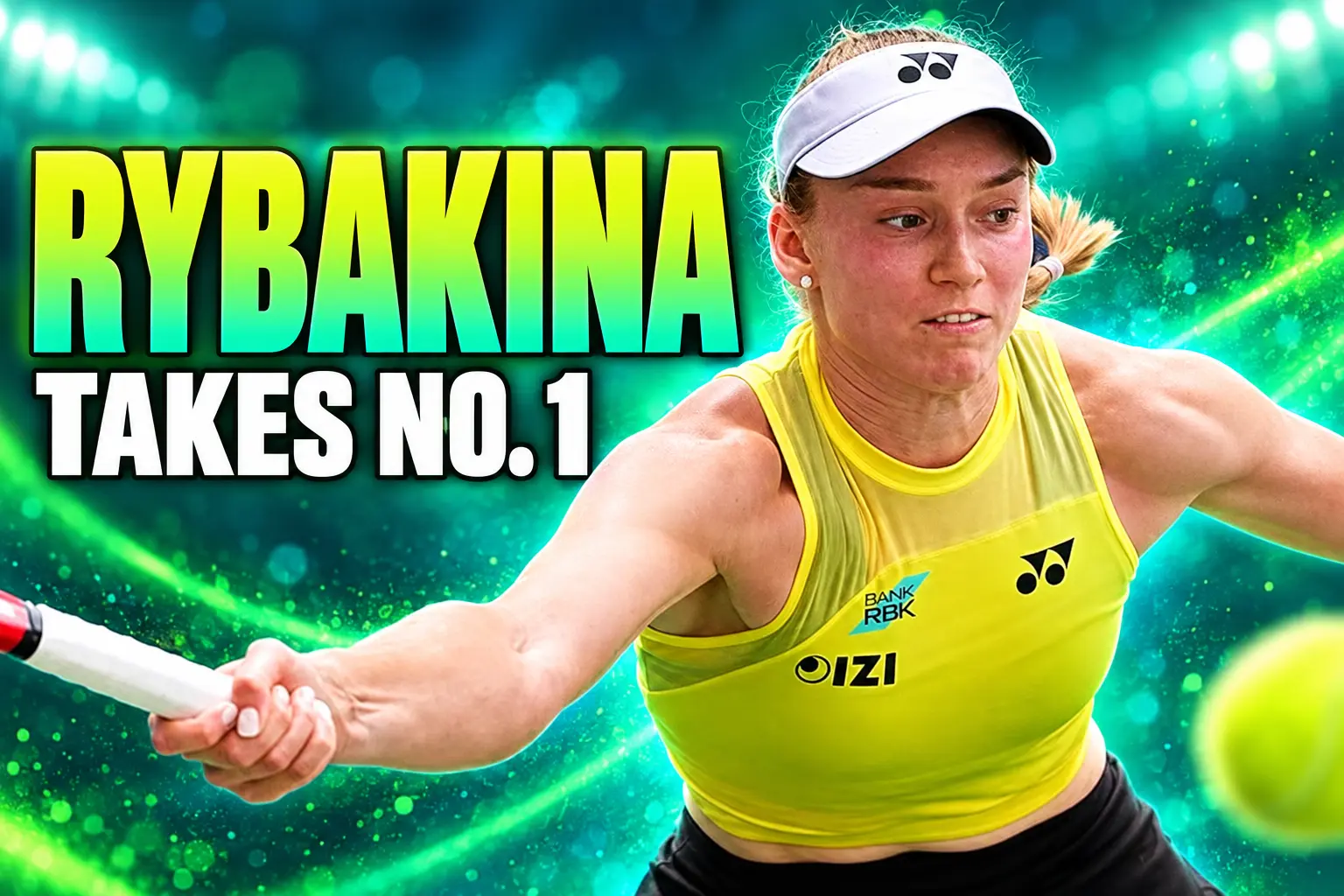
Elena Rybakina Takes World No. 1 With the Trophy Still Open
Elena Rybakina becomes WTA world No. 1 on September 14, locked in by a US Open quarterfinal while the title is still unplayed.

Elena Rybakina will become WTA world No. 1 on September 14 after a US Open quarterfinal, even if Aryna Sabalenka wins the title. She came back from a set down to beat Zheng Qinwen 3-6, 6-1, 6-4 on Wednesday and reach her first Flushing Meadows semifinal, and that was enough to lock the ranking.
Coco Gauff is next. The trophy is still two matches away. The chart is not, and Rybakina called the new number a detail she can park until the tournament is over.
Monday’s Ranking Is Already Settled
The WTA said Wednesday that the 27-year-old will take the top spot when the rankings update on September 14, after the US Open. She is the 30th woman to hold the ranking and the first player from Kazakhstan, man or woman, to get there in singles.
Pegula and Gauff arrived in New York as the other two players who could still steal the job. Each needed to win the title and needed Rybakina out before the last four. Once she beat Zheng, those paths closed. Sabalenka can still defend the US Open as the player who has been No. 1 since October 21, 2024. She cannot keep the ranking if she does.
A round-by-round projection published before the quarterfinals is why the math no longer moves. Rybakina’s semifinal haul sits at 8,681 points. Sabalenka, who is defending a champion’s pile, would land on 8,575 even as the winner, 106 points short. Pegula’s ceiling as champion is 8,485.
PROJECTED WTA POINTS FROM NEW YORK
| Player | As semifinalist | As champion |
|---|---|---|
| Elena Rybakina | 8,681 | 9,901 |
| Aryna Sabalenka | 7,355 | 8,575 |
| Jessica Pegula | 7,265 | 8,485 |
If both Rybakina and Sabalenka stop in the last four, the gap is 1,326 points. That is the quiet part of the week: the new No. 1 can lose on Thursday and still rise on Monday, and the old No. 1 can lift the trophy and still fall.
“It’s just a number right now. My goal is to win the tournaments which I play,” Rybakina said. “It’s an amazing achievement, but you know how quickly everything can change in tennis ranking-wise.”
Two Weeks After She Could Not Walk
The ranking race nearly ended in Ohio, not New York. Seeded No. 2 in Cincinnati, Rybakina needed a final there to take the top spot after Sabalenka lost in the fourth round. She lasted five games against Iga Swiatek.
Serving at 1-4, 40-40, she took a medical timeout for her left ankle, tried one more point, and retired. “It’s painful to walk,” she said. “We’ll know more tomorrow when we have the MRI. It’s been bothering me for a long period of time but felt like I had it under control.” She later said she could not walk without pain for days, missed a full week of hitting, and pulled out of mixed doubles in New York.
FROM A RETIREMENT TO THE TOP SPOT
- August 20, 2026: Retires at 1-4 against Swiatek in Cincinnati with a left ankle injury.
- Late August 2026: Spends days unable to walk without pain, sees more than one doctor, and stays off court for a week.
- September 1, 2026: Beats wild card Thea Frodin 6-3, 6-2 in the US Open first round after a long rain delay.
- September 7, 2026: Beats Naomi Osaka 6-1, 6-4 to reach her first US Open quarterfinal.
- September 9, 2026: Beats Zheng 3-6, 6-1, 6-4; the WTA confirms she will be No. 1 on September 14.
Before the first round she said no one on her team knew if she would be able to play. “My preparation wasn’t that great. I didn’t play for seven days and I couldn’t do much in the gym movement-wise, so we had to really go day by day,” she told reporters after Osaka. “We didn’t even know if I’m going to be able to play or not.”
Zheng, the Olympic champion, had come through qualifying and had just beaten Swiatek from 5-0 down in the opening set. Rybakina dropped a set for the first time in the fortnight, then won 12 of the next 17 games and saved a break point in the third. Gauff, who had watched the ranking race from the other half, did not hedge. “Elena is the new world number one,” she said. “It’s going to be a tough match. These are the moments you live for.”
A 99-Week Streak Ends Without a Decider
Sabalenka’s hold at the top runs 99 consecutive weeks, the sixth-longest straight reign since the WTA list began in 1975, and 107 weeks in total, 10th on the career list. She finished 2024 and 2025 as year-end No. 1 and spent all of 2025 in the chair. The streak stops because of the 12-month window, not because she has been knocked out of her own tournament.
She had to save her title defense first. Against Linda Noskova she trailed 4-2 in the third set and 2-0 in the second tie-break, then won 7-6 (7-1), 3-6, 7-6 (10-7). That kept her in the last four. It did not keep her above Rybakina’s projected total.
LONGEST STRAIGHT RUNS AT WTA NO. 1
- Steffi Graf: 186 weeks, 1987 to 1991.
- Serena Williams: 186 weeks, 2013 to 2016.
- Martina Navratilova: 156 weeks, 1982 to 1985.
- Ashleigh Barty: 114 weeks, 2019 to 2022.
- Chris Evert: 113 weeks, 1976 to 1978.
- Aryna Sabalenka: 99 weeks, October 21, 2024 through the September 14, 2026 list.
Since Barty stepped away in April 2022, only Swiatek (125 career weeks at No. 1) and Sabalenka had sat in that seat. Rybakina is the first new name in more than four years. Sabalenka still has a path to a third straight US Open title, a mark last hit by Serena Williams from 2012 to 2014, and she still has to play for it as the player the list is about to move.
Kazakhstan’s First Singles No. 1
Rybakina was born in Moscow on June 17, 1999, trained at the Spartak Club, and played for Russia as a junior world No. 3. In 2018, at 19, she took Kazakhstani citizenship after the federation offered the money and structure that would let her stay on tour instead of taking a US college place. She has been the first player from that country to win a major, the first inside the top 10, and now the first at No. 1.
She has said for years that the junior decision was about keeping a career alive, not about rewriting where she was born. The ranking is the first time the country has a singles player on the opening line of the sheet, and that is the piece of the week that does not depend on who wins Thursday.
I’m very proud representing Kazakhstan. Every time I come back to Kazakhstan, no matter which city I go, it’s always so many kids. Now they play tennis, and more and more are coming to the tennis facilities. It just proves that everything is possible if you believe. If you work hard.
Elena Rybakina, US Open press conference
On Instagram she wrote, “Anything is possible when you believe! Proud to represent Kazakhstan and make history as the country’s first world number 1.” The WTA put out a separate line that sits beside her on-court shrug: she has wanted the ranking since she was a girl, and she wanted her team in the room when it landed. Both things can be true in the same week. The chart is paperwork. The passport line is not.
Gauff, Pegula and a Possible Australian Open Replay
The draw now puts the new No. 1 against the 2023 champion. Gauff saved two match points in a 2-6, 7-6 (9/7), 6-2 win over Mirra Andreeva, the French Open champion, and she has already beaten big servers in New York by staying in rallies they wanted short. Rybakina’s first-strike game is the test she has been pointing at.
Sabalenka’s semifinal against Jessica Pegula is the other half, a rematch of the 2024 final. If both favorites win, the US Open final is a replay of this year’s Australian Open, which Rybakina took in three sets. If they do not, the ranking still flips on Monday and the trophy goes to someone else.
The top four seeds are all in the last four. The official tournament account put that up as the snapshot of the day.
The top four made it through 👊 pic.twitter.com/GRAYnng2Cv
— US Open Tennis (@usopen) September 9, 2026
That is the odd shape of the fortnight. Four players are still alive for the title, and only one of them is already done with the ranking race. Rybakina can walk into Arthur Ashe on Thursday as the player who has already won the argument the field spent two weeks counting, and still lose the match that she said she actually came for.
The Second-Oldest Debut at the Top
Most first-time No. 1s arrive younger. Martina Hingis was 16 years and 6 months in 1997. Rybakina gets there at 27, the second-oldest debut at the top after Angelique Kerber. She had been stuck at a career high of No. 2 since March 16, and the WTA page still lists her there until the September 14 drop.
The wait was not a lack of weapons. She is 6 ft 0 in with a first serve that has run the tour for years, and she has 13 singles titles, including Wimbledon in 2022 and the Australian Open in January. What she did not have, until Wednesday, was a 12-month window that survived Sabalenka’s defending points at this event.
She also did not have a clean build-up. The ankle had been a problem through the North American swing, and the Cincinnati retirement was the moment the ranking chance looked gone. Two weeks later the same player is the one the list cannot catch.
The 12 Months That Built the Lead
The quarterfinal only certified a pile that had been stacking since last autumn. Rybakina won Ningbo in 2025, then went 5-0 at the WTA Finals in Riyadh, beat Sabalenka in that final, and left with $5.235 million, the largest prize-money payout in women’s sports at the time. She opened 2026 by winning Melbourne, added the Porsche Tennis Grand Prix in Stuttgart in April, and was runner-up at Indian Wells and in Toronto, plus a Miami semifinal.
The live sheet for the year now reads 42 wins and 13 losses in 2026, two titles, and $5,379,335 in prize money. She leads the tour in aces, with more than 350 this season. Stefano Vukov is back in her box. The serve that has always been the point of her game is also the reason a seven-day layoff looked so dangerous, and the reason a 6-1, 6-4 win over Osaka looked so familiar once she could push off the ankle again.
She still has to play Gauff, and she still might see Sabalenka on Saturday if both win. None of that edits Monday’s list. The new No. 1 is already the player from Kazakhstan who could not walk in late August and who, on Wednesday, turned a third-set service game against a qualifier into the first ranking crown the country has ever had.

A CubeSat Will Age Whisky That Never Comes Home

A Charity Quote Cost Shia LaBeouf the FKA twigs NDA

Looker Turned a Model’s Body Into Ad Inventory

Infinity Ward Bets a Paid DMZ Will Stick This Time

Disney Sidesteps a Kimmel Renewal as Failla Cites Losses

How to Get Pre Boarding on Southwest – Skip the Line with These Tricks

False AI Intel Nearly Put US Crews on a Chinese Ship

Tim Cook’s $4.6 Trillion Apple Still Runs on One Phone

Dunes Air Sues Nora Fatehi Over Its Luxury Jet

Australia Treats Cloud Software Payments as Taxable Royalties
-
 TRAVEL3 years ago
How to Get Pre Boarding on Southwest – Skip the Line with These Tricks
-
 NEWS1 month ago
False AI Intel Nearly Put US Crews on a Chinese Ship
-
 BUSINESS2 months ago
Tim Cook’s $4.6 Trillion Apple Still Runs on One Phone
-
 ENTERTAINMENT1 month ago
Dunes Air Sues Nora Fatehi Over Its Luxury Jet
-
 NEWS1 month ago
Australia Treats Cloud Software Payments as Taxable Royalties
-

 NEWS1 month ago
OpenAI Posts a Navier-Stokes Proof Clay Has Not Touched
-

 LIFESTYLE3 years ago
How Long Does It Take for Armpit Hair to Grow? The Stages of Hair Growth and How to Shave It
-

 LIFESTYLE3 years ago
How Often Do You Have to Change a Monkey’s Diaper? The Truth About Pet Monkeys