
NEWS
TSA CT Scanners Catch Oversized Carry-On Bags at Security
TSA CT scanners let laptops stay packed, but their 24.4-by-16.5-inch tunnels and mandatory bins can stop stuffed carry-ons before the gate.

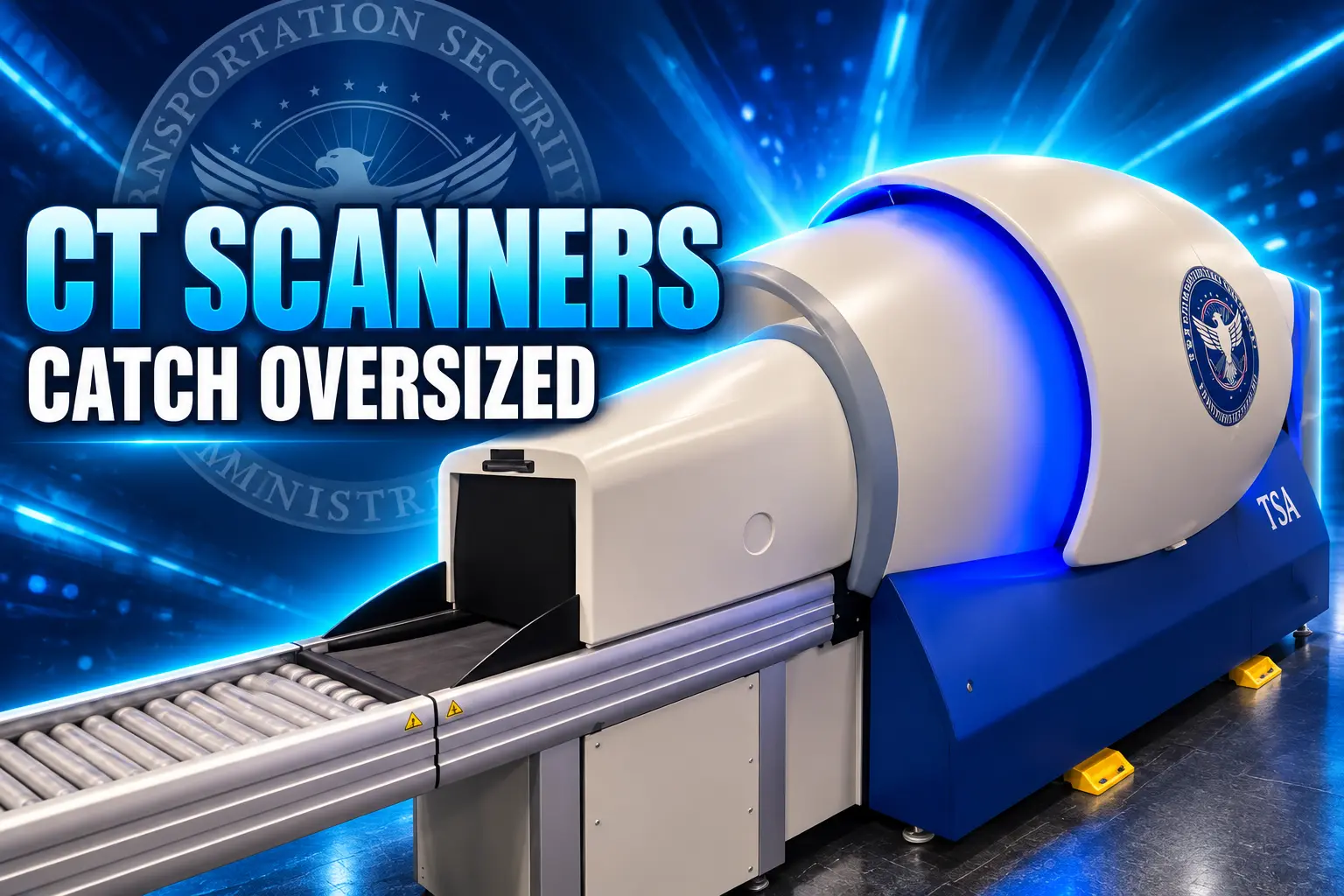
TSA CT scanners open 24.4 inches wide and 16.5 inches high, a tighter mouth than the old X-ray belt, and some stuffed carry-ons no longer fit. The agency has been swapping these computed tomography units into checkpoints so officers get a 3-D look at a bag instead of a flat picture. Travelers who packed everything into a roller to skip the ticket counter are the ones who feel the new limit first.
The same lane lets a laptop and a quart bag of travel-size liquids stay zipped inside. The bag still has to fit through the hole, and it now has to do that sitting in a bin.
The CT Tunnel Is 24.4 by 16.5 Inches
Two of the units TSA is buying publish the same opening. Smiths Detection’s HI-SCAN 6040 CTiX lists a 24.4 by 16.5 inch tunnel, which is 620 by 420 millimeters, with the belt running at 0.2 meters per second. Analogic’s ConneCT sheet uses those same tunnel figures and caps bag length at 39.37 inches, which is not the problem for a cabin roller.
TSA spokesperson Daniel Velez said the new mouth is less than an inch smaller than the machines it replaces, and that the shrink is built into the imaging hardware. “This design is necessary to accommodate the advanced imaging technology and ensure optimal performance,” Velez said. Officers, he added, can help with larger items or special needs.
THE OPENING ON TWO COMMON UNITS
- Smiths HI-SCAN 6040 CTiX: Tunnel is 24.4 inches wide and 16.5 inches high, belt speed 0.2 meters per second.
- Analogic ConneCT: Same 24.4 by 16.5 inch opening, maximum bag length 39.37 inches.
- TSA’s own line: The entry tunnel is slightly smaller, and not every large carry-on will go in.
- The old habit: A bag that used to ride bare on the belt now has to sit in a bin first.
The scanner is a rotating gantry, closer to a medical CT than to the flat 2-D boxes most flyers still picture. TSA says the camera shoots hundreds of images as the bag moves, then software looks for explosives, including liquid explosives, while an officer turns a 3-D image rotated 360 degrees on a screen. That is why a laptop can stay buried in a backpack. It is also why the tunnel is tight. The hardware that builds the picture sits around a smaller hole.
Southwest Still Allows a 24-Inch Bag
Most big U.S. carriers still print a cabin bag of 22 by 14 by 9 inches, wheels and handles included. That size is the one the new mouth was built around. Laid with the long side along the belt, the 14-inch and 9-inch faces sit inside both 24.4 and 16.5 with room to spare.
Southwest is the outlier among the majors. It still publishes a carry-on of 24 by 16 by 10 inches, including wheels and handles, and it still includes that bag on every fare. After the airline dropped free checked bags for most fares in May 2025, that larger cabin limit is how a lot of its passengers avoid the counter. The 24-inch length usually runs along the belt. The 16-inch face is the one that has to clear a 16.5-inch height, a half-inch of air that packing, wheels, and a fat front pocket can eat.
CARRY-ON LIMITS AGAINST THE CT OPENING
| Carrier or machine | Published opening or bag size | What that means at the belt |
|---|---|---|
| American, Delta, United, JetBlue, Alaska | 22 x 14 x 9 inches | Standard cabin size; long side along the belt |
| Southwest | 24 x 16 x 10 inches | 16-inch face sits 0.5 inches under the 16.5-inch height |
| Smiths and Analogic CT tunnel | 24.4 x 16.5 inches | The hole in the machine, not an airline rule |
A bag can match the airline’s printed box and still fail the hole. Expandable spinners sold as “maximum” carry-ons are the usual miss. Zip the extra gusset, stuff the front pocket, and a case that slid through an older X-ray sits too tall or too wide for the new mouth. Soft sides bulge. Hard shells do not compress. Fixed handles and chunky wheels steal the last of that half-inch.
The machine does not read the tag on the bag. It only cares whether the object, in the bin, clears the tunnel.
Roller Bags Now Have to Ride in Bins
The opening is only half of the squeeze. At CT lanes, TSA says every carry-on, including roller bags, must go into a screening bin instead of riding directly on the belt. Older X-ray lines often let a spinner go on bare. These units do not.
The tub has walls. Those walls take space the bag used to have. A roller that would have scraped through on its side can catch on the bin lip even when the empty case still matches the airline card. Officers have been telling people not to force a large item into the tunnel and to ask for help instead. Forcing it is how you jam the lane for everyone behind you.
Look at the machine before you commit to a line. CT units have a rounded, barrel-shaped housing and a smaller circular mouth than the old flat boxes. Airports still run mixed fleets, so one lane may be a CT unit and the next one an older X-ray. Signage lags. The tunnel is the tell.
What Happens When a Bag Will Not Fit?
TSA’s written advice is blunt: large carry-on items should be checked with the airline. Officers still have a few ways to clear a bag that will not enter the new mouth, and none of them is faster than packing to the printed size in the first place.
IF THE BAG WILL NOT GO IN
- Hand inspection: An officer can screen the bag by hand, which means opening it at the table and slowing the people behind you.
- Another lane: If an older X-ray is still open, staff can send you there, which only works while mixed fleets last.
- The ticket counter: You leave the checkpoint, check the bag with the airline, pay whatever same-day fee the ticket carries, and screen again.
The third path is the one that wrecks a tight connection. You have already waited in the security line. Now you walk back to ticketing with a boarding time that does not care about the scanner. Measure the packed bag at home, expansion zipper closed, wheels and handles included. Empty-box dimensions on a product page are not the size that meets the tunnel.
Leave the Laptop Inside the Packed Bag
The trade TSA is selling is real, and it is why the agency keeps installing the units. On a CT lane, laptops and other electronics can stay in the bag. Travel-size 3-1-1 liquids can stay in too. You still pack to the old liquids rule: containers of 3.4 ounces (100 milliliters) or less, in one quart-sized bag, one bag per person. The new machine does not raise that cap. It only skips the unpacking step when the lane is a CT unit.
Analogic’s ConneCT sheet puts the passenger pitch in one line: airports and regulators can leave liquids and electronics packed at the checkpoint. Smiths sells the same idea on the CTiX, with European EDS CB C3 approval and TSA APSS 6.2 certification. Jeff Price, an aviation security professor and author of Practical Aviation Security, has been telling people the water-bottle dream is still downstream of the hardware. “While widespread relaxation of the 3.4-ounce rule will take time as equipment upgrades continue nationwide,” he wrote, the scanners are how the checkpoint gets both a better look and a faster belt.
The use of CT technology by our officers significantly enhances our ability to detect threats at the checkpoint. In the past, our screening technology for carry-on luggage relied on 2-D images. CT technology utilizes advanced algorithms to identify explosives, including liquid explosives and other threat items.
Peter Duffy, Federal Security Director for Alaska, TSA Juneau release
TSA’s national CT page says officers should need fewer bags opened, because they can turn the picture instead of digging. That is the gain. The loss sits at the mouth of the same box. You keep the laptop in, and you may still have to check the suitcase that was holding it.
Undeveloped Film Needs a Hand Inspection
The stronger beam that lets a laptop stay packed is hard on analog film. TSA’s prohibited-items list tells travelers to put undeveloped film, and cameras that still hold it, in a carry-on and to ask for a hand inspection at the checkpoint rather than sending it through the X-ray. Photographers who skip that ask can fog a roll they cannot replace at the gate.
Medical liquids are a separate line. Insulin, saline, and other medically necessary liquids can exceed 3.4 ounces if you declare them. Officers may still want those items out of the bag for a closer look, CT lane or not. The scanner can map density. Policy still wants a human check on the exception.
Shoes are no longer a default strip at most checkpoints, a change TSA made in July 2025. That does not change the bag rule. The bottle of water you forgot in the side pocket will still alarm. The CT unit sees a large uniform mass. It does not care that you meant to finish it airside.
Juneau Told Travelers to Check the Big Ones
The program is not a sudden swap. Analogic and TSA ran ConneCT trials at Phoenix Sky Harbor and Boston Logan in 2017, then kept testing. The national fleet is still a mix, paid for as money arrives, which is why one airport can feel like two different agencies depending on the lane.
THE CT CHECKPOINT TIMELINE
- 2017: Analogic’s ConneCT goes through early TSA trials at Phoenix Sky Harbor and Boston Logan.
- July 6, 2026: A TSA spokesperson puts the installed fleet at 1,162 CT units across 296 airports.
- July 13, 2026: TSA says two new CT checkpoint machines are in service at Juneau International Airport, with roller bags in bins and a warning that large carry-ons may not fit.
Juneau is a small checkpoint with two units, not a hub, and the local release still spent lines on the mouth of the machine. All carry-ons, including rollers, go in bins. Passengers on those lanes may leave laptops and travel-size 3-1-1 liquids packed. Large bags that will not enter should be checked. TSA also wants keys, phones, and loose change in the bag, not in a dish, so fewer items get left in tubs.
As of July 6, 2026, that fleet was 1,162 machines at 296 airports, with more promised as funding allows. Until the last older X-ray is gone, the country is running two rules at once: unpack the laptop on one belt, leave it in on the next, and hope the packed spinner that was legal at the gate still fits the hole in front of you. TSA’s written fix is the unfashionable one. Pack to the airline’s printed size, zipper closed, and check the bag that will not make the tunnel.

A CubeSat Will Age Whisky That Never Comes Home

A Charity Quote Cost Shia LaBeouf the FKA twigs NDA

Looker Turned a Model’s Body Into Ad Inventory

Infinity Ward Bets a Paid DMZ Will Stick This Time

Disney Sidesteps a Kimmel Renewal as Failla Cites Losses

How to Get Pre Boarding on Southwest – Skip the Line with These Tricks

Tim Cook’s $4.6 Trillion Apple Still Runs on One Phone

False AI Intel Nearly Put US Crews on a Chinese Ship

Dunes Air Sues Nora Fatehi Over Its Luxury Jet

Australia Treats Cloud Software Payments as Taxable Royalties
-
 TRAVEL3 years ago
How to Get Pre Boarding on Southwest – Skip the Line with These Tricks
-
 BUSINESS2 months ago
Tim Cook’s $4.6 Trillion Apple Still Runs on One Phone
-
 NEWS4 weeks ago
False AI Intel Nearly Put US Crews on a Chinese Ship
-
 ENTERTAINMENT1 month ago
Dunes Air Sues Nora Fatehi Over Its Luxury Jet
-
 NEWS1 month ago
Australia Treats Cloud Software Payments as Taxable Royalties
-

 NEWS1 month ago
OpenAI Posts a Navier-Stokes Proof Clay Has Not Touched
-

 LIFESTYLE3 years ago
How Often Do You Have to Change a Monkey’s Diaper? The Truth About Pet Monkeys
-

 LIFESTYLE3 years ago
How Long Does It Take for Armpit Hair to Grow? The Stages of Hair Growth and How to Shave It