
LIFESTYLE
Xi Jinping Skipped Dinner and India Fought Over the Menu
Xi Jinping skipped India’s vegetarian BRICS banquet. Wang Yi attended, and Rahul Gandhi’s 80 percent claim turned millet pulao into a food fight.

Chinese President Xi Jinping skipped Prime Minister Narendra Modi’s BRICS gala dinner in New Delhi on September 12, leaving Foreign Minister Wang Yi to sit through an all-vegetarian millet menu. Russian President Vladimir Putin and other leaders ate at Bharat Mandapam. The Leader of the Opposition answered with a food census.
Neither Beijing nor New Delhi has given an official reason for the empty chair. People familiar with the matter said Xi went back to his hotel to rest after a packed first day, and the opposition treated the plate as the story.
Wang Yi Sat Where Xi Jinping Did Not
Xi reached New Delhi on the afternoon of September 12, his first trip to India since an informal summit in Mamallapuram in October 2019. He attended the opening of the 18th BRICS Summit, then held talks with Modi on the sidelines, the first of their meetings on Indian soil since that Tamil Nadu visit.
The Ministry of External Affairs said the two leaders welcomed steady progress since they last met in Tianjin in August 2025, agreed that mutual respect, mutual sensitivity and mutual interest should guide the relationship, and repeated that differences should not become disputes. Modi tied wider ties to peace and tranquillity in the border areas. They also flagged the trade imbalance, supply chains and market access. Modi thanked China for backing India’s BRICS chairship.
The dinner still went ahead without him. Sources said Wang Yi, already in the Chinese delegation, represented Beijing at the table. Abu Dhabi Crown Prince Sheikh Khaled bin Mohamed was the other high-profile absentee, having left for home after the day’s sessions. Xi departed New Delhi on September 13 after the two-day summit.
WHAT WE KNOW
- The skip: Xi attended the summit and the Modi meeting on September 12, then did not appear at the gala dinner.
- The stand-in: Sources said Foreign Minister Wang Yi represented China at Bharat Mandapam that night.
- The other absence: Sheikh Khaled left for the United Arab Emirates after his official work and did not stay for dinner.
- The host’s sprint: The ministry said Modi held 15 formal bilateral meetings over three days around the summit.
WHAT IS UNCONFIRMED
- Official cause: No statement from Beijing or New Delhi has tied the skip to fatigue, protocol, or the menu.
- The rest claim: A source said Xi returned to his hotel to rest; that remains an unofficial explanation.
A banquet plate is a weak snub-meter. Visiting leaders often travel with their own kitchens and skip plated food for security reasons, so reading an empty chair as a verdict on paneer asks the menu to do diplomatic work it cannot carry. The missing official line still left a hole that Indian politics filled in a night.
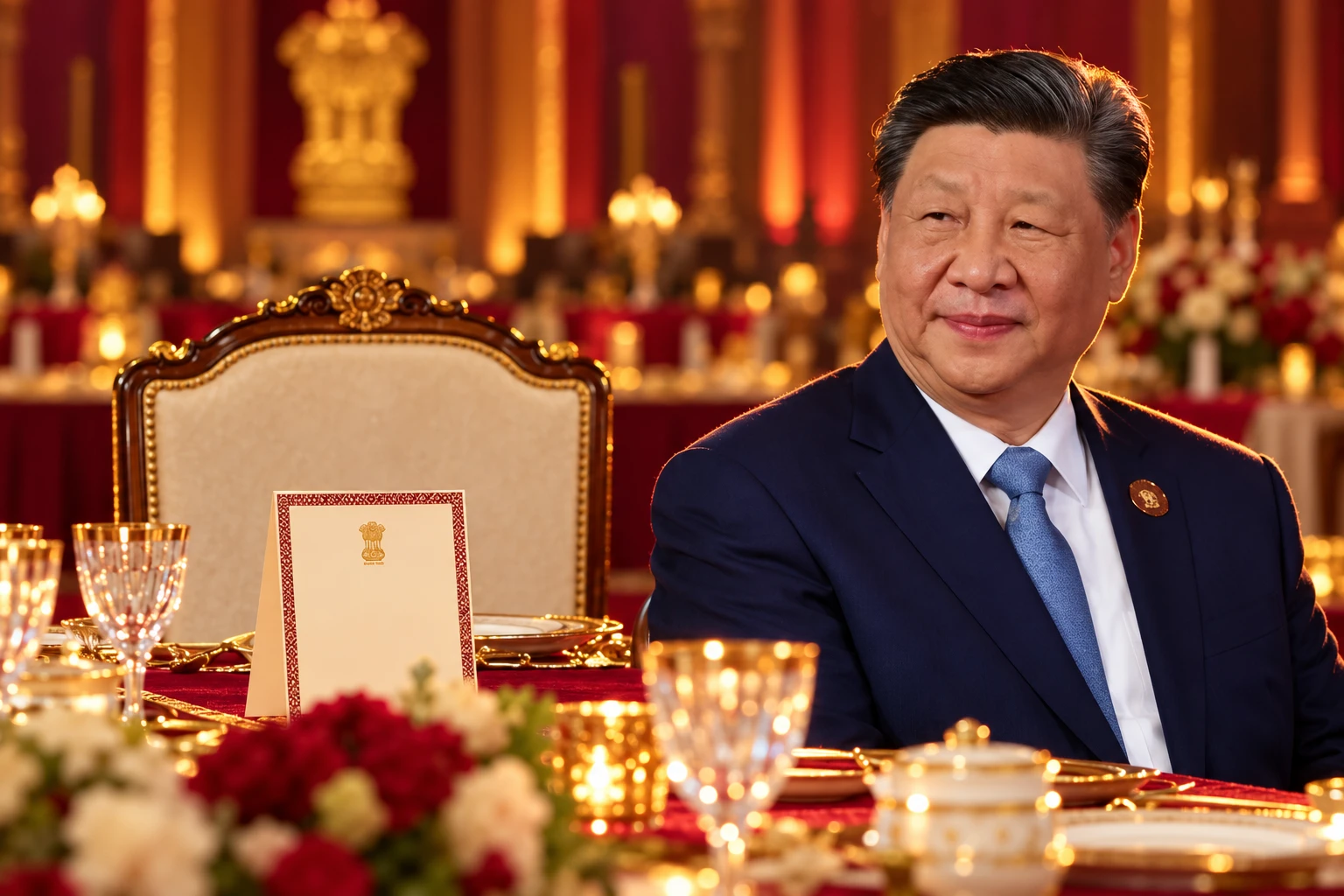
The Menu Sold Millets and Left Meat Off
The card was printed in English and Hindi with a traditional border. A note on Shree Anna called millets nutrient-rich grains that need fewer resources and support climate-resilient farming, and it reminded guests that the United Nations named 2023 the International Year of Millets. The kitchen put three millets into one state meal and kept meat and eggs off the plate.
WHAT THE BRICS GALA PLATE CARRIED
| Course | Dish | What arrived on the plate |
|---|---|---|
| Starter | Khandvi Mille-Feuille | Steamed gram-flour rolls with mustard, coconut and curry leaves, kesar mango, micro-greens, yoghurt dressing |
| Starter | Khumb Galouti | Pan-grilled mushroom kebabs with mint pearls on sheermal |
| Main | Paneer Lababdar | Cottage cheese in a shallot-and-tomato gravy |
| Main | Gucchi Marmik | Himalayan morels and asparagus with saffron, raisins and mamra almonds |
| Main | Carrot-bean poriyal | Carrots and beans in coconut oil and grated coconut |
| Broth | Thakkali belle saaru | Toor dal with tomatoes and curry leaves |
| Grain | Millet pulao | Basmati and pearl millet with spices |
| Dessert | Old Delhi fruit cream with jalebi; shahtoot phirni | Fruit and cream with a fried sweet; milk-and-rice pudding with mulberries and gold leaf |
Beetroot raita and assorted Indian breads sat with the mains. The drinks list was pomegranate juice and coconut water, written on the card as a stream of refreshing flavours.
THREE MILLETS ON ONE MENU
- Pearl millet: Cooked into the pulao with basmati.
- Sorghum: Baked into the Indian bread.
- Barnyard millet: Used in the dessert.
The Indian Council for Cultural Relations staged a BRICS Symphony performance of dancers and musicians from India and other member countries, billed as one rhythm and many cultures. The food branding was the same millet-and-regions pitch India used on this floor in 2023. The political reading of that pitch was new.
Rahul Gandhi Puts 80 Percent on the Plate
Leader of the Opposition Rahul Gandhi posted on the morning of September 13 that 80 percent of Indians are non-vegetarian, that Indian non-vegetarian food is delicious, and that so are his sister’s chole bhature. He put a photograph of the chickpea-and-bread plate next to the line.
For the record: 80% of Indians are non-vegetarian.
Indian non-vegetarian food is delicious. As are my sister's chole bhature. pic.twitter.com/8f6ziKjLan
— Rahul Gandhi (@RahulGandhi) September 13, 2026
Congress leader Dr Shama Mohamed shared the menu and wrote that she was not surprised Xi went back to his hotel, and that she would have done the same. Trinamool Congress MP Mahua Moitra asked whether she would be a bad MP if she told visiting leaders to skip the spread and send security to Karim’s for burrah kebabs. Congress leader Pawan Khera went further than a joke about dinner.
The BJP’s habit of imposing its dietary preferences on fellow Indians is already deeply problematic. Now, they have taken it a step further by imposing their own choices on dignitaries from across the world.
Pawan Khera, Congress leader, on X
Khera called India a rich, diverse, multi-cuisine country and asked why the government had chosen not to put that non-vegetarian kitchen in front of guests. Congress Seva Dal chief organiser Srinivas B.V. wrote that nobody gets to decide what an Indian plate should look like. Observer Research Foundation senior fellow Sushant Sareen called the fight a matter of preference and said he did not see a problem in serving vegetarian food.
The louder complaint from the other side was simpler: the Leader of the Opposition had picked the menu over the 45-page New Delhi Declaration the leaders adopted on September 12 under the theme Building for Resilience, Innovation, Cooperation and Sustainability. The summit had 11 member countries and 10 partner countries in the room. The argument that travelled was chole versus morels.
How Many Indians Eat Meat, According to Surveys
Gandhi’s 80 percent sits close to one official count and a long way from another, and the two counts are not measuring the same thing. Mix them and you get the culture fight the banquet walked into.
Pew Asked People What They Call Themselves
A Pew Research Center survey of 29,999 adults, interviewed face to face in 17 languages from November 17, 2019, to March 23, 2020, found that 39 percent of Indian adults say they are vegetarian and 61 percent say they are not. The same study found that 81 percent of Indian adults limit meat in some way, by dropping some meats, skipping meat on some days, or both.
Among religious groups, 92 percent of Jains, 59 percent of Sikhs, 44 percent of Hindus, 25 percent of Buddhists, 10 percent of Christians and 8 percent of Muslims called themselves vegetarian. Hindu vegetarianism is a regional fact, not a national uniform: 71 percent in the North, 61 percent in the Centre, 57 percent in the West, 30 percent in the South, 19 percent in the Northeast and 18 percent in the East. Hindus who expressed a favourable view of the Bharatiya Janata Party were more likely to call themselves vegetarian (49 percent) than other Hindus (35 percent). That last split is why a millet state dinner reads, to the opposition, as a party kitchen rather than a climate grain.
NFHS Counted Who Has Ever Eaten Meat
The National Family Health Survey-5, run in 2019-21 for the health ministry, asked women and men aged 15 to 49 whether they had ever eaten fish, chicken or meat. Some 16.6 percent of men said they never had, which means 83.4 percent had. Among women, 29.4 percent said they never had, which means 70.6 percent had. In the previous round, NFHS-4, 21.6 percent of men and 29.9 percent of women said they had never eaten those foods. Weekly eating rose as well: 57.3 percent of men and 45.1 percent of women in NFHS-5 said they ate fish, chicken or meat at least once a week.
THREE WAYS TO COUNT A NON-VEG INDIA
| Measure | Figure | What it captures |
|---|---|---|
| Rahul Gandhi, September 13, 2026 | 80 percent of Indians are non-vegetarian | A political round number, in the range of the male NFHS figure |
| Pew, adults 18+ | 39 percent vegetarian; 61 percent not; 81 percent limit meat | Self-description, plus partial abstinence |
| NFHS-5, ages 15-49 | 83.4 percent of men and 70.6 percent of women have eaten fish, chicken or meat | Ever-consumption, not weekly diet and not self-ID |
Gandhi’s figure is a fair headline for the male health-survey count. It is not Pew’s India, in which four adults in ten call themselves vegetarian and eight in ten still treat meat as a restricted food. A Gujarati khandvi starter and a Himalayan morel main can be regional showcases and still leave out the kitchens of Kerala, Bengal and the Northeast. That is the gap Moitra pointed at with Karim’s, and it is also the gap a single national vegetarian banquet cannot close.
Foreign Hosts Went Vegetarian for Modi First
An all-veg leaders’ dinner is not a one-off at Bharat Mandapam, and it is not a rule India invented only for guests who eat meat. When Modi, who does not eat meat, is the visitor, hosts have rebuilt the plate around him.
VEGETARIAN STATE DINNERS AROUND MODI
- June 22, 2023: The White House serves a plant-based state dinner for Modi, with marinated millet and grilled corn salad, stuffed portobello mushrooms, saffron risotto, and a rose-and-cardamom strawberry shortcake. A fish plate is available on request.
- September 2023: India serves G20 leaders an all-vegetarian millet dinner at Bharat Mandapam, with foxtail millet crisps, a jackfruit galette, Kerala red rice and barnyard millet pudding, hosted by President Droupadi Murmu.
- September 12, 2026: Modi hosts BRICS leaders in the same complex with pearl millet pulao, sorghum bread, barnyard millet in dessert, and no meat on the card.
The 2023 G20 meal was sold as a millet showcase in the UN’s millets year. The 2026 card repeats that line almost word for word. The White House dinner went plant-based because the guest of honour is vegetarian. The BRICS dinner went vegetarian because the host wanted the same branding on home ground. Courtesy when Modi travels becomes policy when he hosts, and the opposition hears policy as imposition.
Observer Research Foundation’s Sareen is right that a host may choose a vegetarian kitchen. Khera is right that India has other kitchens. Both can be true at the same banquet. The irony is that the millet plate was built to travel as soft power, and on September 12 it travelled as a domestic argument about who gets to define Indian food.
Putin Stayed for the Jalebi
The room was not empty. Putin sat through the meal, as did Indonesian President Prabowo Subianto, Ethiopian Prime Minister Abiy Ahmed Ali and Kazakhstan President Kassym-Jomart Tokayev, according to the official dinner photograph. Union ministers Amit Shah, Nirmala Sitharaman, Piyush Goyal, Ashwini Vaishnaw and Shivraj Singh Chouhan attended, along with Lok Sabha Speaker Om Birla and chief ministers including Yogi Adityanath, Devendra Fadnavis and Himanta Biswa Sarma.
WHO WAS AT THE TABLE
| Guest | Role | Dinner |
|---|---|---|
| Narendra Modi | Host, Prime Minister of India | Hosted |
| Vladimir Putin | President of Russia | Attended |
| Wang Yi | Foreign minister of China | Attended as Beijing’s representative |
| Xi Jinping | President of China | Did not attend |
| Sheikh Khaled bin Mohamed | Crown Prince of Abu Dhabi | Did not attend; left for home |
The leaders who wanted a photograph with the host got one at lunchtime diplomacy and, for most of them, at dinner. Xi got the bilateral note and a hotel corridor. Gandhi got the last word on the plate, which is a strange trophy for a summit that had just put out a 45-page declaration.
Xi left New Delhi on September 13. The ministry’s account of the meeting was already on the record. It did not mention dinner.

A CubeSat Will Age Whisky That Never Comes Home

A Charity Quote Cost Shia LaBeouf the FKA twigs NDA

Looker Turned a Model’s Body Into Ad Inventory

Infinity Ward Bets a Paid DMZ Will Stick This Time

Disney Sidesteps a Kimmel Renewal as Failla Cites Losses

How to Get Pre Boarding on Southwest – Skip the Line with These Tricks

False AI Intel Nearly Put US Crews on a Chinese Ship

Tim Cook’s $4.6 Trillion Apple Still Runs on One Phone

Dunes Air Sues Nora Fatehi Over Its Luxury Jet

OpenAI Posts a Navier-Stokes Proof Clay Has Not Touched
-
 TRAVEL3 years ago
How to Get Pre Boarding on Southwest – Skip the Line with These Tricks
-
 NEWS1 month ago
False AI Intel Nearly Put US Crews on a Chinese Ship
-
 BUSINESS2 months ago
Tim Cook’s $4.6 Trillion Apple Still Runs on One Phone
-
 ENTERTAINMENT1 month ago
Dunes Air Sues Nora Fatehi Over Its Luxury Jet
-
 NEWS1 month ago
OpenAI Posts a Navier-Stokes Proof Clay Has Not Touched
-

 LIFESTYLE3 years ago
How Often Do You Have to Change a Monkey’s Diaper? The Truth About Pet Monkeys
-

 NEWS1 month ago
Australia Treats Cloud Software Payments as Taxable Royalties
-

 LIFESTYLE3 years ago
How Long Does It Take for Armpit Hair to Grow? The Stages of Hair Growth and How to Shave It