
BUSINESS
Samsung India Cuts TV Jobs as Its Chip Unit Booms
Samsung India is cutting 80-100 TV and appliance executives as memory prices more than doubled, even as its chip unit booked almost all group profit.

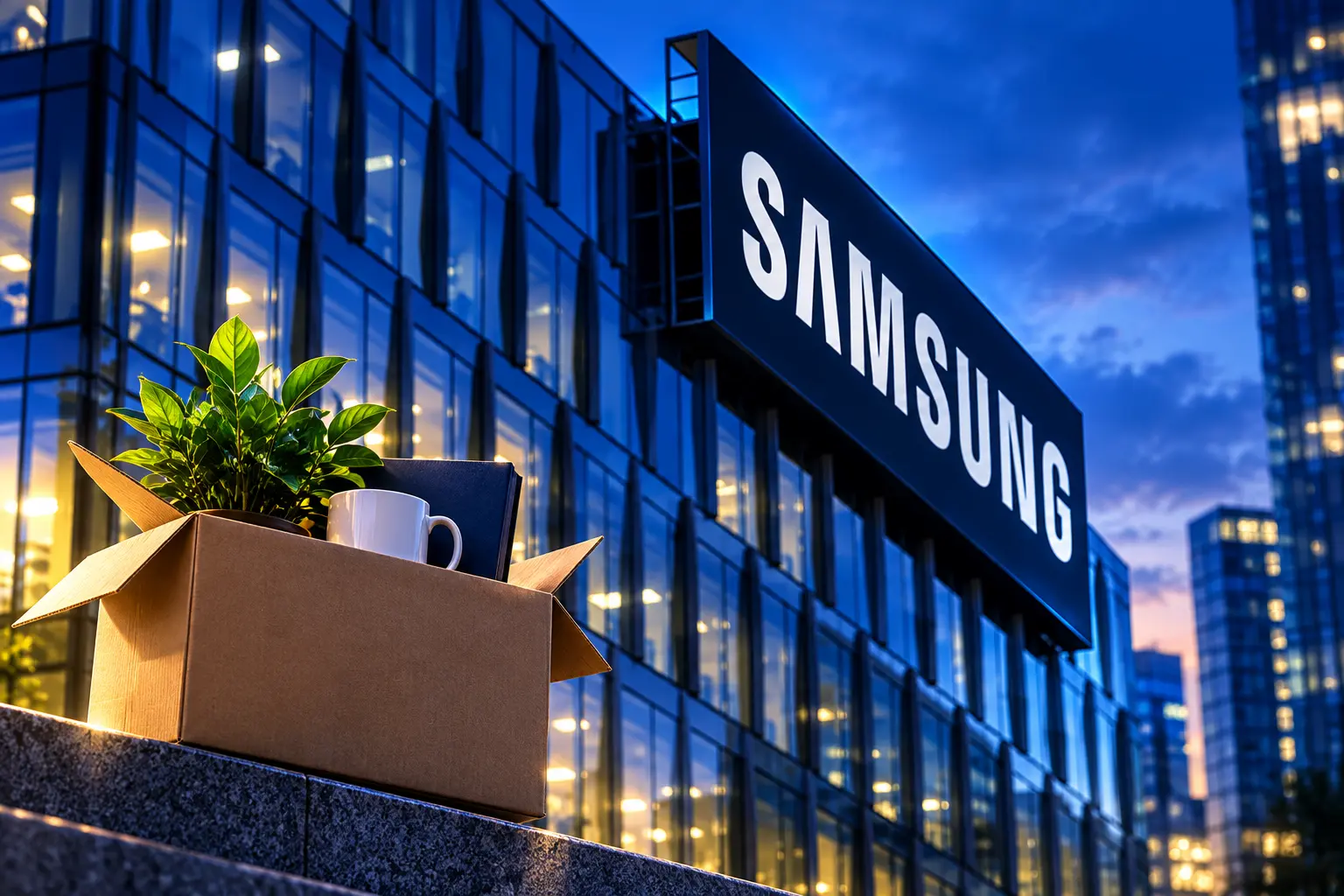
Samsung India has asked 80-100 television and home-appliance executives to leave as memory prices more than doubled, even as its chip unit posted a record profit. The cuts have gone out in small daily batches in early September, and some staff were told to go without serving notice.
The people losing their jobs sell TVs, air conditioners and other home goods in India. Almost all of the group’s profit last quarter sat in the semiconductor division, which is one of three firms that pulled wafers toward AI memory and left everyday chips short.
Eighty to a Hundred Letters Went Out in Batches
Industry executives said the exits cover director-level officials and team leads at headquarters, plus branch and area managers. Samsung India has not issued a public confirmation. The domestic electronics sales team, not counting the much larger smartphone force, has about 550-600 executives.
One of those executives said up to 25% of sales and marketing staff in the electronics business, including off-roll workers hired through agencies, could be affected. The company is offering three months’ salary and an extra month’s pay for each year of service.
WHAT WE KNOW
- Who is out: About 80-100 executives in televisions and home appliances have been asked to leave in batches.
- The pay-off: Severance is three months’ salary plus one extra month for each year of service.
- The offices: Several branches are being merged, including Ranchi with Patna, Delhi with Gurgaon, and Punjab with Chandigarh.
- Phones, for now: The smartphone organisation has been kept out of this round because management wants a Diwali sales rebound.
WHAT IS UNCONFIRMED
- The 25% figure: That share of electronics sales and marketing is an estimate from people briefed on the plan, not a company notice.
- A second round: Executives said another cut could come after Diwali. It has not been announced.
- Headcount: Samsung has not stated how many people it employs in the India sales network or how many letters it intends to issue.
Home appliances are the second-largest category after phones and contributed 11% of Samsung India sales. Filings with the Registrar of Companies show India revenue of about ₹1.1 trillion in FY25, up 12%, with net profit of ₹11,287 crore, up 38%. FY26 numbers are not out. A strong local year did not stop this round of letters.
The Chip Unit Took Nearly All Group Profit
For the quarter ended 30 June 2026, Samsung Electronics’ second-quarter results announcement put consolidated revenue at KRW 171.5 trillion, up 28% from the prior quarter and 130% from a year earlier, and operating profit at KRW 89.5 trillion. The Device Solutions chip division posted KRW 127.5 trillion in sales and KRW 89.2 trillion in operating profit, a 70% margin. That left KRW 0.3 trillion of operating profit for phones, TVs, appliances, displays and Harman combined.
The Device eXperience unit, which houses mobile, TVs and home appliances, posted KRW 48.0 trillion in sales, down 9% quarter on quarter, and an operating loss of KRW 0.8 trillion. Mobile eXperience and Networks recorded KRW 33.2 trillion in sales and a KRW 0.7 trillion loss. Visual Display and Digital Appliances recorded KRW 14.5 trillion in sales and a slight operating loss. The Q2 2026 earnings call slides show memory sales of KRW 120.8 trillion inside the chip division, with record bit shipments of both DRAM and NAND and a record share of sales from servers.
SAMSUNG Q2 2026, BY DIVISION
| Unit | Sales (KRW) | Operating profit (KRW) | Margin |
|---|---|---|---|
| Group | 171.5 trillion | 89.5 trillion | 52.2% |
| Device Solutions (chips) | 127.5 trillion | 89.2 trillion | 70% |
| Device eXperience (phones, TVs, appliances) | 48.0 trillion | 0.8 trillion loss | -2% |
| Mobile eXperience and Networks | 33.2 trillion | 0.7 trillion loss | – |
| Visual Display and Digital Appliances | 14.5 trillion | Slight loss | – |
A year earlier the chip division’s sales were KRW 27.9 trillion. Group operating profit was up 1,814% year on year. The India letters are a local payroll answer to a cost shock that the parent already printed, in public, as a record memory boom on one side of the ledger and a device loss on the other.
Why Samsung India’s TV Staff Are Paying for HBM
High-bandwidth memory, stacked beside AI processors, pays more per wafer than the DRAM that goes into TVs, phones and PCs. Samsung, SK hynix and Micron have moved capacity toward those server parts. Conventional DRAM and NAND used in living-room electronics then ran short, and contract prices rose. India executives said memory chip prices more than doubled, which squeezed margins on sets the local sales force is paid to move.
Samsung did not need a chatbot to take a branch manager’s work. It needed its own memory prices to make a television harder to sell at a profit. The phone division is paying those new prices too, including for chips that sit a few reporting lines away from the unit that just raised them. Other phone makers face the same bill with no chip division to net it against.
While revenue grew year-on-year on solid sales of the Galaxy S26 series and strong Galaxy A series momentum, earnings declined due to elevated component cost pressures across the industry.
Samsung Electronics, second-quarter 2026 results, Suwon
Daniel Araujo, vice president for strategic planning in Mobile eXperience, told the earnings call that memory shortages cut smartphone market volume year on year, mainly in the price-sensitive mass segment, and that combined MX and network operating profit turned to a KRW 0.7 trillion loss. He said annual smartphone shipments are expected to decline as demand softens and memory prices stay high. TrendForce has already counted server DRAM prices jumping 270 percent in 2026, after a 64% rise in the second half of 2025, which is the same squeeze showing up as fewer Indian sales jobs.
Consumer DRAM Is the Product Samsung Stopped Feeding
TrendForce’s 7 September note put DRAM industry revenue of $154.73 billion in the second quarter, up 59.5% from the prior quarter. Bit shipments grew only modestly. Price did the work. Samsung led with $60.98 billion of DRAM revenue, up 63.4% quarter on quarter, and a 39.4% share after an early move into HBM4. SK hynix took $38.59 billion and 24.9%. Micron took $36.0 billion and 23.3%.
DRAM SUPPLIERS, SECOND QUARTER 2026
| Supplier | DRAM revenue | Share | Change QoQ |
|---|---|---|---|
| Samsung | $60.98 billion | 39.4% | +63.4% |
| SK hynix | $38.59 billion | 24.9% | +37.9% |
| Micron | $36.0 billion | 23.3% | +65.5% |
| Industry | $154.73 billion | 100% | +59.5% |
Conventional DRAM contract prices are still rising, though more slowly: TrendForce projects 13-18% growth in the third quarter, because PC and phone buyers cannot absorb another spike like the last two. Consumer DRAM is expected to post the strongest of those gains, because suppliers have cut that supply on purpose. TrendForce also estimates that HBM and registered DIMMs together will take 51% of DRAM bit supply in 2026, and that HBM will take about 22% of the three suppliers’ DRAM wafer input this year, up from 18% at the end of 2025 and on the way to 30% in 2027.
Counterpoint Research puts a 16GB DRAM pack for a smartphone at about $42 in the second quarter of 2025 and about $181 a year later. Korea International Trade Association figures show South Korea shipped fewer DRAM units used in AI chips, including HBM and LPDDR, from May to July, 681.79 million down to 591.74 million, while export value rose from $11.43 billion to $13.55 billion and the average unit price rose from $16.76 to $22.90. Less volume, more money. That is the trade the chip unit made, and it is the bill the TV sales team is now on.
Ranchi Merges With Patna as Offices Combine
The payroll cut is running with a smaller branch map. Several offices are being folded together, which has made some area-manager roles redundant.
THE BRANCHES BEING COMBINED
- Jharkhand and Bihar: Ranchi is being merged with Patna.
- The capital region: Delhi is being merged with Gurgaon.
- The north: Punjab is being merged with Chandigarh.
Those are sales posts, not factory lines. Samsung makes multiple products in India through SIEL, and its southwest Asia headquarters is in Haryana, but the people named in the letters are the ones who run dealer networks and local teams. A weaker rupee and higher raw-material costs were also cited by people briefed on the plan. Memory was the cost they named first. Samsung pushed hard into air conditioners this year and did not get the premium foothold it wanted, which left the appliance P&L with little room once chip and material bills rose.
The Smartphone Team Gets a Diwali Reprieve
Phones are still the main India business, and executives said there will be no immediate cuts there. One of them called it the company’s bread and butter and said management expects a rebound during Diwali, after which the structure “might get evaluated later.” The same people said a second round in TVs and appliances can happen after the festival. India smartphone volumes have already fallen 11-12%, so the reprieve is a bet on festive sell-through, not a claim that the cost shock has passed.
Samsung’s memory outlook for the second half of 2026 still centres on servers, agentic AI and HBM, and it said growth in server DRAM, enterprise SSDs and HBM should keep the market undersupplied even with some cooling in mobile and PCs. Visual Display will lean on sports-season demand and Samsung TV Plus ads. Digital Appliances will lean on AI-labelled products and a wider channel mix. None of that restores the cheap conventional memory the India sales network was built around.
The next test is Diwali phone sell-through. If that rebound does not arrive, the same cost logic that hit television and appliance managers will be applied to the team that was spared in September, while the chip division has already said the shortage does not end with the festival.

A CubeSat Will Age Whisky That Never Comes Home

A Charity Quote Cost Shia LaBeouf the FKA twigs NDA

Looker Turned a Model’s Body Into Ad Inventory

Infinity Ward Bets a Paid DMZ Will Stick This Time

Disney Sidesteps a Kimmel Renewal as Failla Cites Losses

How to Get Pre Boarding on Southwest – Skip the Line with These Tricks

False AI Intel Nearly Put US Crews on a Chinese Ship

Tim Cook’s $4.6 Trillion Apple Still Runs on One Phone

Dunes Air Sues Nora Fatehi Over Its Luxury Jet

OpenAI Posts a Navier-Stokes Proof Clay Has Not Touched
-
 TRAVEL3 years ago
How to Get Pre Boarding on Southwest – Skip the Line with These Tricks
-
 NEWS1 month ago
False AI Intel Nearly Put US Crews on a Chinese Ship
-
 BUSINESS2 months ago
Tim Cook’s $4.6 Trillion Apple Still Runs on One Phone
-
 ENTERTAINMENT1 month ago
Dunes Air Sues Nora Fatehi Over Its Luxury Jet
-
 NEWS1 month ago
OpenAI Posts a Navier-Stokes Proof Clay Has Not Touched
-

 LIFESTYLE3 years ago
How Often Do You Have to Change a Monkey’s Diaper? The Truth About Pet Monkeys
-

 NEWS1 month ago
Australia Treats Cloud Software Payments as Taxable Royalties
-

 LIFESTYLE3 years ago
How Long Does It Take for Armpit Hair to Grow? The Stages of Hair Growth and How to Shave It