
NEWS
The Moon Hides Venus by Day and Lines Up at Dusk
On September 14 the Moon covers Venus in daylight for much of the Old World, then a low western line of Moon, Venus, Spica and Mercury tests northern horizons.

The crescent Moon, Venus, Spica and Mercury form a line after sunset on September 14, with Mercury only 2° high. From 40° N, 90° W, that fourth light sets less than 40 minutes after the Sun. Most people will keep three.
Monday’s geometry already did more than draw a line. At 11:00 UT the Moon passed 0.5° north of Venus and, along a path across Europe, Africa, the Middle East and Asia, covered the planet in daylight. North America missed that hiding. It gets the low western chain instead.
Four Lights Line Up Only If Mercury Holds
Sunset at 40° N, 90° W is 7:10 P.M. local. Twenty minutes later, Venus at magnitude -4.8 stands more than 5° up in the west and is the easy find. The waxing crescent, 17% lit at 10 P.M. from that same spot, sits just over 6° to Venus’s upper left, near the Virgo-Libra border. Spica, magnitude 1.0, lies another 9.1° to Venus’s lower right and needs a slightly darker sky. Mercury, magnitude -0.5, hugs the horizon at 2° and may need binoculars.
THE LINE FROM 40° N, 90° W
| Object | Magnitude | 20 min after sunset | Where it sits |
|---|---|---|---|
| Moon | 17% crescent | Highest of the four | Upper left, Virgo-Libra border |
| Venus | -4.8 | More than 5° high | Just over 6° lower right of the Moon |
| Spica | 1.0 | Needs a darker sky | 9.1° lower right of Venus |
| Mercury | -0.5 | 2° high | Bottom of the line, binoculars likely |
If Mercury is still up, the four run upper left to lower right, Moon at the top and Mercury at the bottom. After Mercury drops, the Moon, Venus and Spica stay aligned until Spica and then Venus set around 8:15 P.M. local daylight time. Moonset is 8:37 P.M. Moonrise was 10:30 A.M. Sunrise was 6:40 A.M.
A flat western horizon is the real ticket, a hill or a roof if trees or houses block the first few degrees. Guides that list four objects without that catch are selling a sport most backyards cannot play. People who go out for the line already know the practical cut: take Venus and the Moon, because anything that close to the Sun is usually lost in dusk.
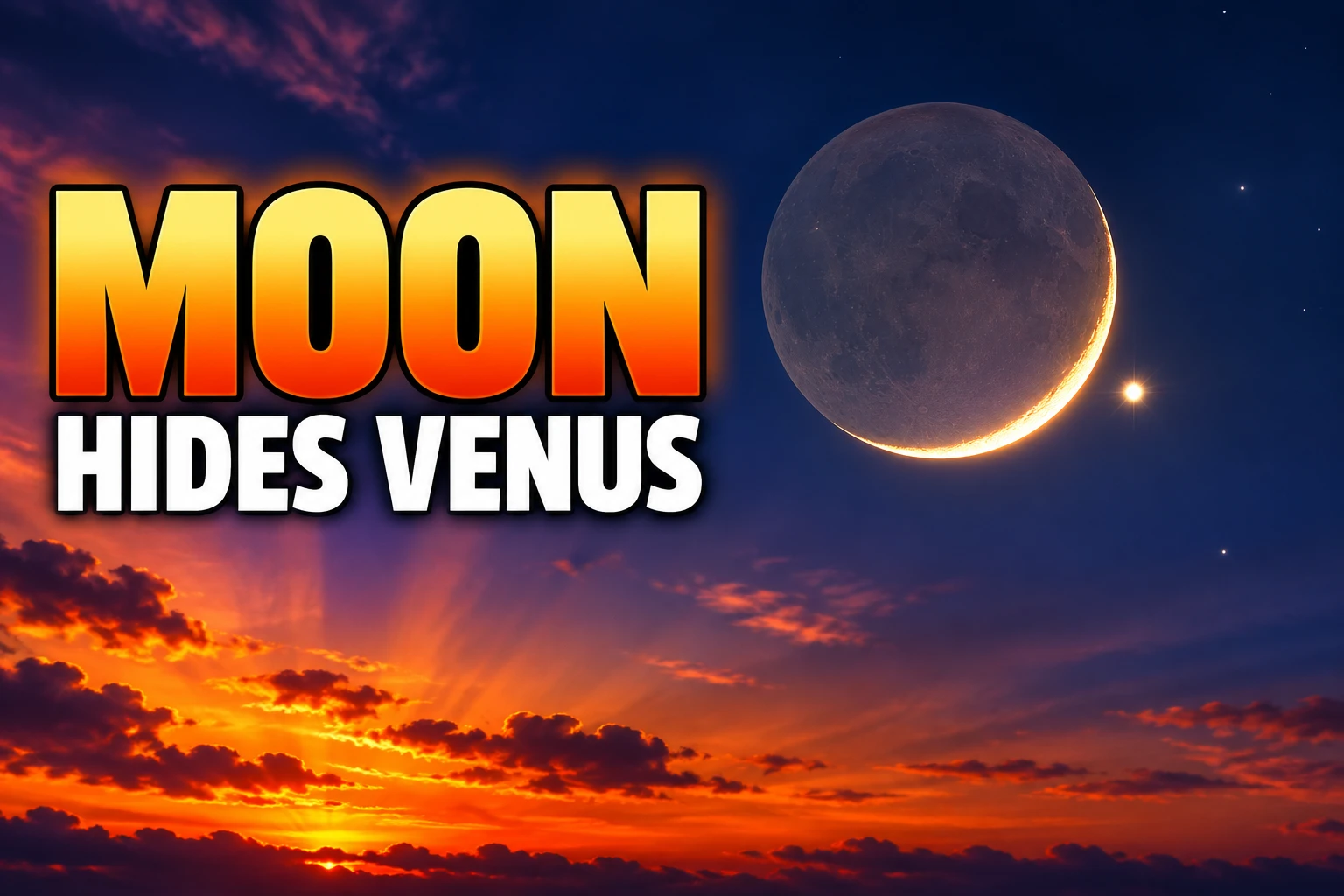
The Moon Already Covered Venus in Daylight
The close pass at 7 A.M. EDT is the same 11:00 UT appulse. SkyEye’s 2026 Venus file lists the planet 0.5° south of the Moon at that hour and flags an occultation. From the Americas the pair is below the horizon then, so the hiding is not on the menu. From the path, the Moon’s dark limb moves over Venus’s own thin crescent.
NASA’s image note on the June 17 daylight event, photographed from the Mary W. Jackson Headquarters building in Washington by Joel Kowsky, lists three lunar occultations of Venus in 2026: June 17 over the United States and parts of Canada, September 14 from parts of Asia, Africa, Europe and western Russia, and November 7 from southern South America.
A lunar occultation occurs when the Moon moves directly in front of another celestial object from our viewpoint on Earth, briefly hiding it from sight.
NASA, Lunar Occultation of Venus image article
On June 17, skywatchers enjoyed a rare event: a daytime lunar occultation of Venus.
If you missed it, there will be another opportunity to see Venus disappear behind the Moon tomorrow, Sept. 14, for parts of Asia, Africa, Europe, and western Russia.
🔗 https://t.co/XGNlsyhngq pic.twitter.com/qm6TbzfLUp
— NASA Marshall (@NASA_Marshall) September 13, 2026
On the path, Venus is about 37 arcseconds across and about 29% lit, a tiny crescent next to the Moon’s much larger one. The Moon takes a little more than a minute to cover that sunlit sliver. At occultation time the Moon itself is about 12% lit, thinner than the 17% evening crescent seen later from the American Midwest.
THE 2026 VENUS OCCULTATIONS
- June 17, 2026: Daylight hiding for the contiguous United States and parts of Canada, photographed from NASA Headquarters in Washington.
- September 14, 2026: Path across Europe, Africa, the Middle East and Asia; North America is out because the pair is below the horizon.
- November 7, 2026: Final Venus hiding of the year, over southern South America and a remote stretch of the southeastern Pacific.
The Al Khatim Astronomical Observatory in Abu Dhabi, run by the International Astronomical Center, timed Monday’s event in local clocks. Covering began at 2:34:59 p.m. Venus took 2 minutes 21 seconds to vanish, stayed hidden for 1 hour 24 minutes, and was back at 4:01 p.m. The UK sits on the western edge of the band, so only the reappearance is in play, and it happens very low in the south-east after moonrise.
Why Northern Evenings Lose the Innermost Planet
Mercury came through superior conjunction on August 27 at 17:00 UT and is only 18 days into this evening showing. It does not reach its greatest eastern elongation of 25.2° until October 12 at 10:00 UT, when SkyEye lists it at magnitude -0.01. On September 14 it is already bright at -0.5, and still a horizon object from mid-northern latitudes because the autumn evening ecliptic lies almost flat on the west.
SkyEye’s 2026 Mercury notes are blunt about who this showing is for. The late January to early March evening window is the one that lifts Mercury for northern temperate observers. The late August to early November window is the one that favours the south. On September 26 at 08:00 UT Mercury passes 0.9° north of Spica. On October 7 it stands 5.1° north of Venus, then hits that October 12 peak and heads toward inferior conjunction on November 4.
So the “connect four” pitch is a northern tease. The same altitude that makes Mercury a 2° binocular target from Illinois or Missouri is a much easier catch from Sydney or Auckland, where the evening ecliptic stands steeper. A clean sea horizon in the Southern Hemisphere turns Monday’s line into a casual photograph. A treeline in the Midwest turns it into a miss.
Venus Peaks in the West on September 18
The planet that makes the line readable is not Mercury. Venus is already at magnitude -4.8, the figure EarthSky assigns to greatest brilliancy at 23 UTC on September 18. That peak is a mix of a large apparent disk and a still-wide crescent, not a full face. Greatest eastern elongation was earlier, on August 15, at 45.9° and magnitude -4.32. Inferior conjunction follows on October 24 at 04:00 UT, when Venus switches from evening to morning sky.
VENUS THIS WEEK
- Evening magnitude: -4.8 on September 14, matching the listed peak on September 18.
- Telescope view: A waning crescent about 37 arcseconds across around the occultation.
- Northern limit: SkyEye says northern temperate observers lose the evening star during September, while the south keeps it into October.
- Next hiding: November 7, 1.0° north of the Moon, for southern South America.
Tony Rice, a NASA Ambassador, put the evening pairing in plain terms: look west shortly after sunset for the slender crescent pointing the way to Venus. Through a telescope the planet is a crescent too, around a quarter lit. That is why the daytime occultation was a two-crescent stack for anyone who could find both disks in a blue sky.
Spica Anchors the Chain From 250 Light-Years
Spica is the only star in the advertised four. It is Alpha Virginis, Virgo’s brightest, about 250 light-years out, a close spectroscopic binary whose two hot B-type stars orbit in 4.0145 days and cannot be split in a backyard telescope. Magnitude 1.0 is modest next to Venus at -4.8, which is why it pops later than the planet as twilight deepens.
On September 2, Venus itself passed 1.5° south of Spica. On September 13 the Moon, Venus and Spica made a short-lived triangle after sunset, with Mercury already a 2° fringe object that vanished about 10 minutes later. Monday’s line is that triangle pulled straight, then clipped at the bottom by the horizon. Miss Mercury and the photograph is still a Moon-Venus-Spica chain, which is the view most western windows will actually deliver.
Dust Along the Ecliptic Glows Before Dawn
Once the western line is gone, the other September 14-15 sky is in the east, before sunrise on the 15th. The waxing evening Moon has left the predawn sky, which is the window the autumn zodiacal light needs. The glow is sunlight reflected by dust particles between the Sun and Earth, shot by Yuri Beletsky at ESO’s La Silla Observatory as a triangular band along the ecliptic.
FALSE DAWN, SEPTEMBER 15
- When: The few hours before sunrise, from a dark site with little artificial light.
- Where: East, along the ecliptic through the head of Leo, then Cancer, Gemini and Taurus.
- Shape: Wide at the base, narrowing toward a point in Gemini or Taurus.
- Limit: The September 23 equinox at 00:06 UTC (8:06 p.m. EDT on September 22) is the seasonal peak, but a bright Moon near month’s end will wipe the glow, so this Moon-free morning is the clean shot.
About two hours before sunrise, Leo’s head is just coming up. Swing from lower left to upper right along that constellation line. The pyramid is faint. City skyglow kills it. A rural eastern horizon is the whole method.
Southern Horizons Keep the Whole Line Higher
Altitude, not enthusiasm, decides who gets four lights. City-by-city evening figures for the Moon and Venus on September 14 show the split without any extra poetry.
MOON AND VENUS AFTER SUNSET, SEPTEMBER 14
| Place | Local time | Moon altitude | Venus altitude | Separation |
|---|---|---|---|---|
| New York | 7:36 P.M. EDT | 8° | 6° | 5.7° |
| Sydney | 7:09 P.M. AEST | 21° | 23° | 2.2° |
| Auckland | 7:37 P.M. NZST | 20° | 23° | 2.9° |
| Singapore | 8:13 P.M. SGT | 16° | 17° | 0.5° |
| New Delhi | 7:11 P.M. IST | 10° | 10° | 0.6° |
| London | Evening pair | Not visible | Not visible | – |
New York’s 8° Moon is a treeline problem. Sydney’s 21° Moon is a postcard. Singapore and New Delhi, still on the occultation side of the planet, see the pair much closer together in the evening, 0.5° and 0.6°, because they are looking after the 11:00 UT appulse has begun to open again. London’s evening pairing does not clear the horizon.
Mercury’s clock is still running toward October 12. Southern observers who skip Monday still have weeks of a climbing innermost planet, with a 0.9° Spica pairing on September 26. Mid-northern observers who miss the 2° window on September 14 do not get a second easy evening shot in this apparition. They get Venus, a crescent, and a first-magnitude star, which is still a line, just not four.

Looker Turned a Model’s Body Into Ad Inventory

Infinity Ward Bets a Paid DMZ Will Stick This Time

Perseverance Maps Three Fluids Through Jezero’s Carbonate Rim

Verity Beats Tom Cruise as October Movies Crowd Theaters

Ulefone Omni Sentinel Puts Idle Armor Phones on Watch

How to Get Pre Boarding on Southwest – Skip the Line with These Tricks

Tim Cook’s $4.6 Trillion Apple Still Runs on One Phone

Dunes Air Sues Nora Fatehi Over Its Luxury Jet

Australia Treats Cloud Software Payments as Taxable Royalties

OpenAI Posts a Navier-Stokes Proof Clay Has Not Touched
-
 TRAVEL3 years ago
How to Get Pre Boarding on Southwest – Skip the Line with These Tricks
-
 BUSINESS1 month ago
Tim Cook’s $4.6 Trillion Apple Still Runs on One Phone
-
 ENTERTAINMENT4 weeks ago
Dunes Air Sues Nora Fatehi Over Its Luxury Jet
-
 NEWS4 weeks ago
Australia Treats Cloud Software Payments as Taxable Royalties
-
 NEWS4 weeks ago
OpenAI Posts a Navier-Stokes Proof Clay Has Not Touched
-

 LIFESTYLE3 years ago
How Often Do You Have to Change a Monkey’s Diaper? The Truth About Pet Monkeys
-

 LIFESTYLE3 years ago
How Long Does It Take for Armpit Hair to Grow? The Stages of Hair Growth and How to Shave It
-

 NEWS4 weeks ago
China’s Supreme People’s Court Gives AI Apps Safe Harbor