
BUSINESS
Record Diesel Prices Pay the Refiners Still Able to Run
U.S. diesel hit a record $6.23 a gallon as Gulf Coast refiners run full tilt and collect the $100 cracks two wars created.

The AAA motor club put the U.S. national average diesel price of $6.23 a gallon on Sept. 14, the highest figure in its record, as two wars keep the fuel scarcer than the crude used to make it. A year earlier the same average was $3.69. Regular gasoline, by comparison, stood at $4.32.
Oil traders like to say you cannot print barrels. The machines that still turn barrels into diesel are printing something else: a margin so wide that every plant outside the war zone is running as hard as the pipes allow, and the people who burn the fuel are the ones paying for the scarcity.
THE SQUEEZE IN FOUR FIGURES
- Pump record: AAA diesel averaged $6.23 a gallon on Sept. 14, up 33 cents from $5.90 a week earlier.
- Plant rate: U.S. refineries ran at 97.8 percent of capacity in the week ending Sept. 4, the Energy Information Administration said.
- Tank cushion: Distillate stocks were 13 percent under the five-year average even after a 2.1 million-barrel build.
- Refiner take: The diesel crack, the gap between crude and the finished fuel, has been running near $100 a barrel.
Those four numbers describe one market. Crude can still be drilled, shipped around Hormuz on escorted tankers, or pulled from a cavern. Diesel has to come out of a hydrocracker that takes years to build and a few hours of drones to idle.
The Diesel Printer Is a Working Refinery
Diesel is the world’s most used refined oil product, close to 30 percent of total oil demand, the International Energy Agency said in its September Oil Market Report. Trucking takes about half of that barrel. Rail freight, construction, factories, mines and farms take the rest. China and India lean on it more than the United States, which burns about twice as much gasoline as diesel. The shortage still showed up in American politics. National Economic Council Director Kevin Hassett called the cost of diesel “a major concern for us.”
The industry already has a nickname for what plants do when that concern turns into a price. They go into “max diesel” mode, tweaking units to squeeze a couple of extra percentage points of distillate from each barrel. The trade-off is usually jet fuel, the product refiners spent the summer protecting for airlines. The diesel market is about 29.5 million barrels a day. Jet fuel is under 8 million. Small shifts move jet. They barely dent diesel.
U.S. Energy Secretary Chris Wright put the bind in plain language after diesel marched toward $6. “The bigger problem is refining capacity,” he said, adding that diesel is a harder case than gasoline. Wright said the administration wants to expand American plants and is pushing Venezuela to restore some of its own. None of that adds a hydrocracker this winter.
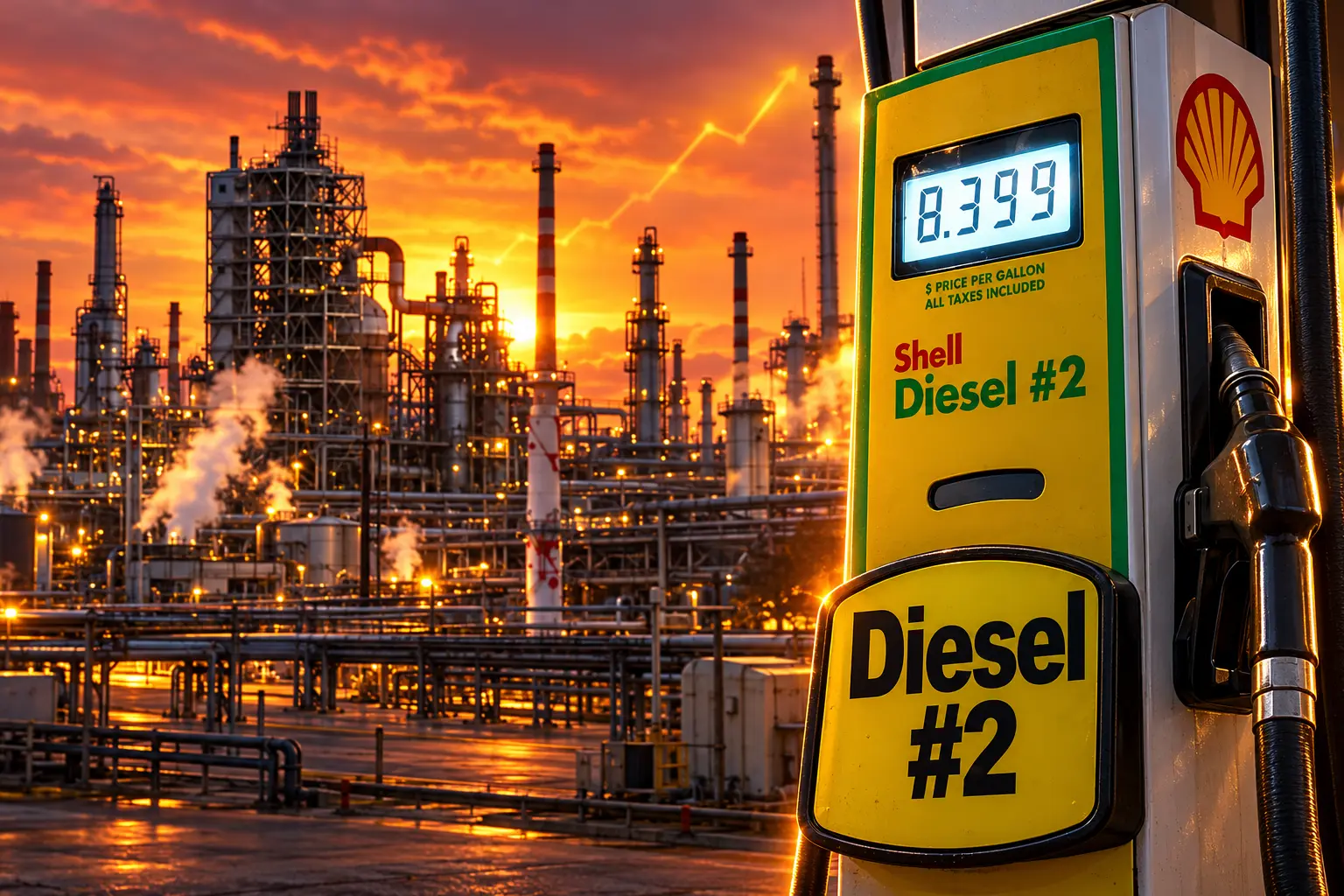
Why Diesel Now Costs More Than Crude
The IEA said U.S. diesel and gasoil prices pushed through $200 a barrel in early September, 94 percent above their level before the United States and Israel struck Iran on Feb. 28. ICE Brent was about $105 a barrel at the time the agency wrote, up $21 from the start of August and 45 percent above pre-war levels. North Sea Dated crude averaged $91.00 in August, then jumped to $113.48 on Sept. 9. The fuel made from the barrel outran the barrel.
Al Salazar at Enverus Intelligence described the arithmetic in August, when diesel near $180 a barrel against $85 West Texas Intermediate left refiners a roughly $100 a barrel diesel crack. “This is shortage pricing, plain and simple,” he wrote. “It is the market’s way of rationing a product that physical capacity can no longer supply at the rate demand requires.” European diesel cracks later cleared $100 a barrel as well, the IEA said, and Atlantic Basin refining margins set records in August.
The older yardstick, the 3-2-1 crack spread, treats three barrels of crude as two of gasoline and one of distillate. That gauge has been running around $65 a barrel this month. From 1985 to 2021 it averaged about $10.50. Even in 2004-2008, when Chinese oil demand exploded, it never cleared $30. Goldman Sachs more than doubled its 2027 forecast for U.S. diesel margins to $63 a barrel from $27, and for Europe to $49 from $19, on the view that lost plants do not come back on a banker’s calendar.
Amrita Sen, founder of Energy Aspects, told an interviewer the cap on crude “has always been refining margins,” and that the market is now in “an upward spiral between crude and products.” West of Suez, she said, refiners still have room to pay up for barrels. East of Suez, freight into Hormuz and Dubai’s steep backwardation are already forcing run cuts because the crude cannot get in, not because diesel demand is weak.
Gulf and Russian Exports Fell 1.6 Million Barrels
The IEA’s September report is blunt about where the missing diesel went. Gulf countries’ net diesel and gasoil exports averaged 390,000 barrels a day in August, just over a quarter of their pre-war level, because flows through the Strait of Hormuz stayed tightly constrained. Attacks on Russia’s refining system, and a near halt in product exports after Ukraine stepped up its strikes, added to the hole. Combined, Gulf and Russian net diesel and gasoil exports in August were 1.6 million barrels a day lower than in February, when those two sources made up almost 45 percent of global seaborne trade.
WHAT THE IEA COUNTED IN AUGUST
- Gulf oil exports: About 13 million barrels a day, nearly half the pre-war rate.
- Products and LPG: Almost 60 percent, or 3.7 million barrels a day, below February.
- Gulf diesel and gasoil: 390,000 barrels a day net, a little more than a quarter of the old pace.
- World runs: 81.4 million barrels a day, up 960,000 from July but 4.2 million below a year earlier.
Salazar’s August tally of idle hardware sits behind those trade numbers: about 5 million barrels a day of Russian refining capacity offline after Ukrainian strikes, and another 2 million barrels a day shuttered in the Middle East. Valero Chief Operating Officer Gary Simmons told investors on the company’s July 30 call that the wars in Eastern Europe and the Middle East had shut refineries with about 5 million barrels a day of capacity. Andy Lipow, president of Lipow Oil Associates, put the lost diesel at nearly 8 percent of world supply. Moscow extended a diesel export ban through Sept. 30 to protect its own pumps.
Saudi export plants inside the Gulf have stayed largely idle, with only limited use of tanker runs that avoid the strait. Kuwait, the United Arab Emirates and Iraq have used those routes more. The IEA said crude losses from the Gulf had narrowed to just under 45 percent, helped by bypass pipelines and U.S. military escorts, while refined products did not get the same relief. Wright said a seven-day average of just under 11 million barrels a day of oil and products was moving on the water through the strait, with another 3 million to 5 million barrels a day on bypass lines. That is a crude story. It is not a diesel story.
U.S. Plants Are Already Running Near Full Tilt
Every unused point of capacity in Texas and Louisiana is now a bid for the world’s missing barrel. The EIA said refiners ran U.S. plants at 97.8 percent in the week ending Sept. 4, processing 17.6 million barrels a day, up 91,000 from the week before. Distillate output rose to 5.3 million barrels a day. The prior week, ending Aug. 28, utilization printed 98 percent. There is almost no slack left to absorb a hurricane, a fire or another drone night in the Urals.
The agency’s weekly report, released Sept. 10, also showed why the pump does not care that crude tanks look ordinary. Commercial crude inventories were 424.1 million barrels, in line with the five-year average. Distillate tanks told a different story.
EIA WEEK ENDING SEPT. 4
| Gauge | Latest | Context |
|---|---|---|
| Refinery utilization | 97.8% | Four-week average 97.6% |
| Distillate production | 5.3 million b/d | Up from 5.1 million the prior week |
| Distillate stocks | 106.3 million barrels | 13% below the five-year average |
| On-highway diesel (EIA, Sept. 7) | $5.967 a gallon | Up 37 cents in a week, $2.20 from a year earlier |
| WTI crude (Sept. 4) | $92.69 a barrel | Up $8.12 in a week |
Distillate inventories rose 2.1 million barrels in that week, a build the market had not been expecting, and still sat 13 percent under the seasonal five-year line. The EIA’s weekly stock table put the U.S. total at 106.3 million barrels of distillate on Sept. 4, up from 104.2 million on Aug. 28 and 103.4 million on Aug. 21. East Coast tanks had been the weak link, falling to 19.3 million barrels on Aug. 28 before a bounce to 21.7 million. Four-week distillate demand, measured as product supplied, averaged 3.7 million barrels a day, down 2.6 percent from a year earlier. Price is already chewing on consumption. It has not chewed enough to refill the tanks.
The Strategic Petroleum Reserve is the other crude-heavy tool that did little for diesel. EIA data show 285.4 million barrels of crude in the SPR on Sept. 4, against 405.2 million a year earlier, a 119.8 million-barrel gap. Japan tapped stocks too. Both hoards are mostly crude. They ease the oil tape. They do not fill a truck.
Independent refiners are the ones who live on that gap. Phillips 66 told investors its worldwide realized refining margin jumped to $24.08 a barrel in the second quarter from $10.11 in the first, with crude utilization at 96 percent. U.S. distillate exports have been running at a record clip, near 1.9 million barrels a day in early August, because Europe and Latin America will pay Gulf Coast prices for barrels that no longer leave Primorsk or Ras Tanura. That export bid is why American stocks can fall even while plants run flat out. The shortage is global. The cash register is in Houston, Port Arthur and Garyville.
The Bill Lands on Freight, Food and Heat
AAA first printed a national diesel average above $6 on Sept. 11, at $6.06 a gallon, beating the June 2022 high of about $5.82. By Sept. 14 the record was $6.23. Some California stations listed $9.99, the highest figure many pumps can display, according to Patrick De Haan, head of petroleum analysis at GasBuddy. California’s average on Sept. 11 was $7.98. That West Coast island has its own closed plants and import habit. The $6.23 national print is the two-war number.
Wholesale barrels were already changing hands above $5 a gallon in early September, which is why the pump was not done. New York Harbor heating oil, the East Coast cousin of diesel, was $4.454 a gallon on Sept. 4, up 20 cents in a week and $2.26 from a year earlier. Winter has not started.
WHERE A $6 DIESEL BILL SHOWS UP
- Trucking: About half of world diesel goes into freight, so the surcharge hits every grocery pallet and parcel.
- Farms: Tractors and harvesters burn distillate through the fall, then the cost moves into food.
- Jobsites: Excavators, cranes, generators and haul trucks price diesel into bids that were signed when fuel was $3.69.
- Heat: Heating oil in the Northeast and Europe draws from the same distillate pool as road diesel.
- Asia: India and China use more diesel relative to gasoline than the United States, so the same crack does more damage to their freight bills.
Four-week U.S. distillate demand is already 2.6 percent lower than a year ago. That is the demand destruction the textbooks promise. It is also an economic cost, not a spare plant. Shale drillers in the United States, and producers in Canada, Brazil, Venezuela, Argentina and Guyana, can add crude in weeks. Adding a refinery takes years. Running the ones that remain a couple of points harder is the entire short-term supply response, and those points are largely used up.
China’s role is easy to get backward. Seaborne crude arrivals were 7.14 million barrels a day in August, Kpler’s vessel tracking showed, against an 11.41 million-barrel average in the three months before the Feb. 28 strikes. That pullback took Chinese crude off the water and, for months, looked like a gift to a tight oil market. It also kept Chinese plants from running at the old clip. When Beijing later loosened clean-product export room, light and middle distillate shipments rose to 963,000 barrels a day in August from a 713,000-barrel pre-war average. High cracks pull product out of Asia the same way they pull it out of the Gulf Coast. The lost Russian and Gulf barrels still dwarf that trickle.
Trump Asks Ukraine to Spare Diesel Plants
President Donald Trump spent Sept. 13 making the shortage someone else’s targeting choice. Speaking at the Irish Open, held at his family’s course in Doonbeg, he said he had already raised the issue with President Volodymyr Zelensky.
Mr. Zelensky has to do one thing. He has to stop knocking out diesel fuel in Russia. Let him go after targets, but not diesel fuel, because he’s causing a shortage of diesel. This isn’t done by the Middle East. This is done by what’s happening with Russia and Ukraine.
Donald Trump, President of the United States, Doonbeg, Ireland, Sept. 13, 2026
He repeated the ask later aboard Air Force One. “Diesel is being driven up by the fact that it’s having a hard time coming out of Russia and that’s a case that hurts the world we got to stop,” he said. Ukraine treats refineries as military targets after years of Russian strikes on its own grid, and it did not issue an immediate public reply.
The IEA’s own arithmetic does not let the Middle East off. Gulf diesel is at a quarter of its old export rate, and the agency said wars in the Gulf and the Red Sea’s Bab el-Mandeb, plus a Russia-Ukraine war now in its fifth year, have stretched the global refining system to the limit. Global observed oil stocks fell another 95 million barrels in August, taking the draw since February to 507 million barrels, or 2.8 million barrels a day. World oil demand is now seen dropping 2.5 million barrels a day in 2026, with the losses concentrated in middle distillates and petrochemical feedstocks, especially in Asia. That is rationing by price, written into an official outlook.
Washington has also been hunting for a domestic lever that does not wait on Kyiv. Trump met independent refiners in early September, a group that included Marathon Petroleum, Phillips 66, Valero Energy, Chevron, Delek US and PBF Energy. The plants’ message, as it filtered out, was not “build a greenfield refinery.” It was to expand and debottleneck the units that already run, including through possible use of the Defense Production Act. No decision has been announced. Wright has already said U.S. gasoline may ease in the coming weeks on regulatory relief. He did not say that about diesel.
A Warmer Winter Will Not Rebuild Lost Plants
The only near-term cushion anyone in the oil trade will still name out loud is weather. A quieter Atlantic hurricane season has left Texas and Louisiana plants with fewer forced outages than a typical fall. Long-range models still point to a milder winter in parts of Europe and North America, which would cut heating-oil burn and bleed some pressure out of the distillate pool. That is a bet, not a policy. A single Gulf storm, or a cold December in New England, wipes it out.
HOW THE MARKET GOT TO $6.23
- Feb. 28, 2026: The United States and Israel strike Iran, and tanker traffic through Hormuz collapses.
- Summer 2026: Ukrainian strikes idle Russian plants; Moscow bans diesel exports; U.S. and European refiners shift into max diesel after a jet-fuel scare.
- August 2026: IEA counts Gulf diesel exports at 390,000 barrels a day and a 1.6 million-barrel combined Gulf-Russia shortfall versus February; Atlantic margins hit records.
- Sept. 4, 2026: EIA shows 97.8 percent utilization and distillate stocks 13 percent below the five-year average.
- Sept. 11, 2026: AAA diesel averages $6.06, the first print above $6.
- Sept. 13, 2026: Trump tells Zelensky to stop hitting Russian diesel plants.
- Sept. 14, 2026: AAA records $6.23, a new high.
New plants will not arrive on that calendar. The IEA sees global refinery runs averaging 81.5 million barrels a day in 2026, 2.6 million below last year, before any rebound in 2027 that still assumes the Gulf comes back. Until those units restart, or until enough truckers, farms and boiler owners simply use less, the printer the market has is the one already humming on the Gulf Coast, and it charges a $100 crack to run.
Zelensky has not said whether Russian hydrocrackers are now off his target list. U.S. plants cannot add a second 98 percent. The next move in diesel is still a function of drones, tankers and the weather, not a press that can stamp out gallons overnight.

A CubeSat Will Age Whisky That Never Comes Home

A Charity Quote Cost Shia LaBeouf the FKA twigs NDA

Looker Turned a Model’s Body Into Ad Inventory

Infinity Ward Bets a Paid DMZ Will Stick This Time

Disney Sidesteps a Kimmel Renewal as Failla Cites Losses

How to Get Pre Boarding on Southwest – Skip the Line with These Tricks

False AI Intel Nearly Put US Crews on a Chinese Ship

Tim Cook’s $4.6 Trillion Apple Still Runs on One Phone

Dunes Air Sues Nora Fatehi Over Its Luxury Jet

OpenAI Posts a Navier-Stokes Proof Clay Has Not Touched
-
 TRAVEL3 years ago
How to Get Pre Boarding on Southwest – Skip the Line with These Tricks
-
 NEWS1 month ago
False AI Intel Nearly Put US Crews on a Chinese Ship
-
 BUSINESS2 months ago
Tim Cook’s $4.6 Trillion Apple Still Runs on One Phone
-
 ENTERTAINMENT1 month ago
Dunes Air Sues Nora Fatehi Over Its Luxury Jet
-
 NEWS1 month ago
OpenAI Posts a Navier-Stokes Proof Clay Has Not Touched
-

 LIFESTYLE3 years ago
How Often Do You Have to Change a Monkey’s Diaper? The Truth About Pet Monkeys
-

 NEWS1 month ago
Australia Treats Cloud Software Payments as Taxable Royalties
-

 LIFESTYLE3 years ago
How Long Does It Take for Armpit Hair to Grow? The Stages of Hair Growth and How to Shave It