
NEWS
A Houthi Drone Near Mecca Reopens Saudi Arabia’s Yemen War
Saudi air defenses destroyed a Houthi drone south of Mecca, a red-line claim over a shut oil pipeline and a Houthi hold on the Red Sea.

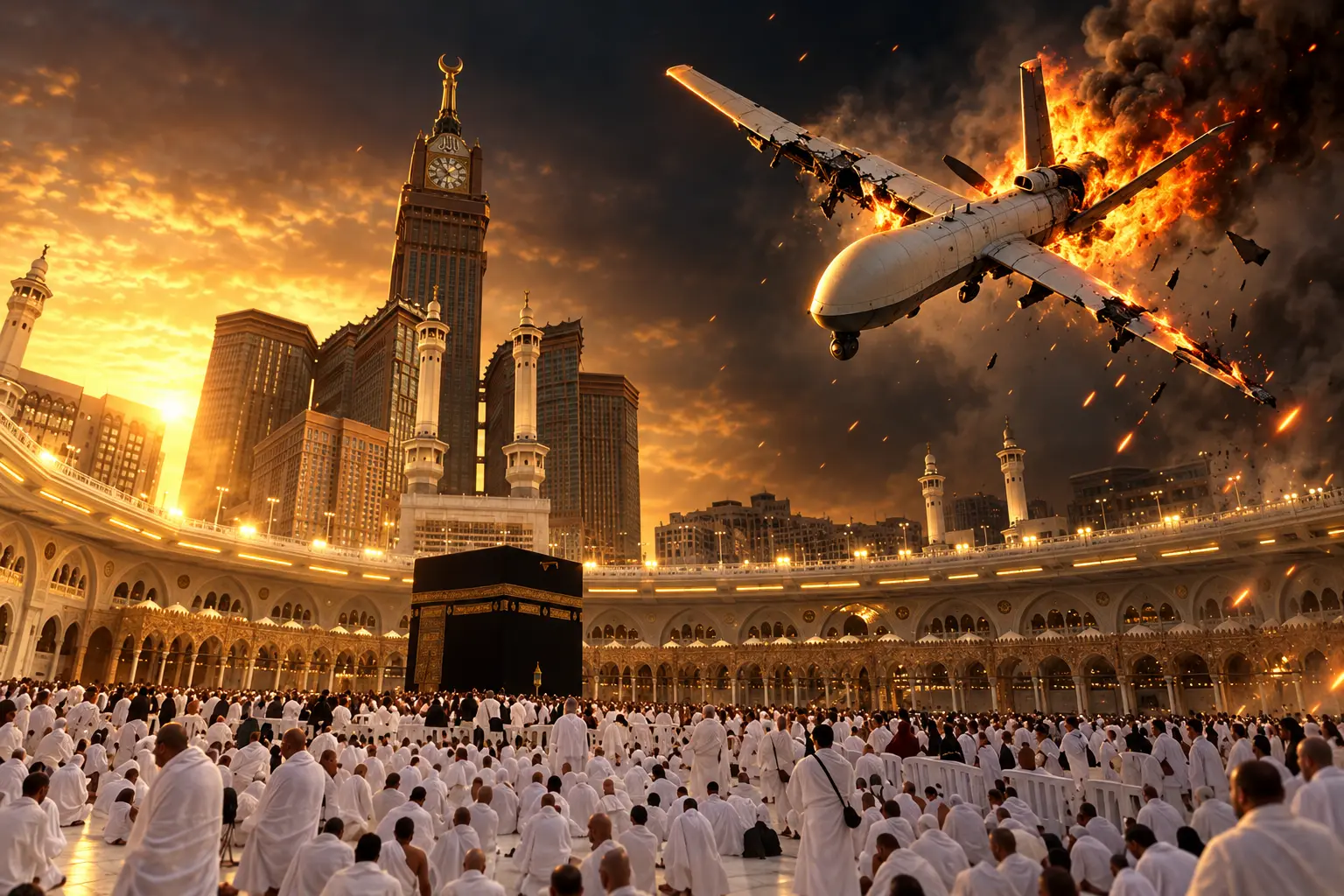
Saudi air defenses destroyed a Houthi drone south of Mecca at 6:50 p.m. on September 15, 2026, before it reached the city’s prohibited airspace. Brigadier General Turki al-Malki, spokesman for the Saudi-led coalition in Yemen, said the wreckage fell south of Islam’s holiest city and called the security of the Two Holy Mosques and their visitors a “red line.”
The intercept is the political fuse on a fight that had already moved to oil. The East-West line that carries Saudi crude to the Red Sea has been shut since September 11, and Houthi fighters now hold ground on the Bab el-Mandeb, the strait that is the remaining way out while the Strait of Hormuz stays almost closed after nearly seven months of U.S.-Iran war.
A Drone Died South of Mecca at 6:50 p.m.
The Joint Forces Command said Royal Saudi Air Defense Forces killed the aircraft before it entered restricted airspace over Mecca, using another name for the city, Makkah Al-Mukarramah. Al-Malki called the flight a disgraceful attempt to frighten pilgrims and harm civilians and residents, and he said the coalition would not hesitate to take deterrent measures against what he labeled Houthi terrorist behavior.
Saudi authorities pushed security alerts through Mecca, Taif, and Jeddah, the kingdom’s second-largest city. The Mecca warning, the first in the holy city since 2017, was lifted after a few minutes. Night-sky clips of a bright object near a mosque moved quickly online; their authenticity was not established, and at least one video in circulation matches an older intercept near Medina, not this one.
The Saudi embassy in Washington restated the coalition line the same evening.
The spokesperson for the Coalition to Restore Legitimacy in Yemen: The Royal Saudi Air Defense Forces intercepted and destroyed a drone that was fired by the terrorist Houthi militia before it entered the prohibited area over the holy city of Makkah on Tuesday. https://t.co/RjYxmalGY6
— Fahad Nazer فهد ناظر (@KSAEmbassySpox) September 15, 2026
The Organisation of Islamic Cooperation condemned the reported attacks on Mecca and the Medina region. Al-Malki tied the drone to a ballistic missile the coalition said the Houthis fired toward Mecca on July 27, 2017, and he called this the second such attempt.
Houthis Call the Charge a Worn-Out Lie
Houthi officials rejected the Mecca accusation before the coalition’s full statement had even settled. Mohammed al-Farah, a member of the Houthi political bureau, called the allegation “an outright lie” in comments carried by the Houthi-run SABA news agency. A Houthi military source, also through SABA, went further.
We categorically deny that there is any threat from Yemen directed at the city of Mecca or any other holy sites.
Houthi military source, statement to SABA
Hazem al-Assad, a Houthi official, wrote on X that claims about targeting Mecca are a worn-out lie that has been used before and no longer fools anyone. That is the same split the two sides ran in 2017: Riyadh names the holy city, Sanaa names a military aim or denies the city altogether. Intent is the whole dispute, because a drone that dies south of Mecca can still be sold as an attack on every Muslim, or as a shot at an air base that happens to sit in the same province.
WHAT WE KNOW
- The intercept: Saudi air defenses destroyed a drone south of Mecca at 6:50 p.m. on September 15, before prohibited airspace, the coalition said.
- The alerts: Warnings ran in Mecca, Taif, and Jeddah; the Mecca alert was lifted after a few minutes.
- The denial: Houthi political and military voices say they did not target Mecca or other holy sites.
WHAT IS UNCONFIRMED
- The aim: No independent radar track has been made public, so the intended target remains the two sides’ word against each other.
- The videos: Footage of a projectile near a mosque has not been verified as this intercept.
- The next strike: Al-Malki promised deterrent measures and did not describe them.
The argument will not be settled by a press release. It will be settled by whether Saudi Arabia treats a failed approach to Mecca as a license to reopen a war it had tried to freeze.
69 Kilometers South, the 2017 Script Returns
On July 27, 2017, the coalition said it intercepted 69 km south of the city a ballistic missile over Al-Wasliya in Taif province. The Center for Strategic and International Studies Missile Threat project recorded the shot as an 800 km Borkan-1 fired from northern Yemen by Houthi-Saleh forces. No damage was reported. The coalition called it a desperate attempt to spoil Hajj, then still a month away. Houthi-Saleh outlets said the Burkan-1 was aimed at King Fahd Air Base, about 70 km west of Mecca.
The geography has barely moved. Taif still sits on the pilgrim road. The air base is still the plausible military target in the same neighborhood. The political payload is still the word Mecca.
TWO SHOTS AT THE HOLY CITY
| Fact | July 27, 2017 | September 15, 2026 |
|---|---|---|
| Weapon | Borkan-1 ballistic missile, 800 km class | Unmanned drone |
| Where it died | 69 km south of Mecca, Al-Wasliya, Taif | South of Mecca, 6:50 p.m. local |
| Coalition claim | Aimed at Mecca, to spoil Hajj | Aimed at Mecca, a red line |
| Houthi claim | King Fahd Air Base, about 70 km west of Mecca | No threat to Mecca or holy sites |
| City alert | Not recorded as a Mecca-wide warning | Mecca, Taif, Jeddah; Mecca lifted in minutes |
A CSIS note at the time said the intended 2017 target was still uncertain. That sentence could be copied onto this drone. What changed is the war around it. In 2017 the coalition was deep in Yemen and Hajj was weeks off. In 2026 the annual Hajj of late May is over, Umrah runs all year, and Saudi Arabia had spent recent years trying to keep Yemen quiet.
Since Friday, the Hormuz Bypass Has Been Dark
The drone did not shut the oil. The oil was already shut. Saudi Arabia closed the 1,200-kilometer East-West pipeline on September 11, a day after drones the kingdom said came from Iraq hit the system. The Ministry of Energy called the stop a precautionary measure. The Foreign Ministry said it would not hit back, to give Baghdad “an opportunity to take the necessary measures.” Iraqi Prime Minister Ali al-Zaidi, who also commands the military, ordered an inquiry in Maysan province and dismissed the operations commander there.
Global Energy Monitor lists the line, also called Petroline, as a 1981 build from Abqaiq to Yanbu on the Red Sea, with capacity raised to 5 million barrels a day in 1992. For most of this war it has been the Hormuz bypass, moving crude west so tankers can leave by the Red Sea instead of the Gulf. The International Energy Agency said that by early June, Saudi Arabia had more than doubled Red Sea loadings to more than 5 million barrels a day. Rystad Energy later put the late-August average through the line and out of Yanbu at 2.6 million to 4 million barrels a day. Four million barrels a day is about 4% of global supply, the IEA has said.
Wright Says Days, Officials Say Weeks
Two regional officials briefed on the damage told reporters that repairs, including work at a major pumping facility, could take 3 to 5 weeks, with possible partial flow in between. Satellite images showed a pumping station badly burned. U.S. Energy Secretary Chris Wright, speaking on September 15 on the sidelines of a G20 energy meeting in Houston, gave a shorter clock.
It’s still a detailed assessment, but I think it will be measured in days.
Chris Wright, U.S. Energy Secretary, on CNBC
Saudi Arabia has not said when the pumps restart. The IEA, in its monthly report, said Saudi crude supply fell 2.3 million barrels a day to 6 million barrels a day in August, the lowest in more than three decades, after hits on ships in the Bab el-Mandeb, the Jazan refinery, shipping near Yanbu, and the Abqaiq processing site. No Saudi crude had left Yanbu since September 11, according to vessel tracker Vortexa. Janiv Shah, vice president of oil markets at Rystad, put Yanbu’s export cover in a range of two to six days.
A drone over Mecca does not move those barrels. It decides whether Riyadh answers a pipeline fire and a coastal collapse with a limited repair job, or with a campaign it can sell as defense of the Kaaba.
Mokha, Mayun and the Hanish Islands
While Mecca’s sirens ran for minutes, the Houthis spent days taking the water that makes the pipeline worth repairing. They seized the Red Sea port of Mokha and Mayun, the volcanic island also called Perim that sits inside the Bab el-Mandeb. Government and Houthi officials then described the capture of Greater Hanish and Lesser Hanish, about 160 km north of the strait. The channel itself is 28 km (17 miles) wide. The Hanish hold also puts Houthi forces about 32 km from the U.S. base in Djibouti.
WHAT THE HOUTHIS TOOK ON THE RED SEA
- Mokha: The main government port on the approach to the strait, taken before Saudi jets struck the airport.
- Mayun (Perim): The island in the middle of the Bab el-Mandeb, confirmed by a senior Yemeni government officer and a Houthi official.
- Greater and Lesser Hanish: The next island pair north, after hundreds of government-aligned fighters pulled back.
A Houthi armed forces statement on September 11 vowed “escalation for escalation” and said maritime navigation was safe for all companies except Saudi vessels. Lloyd’s List Intelligence has said shipping through the Bab el-Mandeb had already fallen by about 60% since late 2023, then recovered some as Saudi loadings fled Hormuz, then shrank again under the new blockade declared in July. That leaves a longer detour north through Suez or Egypt’s pipeline, a poor substitute for Asian buyers, and a route the Houthis have also threatened.
NINE DAYS THAT CLOSED THE BYPASS
- September 10, 2026: Drones the Saudi Foreign Ministry says came from Iraq hit the East-West system.
- September 11, 2026: Riyadh shuts the pipeline as a precaution. Houthi forces take Mayun in the Bab el-Mandeb.
- September 14, 2026: Missile and drone attacks on Khamis Mushait, Abha, and Taif wound 13 civilians and damage 7 homes and 2 vehicles, the coalition said.
- September 15, 2026: Air defenses destroy a drone south of Mecca at 6:50 p.m. Alerts run in Mecca, Taif, and Jeddah.
- September 16, 2026: Al-Malki calls holy-site security a red line and promises deterrent measures.
Yemen’s internationally recognized government said it was stunned that Saudi aircraft did not stop the fall of Mokha, about 80 km from the strait, and a senior officer judged that Riyadh lacked a U.S. green light for a large air campaign. The U.N. migration agency said more than 46,000 people fled in a week. Abdusattor Esoev, the International Organization for Migration’s mission chief in Yemen, said people left with whatever they could grab. The old war, frozen by an April 2022 truce, is moving again through a country of 40 million that has already lost 150,000 dead.
Why Washington Offers Intelligence, Not Warplanes
Crown Prince Mohammed bin Salman phoned President Donald Trump seeking military support. Three people familiar with the talks said Washington has kept that help to intelligence, not combat aircraft over Yemen. Wright said Saudi Arabia is trying to move more oil out of the Strait of Hormuz with U.S. military assistance, a different job from retaking Perim.
WHAT THE UNITED STATES HAS AGREED TO DO
- Intelligence: Support for Saudi defenses, not a new Yemen air war.
- Hormuz escort: Help moving crude away from Iranian fire in the Gulf, per Wright.
- No green light: Yemeni officers say they have not seen U.S. approval for a large Saudi campaign on the Red Sea coast.
The Houthis seized Sanaa in 2014. Saudi Arabia led a coalition into Yemen in 2015. That war quieted under the 2022 ceasefire and then reignited when Houthi fighters pushed back government-aligned forces and declared a blockade of Saudi shipping in July. Iran’s government has called for a return to Saudi-Houthi talks and an end to the kingdom’s blockade of Houthi-held areas. Iranian Foreign Minister Abbas Araghchi said he spoke with his Saudi counterpart about restoring stability. The IRGC’s spokesperson, in a separate remark, said any settlement with the United States should include Yemen.
A Mecca red line is useful in that argument. It is harder for Washington to stay on intelligence only if the next alert is over the Grand Mosque rather than a pumping station in the desert. It is also useful in Sanaa, if the charge can be dismissed as a worn-out lie and the real campaign can stay on tankers and islands.
Umrah Did Not Pause for the Alert
Hajj in late May is finished. Umrah is not. The Ministry of Hajj and Umrah, on September 15, was still pointing visitors to its Umrah and Ziyarah Guide and, in a separate note, to the 1.68 million overseas Umrah pilgrims it counted in Ramadan, with more than 1.1 million Rawdah bookings from 155 nationalities. Photographs from the Grand Mosque on September 14 show tawaf continuing in the usual dense circles.
That is the audience al-Malki was addressing when he talked about a black mark and the birthplace of the Islamic revelation. It is also the audience the Houthis were addressing when they said they do not target holy sites. The sirens in Mecca lasted minutes. The pipeline is still dark. The islands are still in Houthi hands. The pilgrims, for now, are still walking.
Disclaimer: This article is news reporting and analysis of military claims, shipping, and oil-supply figures. It is informational only and is not investment advice, energy-trading advice, or a recommendation to buy or sell crude, refined products, or related securities. Readers who may act on oil-market or travel decisions should consult a licensed financial adviser or their relevant national travel authority. Figures, outage estimates, and territorial claims reflect the named officials, agencies, and trackers cited here and can change as repairs, fighting, and official tallies move.

A CubeSat Will Age Whisky That Never Comes Home

A Charity Quote Cost Shia LaBeouf the FKA twigs NDA

Looker Turned a Model’s Body Into Ad Inventory

Infinity Ward Bets a Paid DMZ Will Stick This Time

Disney Sidesteps a Kimmel Renewal as Failla Cites Losses

How to Get Pre Boarding on Southwest – Skip the Line with These Tricks

False AI Intel Nearly Put US Crews on a Chinese Ship

Tim Cook’s $4.6 Trillion Apple Still Runs on One Phone

Dunes Air Sues Nora Fatehi Over Its Luxury Jet

OpenAI Posts a Navier-Stokes Proof Clay Has Not Touched
-
 TRAVEL3 years ago
How to Get Pre Boarding on Southwest – Skip the Line with These Tricks
-
 NEWS1 month ago
False AI Intel Nearly Put US Crews on a Chinese Ship
-
 BUSINESS2 months ago
Tim Cook’s $4.6 Trillion Apple Still Runs on One Phone
-
 ENTERTAINMENT1 month ago
Dunes Air Sues Nora Fatehi Over Its Luxury Jet
-
 NEWS1 month ago
OpenAI Posts a Navier-Stokes Proof Clay Has Not Touched
-

 LIFESTYLE3 years ago
How Often Do You Have to Change a Monkey’s Diaper? The Truth About Pet Monkeys
-

 NEWS1 month ago
Australia Treats Cloud Software Payments as Taxable Royalties
-

 LIFESTYLE3 years ago
How Long Does It Take for Armpit Hair to Grow? The Stages of Hair Growth and How to Shave It