
BUSINESS
Modi’s BRICS Tea With Xi Restages an Old Method
Video of Modi sipping tea with Xi and Putin at BRICS 2026 restages a Wuhan-era method after Galwan and a split official account of the border.

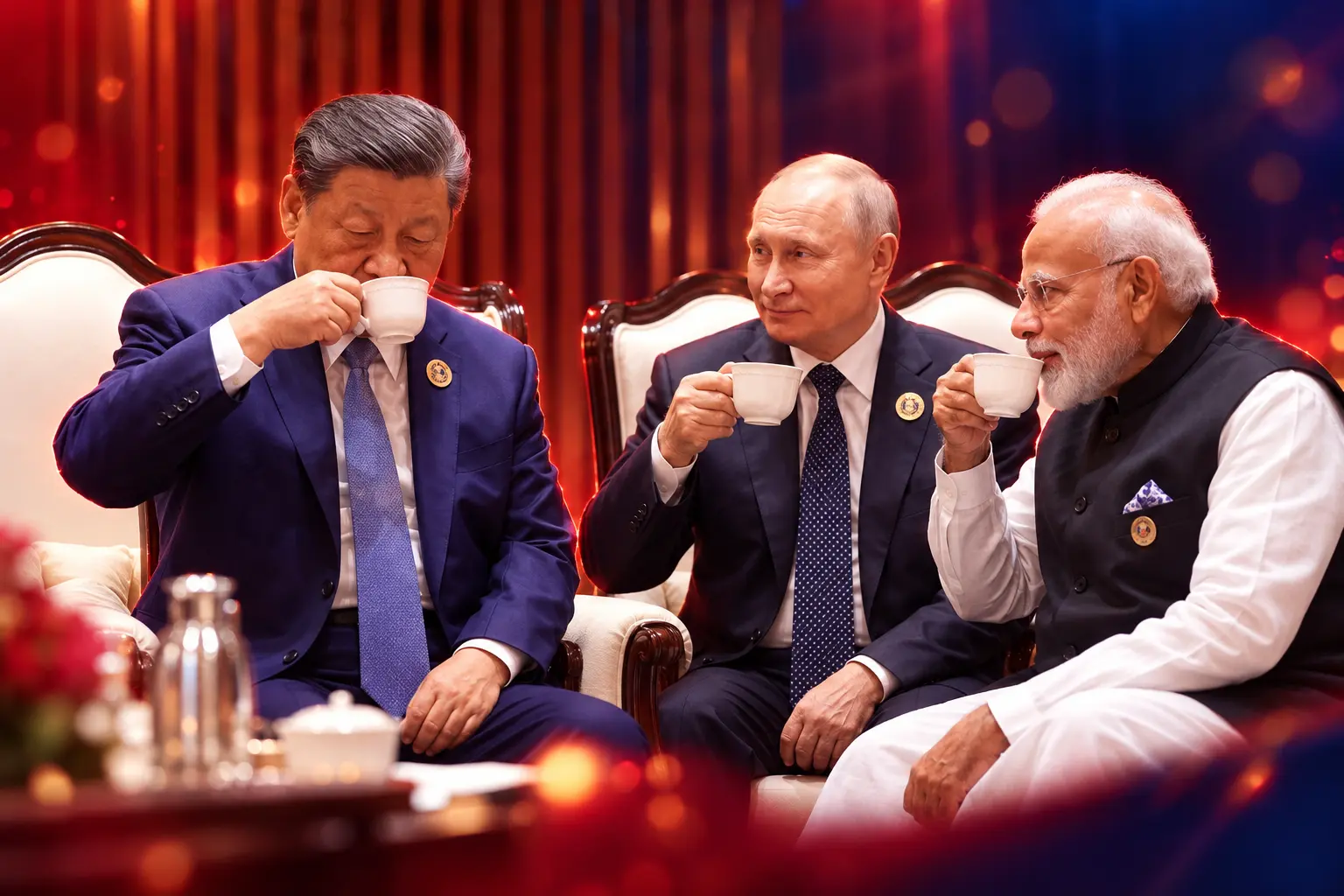
A video from the 18th BRICS Summit shows Prime Minister Narendra Modi sipping tea with Chinese President Xi Jinping and Russian President Vladimir Putin in New Delhi. The clip, shared through the NaMo App after the gathering at Bharat Mandapam on September 12 and 13, also records a close handshake with Indonesian President Prabowo Subianto as the leaders left.
The cups are the part that will travel. They are also the oldest tool in this relationship, pulled out again on Indian soil after a border clash, a years-long freeze, and a slow thaw that still has no settled line on the map.
The Tea Cup Is an Old Instrument
The montage opens with Modi walking into the hall with his security detail, then cuts to the three men with cups in a quieter corner of the venue. Later frames show him studying a large artwork with other leaders, taking his seat at the main table, and greeting delegates in small groups before the formal sessions. Prabowo appears near the end, shaking hands at close range and exchanging a warm gesture.
The official clip is the version the host wants seen. It is not a leak from the margins. It is a finished tape of informal contact, released once the closed sessions were done.
On the lawn outside Bharat Mandapam, Modi also gathered Xi and Putin for the family photograph and had them lock hands. The pose is being read as warmth. It is also the host arranging two larger powers into a single Indian frame, then holding that frame long enough for cameras to catch it. The tea table does the same work with less strain: three men, no flags in the shot, a drink that India has used with China before.
Wuhan’s Informal Method Broke at Galwan
In April 2018, after the Doklam stand-off, Modi and Xi spent two days in Wuhan with almost no protocol. They walked by East Lake, took a boat, and drank tea. Indian officials later said the Chinese side served Assam tea, not a local brew, and that Modi showed Xi how he used to pour for customers when he sold tea. The two men ran six rounds of talks that stretched close to ten hours. No joint statement came out of it. The point was the method: long, informal, personal, and built around a cup.
Xi came to India in October 2019 for a second informal summit at Mamallapuram, on the Tamil Nadu coast. They talked about the trade gap, the border, and a line both sides still repeat: differences should not become disputes. That was Xi’s last trip to India until this summit.
The method did not survive the next summer. In June 2020, Indian and Chinese troops clashed in the Galwan Valley in eastern Ladakh. Twenty Indian soldiers were killed. High-level contact froze. The Special Representatives on the boundary stopped meeting. For four years the two leaders shared multilateral stages and almost no bilateral table.
THE MODI-XI LINE, 2018 TO 2026
- April 27 and 28, 2018: Modi and Xi drink tea beside East Lake in Wuhan and talk for close to ten hours after Doklam.
- October 11 and 12, 2019: The two hold a second informal summit at Mamallapuram, Xi’s last visit to India before New Delhi.
- June 2020: Troops clash at Galwan; 20 Indian soldiers are killed and leader-level talks freeze.
- October 23, 2024: On the sidelines of BRICS in Kazan, they hold their first formal bilateral in five years after a patrol deal on the Line of Actual Control.
- August 2025: They meet again in Tianjin, the stop both governments now cite as the last one before Delhi.
- August 25, 2026: National Security Adviser Ajit Doval and Chinese Foreign Minister Wang Yi reach an eight-point understanding on the boundary talks.
- September 12, 2026: Xi sits with Modi at Bharat Mandapam, then appears in the tea clip with Putin.
Kazan ended the freeze, not the dispute. Analyst Tanvi Madan at Brookings called the 2024 turn a tactical thaw rather than a strategic shift, and warned against reading a patrol deal as the 2020 crisis closed. New Delhi still treats border peace as the condition for everything else. Beijing still wants the relationship and the boundary to move on parallel tracks.
What Delhi and Beijing Each Wrote Down
The two leaders met on the afternoon of September 12, on the sidelines of the summit. The Prime Minister’s Office said they welcomed “steady progress” since Tianjin and agreed that both countries should take a strategic, long-term view. Modi said ties should rest on three mutuals: mutual respect, mutual sensitivity and mutual interest. He put the border first.
Peace and tranquillity in the border areas remains an essential basis for the continued development of bilateral relations.
Prime Minister’s Office, New Delhi, September 12, 2026
The same note, carried by the external affairs ministry, says both sides committed to a fair, reasonable and mutually acceptable settlement of the boundary, and that they must observe existing agreements. On trade, they named the structural imbalance, supply chains, and the need for predictable market access. Modi thanked China for backing India’s BRICS chairship and wished Beijing well for 2027.
China’s foreign ministry published a longer and different account of the same hour. Xi, in that version, said the recent improvement “has not come easily and is worth cherishing,” and that the two countries should be partners rather than rivals. Beijing’s text also puts words in Modi’s mouth that the Indian note does not carry: that India’s China policy is not affected by any third party, that its positions on Taiwan and Tibet are unchanged, and that India will not allow anti-China activity from its soil.
DELHI VERSUS BEIJING ON THE SAME MEETING
| Point | India’s published note | China’s foreign ministry note |
|---|---|---|
| Border | Peace is the essential basis; honour existing agreements | Move ties and the boundary in parallel, each supporting the other |
| Settlement formula | Fair, reasonable and mutually acceptable | Same formula |
| Third countries | Not mentioned | Independent policy, not affected by any third party |
| Taiwan and Tibet | Not mentioned | Policy unchanged; no anti-China activity from Indian soil |
| Guiding words | Respect, sensitivity and interest | Respect and trust |
India put peace and tranquillity in the border areas at the top of the page. China put partnership language, and a Taiwan-Tibet line, at the centre of its own. Sensitivity, the word India uses when it talks about Tibet and the border, does not appear in Beijing’s version. Trust does. The tea clip does not resolve that gap. It just sits on top of it.
The 140-Paragraph Text Names Pahalgam
The grouping around that tea table is no longer five countries. The 18th summit brought together the 11 full members under India’s chair, on the grouping’s twentieth year, with partner countries and an outreach session on the second day. The theme was “Building for Resilience, Innovation, Cooperation and Sustainability.”
On September 12, Modi announced that the New Delhi Declaration adopted by consensus had cleared the room. No member objected, he said, after talks that had to bridge Iran and the United Arab Emirates, who had been at odds over language on West Asia. Ministerial talks in May had not produced a joint statement. Getting a full leaders’ text through an 11-member, consensus club was the chair’s first job, and it was not a given.
WHAT THE NEW DELHI DECLARATION LOCKED
- Pahalgam: Members “condemn in the strongest terms” the April 22, 2025 attack in Jammu and Kashmir that killed 26 people, and name cross-border movement of terrorists, terror financing and safe havens.
- Payments: The BRICS Payment Task Force is told to keep studying local-currency settlement and cross-border links, with an explicit note that no single approach fits all members.
- Trade rules: Unilateral tariff and non-tariff measures are called inconsistent with World Trade Organization rules, and carbon border tools are opposed.
- UN seats: China and Russia, as permanent members of the Security Council, again support a greater role for India and Brazil, including in the Council.
- The next chair: Leaders declare full support for China to hold the 19th summit in 2027.
The Pahalgam line is the one India will keep. It had to pass a table that includes China, which has often blocked or slowed Indian bids to list Pakistan-based actors at the United Nations. Naming the attack, the death toll, and cross-border movement in a consensus text is the hard sentence in the 140-paragraph document. The payments paragraph is the soft one: study, interoperability, no common currency, no one path.
Modi also floated a Continuity and Implementation Mechanism, a troika to chase decisions after the gavel passes, plus a digital ledger of who owns which task. BRICS still has no permanent secretariat. The proposal is a way to keep paper from dying when the chair rotates to Beijing.
Putin Shared a Car and Prabowo Closed the Tape
Putin arrived first. On September 11, 11 days after the two men met at the Shanghai Cooperation Organisation gathering in Bishkek, Modi sat with him in New Delhi and then rode with him by car to Bharat Mandapam. They walked the Innoprom industrial show together. Modi later wrote that they had talked about the Programme for Economic Cooperation 2030 and about work in infrastructure, energy, technology, defence and culture.
The public target from those talks is $100 billion in bilateral trade by 2030. India pressed for more room in the Russian market, because the flow is still heavily one way, with Indian imports of Russian energy and fertiliser far larger than Indian exports. They also discussed the safety of Indian seafarers in the Black Sea, civil nuclear projects, critical minerals, and defence. Putin invited Modi to the next annual India-Russia summit, expected later in the year. Ukraine was in the room as a subject India keeps putting back on the table, not as a line the BRICS text was willing to sharpen.
Prabowo, whose country now sits in the 11 as a full member, is the third man in the candid tape and the one the wire copy treated as colour. He is not colour for the club. Indonesia’s presence is how the expanded BRICS claims the wider Global South, and the close-range handshake at the end of the summit is India showing that the new members get bilateral time, not only a seat in the family photo. South African President Cyril Ramaphosa, speaking after the close, said the grouping wanted a multilateral system “where there is no dominance of one player or country over others.”
Modi ran 15 formal leader-level meetings across September 11, 12 and 13, on top of pull-asides. The tea with Xi and Putin is one frame from that grind. The car ride with Putin is another. The last handshake with Prabowo is a third. They are all contact, and they are all for cameras that the West still watches.
Locked Hands Leave the Border Unsettled
The locked-hands photograph and the tea service will outrun the 140 paragraphs. That is why they were staged. Delhi can put Xi and Putin in the same informal shot, on Indian soil, and make the clip look easy. The easy look is the product.
The product does not move troops. India’s published line after the Xi meeting still makes border peace the condition for the rest of the relationship. China’s published line still wants the relationship and the boundary to advance together, and still wants Indian silence on Taiwan and Tibet written into the record. Those two texts sat on the same afternoon as the cups.
China takes the chair in 2027. The next test of this method is not another montage. It is whether the Line of Actual Control stays quiet while Beijing runs the grouping, and whether the Pahalgam sentence is still on the page when the gavel changes hands.
Frequently Asked Questions
Which countries are full BRICS members after the Delhi summit?
The 11 full members are Brazil, Russia, India, China, South Africa, Egypt, Ethiopia, Indonesia, Iran, Saudi Arabia and the United Arab Emirates. Partner countries joined an outreach session on September 13, and the leaders’ text encouraged them to take a larger part in working-level work without converting that layer into full membership at this meeting.
Did BRICS agree to a common currency in New Delhi?
No. The leaders asked the BRICS Payment Task Force to keep studying faster local-currency settlement and cross-border links, and they wrote into the text that no single approach fits all members. There was no new common currency, no new large lending window, and no binding tariff tool attached to the complaint about unilateral trade measures.
How many events did India run in its BRICS chair year?
Under the 2026 chairship India convened more than 400 meetings in 30 cities, drawing in ministers, parliamentarians, agency heads, businesses and experts, according to the South African government’s account of the summit close. That calendar is the working layer behind the two days of leaders’ sessions at Bharat Mandapam.
Where will the 19th BRICS Summit be held?
China will hold the BRICS chair in 2027 and host the 19th summit. Modi conveyed best wishes for that presidency in his meeting with Xi, and the leaders’ declaration gave it full support, with Ramaphosa saying after the close that he looked forward to the next gathering there.

A CubeSat Will Age Whisky That Never Comes Home

A Charity Quote Cost Shia LaBeouf the FKA twigs NDA

Looker Turned a Model’s Body Into Ad Inventory

Infinity Ward Bets a Paid DMZ Will Stick This Time

Disney Sidesteps a Kimmel Renewal as Failla Cites Losses

How to Get Pre Boarding on Southwest – Skip the Line with These Tricks

False AI Intel Nearly Put US Crews on a Chinese Ship

Tim Cook’s $4.6 Trillion Apple Still Runs on One Phone

Dunes Air Sues Nora Fatehi Over Its Luxury Jet

OpenAI Posts a Navier-Stokes Proof Clay Has Not Touched
-
 TRAVEL3 years ago
How to Get Pre Boarding on Southwest – Skip the Line with These Tricks
-
 NEWS1 month ago
False AI Intel Nearly Put US Crews on a Chinese Ship
-
 BUSINESS2 months ago
Tim Cook’s $4.6 Trillion Apple Still Runs on One Phone
-
 ENTERTAINMENT1 month ago
Dunes Air Sues Nora Fatehi Over Its Luxury Jet
-
 NEWS1 month ago
OpenAI Posts a Navier-Stokes Proof Clay Has Not Touched
-

 LIFESTYLE3 years ago
How Often Do You Have to Change a Monkey’s Diaper? The Truth About Pet Monkeys
-

 NEWS1 month ago
Australia Treats Cloud Software Payments as Taxable Royalties
-

 LIFESTYLE3 years ago
How Long Does It Take for Armpit Hair to Grow? The Stages of Hair Growth and How to Shave It