
NEWS
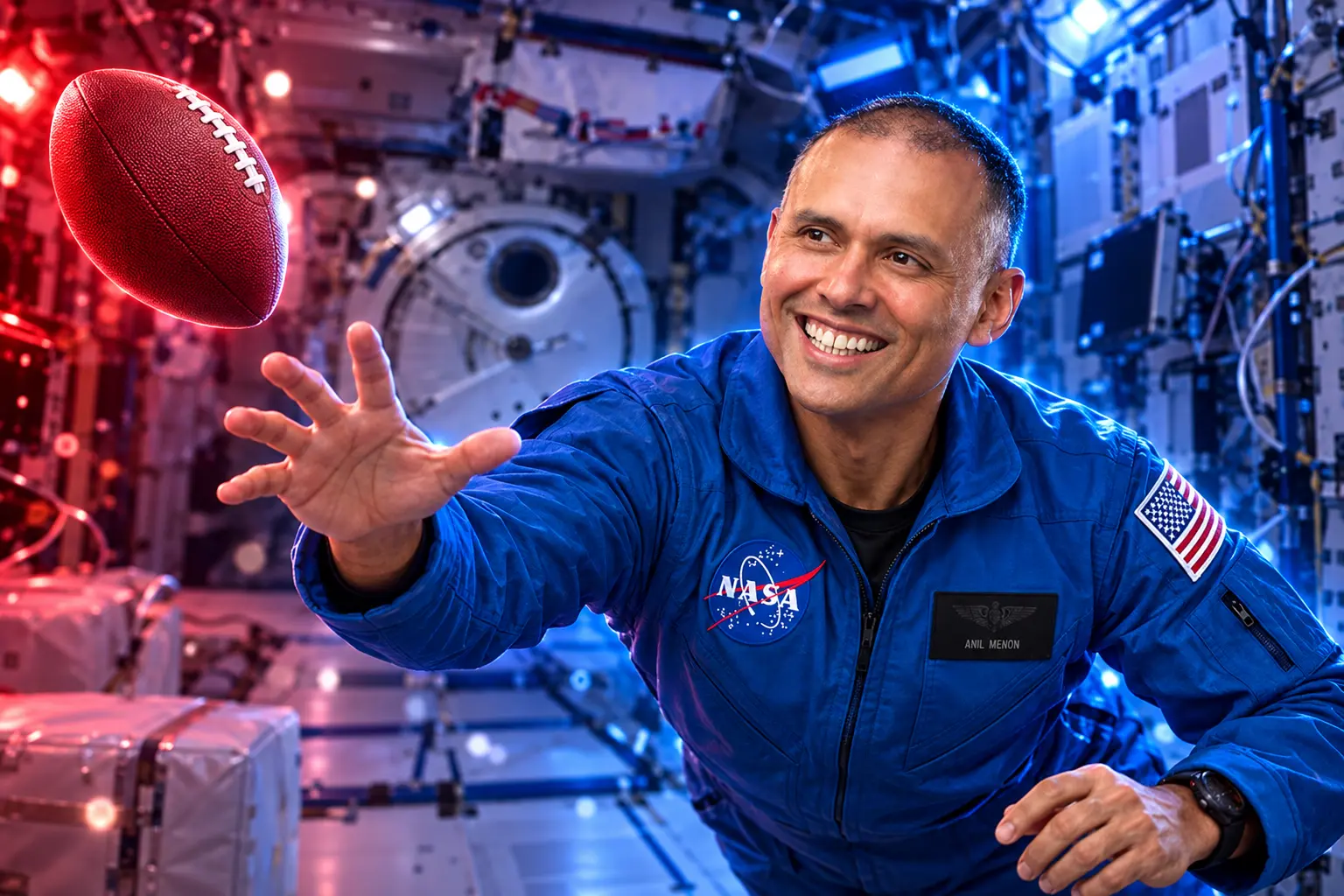
Anil Menon Floats a Football Through the Station
Anil Menon’s ISS football clip is weekend rest on a flight timeline, posted by a former station flight surgeon after three August spacewalks.

NASA astronaut Anil Menon posted a video of himself playing football inside the International Space Station on Sept. 13, 2026. He wrote that the game is one thing that brings the crew together, and that a weekend unwind helps them get ready for another busy week.
Menon is an emergency physician and a colonel in the U.S. Space Force who spent years as a NASA flight surgeon supporting station crews. The clip landed 61 days after he launched, and after three spacewalks in August.
Anil Menon Floats a Football Through the Station
The video is a vertical clip from inside a station module. A ball drifts. Menon and at least one crewmate chase it without a floor to plant on. He posted it on a Sunday from his account @astro_anil, with a line that could have come from any tired shift worker.
Football is one thing that brings us all together on the space station! On the weekend, it’s good to unwind because it helps us get ready for another busy week.
Anil Menon, NASA astronaut, on X
Football is one thing that brings us all together on the space station! On the weekend, it’s good to unwind because it helps us get ready for another busy week. pic.twitter.com/6xYuFUhLEn
— Anil Menon (@astro_anil) September 13, 2026
On Sept. 14 he posted again, a shorter clip titled as station life, this time on reclaiming water. The football is one square on a public log of ordinary systems, meals, medical work, and rest.
He Used to Be the Doctor on the Other End of the Line
NASA selected Menon in the 2021 astronaut class. He reported in January 2022. Before that he was the person on the ground whose job was to keep other people healthy in the same vehicle.
He started as a NASA flight surgeon in 2014 and supported four long-duration crew members, serving as deputy crew surgeon on Soyuz 39 and Soyuz 43 and as prime crew surgeon on Soyuz 52. He lived and worked in Star City, Russia, for more than six months. He later became SpaceX’s first flight surgeon and helped launch the company’s first humans on the Demo-2 mission.
He was born and raised in Minneapolis to Ukrainian and Indian immigrants, and he is married to Anna Menon; they have two children. He still practices emergency medicine and holds current board certification in aerospace medicine and emergency medicine. NASA’s own biography is the file of a doctor who trained to treat crews, then joined one.
He launched aboard Soyuz MS-29 on July 14, 2026, with Roscosmos cosmonauts Pyotr Dubrov and Anna Kikina, for an approximately eight-month stay. The hatch opened at 4:30 p.m. EDT that day. NASA has him returning in April 2027.
A flight surgeon already knows why a Sunday kickabout is on the plan. NASA assigns physicians with specialized training in space medicine to each named crew, and those doctors monitor health before, during, and after a mission. Menon used to be that physician. Now the private medical conferences run the other way.
Three August Spacewalks Before Sunday
Expedition 75 began on July 26, 2026. Menon is a flight engineer on a seven-person crew commanded by Jessica Meir. The research slate includes in-space manufacturing, augmented reality and artificial intelligence methods for crew health checks, and bioprinting human tissue. The football clip did not land in a quiet month.
FROM LAUNCH TO THE SUNDAY CLIP
- July 14, 2026: Menon, Dubrov, and Kikina reach the station on Soyuz MS-29 for an eight-month increment.
- July 26, 2026: Expedition 75 begins after Soyuz MS-28 departs, with Meir in command.
- Aug. 6, 2026: Menon and Meir finish a spacewalk of 6 hours 27 minutes.
- Aug. 18, 2026: Menon and ESA astronaut Sophie Adenot finish a spacewalk of 6 hours 23 minutes.
- Aug. 25, 2026: Menon and Adenot finish a spacewalk of 6 hours 30 minutes.
- Sept. 13, 2026: Menon posts the football video from inside the station.
Those three August exits add up to 19 hours 20 minutes outside. A rookie flier spent his first full month on board cycling through the airlock with Meir and Adenot, then used a Sunday to float a ball down a module. On Sept. 9, four days before the football post, he also showed an ultrasound session aimed at blood-flow changes that worry physicians in weightlessness, including the risk of clots. The weekend clip sits next to that work, not apart from it.
How the Station Protects a Weekend
NASA and its partners treat time off as part of keeping a crew able to work. A typical station stay lasts about six months; Menon’s is longer. The outpost flies about 250 miles up, and crews have lived there without a gap for more than 24 years. In that tin-can routine, sleep, gym time, family calls, and a lighter weekend are written onto the same timeline as science and repairs.
ESA flight controllers still plan 6.5 hours of scheduled station work on a standard crew day, plus a midday meal and 8.5 hours of sleep. NASA separately books two and a half hours of daily exercise so muscle, bone, aerobic fitness, and balance do not slide in a place with no floor load. Menon’s own caption is the crew version of that rule: unwind, then face the next week.
THE GYM THAT NEVER GETS THE WEEKEND OFF
| Device | What it stands in for |
|---|---|
| ARED | Free weights, via vacuum cylinders |
| T2 | A treadmill run |
| CEVIS | A stationary bike |
Food is on that list too. NASA’s space food lab builds meals that are both fuel and a taste of home, and crews can add personal items. The agency says food plays a psychosocial role on a long stay, which is a dry way of saying a familiar bite does some of the same work as a floating ball.
HOW NASA BACKS A CREW’S HEADSPACE
- Family contact: Crew members can email, call, and join video conferences with family and friends.
- Care packages: Personal items ride up on cargo resupply flights.
- A psychologist on call: Astronauts can teleconference with a psychologist if they need to.
- Team skills: Training before flight covers self-care, team care, communication, and leadership.
Applicants are screened for adaptability and resilience long before a Soyuz ride. Once in orbit, the behavioral health team sets support for each person and each family. A Sunday football clip is the part of that system that can be posted without breaking medical privacy.
A Kick That Throws the Kicker Backward
There is no pitch. There is no turf. A kicked ball does not roll to a stop; it keeps going until a wall, a hand, or a filter grate takes the energy out of it. Push off a handrail to chase it and you rotate. Kick hard and you travel in the opposite direction. Newton’s third law is the referee, and it does not care about offside.
That is why orbit football looks slow and a little silly. A powerful strike is a bad idea inside a module lined with experiments, laptops, and ventilation. The useful move is a tap, a redirect, a header that sends the ball to the next person and leaves the kicker roughly where they started. Anyone who wants Earth rules would have to rewrite them, because the field is a tube and the players cannot plant a foot.
Crews have been doing some version of this for years. During the 2014 World Cup, NASA astronauts Steve Swanson and Reid Wiseman and ESA astronaut Alexander Gerst put a small ball through bicycle kicks and headers for a station video. The 2026 clip is the same physics with a new roster. The joke is old. The need for a shared, low-stakes game is older.
Football Is the Crew’s Shared Language
Expedition 75 is a U.S., Russian, and European mix on a vehicle that has always been a partnership. A private joke in one language dies at the hatch. A ball does not.
WHO IS ON BOARD WITH HIM
| Crew member | Agency | Role |
|---|---|---|
| Jessica Meir | NASA | Commander |
| Jack Hathaway | NASA | Flight engineer |
| Sophie Adenot | ESA | Flight engineer |
| Andrey Fedyaev | Roscosmos | Flight engineer |
| Anil Menon | NASA | Flight engineer |
| Pyotr Dubrov | Roscosmos | Flight engineer |
| Anna Kikina | Roscosmos | Flight engineer |
Menon flew to the station with Dubrov and Kikina. He has now gone outside with Meir and twice with Adenot. Football, in his caption, is the activity that gathers that whole list. Chess needs a board and a shared rating. A movie needs a language track. A ball only needs people willing to miss on purpose.
The Match Ball Already Did Science in Orbit
A football on this station is also hardware. In 2019, researchers working with the ISS National Laboratory used microgravity to study how a soccer ball’s internal mass affects motion, stability, and rotation. NASA says those findings fed work on how embedded electronics, including match-ball sensors, change the way a ball behaves. Adidas has put electronics inside official match balls used in major tournaments since 2022. The sensors track speed, position, and contact, and they add mass in specific spots, which is exactly the variable the station can isolate when nothing falls.
NASA and Adidas turned that into a STEMonstration that compares how well-balanced and poorly balanced balls spin when they are free-floating. Engineers at NASA Ames had already run the 2014 Brazuca ball through a wind tunnel to map knuckling, the wobble that shows up on low-spin kicks. The station test is the cousin of that work: center of mass versus geometric center, the same problem that shows up in spacecraft and satellites.
The official FIFA World Cup ball went to space!
We're working to inspire the next generation by showing how space exploration inspires innovation in sports science — and everyday life. Learn more: https://t.co/CWbI8MFDtp pic.twitter.com/ebJtkpD5uM
— NASA (@NASA) June 20, 2026
NASA posted on June 20, 2026, that the official FIFA World Cup ball had gone to space. A station photo from March 2, 2026, already showed a soccer ball floating in the modules. The tournament itself ran June 11 to July 19. Menon launched on July 14, while the Cup was still on, and into a house that already had the toy and the lesson. He did not invent football in orbit. He picked up a ball that had been a physics demo and used it the way a crew uses a weekend.
He is due back in April 2027. Until then the weekday still holds the gym, the timeline, and the private medical loop he once ran from Houston. The Sunday ball is how that loop looks when a doctor on the crew is the one holding the camera.

A CubeSat Will Age Whisky That Never Comes Home

A Charity Quote Cost Shia LaBeouf the FKA twigs NDA

Looker Turned a Model’s Body Into Ad Inventory

Infinity Ward Bets a Paid DMZ Will Stick This Time

Disney Sidesteps a Kimmel Renewal as Failla Cites Losses

How to Get Pre Boarding on Southwest – Skip the Line with These Tricks

False AI Intel Nearly Put US Crews on a Chinese Ship

Tim Cook’s $4.6 Trillion Apple Still Runs on One Phone

Dunes Air Sues Nora Fatehi Over Its Luxury Jet

OpenAI Posts a Navier-Stokes Proof Clay Has Not Touched
-
 TRAVEL3 years ago
How to Get Pre Boarding on Southwest – Skip the Line with These Tricks
-
 NEWS1 month ago
False AI Intel Nearly Put US Crews on a Chinese Ship
-
 BUSINESS2 months ago
Tim Cook’s $4.6 Trillion Apple Still Runs on One Phone
-
 ENTERTAINMENT1 month ago
Dunes Air Sues Nora Fatehi Over Its Luxury Jet
-
 NEWS1 month ago
OpenAI Posts a Navier-Stokes Proof Clay Has Not Touched
-
 LIFESTYLE3 years ago
How Often Do You Have to Change a Monkey’s Diaper? The Truth About Pet Monkeys
-

 NEWS1 month ago
Australia Treats Cloud Software Payments as Taxable Royalties
-

 LIFESTYLE3 years ago
How Long Does It Take for Armpit Hair to Grow? The Stages of Hair Growth and How to Shave It