
NEWS
Crew-13 Sets a U.S. Docking Record as Crew-12 Waits
Crew-13 reached the ISS in 7 hours 55 minutes, a U.S. record, yet Crew-12 is still waiting on California splashdown weather to come home.

SpaceX flew NASA’s Crew-13 astronauts to the International Space Station in 7 hours 55 minutes on Oct. 1, the fastest launch-to-docking by a U.S. spacecraft in station history. The same crew rotation is still open. Crew-12 remains on board, waiting on Pacific weather for a ride home that has already slipped past Monday.
The record chase ended at Harmony’s forward port at 7:05 p.m. EDT. The return still depends on winds, waves, and recovery helicopters off California.
Crew-13 Made the Station in 7 Hours 55 Minutes
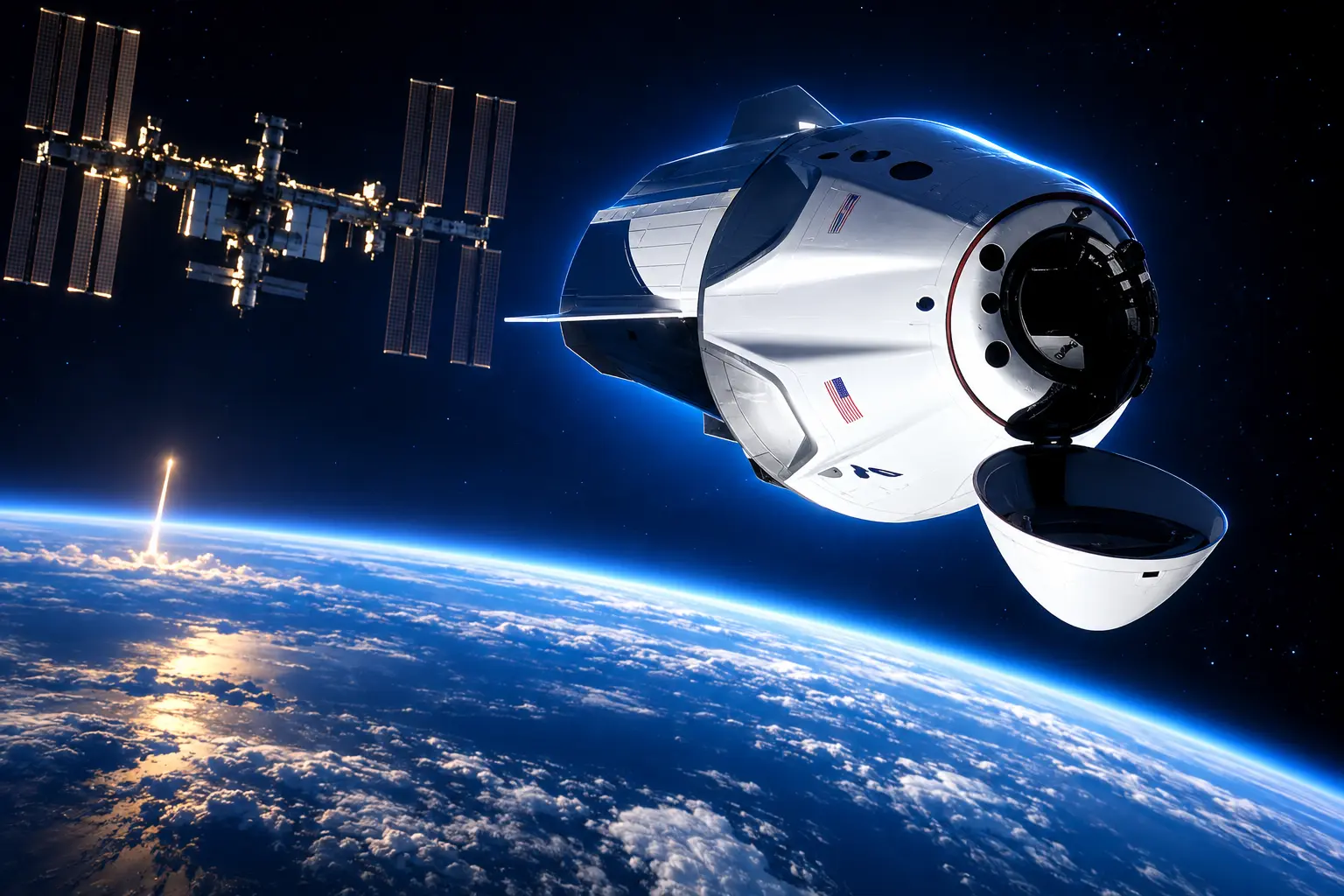
A Falcon 9 lifted Dragon Grace from Space Launch Complex 40 at Cape Canaveral Space Force Station at 11:10 a.m. EDT on Thursday, Oct. 1. NASA astronauts Jessica Watkins and Luke Delaney, Canadian Space Agency astronaut Joshua Kutryk, and Roscosmos cosmonaut Sergey Teteryatnikov were strapped in for a science stay of about six months.
NASA had sold the run as a 7-hour, 50-minute flight with docking near 7 p.m. The flown time was 7 hours 55 minutes, still the fastest launch-to-docking by a U.S. spacecraft in the history of the station. Hatch opening came at 9:19 p.m., later than the 8:45 p.m. target on the pre-launch plan, after pressure checks between Grace and Harmony.
THE FLIGHT CLOCK
- Launch: 11:10 a.m. EDT, Oct. 1, from SLC-40 at Cape Canaveral.
- Docking: 7:05 p.m. EDT at Harmony’s forward port, 7 hours 55 minutes after liftoff.
- Hatch: Opened at 9:19 p.m. as the four floated into Expedition 75.
- Ship: Dragon Grace, on its second station visit after Axiom Mission 4.
Watkins, a geologist who spent 170 days on the station with Crew-4 in 2022, is the first NASA astronaut to launch on a Crew Dragon twice. Delaney, a Navy test pilot on his first flight, sat in the pilot seat. Kutryk is the first Canadian on a commercial crew flight after NASA moved him off a Starliner assignment that became an uncrewed cargo run. Teteryatnikov, a former naval engineer, is also making his first trip to orbit.
NASA Administrator Jared Isaacman called the launch another show of commercial crew as a working airline to low Earth orbit. “Jessica, Luke, Joshua, and Sergey will carry forward important work aboard the International Space Station while helping us build the experience and capabilities needed for ambitious missions to the Moon and beyond,” Isaacman said.
After they came aboard, Kutryk sounded like a man who had just lived a very long Thursday. “I cannot believe I’m here. What a crazy day. A long day,” he said. “It feels really good to have CSA back, the Canadian flag back.”
Why the Chase Shrank to One Workday
The short trip did not come from a new engine or a redesigned capsule. Grace flew the same autonomous approach SpaceX has used for years, with the crew able to take the controls if the software failed. Julianna Scheiman, who directs NASA science and Dragon programs at SpaceX, put the clock down to where the station sat in its orbit at the moment of launch.
We got lucky this time. The space station was in an opportune spot in space, and the orbital mechanics, the physics of it all, worked out for it to be the shortest launch-to-docking time we’ve had to date.
Julianna Scheiman, director of NASA science and Dragon programs at SpaceX, Crew-13 post-launch press conference
She added that the profile sat close to the fastest the physics allow from Florida. Cape Canaveral sits well south of the station’s 51.6-degree path, so Dragon has to chase and catch a laboratory that is already racing northeast. When the lab is in the right place at liftoff, the chase burns shrink. When it is not, crews spend a night in orbit, as they did on the Crew-11 flight in August 2025.
That earlier crewed run still held the U.S. people-carrying mark until Thursday, at 14 hours 43 minutes. The previous U.S. record of any kind sat with a cargo Dragon, CRS-31, which docked in 12 hours 33 minutes in November 2024. Crew-13 beat both in a single afternoon.
U.S. AND SOYUZ TRIPS TO THE STATION
| Flight | Date | Launch to dock | Crewed |
|---|---|---|---|
| Crew-13 (Dragon Grace) | Oct. 1, 2026 | 7 hours 55 minutes | Yes |
| CRS-31 cargo Dragon | November 2024 | 12 hours 33 minutes | No |
| Crew-11 | August 2025 | 14 hours 43 minutes | Yes |
| Soyuz fast-track from Baikonur | Typical profile | About 3 hours | Yes |
Russian crews have used two-orbit rendezvous from Baikonur for years because the pad sits closer to the station’s inclination. The Florida record is real. It is also a local trophy. The phasing window, not a secret Dragon upgrade, did the work.
Meir Passed Command to Dubrov on Sunday
Once Grace was hard-docked, the station had 11 people aboard, the usual overlap that lets one crew teach the next where the fire extinguishers live. NASA astronaut Jessica Meir still held command. On Sunday, Oct. 4, at 10:20 a.m. EDT, she handed the symbolic station key to Roscosmos cosmonaut Pyotr Dubrov in a ceremony NASA streamed live.
Dubrov timed his first words to a calendar date Moscow has marked for generations. Sputnik 1 flew 69 years earlier, on Oct. 4, 1957.
It has a special meaning for me today, because 69 years ago on this day, the first Sputnik was launched.
Pyotr Dubrov, ISS commander, change-of-command ceremony
Meir, Jack Hathaway, Sophie Adenot of the European Space Agency, and Andrey Fedyaev of Roscosmos then began the formal handover of daily jobs, emergency roles, and experiment care to the new arrivals. The speech is tradition. The work is a checklist: which laptop runs which rack, who sleeps where, who is the backup for a depress alarm.
Dr. Lori Glaze, associate administrator of NASA’s Human Spaceflight Mission Directorate, had framed the launch as part of a steady commercial cadence that keeps a U.S. crew on the station without a government-owned taxi. The Sunday ceremony showed the other half of that bargain. A Russian commander now holds the lab while an American commercial capsule waits for a weather slot to leave it.
Eleven People Share the Station Until Undocking
Expedition 75 already had seven people when Grace arrived. Crew-13 made 11. That crush lasts only as long as the departing Dragon stays clamped to the station, and it is the period when mistakes in a handoff show up.
WHO STAYS AND WHO LEAVES
- Coming home on Crew-12: Jessica Meir and Jack Hathaway of NASA, Sophie Adenot of ESA, and Andrey Fedyaev of Roscosmos.
- Already aboard and staying: NASA astronaut Anil Menon and Roscosmos cosmonauts Pyotr Dubrov and Anna Kikina.
- Just arrived on Crew-13: Jessica Watkins, Luke Delaney, Joshua Kutryk, and Sergey Teteryatnikov.
After Crew-12 leaves, seven people remain. Watkins takes the long-duration NASA seat she trained for as a Mars geologist who once worked on Curiosity’s science team. Delaney shifts from first-flight passenger to station operator. Kutryk starts Canadian health studies on bone, blood, and eyes. Teteryatnikov joins Dubrov and Kikina on the Russian segment.
The overlap is also when cargo moves. Crew-13 still has to unpack Grace, swap safety gear, and learn the emergency roles Meir’s team is leaving behind. None of that cares that the new ship got there before dinner in Houston.
A Weather Hold Off California
NASA and SpaceX had looked at a Monday undock. After a review of splashdown weather and sea state off California, they slipped the plan. They are now targeting undocking no earlier than Oct. 7 at 1:05 a.m. EDT, with splashdown about 11:25 a.m. on Thursday, Oct. 8. The exact minute can move with the chosen landing zone.
Dragon lands in water. Recovery teams work three supported sites near Los Angeles, Oceanside, and San Diego. They want daylight when they can get it, calm wind, and waves a helicopter can live with. If those tests fail, the crew stays put.
.@NASA and @SpaceX now target no earlier than 1:05 a.m. EDT on Wednesday, Oct. 7, for Crew-12’s departure following a review of weather and splashdown conditions off the California coast. More… https://t.co/8VZNeFwMfd pic.twitter.com/EAeoFPUDgd
— International Space Station (@Space_Station) October 3, 2026
The rules are written down to knots and miles. Teams look for wind no greater than 10 to 12 knots, lightning not within 10 miles and no greater than a 25% chance inside the protected box, and a 10 nautical-mile safety zone cleared with the Coast Guard and the FAA. A weather review sits about 48 hours before undocking. A final site call comes 6 hours prior. Managers can still stop the undock 2.5 hours out. If they undock and the seas go bad, they can wave off and wait about 48 hours for the next landing chance.
THE ROTATION CLOCK
- Oct. 1, 2026: Crew-13 launches at 11:10 a.m. EDT and docks at 7:05 p.m. in 7 hours 55 minutes.
- Oct. 4, 2026: Meir hands command to Dubrov at 10:20 a.m. EDT and Crew-12 transfers station jobs.
- Oct. 7, 2026: Targeted undock at 1:05 a.m. EDT, weather and recovery teams willing.
- Oct. 8, 2026: Targeted splashdown about 11:25 a.m. off California, then a flight to Houston.
The fast ride up did not buy a fast ride down. Florida gave Crew-13 a clean Thursday. The Pacific still owns Crew-12’s clock.
What Science Rides Home With Crew-12?
Crew-12 has been on the station since Feb. 13, when Meir, Hathaway, Adenot, and Fedyaev launched, docking the next day at 3:15 p.m. ET. Adenot has now spent more than 230 days in orbit, the longest stay by a European astronaut. CNES, the French space agency, built a suite of French health and biology work around her Epsilon flight, including nearly 200 experiments on the station.
The samples and data coming down with them are the part of the mission that cannot stay in orbit. Jack Hathaway worked crystal growth in the Pharmaceutical In-space Laboratory, where cancer-targeting compounds form more slowly and with fewer defects when there is no convection. The Cold Atom Lab flew an upgrade that makes more ultracold atoms for quantum work that feeds sensors and, NASA says, hardware as ordinary as phone parts and solar cells.
CREW-12 WORK COMING DOWN
- Drug crystals: Cancer-targeting compounds grown in microgravity for cleaner structures than Earth labs can make.
- Cold atoms: Quantum tests in the Cold Atom Lab after an upgrade that raised the atom count.
- Bone and cartilage: Wooden bone scaffolds and engineered cartilage aimed at repair on Earth and on long flights.
- Closed-loop health: DNA reads of antibiotic-resistant bacteria, stem-cell expansion, and tests of making IV fluids on board.
Crew-13’s own list is just opening. NASA says the new four will grow stem-cell tissues for heart disease and Parkinson’s studies, try a mostly hands-off plant growth system, and test a diagnostic device for inflight health checks, including blood-flow problems that show up in weightlessness. That work starts after the goodbye photos, not before.
Baikonur’s Three-Hour Track Still Wins
Nothing about Thursday moved the global rendezvous record. Soyuz crews from Baikonur still fly a faster profile, about 3 hours when the two-orbit template is on. Florida is a poorer starting point for a 51.6-degree station, and Dragon’s same-day run was the day the geometry lined up. Scheiman said they got lucky. The docking video looks like a capability leap. The math looks like a good launch slot.
Watkins told the ground before liftoff that the teams had made the extraordinary look routine. That line fits the flight up. It does not fit the wait to come down. Commercial crew can now put four people on Harmony before the dinner shift in Houston, and it still cannot promise a Monday splashdown when the Pacific is ugly.
Mission managers will run another weather review about 48 hours before the Oct. 7 undock. If the seas off Los Angeles, Oceanside, or San Diego stay inside the 10 to 12 knot box, Meir’s crew splashes down about 11:25 a.m. on Oct. 8. If they do not, Grace’s record stays on the board, and Freedom’s four stay on the station.

A CubeSat Will Age Whisky That Never Comes Home

A Charity Quote Cost Shia LaBeouf the FKA twigs NDA

Looker Turned a Model’s Body Into Ad Inventory

Infinity Ward Bets a Paid DMZ Will Stick This Time

Disney Sidesteps a Kimmel Renewal as Failla Cites Losses

How to Get Pre Boarding on Southwest – Skip the Line with These Tricks

Tim Cook’s $4.6 Trillion Apple Still Runs on One Phone

Dunes Air Sues Nora Fatehi Over Its Luxury Jet

Australia Treats Cloud Software Payments as Taxable Royalties

OpenAI Posts a Navier-Stokes Proof Clay Has Not Touched
-
 TRAVEL3 years ago
How to Get Pre Boarding on Southwest – Skip the Line with These Tricks
-
 BUSINESS1 month ago
Tim Cook’s $4.6 Trillion Apple Still Runs on One Phone
-
 ENTERTAINMENT1 month ago
Dunes Air Sues Nora Fatehi Over Its Luxury Jet
-
 NEWS1 month ago
Australia Treats Cloud Software Payments as Taxable Royalties
-
 NEWS1 month ago
OpenAI Posts a Navier-Stokes Proof Clay Has Not Touched
-

 LIFESTYLE3 years ago
How Often Do You Have to Change a Monkey’s Diaper? The Truth About Pet Monkeys
-

 SPORTS3 years ago
Why Marching Band is Not a Sport – The Misconception and Disrespect of Marching Band
-

 NEWS3 weeks ago
False AI Intel Nearly Put US Crews on a Chinese Ship