
NEWS
A CubeSat Will Age Whisky That Never Comes Home
Glasgow and Kyushu will fly 10ml of whisky on a CubeSat in 2028, after Ardbeg’s ISS vials extracted less oak flavour than Earth controls.

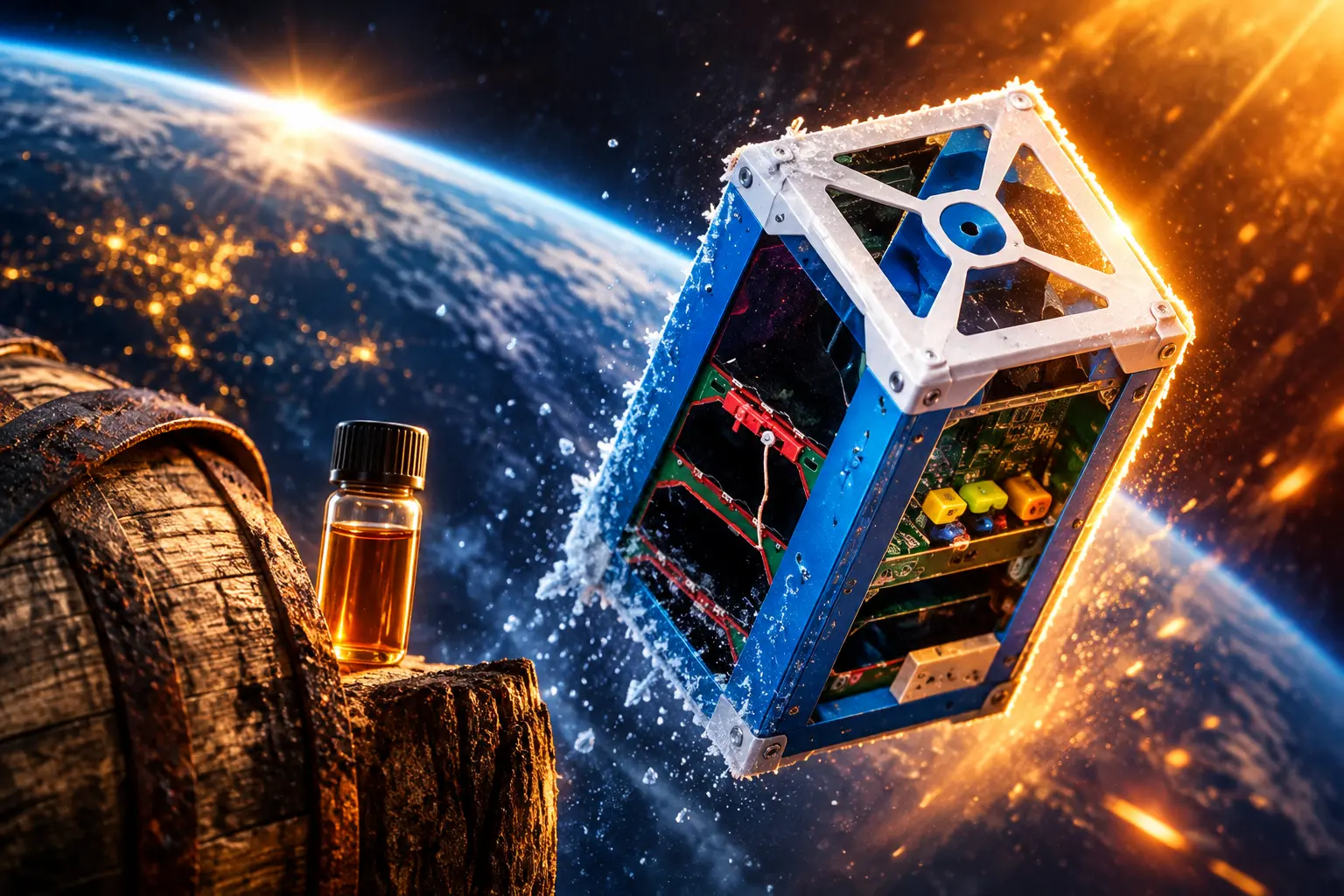
A University of Glasgow team plans to fly 10ml of whisky and a cask fragment on a CubeSat in 2028 and leave it in orbit for up to five years. The satellite, nicknamed Space Puffin, is not coming back. An artificial tongue will watch the chemistry from the ground, in a joint Scotland-Japan CubeSat experiment with the Kyushu Institute of Technology.
Scotland has already sent spirit into orbit. Ardbeg’s vials spent 971 days on the International Space Station, and the oak gave up less flavour there than it did in matching samples on Islay. Space Puffin is a different bet: a free-flying box that will bake and freeze about every 90 minutes, with no glass of the result waiting at the end.
10ml of Spirit Will Circle Earth for Five Years
The current plan is a SpaceX supply run to the International Space Station in 2028, then a shove into its own orbit from the Japanese module. JAXA has been sending small satellites out that way for years, and recent CubeSats deployed from Kibo still use the same airlock-and-arm path. Once Space Puffin is clear of the station, it is meant to run for up to five years.
On board, researchers want a tiny volume of fluid, a piece of cask wood, and a sensor that can watch both. They will also try to show how ethanol can be pulled out of a mix in orbit, using the same cereal, water and yeast chemistry that starts a whisky on Earth. The CubeSat will not carry a barrel. Different distilleries in Scotland and Japan are expected to give samples, but none has been named. Prototype kit was photographed at Glengoyne Distillery in Dumgoyne, which is a location for the pictures, not a confirmed supplier.
WHAT WE KNOW
- Launch target: 2028 on a SpaceX supply flight, then a release from the Japanese module.
- Payload: 10ml of fluid plus a fragment of cask wood, watched by an artificial tongue.
- Time aloft: up to five years of data beamed to Earth.
- Recovery: this CubeSat stays in orbit; there is no plan to bring the 10ml home.
WHAT IS UNCONFIRMED
- The spirit: which Scottish and Japanese distilleries will fill the vials.
- A later bottle: whether investors fund a returnable litre in three to five years.
- The thermal box: how far the spacecraft damps the raw swing of orbital heat and cold.
Seven final-year mechanical engineering students from Glasgow are in Kyushu in autumn 2026 for a three-month design stint on the battery, radio and onboard computers. Micah Chapman is there with Liam Alkire, Fraser Allen, Milo Godwin, Peter Moody, Yuki Suter and Muhammad Taha Malik. Stirling-based distillery design firm Allen Associates paid for the trip. The student group GU Orbit is also on the project.
Ardbeg Already Sent Vials to the Space Station
In August 2011, Ardbeg Distillery on Islay and Houston firm NanoRacks packed MixStix vials for the station: 6ml of new-make distillate separated from charred American white oak shavings taken from an ex-bourbon cask. Astronauts broke the glass divider in January 2012 so the spirit could sit on the wood. Dr Bill Lumsden, then director of distilling, whisky creation and whisky stocks at Ardbeg, ran a matching set of vials on Islay at the same moment.
The station vials came back to the Baikonur Cosmodrome on 12 September 2014 after 971 days of oak contact in orbit, circling Earth 15 times a day. They reached Ardbeg in November 2014. Lumsden’s paper compared gas chromatography, high-pressure liquid chromatography and a tasting panel against the Earth controls. The university’s new project states, plainly, that whisky and oak have been to space before, always inside the station and always with a ride home.
THE SPACE WHISKY CALENDAR
- August 2011: Ardbeg MixStix vials launch toward the International Space Station.
- January 2012: astronauts and Lumsden break the dividers so distillate meets oak in orbit and on Islay.
- 12 September 2014: the station vials land in Kazakhstan after 971 days of contact.
- Autumn 2026: seven Glasgow students arrive in Kyushu to co-design Space Puffin.
- 2028: planned CubeSat launch on a SpaceX supply mission, then a Japanese-module deploy.
The calendar is the point of the new work. Space Puffin is not a first contact between Scotch and orbit. It is a second attempt with a harder thermal cycle and no sample to nose.
The Oak Held Back Its Flavour in Orbit
Major volatile congeners, the alcohols, aldehydes, ketones and esters made in the wash and still, looked much the same in space and on Earth. Phenolics that give Ardbeg its smoke did not shift in a big way either. The split showed up in the wood.
TWO ORBITAL WHISKY TESTS
| Detail | Ardbeg MixStix | Space Puffin |
|---|---|---|
| When | 2011 to 2014 | Planned 2028 |
| Where it sat | Inside the ISS | Free-flying CubeSat |
| Spirit volume | 6ml | 10ml |
| Wood | Charred oak shavings | Cask fragment |
| Time in contact | 971 days | Up to five years |
| Comes home | Yes, September 2014 | No |
| How it is read | Lab tests after return | Artificial tongue in orbit |
Lignin breakdown products, the main flavour-active oak extracts, were higher in the Islay controls than in the station set. Lumsden wrote that microgravity inhibited their extraction from oak. Ellagic acid and gallic acid, tannin breakdown products, ran the other way and looked higher in the space samples. The mix was uneven: some wood compounds came out readily, others did not, so the ratio itself looked odd.
The tasting still surprised the panel. Almost everyone in the triangle tests picked a difference. Earth samples nosed like an aged Ardbeg, woody, with cedar, sweet smoke and balsamic vinegar. The station samples went toward antiseptic smoke, rubber, smoked fish and a perfumed note Lumsden likened to violet or cassis, then smoked fruit, peat, peppermint and ham. He called the space set noticeably different, with more of Ardbeg’s phenolic character showing through.
That is the baseline Space Puffin has to beat. The last time Scotch sat on oak in orbit, the wood did not flood the spirit. It held back.
Why Space Puffin Leaves the Station Behind
Ardbeg’s vials lived in a shirtsleeves laboratory that happens to float. Space Puffin is built to leave that comfort. After the Japanese module lets it go, the CubeSat will see the day-night slam of low Earth orbit, a lap of about 90 minutes. Dr Gilles Bailet of the James Watt School of Engineering, who leads the project, has said temperatures in space can swing from around minus 150 degrees to 200 degrees. The team is designing the spacecraft to give the whisky a kinder box than raw orbit, while still letting the wood move.
“We build our spacecraft to be able to get an environment which is better for the whisky, but this wood will breathe faster than on Earth,” Bailet said. “And so we are hoping that we’ll be able to accelerate the ageing to be able to get something more interesting.”
Warehouse casks already swell and shrink with the seasons. The Glasgow bet is that a 90-minute pulse of heat and cold will make a small stave do that work faster, so colour and chemistry move on a clock a dunnage warehouse cannot match. That is a different mechanism from Ardbeg’s test, which asked what microgravity alone does to terpenes and oak extractives in a stable cabin.
The university also says this will be the first time whisky is exposed to the vacuum of space, because earlier samples never left the station. The liquid still sits inside a sealed CubeSat. The change is the vehicle: a small satellite in free orbit, not a vial in a rack. Bailet has said he wants a full cask and a returnable litre if investors appear, and that a litre could come back within three to five years. That is a later mission. This one ends as data.
A recovered litre would sit with collector bottles, not with a pub optic. The 10ml that flies in 2028 cannot be drunk at all. The joke about a queue of taste testers writes itself, and it misses the hardware. There is nothing to pour.
An Artificial Tongue Will Do the Tasting
Because the satellite stays up, the experiment needs a sensor that can work without a stillman. The kit is a nanophotonic tongue first built at Glasgow by Dr Alasdair Clark, now professor of nanoscale engineering. A 2019 paper in Nanoscale described a reusable gold and aluminium nano-array tongue that reads two plasmonic peaks per patch. Linear discriminant analysis split off-the-shelf whiskies with greater than 99.7 percent accuracy.
In those lab tests, the device tasted Glenfiddich, Glen Marnoch and Laphroaig, told the same whisky aged in different casks apart, and separated 12, 15 and 18 year statements of one brand. The metal “tastebuds” are about 500 times smaller than human ones. Clark has said the tongue cannot name every molecule in a glass, any more than a person can, but it can tell complex mixtures apart fast enough to reuse.
WHAT THE TONGUE IS FOR IN ORBIT
- Terpenes: small shifts in the flavour-building compounds Ardbeg already chased on the station.
- The wood: how the cask fragment changes as it heats and cools each 90-minute lap.
- Colour: a ground link for the look of the spirit as the years pass.
- Ethanol: whether the orbital kit can show extraction of a solvent used in many drugs.
On Earth the tongue was a counterfeit and quality tool. In orbit it is the only palate the mission gets. If the wood really does breathe faster, the trace will be a spectrum, not a dram.
The CubeSat Is an Ethanol Testbed Too
Bailet’s public case for the project is larger than a rare bottle. Whisky, he argues, is a chemistry set people already understand, so it is a fair model for watching fermentation, extraction and slow chemical change when gravity drops away. Ethanol is a workhorse solvent in drug making. The same small satellite is meant to test whether that step can be done in orbit at all.
Whisky gives us a very recognisable, very well-understood model for studying and monitoring biological and chemical processes in microgravity. This project will provide valuable new insights into how fermentation and chemical evolution can be monitored and controlled in space, as well as how ethanol can be made in orbit. Our ultimate aim is that our project could help to scale up chemistry and biomanufacturing in space, where there is a great deal of potential to produce high-value pharmaceuticals and next-generation cancer therapeutics.
Dr Gilles Bailet, James Watt School of Engineering, University of Glasgow
That claim sits on a long station record. NASA has called protein crystal growth on the station the largest single class of experiments there, with hundreds of runs over more than two decades. JAXA accounts for about two-thirds of those protein-crystal studies, many of them in the same Kibo module that will toss Space Puffin overboard. Crystals grown in microgravity have come out larger and more uniform than Earth twins, which is why drug firms keep buying time in orbit.
Bailet has also been building a 3D printer for structures in space, with parabolic-flight tests already done. The whisky CubeSat is a student-scale chemistry bench in that same line of work, not a distillery. If the tongue sees clean ethanol extraction and a wood sample that actually moves, the useful output is a method. The flavour notes are a bonus the first flight cannot pour.
Glasgow Students Reverse Taketsuru’s Old Route
Chapman, one of the seven in Kyushu, reached for a Glasgow story that whisky people already know. “More than a century ago, a Japanese student called Masataka Taketsuru came to Glasgow to study chemistry. While he was here, he visited distilleries and returned to Japan with a detailed knowledge of whisky-making. He began work at a distillery and became world-famous as the father of Japanese whisky.” Chapman said he was thrilled to be on a project that unites Scotland and Japan again, this time by sending that chemistry the other way, into orbit, via Kyushu.
Dr Saeko Yazai of Glasgow’s School of Critical Studies ran Japan orientation for the team with the Consulate General of Japan in Edinburgh. She pointed to a 160-year thread of engineers and students moving between the two countries, Taketsuru among them. Geoff Nisbet, lead process design engineer at Allen Associates, put it in distillery language: the firm’s fingerprints are on stillhouses across Scotland, and he had not expected the next set to end up in space.
Bailet has a local labour argument as well. He said talented students who want a space career have often felt they must leave Scotland, and that flying hardware before graduation is a way to keep that cohort at home. The CubeSat is one piece of that pitch. It is also a three-month crash course in batteries, radios and the unglamorous computers that keep a vial of spirit from becoming debris.
The distilleries that will fill the 10ml have not been chosen. The students in Kyushu are still on the power system and the radio. In 2028, if the supply ship and the Japanese airlock do their jobs, a very small Scottish-Japanese satellite will start a five-year watch on wood and ethanol, and it will not bring a drop back.

A CubeSat Will Age Whisky That Never Comes Home

A Charity Quote Cost Shia LaBeouf the FKA twigs NDA

Looker Turned a Model’s Body Into Ad Inventory

Infinity Ward Bets a Paid DMZ Will Stick This Time

Crew-13 Sets a U.S. Docking Record as Crew-12 Waits

How to Get Pre Boarding on Southwest – Skip the Line with These Tricks

Tim Cook’s $4.6 Trillion Apple Still Runs on One Phone

Dunes Air Sues Nora Fatehi Over Its Luxury Jet

Australia Treats Cloud Software Payments as Taxable Royalties

OpenAI Posts a Navier-Stokes Proof Clay Has Not Touched
-
 TRAVEL3 years ago
How to Get Pre Boarding on Southwest – Skip the Line with These Tricks
-
 BUSINESS1 month ago
Tim Cook’s $4.6 Trillion Apple Still Runs on One Phone
-
 ENTERTAINMENT1 month ago
Dunes Air Sues Nora Fatehi Over Its Luxury Jet
-
 NEWS1 month ago
Australia Treats Cloud Software Payments as Taxable Royalties
-
 NEWS4 weeks ago
OpenAI Posts a Navier-Stokes Proof Clay Has Not Touched
-

 SPORTS3 years ago
Why Marching Band is Not a Sport – The Misconception and Disrespect of Marching Band
-

 LIFESTYLE3 years ago
How Often Do You Have to Change a Monkey’s Diaper? The Truth About Pet Monkeys
-

 NEWS3 weeks ago
False AI Intel Nearly Put US Crews on a Chinese Ship