
BUSINESS
Xi Leaves Washington With Taiwan Arms Still on Hold
Trump and Xi closed a three-day Washington visit with tea and a stability pledge, while a $14 billion Taiwan arms package stayed unsigned ahead of two more meetings.

Donald Trump and Xi Jinping ended their Washington summit on September 25 with tea, an Archives tour, and no signed $14 billion Taiwan arms deal. The White House called the visit one of friendship and success. Beijing called it strategic stability.
The product that will travel is quieter than the flyover. A weapons package Congress cleared in January stayed on the president’s desk, and the two men booked two more meetings before the year is out.
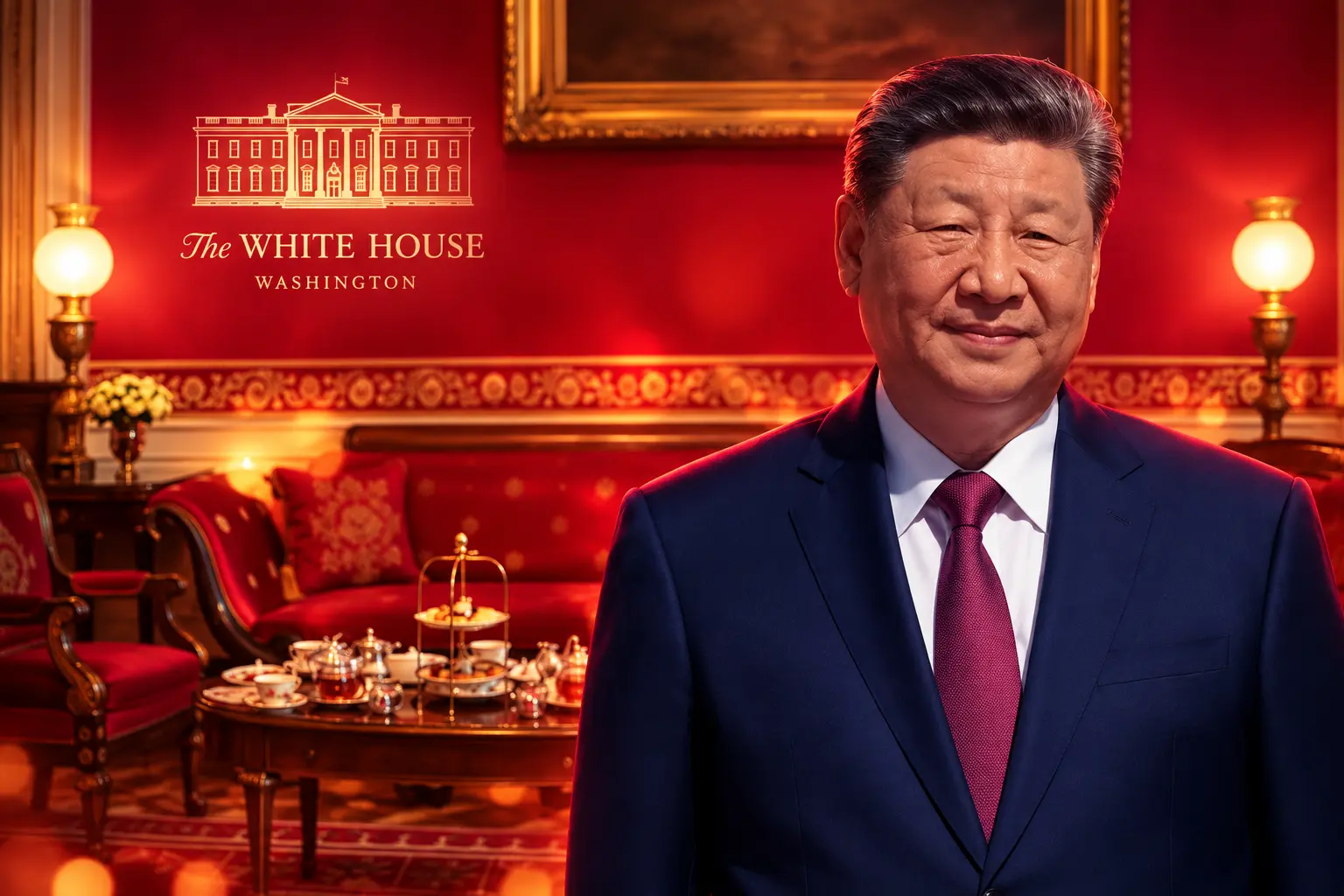
Tea in the Red Room, Then the Archives
Xi Jinping and Peng Liyuan arrived on September 23 for a three-day state visit, the first White House stay by a Chinese president in more than a decade, the White House said, and the first time a Chinese leader has made two formal state visits to the United States. Talks sat on September 24. The close sat on September 25, with tea in the Red Room and a walk through the National Archives, staged for the 250th anniversary of American independence.
THE THREE DAYS IN WASHINGTON
- September 23, 2026: Xi lands for the state visit as Treasury Secretary Scott Bessent says a trade truce set to lapse on November 10 will run to January 10, 2027.
- September 24, 2026: Arrival ceremony, bilateral talks, and a state dinner. Xi tells the South Lawn the two countries must hold the line of no conflict and no confrontation.
- September 25, 2026: Tea in the Red Room, a National Archives tour of the Declaration of Independence, the Constitution, and the Bill of Rights, then farewell on the steps.
Trump used the tea to claim “tremendous strides” and said farmers would be “very happy.” He had already given Xi a custom bald eagle statue at the dinner and a look at Marine One and the new South Lawn helipad, joking that the Chinese leader “likes granite.” At the Archives he compared founding dates aloud: 250 years for the United States, 6,000 for China, “a little difference,” he said, “but we’re very proud of our 250.”
.@POTUS: "We've had a tremendous visit from two spectacular people, and we really enjoyed it — and I think we've made tremendous strides. We've made great strides. Very positive for both countries." pic.twitter.com/X9qDDjEaoH
— Rapid Response 47 (@RapidResponse47) September 25, 2026
The Chinese Foreign Ministry said the presidents exchanging visits in less than half a year was unmatched in the history of the relationship. Xi’s public formula, set in Beijing in May and repeated in Washington, was a “constructive” relationship of “strategic stability on the basis of respect, fairness and reciprocity.” The week’s paper did not put Taiwan weapons, rare earths, or a long trade deal inside that sentence.
The $14 Billion Package Stayed Unsigned
The administration approved an $11 billion Taiwan arms sale in December, described then as the largest to date. A second package, $14 billion, cleared Congress in January and never got a presidential signature. After the May summit in Beijing, Trump said he was holding it “in abeyance” and called it “a very good negotiating chip.” It was still unsigned when Xi left Joint Base Andrews on September 25.
Beijing had treated the signature as a condition of the guest list. Chinese officials warned that announcing the sale could wreck the Washington meeting; Xi landed anyway, which is how you know the condition was met. In the talks he went further than the usual U.S. line of not supporting Taiwan independence. The Chinese readout asked Washington to “adhere to the correct position of opposing ‘Taiwan independence’” and to handle the Taiwan question with caution.
ARMS AND MONEY STILL ON HOLD
| Item | Status after the visit | Amount |
|---|---|---|
| December 2025 arms sale | Approved | $11 billion |
| January 2026 arms package | Unsigned | $14 billion |
| Foreign military financing, per Senate letter | Not moved by the State Department | $300 million |
| Pentagon funds, per Senate letter | Not obligated | $1 billion |
That $300 million and $1 billion are the cash Democrats later bundled as $1.3 billion in funds, sitting beside the $14 billion sale. U.S. Ambassador to China David Perdue told interviewers on September 25 that Taiwan policy had not changed, including the 1979 Taiwan Relations Act, which requires Washington to provide Taiwan with the means to defend itself. “We don’t support independence,” he said, and “we want peace across the strait.” Xi’s ask, on the Chinese record, was that the United States oppose independence, a harder verb than Perdue used.
In the context of the current standdown on Taiwan arms sales, China may increasingly view that restraint as a new baseline rather than a temporary pause. Beijing’s objective is to get Trump to absorb Chinese red lines into his own definition of a stable relationship.
Craig Singleton, China program senior director, Foundation for Defense of Democracies
Secretary of State Marco Rubio, speaking in New York as Xi arrived, gave a different reason for delay: U.S. factories cannot ship what they do not have. “When we sell something, that means we don’t have it anymore,” he said, pointing to munitions strain from the Iran war. Both things can be true on paper. Only one of them explains why Beijing threatened to skip the summit if the package moved first.
WHERE EXPERTS DISAGREE
- David Perdue: The ambassador said there has been no change in Taiwan policy, including the 1979 law, and that Xi has “gotten that message.”
- Nicholas Burns: The former U.S. ambassador to China said Washington is “wavering” from the Taiwan Relations Act, “a very dangerous thing to do,” and that a state dinner for an adversary outranked a true ally.
- Craig Singleton: He reads Xi’s “adhere” as a claim that Washington is already behaving as Beijing wants, and that the pause can harden into the floor of “stability.”
Burns wanted the week’s honors to have gone to Japanese Prime Minister Sanae Takaichi. The White House rolled out a 479-person military arrival, a Silent Drill review, a flyover, and tea service instead. The argument after the close is not whether the china was fine. It is whether an unsigned sale, left in place so the guest would board the plane, is now the price of the next two meetings as well.
Farmers Get a Promise, Details Come Monday
Trade was the track that actually produced paper, and even there the week bought time more than it closed a market. Bessent announced the two-month truce extension on September 23, moving the Busan lapse date from November 10, 2026, to January 10, 2027. U.S. Trade Representative Jamieson Greer, speaking as the visit ended, called the arrangement “a managed trade situation” and said more detail would come on September 28.
The White House did not wait for Monday to name a figure. Its September 25 fact sheet said the Board of Trade, chartered in Beijing in May and “operationalized” this visit, reached consensus on more favorable tariff treatment for $30 billion of non-sensitive goods in each direction. U.S. exports on that list include farm goods, fish and seafood, logs and wood products, cosmetics, and medical devices. U.S. imports include small appliances, toys, holiday decorations, and children’s car seats. A working group will sit on farm market-access barriers. China, the same sheet said, will import at least 10 million metric tons of U.S. coal in 2027 and again in 2028.
WHAT THE BOARD OF TRADE PUT ON PAPER
| Track | What was written down | When it bites |
|---|---|---|
| Preferential goods lane | $30 billion each way, non-sensitive products | Consensus dated September 25; Greer promised more on September 28 |
| Coal | At least 10 million metric tons from the United States | 2027 and 2028 |
| Tariff truce | Two-month extension of the Busan pause | Through January 10, 2027 |
| Farm purchases | Prior 25 million metric ton soybean pledge still in force, per Greer | Each year, 2026 through 2028 |
Greer said the point of the lane is insulation: those goods would keep better terms even if either government later piled on new tariffs. He also said China had agreed to buy more soybeans and other farm products and to keep rare earths flowing to U.S. plants, and that Washington would “evaluate and reevaluate” whether the “relative peace” on the economic front should continue. Bessent had already said China was behind schedule on farm purchases. Trump’s line that farmers will be happy is a forecast. The soybean pledge of 25 million metric tons a year was signed last year. The new coal tons sit in 2027 and 2028. Monday’s release is where the $30 billion is supposed to turn into product codes and dates.
Taipei Asks Whether Concessions Help America
Taiwan was not in the room and still sat in the middle of it. Deputy Foreign Minister Francois Wu, speaking in Taipei on September 26, asked whether concessions on the island would serve U.S. interests at all. Keeping military sales, giving Taiwan enough to defend itself so it does not live under Chinese rule, and “allowing Taiwan’s semiconductor industry to continue contributing to the world, these are important U.S. interests,” he said. Taiwan makes the advanced chips that train the same systems Washington and Beijing have now agreed to discuss under a new name.
Wu said Taipei had been in “continuous communication” with Washington through the visit. On the next two leader meetings, he did not pretend the calendar was harmless. “Of course, if we can get guarantees, that would be best.” Short of that, “prepare as much as possible, communicate as much as possible, and make requests as much as possible.” He added that “many things we thought would be very bad didn’t happen,” a careful way of saying the week could have been worse and still was not a clearance of the $14 billion sale.
People’s Daily, the party’s flagship paper, did not wait for Monday’s trade sheet. On September 26 it called Taiwan “the core of China’s core interests and the first unbreakable red line in China-U.S. relations.” That is the baseline Beijing wants written under the word stability. Perdue’s “we don’t support independence” is the baseline Washington is willing to say out loud. The gap between those verbs is where the unsigned crate sits.
Senate Letters Landed Before Xi Did
Congress did not treat the pause as a rounding error. On September 23, Sens. Mitch McConnell, John Cornyn, Lisa Murkowski, and Thom Tillis wrote Rubio and Defense Secretary Pete Hegseth about more than $15 billion in stalled security help: the $300 million in financing, the $1 billion at the Pentagon, and the $14 billion sale. “We are concerned by President Trump’s description of Taiwan as ‘a very good negotiating chip’ in engagements with Xi Jinping and the Chinese Communist Party,” they wrote. Influence in the Indo-Pacific, they argued, is hard to project if the price of a polite arrival ceremony is “denying our partners key deterrent capabilities.”
WHAT THE SENATE ASKED FOR
- The sale: Immediate movement on the $14 billion package of missile defenses, anti-drone gear, and related systems.
- The cash: Obligation of the $300 million in foreign military financing and the $1 billion at the Defense Department.
- The Democrats’ add: A statement signed by at least 19 of the 47 members of the Senate Democratic caucus also demanded that aid, plus a public push on human rights and on Americans still detained.
The Democratic text went further on chips and minerals, criticizing looser rules on high-end chip sales to China and calling the two-month tariff truce a weak answer to Beijing’s hold on rare-earth refining. Some of Trump’s fellow Republicans marked the same week by asking him to release the Taiwan funds. Rubio’s factory-capacity argument does not move those letters off the table. It also does not sign the package. If the pause was a chip, the visit ended with the chip still in Trump’s hand and Xi already booked for two more bites at it.
What Two More Summits This Year Freeze
Xi invited Trump and Melania Trump to the APEC leaders’ meeting in Shenzhen in November and said they could meet again at the G20 in Miami in December. Trump answered, “We will, and we’ll be speaking a lot.” After Xi’s plane left, he put it on the record: meetings in China in November and at the G20 in December in Miami. “Much has been, and will be, accomplished.”
The White House fact sheet says both governments will support each other as hosts and that both leaders intend to attend. That is three leader-level meetings in one year once you count Beijing in May, Washington in September, and the two still ahead, a pace the Chinese side called unmatched. Each date is another chance to trade a photo for a delay. Wu flagged exactly that risk on September 26. Analysts who watched the May hold already said Beijing would try to push any signature past the U.S. visit; the U.S. visit has now come and gone, and the signature did not.
A pause that lasts from January to May can be called a chip. A pause that then survives September, with November and December already on the calendar and a trade truce running into January, starts to look like the furniture. Singleton’s warning was that China would treat restraint as the new floor. The floor is what you stand on when you say the word stability.
Iran, Hormuz, and a New Name for AI
Asked at the Archives whether the two men had discussed the war involving Iran, Trump said, “We did, we did.” On reopening the Strait of Hormuz, he said, “I think we’re going to do great,” and stopped there. The White House fact sheet filled in two lines the podium did not: the leaders agreed that Iran can never have a nuclear weapon, and that “no country or institution can be allowed to impose tolls on international waterways.” Trump also urged Xi to raise output of refined petroleum to steady global supply. Beijing has denied U.S. claims that it has backed Iran in the fighting. Nothing in the public paper shows a joint plan for the strait, only those two sentences and Trump’s forecast.
Artificial intelligence got a rebrand on the American side of the paper. The fact sheet said the leaders agreed to use “super intelligence” rather than “artificial intelligence,” set up a U.S.-China Super Intelligence Dialogue whose next exchange will come by November 2026, and opened a bilateral channel for incidents. Xi’s own readout kept the old name. He said the two countries “may have competition, but they may cooperate even more,” that AI “must be kept under human control,” and that the work should be “for the positive and for good.” There was no public deal on export controls, chip sales, or model limits. The dialogue’s first date sits in the same month as APEC in Shenzhen, which means the AI channel and the Taiwan ask will share a calendar.
Xi leaves with the guest honors, a two-month trade pause, a $30 billion goods lane still waiting on Monday’s fine print, and a U.S. weapons package that did not move. Trump leaves with a farmer’s promise, a coal tonnage in 2027, and another session with Xi in China before Thanksgiving. People’s Daily has already named the red line it expects those sessions to respect. The crate on the desk is how you measure whether they did.

A CubeSat Will Age Whisky That Never Comes Home

A Charity Quote Cost Shia LaBeouf the FKA twigs NDA

Looker Turned a Model’s Body Into Ad Inventory

Infinity Ward Bets a Paid DMZ Will Stick This Time

Disney Sidesteps a Kimmel Renewal as Failla Cites Losses

How to Get Pre Boarding on Southwest – Skip the Line with These Tricks

False AI Intel Nearly Put US Crews on a Chinese Ship

Tim Cook’s $4.6 Trillion Apple Still Runs on One Phone

Dunes Air Sues Nora Fatehi Over Its Luxury Jet

OpenAI Posts a Navier-Stokes Proof Clay Has Not Touched
-
 TRAVEL3 years ago
How to Get Pre Boarding on Southwest – Skip the Line with These Tricks
-
 NEWS1 month ago
False AI Intel Nearly Put US Crews on a Chinese Ship
-
 BUSINESS2 months ago
Tim Cook’s $4.6 Trillion Apple Still Runs on One Phone
-
 ENTERTAINMENT2 months ago
Dunes Air Sues Nora Fatehi Over Its Luxury Jet
-
 NEWS2 months ago
OpenAI Posts a Navier-Stokes Proof Clay Has Not Touched
-

 LIFESTYLE3 years ago
How Often Do You Have to Change a Monkey’s Diaper? The Truth About Pet Monkeys
-

 NEWS2 months ago
Australia Treats Cloud Software Payments as Taxable Royalties
-

 LIFESTYLE3 years ago
How Long Does It Take for Armpit Hair to Grow? The Stages of Hair Growth and How to Shave It