
NEWS
Joshna Chinappa’s Sixth Medal Leaves the Olympic Door to Anahat
Joshna Chinappa locked a sixth Asian Games medal in Nagoya, but only a singles gold is a named Los Angeles 2028 squash place.

Joshna Chinappa locked a sixth Asian Games medal on Friday, September 25, when she and Velavan Senthilkumar reached the mixed doubles semifinals in Nagoya. Anahat Singh and Abhay Singh joined them in the last four of the singles draws, where a gold medal is a named place at Los Angeles 2028 and a bronze is not.
Squash makes its Olympic debut at those Games. The Asian Games men’s and women’s singles champions take the first named quotas, subject to eligibility. Mixed doubles does not. That split is now the whole Indian day on court.
Three Indian Squash Paths Split on Saturday
The eight-person Indian squad is playing five events at the Nagoya Kinjo Futo Arena, with singles and mixed doubles running through September 27 and team ties from September 28 to October 2. Friday’s quarterfinals put three Indian names into Saturday’s medal round, and they are not the same kind of medal round.
Chinappa, 40, and Senthilkumar needed less than half an hour to beat David Pelino and Jemyca Aribado of the Philippines 11-3, 11-5. There is no mixed doubles bronze play-off on the published schedule, so that semifinal berth is already a medal. Anahat and Abhay still have to win once more for a final, or win Sunday’s 3/4 play-off for bronze if they lose.
FRIDAY’S THREE PATHS
| Event | India | Friday score | Saturday opponent | LA 2028 quota |
|---|---|---|---|---|
| Mixed doubles | Joshna Chinappa, Velavan Senthilkumar | 11-3, 11-5 vs Philippines | Yo Ka Lee, Ming Hong Tang (Hong Kong) | No |
| Women’s singles | Anahat Singh | 11-2, 11-5, 11-3 vs Tanvi Khanna | Satomi Watanabe (Japan) | Gold only |
| Men’s singles | Abhay Singh | 11-4, 11-3, 11-6 vs Ryonosuke Tsukue | Muhammad Ashab Irfan (Pakistan) | Gold only |
Senthilkumar is at his first Asian Games. The pair, seeded three, had already beaten Indians Suraj Chand and Shameena Riaz 11-7, 11-10 in the round of 16. They play Hong Kong from 8:30 a.m. IST on Saturday, September 26.
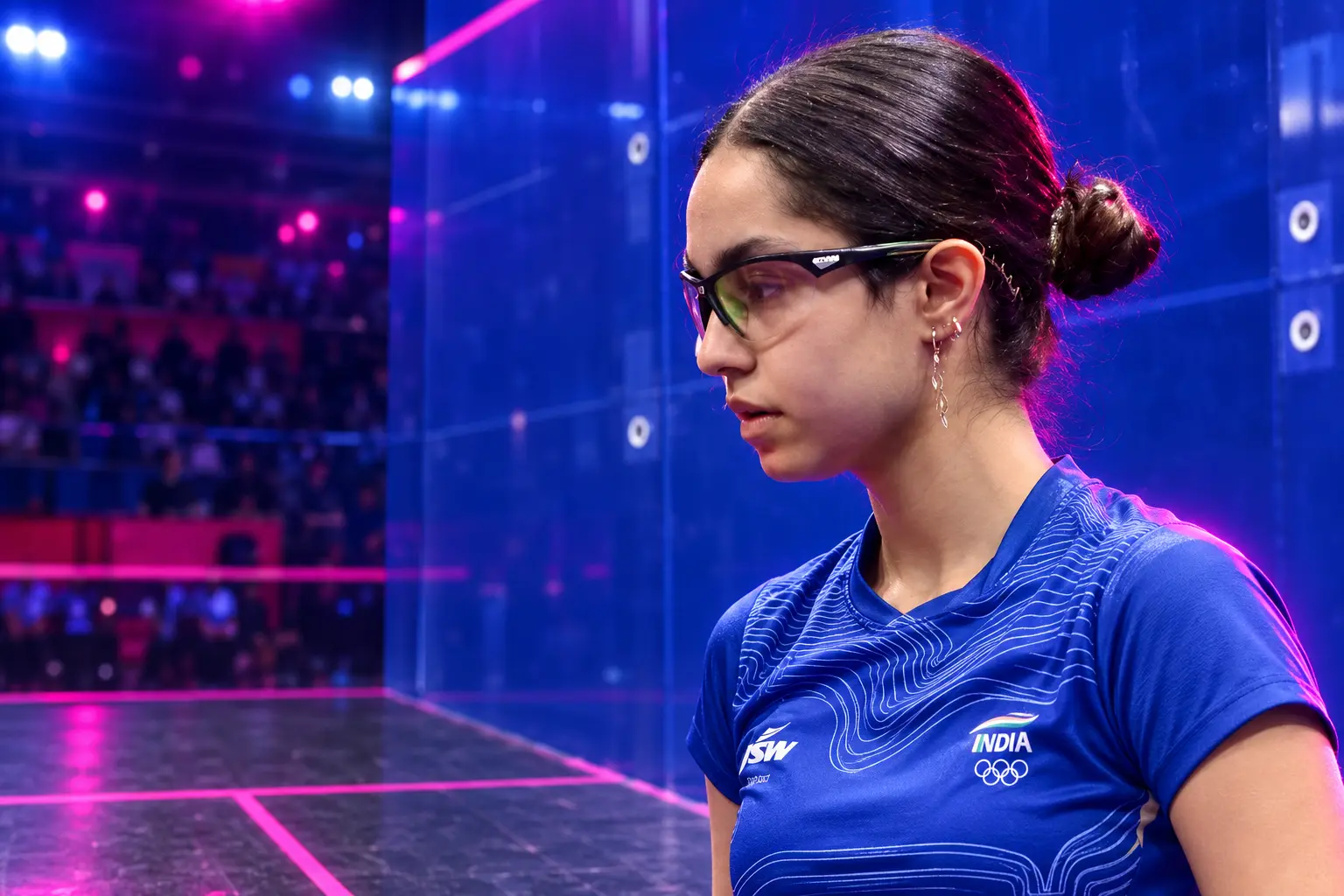
Joshna Chinappa’s Sixth Medal Comes Without Gold
Chinappa turned 40 on September 15, ten days before the quarterfinal, and is playing a record seventh Asian Games. She has been in the Indian side at every edition since Busan 2002, when she was 16. That is 24 years. Saurav Ghosal, who retired in 2025, had held the squash mark at six appearances.
The medal is her sixth at the Games and her first in mixed doubles. She still has never won Asian Games gold. The previous five were a team bronze in Guangzhou in 2010, team silver in Incheon in 2014, team silver and a singles bronze in Jakarta in 2018, and team bronze at Hangzhou in 2022.
SEVEN GAMES, ONE MISSING COLOUR
- 2002, Busan: Debuts at 16, no medal.
- 2006, Doha: Second Games, still off the podium.
- 2010, Guangzhou: Team bronze, India’s first squash medal at the Asian Games.
- 2014, Incheon: Team silver.
- 2018, Jakarta: Team silver and a singles bronze.
- 2022, Hangzhou: Team bronze, with Anahat already in that women’s group.
- 2026, Nagoya: Seventh Games, mixed doubles semifinal, sixth medal.
Indian squash had 18 Asian Games medals before Nagoya, three of them gold. Two of those golds came in Hangzhou, through the men’s team and the mixed doubles pair of Dipika Pallikal and Harinder Pal Sandhu, who is coaching this squad. Chinappa has gold from the World Championships, the Commonwealth Games and the Asian Championships. The Asian Games title is the one that has not arrived.
Winning a medal for your country is always very special. And that’s been my motivation all my career.
Joshna Chinappa, after the mixed doubles quarterfinal, Nagoya Kinjo Futo Arena
She said she had not expected to still be here for a seventh Games. She trains five to six hours a day, five or six days a week, with a fitness trainer, a psychologist, a coach, a nutritionist and a dietician, plus meditation and breathing work. After 35 she had to change that load, with more gym work because the body no longer recovers as it did. “I don’t really have any targets, to be honest,” she said. “Right now, I’m just happy playing for India.”
That is a useful correction to the farewell talk that followed the sixth medal. She has not said this is a last dance. She has said she is taking the next match, against Hong Kong, and that Asian Games gold is brutally hard because so many of the world’s best players are Asian.
Anahat Singh Ends an All-Indian Quarterfinal in 15 Minutes
Anahat is 18, ranked 20 in the world, and the third seed. She is also the junior world champion, a title she won on July 25 in Niagara-on-the-Lake by beating Egypt’s Ruqayya Salem 11-3, 11-7, 11-9. That ended a long Egyptian hold on the girls’ title and went one step past Chinappa’s runner-up finish in 2005, which had stood as India’s best result at those championships.
She had a bye into the round of 16 here and beat Singapore’s Au Yeong Wai Iynn 11-4, 11-5, 11-7. Waiting in the quarterfinal was Tanvi Khanna, 30, the seventh seed, ranked 63 at the time of the Asian Games seedings. Tanvi had come through Kim Dami of Korea and Au Yeong Wai Yhann of Singapore. The all-Indian match lasted 15 minutes.
Anahat took the first game 11-2 in five minutes with drops that Tanvi never settled against. The second was 11-5 in six minutes. The third was 11-3. Tanvi scored 10 points in the match. Anahat now has a bronze play-off on Sunday if Saturday goes wrong, and a gold-medal match if it does not. She was already on the Hangzhou podium in the women’s team and mixed doubles. This is the first time the singles gold is also an Olympic place.
Satomi Watanabe Is the Home Wall on Saturday
The semifinal is against Japan’s Satomi Watanabe, the world No. 6 and a Hangzhou bronze medallist, from 10:30 a.m. IST. Ghosal, who coaches Anahat, put the tactical problem in one line last week: whether Anahat can make Watanabe play Anahat’s game, with angles and variety, rather than Watanabe’s hard, flat hitting.
They have played once on the PSA tour. At the Tournament of Champions on January 25, Anahat won the first two games 11-6, 11-6, then lost 2-11, 8-11, 6-11. Watanabe changed shape after the hole and took the last three games. That is the tape both camps already have.
WHAT SATURDAY’S WOMEN’S SEMIFINAL CARRIES
- The ranking gap: Anahat is world No. 20; Watanabe is world No. 6 and the home player in Nagoya.
- The last meeting: Anahat led 2-0 in January and still lost 2-3 at the Tournament of Champions.
- The medal math: a win puts Anahat in Sunday’s gold match at 1:30 p.m. IST; a loss sends her to the 8:30 a.m. bronze play-off.
- The Olympic clause: only the women’s singles champion gets a named Los Angeles quota, and only if she meets eligibility rules later in the cycle.
Malaysia’s Sivasangari Subramaniam, the world No. 5, sits on the other side of the women’s draw as the top seed. The final, if Anahat gets there, is the match that would actually punch the ticket. Saturday is the match that decides whether that final exists for her.
Abhay Singh Meets Pakistan After Veer Chotrani Falls
Abhay, 28, from Chennai, is the second seed and ranked 24. He has been clinical. He beat Thailand’s Arkaradet Arkarahirunya 11-1, 11-0, 11-2, Sri Lanka’s Ravindu Laksiri 11-3, 11-5, 11-6, then Japan’s Ryonosuke Tsukue 11-4, 11-3, 11-6 in 30 minutes. Tsukue was the local favourite. Abhay never let him build a game.
The semifinal is Pakistan’s Muhammad Ashab Irfan, from 11:15 a.m. IST. Irfan had to come from a game down to beat Veer Chotrani, India’s fourth seed, ranked 38 at seeding. Chotrani took the first game 11-6 after a ten-minute burst, then dropped 8-11, 3-11, 3-11. The match ran 41 minutes. Two days earlier Chotrani had survived a five-game round of 16 against Malaysia’s Sanjay Jeeva. He could not repeat that recovery.
Ghosal said in May that if Olympic places were handed out on rankings at that moment, Indian men would miss the eight ranking slots, which is why he called the Asian Games the best path. He also said medalling is one thing, and that this path requires a title. Abhay is the Indian in a position to test that. A win on Saturday puts him in Sunday’s gold match at 12:30 p.m. IST. A loss puts him in the 9:15 a.m. bronze play-off. Irfan is 22. The India-Pakistan men’s singles meeting is the one Friday result that still has a live rivalry attached.
How an Asian Games Gold Becomes an Olympic Place
The IOC executive board approved the squash system on February 1 in Milan. World Squash and the PSA built five routes to a 16-player draw in each gender, 32 athletes in all, with a cap of two players per country. Matches at Los Angeles will be singles only, at the Comcast Squash Center at Universal Studios, from July 15 to 24, 2028.
Nagoya is the first event on that map. Five athletes per gender come from continental titles. The United States, as host, gets one place per gender. Eight more come from the PSA world list. One universality place sits beside a 24-player last tournament on June 6-10, 2028. The ranking places lock on 22 May 2028. A continental champion who later fails eligibility can see that quota move to the next eligible player from the same event.
LA 2028 SQUASH PLACES PER GENDER
| Route | Places | When it is decided |
|---|---|---|
| Continental title, including the Asian Games | 5 | 2026 and 2027 |
| Host place (United States) | 1 | Already assigned, with conditions |
| PSA world rankings | 8 | 22 May 2028 |
| Universality | 1 | Early 2028 window |
| Final qualifying tournament | 1 | June 6-10, 2028 |
That is why a mixed doubles medal, even a sixth for Chinappa, does not move the Olympic list, and why a singles bronze does not either. Chinappa herself pointed at the younger group. She called the Olympic debut overdue and said India has players who can be stronger in two years and can win a medal in Los Angeles. She still plays PSA singles; doubles, she said, is something they put together for the Games.
Team Matches Start After the Singles End
The Saturday singles semifinals in Nagoya sit in front of a second week that the Friday recap barely reached. Women’s team pool play begins September 28. India’s women, Anahat, Chinappa, Tanvi and Shameena, are in Pool C with Japan, China and Iran. The men’s team of Abhay, Chotrani, Senthilkumar and Chand is in Pool A with Korea and China. Team quarterfinals are September 30. Gold matches are October 2.
Japan is in the women’s pool, which means Watanabe’s country is still on the sheet even after Saturday. China is in both Indian pools. Those ties do not carry Olympic quotas. They are the rest of the programme that starts once the named tickets are either taken or left on the table.
Chinappa and Senthilkumar play first on Saturday, then Anahat against Watanabe, then Abhay against Irfan. Sunday’s order is the women’s bronze play-off, the men’s bronze play-off, the mixed doubles final, the men’s gold match and the women’s gold match. One Indian medal is already in the bag. The two that can still change a 2028 draw are the ones that have to be won, not reached.

A CubeSat Will Age Whisky That Never Comes Home

A Charity Quote Cost Shia LaBeouf the FKA twigs NDA

Looker Turned a Model’s Body Into Ad Inventory

Infinity Ward Bets a Paid DMZ Will Stick This Time

Disney Sidesteps a Kimmel Renewal as Failla Cites Losses

How to Get Pre Boarding on Southwest – Skip the Line with These Tricks

False AI Intel Nearly Put US Crews on a Chinese Ship

Tim Cook’s $4.6 Trillion Apple Still Runs on One Phone

Dunes Air Sues Nora Fatehi Over Its Luxury Jet

OpenAI Posts a Navier-Stokes Proof Clay Has Not Touched
-
 TRAVEL3 years ago
How to Get Pre Boarding on Southwest – Skip the Line with These Tricks
-
 NEWS1 month ago
False AI Intel Nearly Put US Crews on a Chinese Ship
-
 BUSINESS2 months ago
Tim Cook’s $4.6 Trillion Apple Still Runs on One Phone
-
 ENTERTAINMENT2 months ago
Dunes Air Sues Nora Fatehi Over Its Luxury Jet
-
 NEWS2 months ago
OpenAI Posts a Navier-Stokes Proof Clay Has Not Touched
-

 LIFESTYLE3 years ago
How Often Do You Have to Change a Monkey’s Diaper? The Truth About Pet Monkeys
-

 NEWS2 months ago
Australia Treats Cloud Software Payments as Taxable Royalties
-

 LIFESTYLE3 years ago
How Long Does It Take for Armpit Hair to Grow? The Stages of Hair Growth and How to Shave It