
AUTO
MG Bets the Hector Cabin Can Sell a Family EV
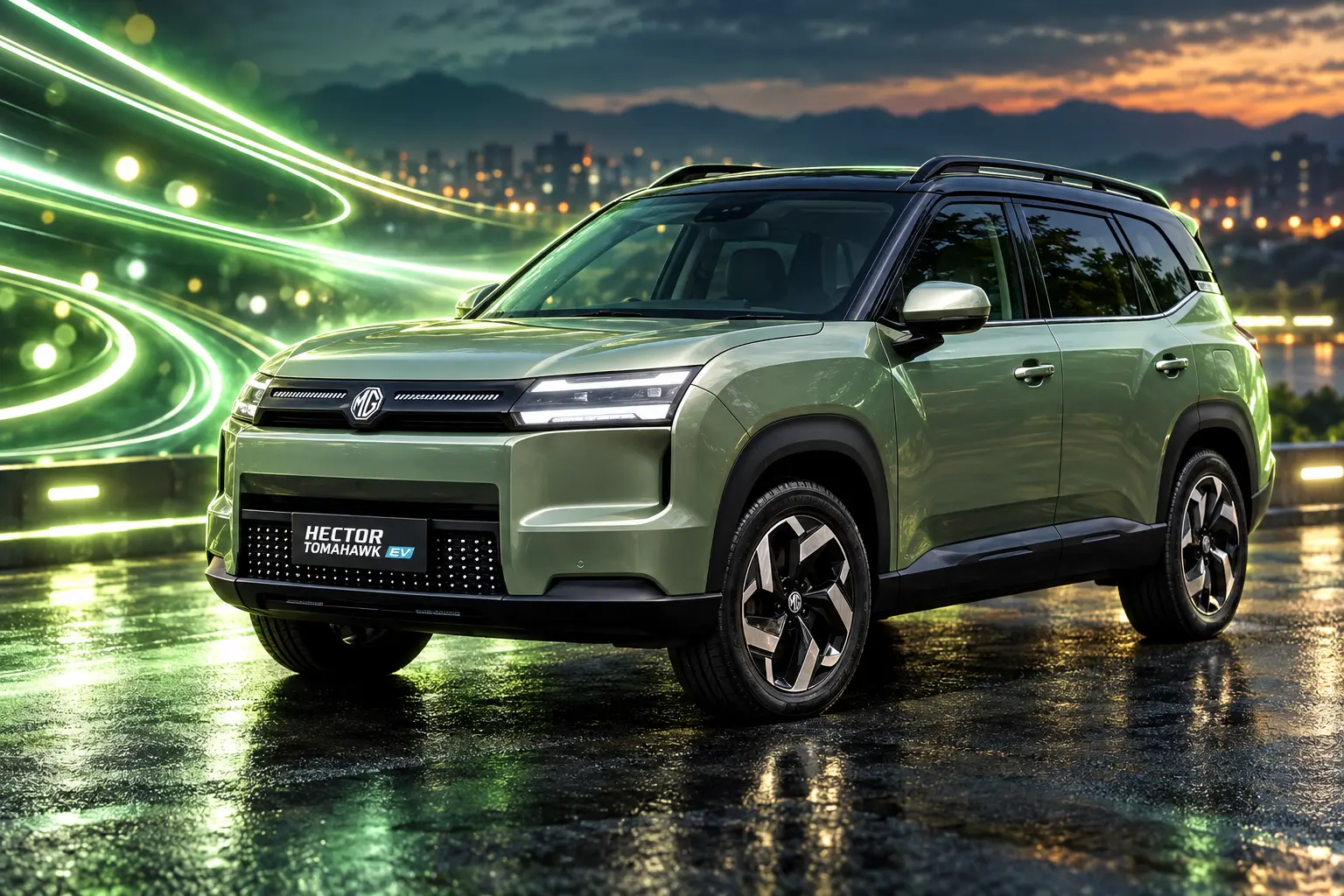
The MG Hector Tomahawk EV sells seven seats, Battery-as-a-Service from ₹13.99 lakh and vehicle-to-home power.

JSW MG Motor India priced the Hector Tomahawk EV from ₹19.49 lakh on 26 August 2026, or ₹13.99 lakh if you rent the battery at ₹4.90 a kilometre. The 69.2 kWh pack is certified at 517 km, and an MG-hosted drive in Kochi already points to about 400 km when the car is not being wrung out.
Seven seats, a wall-box that arrives with the car, and a battery that can feed a house are the levers. The 15.6-inch screen is how MG has sold a Hector since 2019.
The Hector Name Is Doing the Hard Selling
This is not a battery pack dropped into the petrol Hector. The Tomahawk is a new, taller SUV built at Halol in Gujarat on MG’s ADAPT architecture, a rebrand of Baojun’s Tianyu D setup, and it is offered as a five-seater or a seven-seater. It is 4,745 mm long, 1,850 mm wide and 1,770 mm tall, with a 2,810 mm wheelbase, so it sits larger than the combustion Hector it still shares a name with.
Anurag Mehrotra, managing director of JSW MG Motor India, has spent years tying that name to volume. The petrol and diesel Hector was the company’s first India product and, by his count at the December 2025 facelift, had found 1,50,000 customers.
The Hector was our maiden nameplate and quickly became synonymous with the MG brand, emerging as one of India’s most loved SUVs with 1,50,000 customers since its debut.
Anurag Mehrotra, Managing Director, JSW MG Motor India, All-New Hector launch
The electric bet sits on a second nameplate too. The Windsor EV, which took Battery-as-a-Service into the Indian passenger-car market, had passed 75,000 sales by July 2026. JSW MG sold 70,554 vehicles in 2025 and has said it wants 100,000 in 2026, with Halol able to build about 6,000 Tomahawks a month across the EV and the plug-in hybrid. Parth Jindal, a director at the company, said at launch that the two versions could be sold out for the rest of 2026 within two weeks. That remains his claim, not a booked-out confirmation.
THE TOMAHAWK CALENDAR
- 16 July 2026: JSW MG unveils ADAPT, the architecture that supports EV, HEV, PHEV and REEV on one floorplan.
- 26 August 2026: Hector Tomahawk EV and PHEV prices go public, with EV Battery-as-a-Service from ₹13.99 lakh.
- September 2026: EV test drives, showroom cars and deliveries are scheduled to begin.
- November 2026: The plug-in hybrid, priced from ₹25.69 lakh, is due to follow for buyers who still want a petrol tank.
The PHEV is the hedge for diesel switchers. The EV is the car you can order now, and it is the one testers have already put on Kerala tarmac.
Seven Seats Start at ₹13.99 Lakh
Outright, the Tomahawk EV runs from ₹19.49 lakh to ₹23.49 lakh, all ex-showroom. The five-seat body is locked to the top Essence trim. The seven-seat body is the default on Excite and Exclusive, and it is still available on Essence. MG calls the Battery-as-a-Service rates introductory and limits them to a set number of bookings.
HECTOR TOMAHAWK EV EX-SHOWROOM CARD
| Variant | Seats | Outright | BaaS (plus ₹4.90/km) |
|---|---|---|---|
| Excite | 7 | ₹19.49 lakh | ₹13.99 lakh |
| Exclusive | 7 | ₹21.99 lakh | ₹15.99 lakh |
| Essence | 5 | ₹22.99 lakh | ₹16.99 lakh |
| Essence | 7 | ₹23.49 lakh | ₹17.49 lakh |
A 7.4 kW AC wall box and its installation come with the car, which is a bill many rivals still add later. The first owner also gets a lifetime warranty on the high-voltage pack; a second owner or a commercial registration falls back to 8 years or 1,60,000 km, whichever comes first. The vehicle warranty is 3 years with no kilometre cap, roadside assistance matches that term, and two labour-free services sit in the box. MG’s 3-60 buyback plan promises 60 percent of the original ex-showroom price after three years if you take that extra cover.
Desert Squadron Looks Rich Until You Find the Wires
MG names the cabin Desert Squadron: almond-brown man-made leather on a black dash, a white headliner, brushed aluminium, and a two-spoke flat-bottom wheel. Testers on the Kochi drive called the layout likeable and free of squeaks. They also left a punch list that will matter more than karaoke after the first month.
CABIN NOTES FROM THE KOCHI DRIVE
- The horn: The pad is hard to reach with your thumbs and hard to press, which is a poor joke in Indian traffic.
- The mirror: Exposed wiring behind the auto-dimming IRVM is the one finish miss you see every time you glance up.
- The sills: No scuff plates, front or rear, on a tall SUV that will see school shoes.
- The seats: Six-way electric adjustment with memory for the driver, four-way electric for the passenger, and ventilation for both, but the foam is soft and one tester wanted out on a longer stint.
- The screen pile: Regen level, seat ventilation and several ADAS toggles live in the 15.6-inch head unit, and some of those menus want the car stopped.
- The camera: The 360-degree view with a transparent-chassis mode is there; the image quality is not the best in class.
- The rear bench: A 5-foot-10 tester had spare knee and head room, a flat floor for a middle passenger, 60:40 split and recline, sunblinds, two USB-C ports and a wide armrest, with a knees-up pose from the high EV floor.
Physical switches still exist for the air-conditioning and the hazards. A 50W wireless pad with a cooling vent sits in the console, with a second phone shelf beside it. Music runs through a 10-speaker Infinity system that stayed clean at high volume on the test car, even if some drivers wanted sharper treble. i-SMART brings 80-plus connected features, wireless Android Auto and Apple CarPlay, gesture control, and a Gen AI voice assistant that will also do karaoke. Ambient lighting is a 256-colour setup along the dash, doors and roof. The dual-pane sunroof is huge, with an electric opaque shade.
The five-seat boot is 610 litres, and folding the second row opens 1,053 litres. The seven-seat body is the honest family trade: 192 litres with all three rows up, 528 litres with the third row folded. There is no frunk under the bonnet, which is empty space a front-motor EV could have used. Tools, the charging lead and the warning triangle sit in a segmented tray under the boot floor. The tailgate is powered.
What 200 Kilometres in Kochi Returned
The motor sits on the front axle and makes 150 kW, 204 PS and 310 Nm. MG’s 0 to 100 km/h claim is 8.2 seconds. In Kochi traffic the car will creep at 7 km/h with no throttle, which takes the sting out of crawl-and-go queues. On a clear road it is brisk enough to leave a red light ahead of most petrol SUVs, and it will hold three-digit speeds without fuss. It is not a dual-motor toy, and the testers said as much: useful, not exciting, and the range falls fast if you keep asking for the 8.2-second figure.
Four drive modes retune throttle, brakes and steering weight. Standard is the default and the one that makes sense most of the day. Eco dulls the throttle and is the smoothest in town. Sport sharpens everything and is the overtake mode on undivided highways; in the city the same mapping can feel spiky. Custom lets you mix the pieces. Cabin insulation is the quiet EV kind, helped by sound-absorbing glass, with wind and tyre roar kept in check.
Regen is the miss. Four levels (Comfort, Standard, Strong, Intelligent) live in the touchscreen, with no paddles and no true one-pedal mode. Even Strong still wants the pedal to finish a stop. Intelligent tries to read traffic and choose a level for you. For a family EV that will spend its life in city jams, that is a daily irritation, and it is the complaint that keeps coming back from people who have already driven the car in Kerala.
Over roughly 200 km of mixed running, including hard sprints, idling and mode-flicking, the testers used about half the battery and said a careful driver should see about 400 km. That sits under the 517 km MIDC claim and in line with a separate 140 km Kerala loop that returned about 6 km per kWh, which also points to more than 400 km if you are not showing off. Use the 517 km figure for the brochure. Budget 400 km for a real week.
The chassis is MacPherson strut in front and multi-link at the rear, on 18-inch wheels with 225/55 JK Tyre Ranger HP rubber at 36 psi. The ride is on the firm side. Low-speed broken tar comes through as jiggly, and a deep pothole still thumps the cabin; it calms down as speed rises and stays stable in a straight line at highway pace. Body roll on a tall SUV is present and controlled. The Rangers start squealing earlier than you want in a hairpin, so the first owner who likes a ghats weekend will be shopping for stickier rubber. Steering is light in town and weights up with speed, with little genuine feel. The discs stop the car in a straight line from high speed; the pedal itself feels numb.
Front-Drive and 90 kW Are the Trade
This is where the wager shows its cost. The Tomahawk EV uses a CCS2 port and a 90 kW DC peak, with 30 to 80 percent quoted in 35 minutes. Overnight, the included 7.4 kW AC unit needs about 12.5 hours from 10 to 100 percent. A portable 15A lead is in the boot. Ground clearance is 230 mm at the pack, and the testers cleared Kerala speed breakers without drama. Full underbody shielding hides the cables. A 17-inch space-saver (T145/70, 60 psi) hangs under the floor, which is more honest than a tyre-repair kit on a family SUV.
In the five-seat electric SUV band, market listings put the Mahindra XEV 9e from ₹21.90 lakh and the Tata Harrier EV from about ₹21.49 lakh. Both quote higher certified ranges on their bigger packs and both sit in the 175 kW charging class. The Tomahawk’s answer is a lower entry price, a 7.4 kW box in the deal, and the option of a third row that those two do not offer. The three-row fight is a different shelf: Mahindra’s XEV 9S and the Kia Carens Clavis EV. Treating the Tomahawk as the only seven-seat EV in India would be wrong. Treating it as the cheapest way into a 69.2 kWh three-row EV is the actual pitch.
HOW THE FIVE-SEAT EV RIVALS LINE UP
| Model | Entry price | Battery | Claimed range | DC peak | Third row |
|---|---|---|---|---|---|
| Hector Tomahawk EV | ₹19.49 lakh | 69.2 kWh | 517 km MIDC | 90 kW | Yes, on most trims |
| Mahindra XEV 9e | ₹21.90 lakh | 59 or 79 kWh | 542 to 656 km | 175 kW class | No |
| Tata Harrier EV | About ₹21.49 lakh | 65 or 75 kWh | 538 to 627 km | 175 kW class | No |
Safety kit is 6 airbags, electronic stability control, TPMS, ISOFIX, an acoustic pedestrian alert and Level 2 ADAS with 11 functions, including lane-departure warning and prevention, forward-collision warning, automatic emergency braking, adaptive cruise and high-beam assist. The 360-degree camera adds wheel view. No independent crash test has been published yet; MG says an NCAP rating will follow certification. Colours are Khaki Green, Aurora Silver, Celadon Blue, Pearl White, Starry Black and Shadow Gold, with dual-tone roofs in Starry Black on Khaki Green or Shadow Gold. Essence cars wear red calipers on those 18-inch rotor alloys, which look small under the body.
The Per-Kilometre Bill Behind the Sticker
Battery-as-a-Service is the Windsor trick, scaled to a 69.2 kWh pack. You buy the car cheaper. MG and its finance partners keep the battery and charge ₹4.90 for every kilometre the telematics unit records. Electricity is extra. On the Excite seven-seater the headline cut is ₹5.50 lakh, ₹19.49 lakh down to ₹13.99 lakh, which is the number on the launch post.
Plug into a whole new experience.
Bold design.
Intelligent technology.
Immersive interiors.
And an electric heart.BaaS Range Starts at ₹13.99 lakh* with Battery Rental at ₹4.9/km*.
MG Hector Tomahawk EV.
Plug-In To The Future.*T&C Apply.#MGHectorTomahawkEV… pic.twitter.com/OdD7LvSEAa
— Morris Garages India (@MGMotorIn) August 26, 2026
Drive 1,200 km in a month and the battery line is ₹5,880, before you pay to charge. Drive 15,000 km in a year and it is ₹73,500. Spend the ₹5.50 lakh you saved on the Excite at ₹4.90 a kilometre and the gap is gone at 1,12,245 km. Low-mileage school-run households can live with that. A highway family that stacks 2,000 km months will pay the pack off in cash they could have put into the outright car. Some Windsor finance partners imposed a 1,500 km monthly floor; others billed actual running. Tomahawk buyers should read the specific contract, because MG has not published a single public tariff sheet for every Tomahawk financier the way it did in the Windsor FAQ.
BAAS MATH ON THE EXCITE 7-SEATER
- Upfront cut: ₹5.50 lakh versus buying the battery with the car.
- Monthly rent: ₹5,880 if you drive 1,200 km, plus charging.
- Yearly rent: ₹73,500 at 15,000 km, still before electricity.
- Gap closed: 1,12,245 km at ₹4.90, after which outright ownership would have been cheaper on the battery line alone.
Replies under the launch post did not argue about karaoke. They dragged up clutch failures on older petrol Hectors and a messy dealer story. That is the residue this EV has to outlast. A quiet motor does not automatically reset service trust, and the lifetime battery cover is doing a lot of the reassurance work the old powertrain no longer can.
A Parked SUV That Can Run the House
MG’s product page calls the Tomahawk EV India’s first car with Vehicle-to-Home. In a power cut the pack can feed household loads. Vehicle-to-load runs camp kit from the car, and vehicle-to-vehicle can top up another EV. Camp Mode is the cabin preset that leans on that socket. Power stops when state of charge hits 10 percent, so the car is not stranded at zero for the sake of a fan. MG has not published a kilowatt rating for the home hookup, so treat any specific output figure you see on forums as unverified until the company does.
Pet Mode holds cabin temperature and puts a “return soon” note on the screen. Valet Mode locks personal data behind a PIN. Energise Mode blasts the fan for five minutes. That is not why a family writes a cheque. They write it because the third row exists, the wall box is in the deal, the battery is rented if they want it, and the same car can keep the lights on when the grid does not.
The Kochi testers got a car that is easy in traffic, quiet, wide in the middle row and short of one-pedal polish. They also got a horn that fights back, a firm low-speed ride and a 90 kW plug in a market that is already selling 175 kW. MG is fine with that trade. The company is not trying to beat a Harrier EV off a fast-charger. It is trying to move a Hector household into a 69.2 kWh pack without asking them to give up the third row, and it will let the per-kilometre bill do the closing.

A CubeSat Will Age Whisky That Never Comes Home

A Charity Quote Cost Shia LaBeouf the FKA twigs NDA

Looker Turned a Model’s Body Into Ad Inventory

Infinity Ward Bets a Paid DMZ Will Stick This Time

Disney Sidesteps a Kimmel Renewal as Failla Cites Losses

How to Get Pre Boarding on Southwest – Skip the Line with These Tricks

False AI Intel Nearly Put US Crews on a Chinese Ship

Tim Cook’s $4.6 Trillion Apple Still Runs on One Phone

Dunes Air Sues Nora Fatehi Over Its Luxury Jet

OpenAI Posts a Navier-Stokes Proof Clay Has Not Touched
-
 TRAVEL3 years ago
How to Get Pre Boarding on Southwest – Skip the Line with These Tricks
-
 NEWS1 month ago
False AI Intel Nearly Put US Crews on a Chinese Ship
-
 BUSINESS2 months ago
Tim Cook’s $4.6 Trillion Apple Still Runs on One Phone
-
 ENTERTAINMENT2 months ago
Dunes Air Sues Nora Fatehi Over Its Luxury Jet
-
 NEWS2 months ago
OpenAI Posts a Navier-Stokes Proof Clay Has Not Touched
-

 LIFESTYLE3 years ago
How Often Do You Have to Change a Monkey’s Diaper? The Truth About Pet Monkeys
-

 NEWS2 months ago
Australia Treats Cloud Software Payments as Taxable Royalties
-

 LIFESTYLE3 years ago
How Long Does It Take for Armpit Hair to Grow? The Stages of Hair Growth and How to Shave It