
NEWS
Delhi Puts Construction and Cars on a Fixed Winter Clock
Delhi will freeze construction and double parking from November 1 under a June gazette, after years of GRAP curbs that waited on the AQI.

Delhi will freeze dust-heavy construction from November 1 and shut almost every site from December 10, under a winter calendar the government gazetted in June. Environment minister Manjinder Singh Sirsa set out the dates on September 28 after a meeting chaired by Union environment minister Bhupender Yadav, with Chief Minister Rekha Gupta and PWD minister Parvesh Verma present.
Parking fees at authorised lots will double, half of office staff must work from home, and outstation vehicles below BS-VI will be turned back at the border. The steps sit on top of GRAP, they do not replace it.
The June Gazette Already Wrote November
The September briefing sounded like a new winter crackdown. The legal clock had already started on June 23 directions under the Environment Protection Act, which lock the same curbs in from November 1 to February 28 every year and cancel earlier seasonal orders.
Gupta had said in June that the city did not want to wait for winter, and that agencies and builders should know the steps months ahead. Sirsa had argued that changing GRAP stages left people unsure, and that a fixed window would let them prepare.
The Delhi Government has notified a comprehensive Winter Pollution Master Plan to tackle seasonal air pollution through timely, preventive and technology-driven measures.
Key measures effective from 1 November to 28 February include:
🔹Strict enforcement of ‘No PUC, No Fuel’… pic.twitter.com/Fkvb0bhAlN
— CMO Delhi (@CMODelhi) July 2, 2026
The notification itself is blunt about why the dates sit there. For 2023-24, 2024-25 and 2025-26, air from November 1 to February 15 ran a median AQI of 312 to 342, with peaks of 461 to 494. That band is “very poor” on a normal day and “severe plus” on the worst ones.
THE WINTER CLOCK FOR 2026-27
- June 23, 2026: The environment department notifies the annual winter directions under Section 5 of the Environment (Protection) Act, 1986.
- October 1, 2026: A drive against vehicles with invalid PUC certificates begins, ahead of the seasonal window.
- November 1, 2026: Dust-generating demolition and open civil work stop, except essential public infrastructure. Outstation vehicles below BS-VI are barred. Parking fees double. Offices move to 50 percent attendance and staggered hours.
- December 10, 2026: A complete construction and demolition ban begins, except urgent government and emergency work. Trucks carrying sand, stone, bricks, cement and debris are kept out.
- January 20, 2027: The complete ban lifts after 42 days. Outdoor dust work remains off until January 31.
- February 28, 2027: Doubled parking and the 50 percent work-from-home window end.
Finishing, plumbing and electrical work may continue inside sites during the November-January outdoor freeze if dust rules are met. Open dumping of debris outside the plot stays banned, with fines for breaches. Large sites above 1,000 sq m must run mist systems; commercial buildings above 3,000 sq m and G+5 were told to fit anti-smog guns by August 15.
GRAP Used to Chase the Index
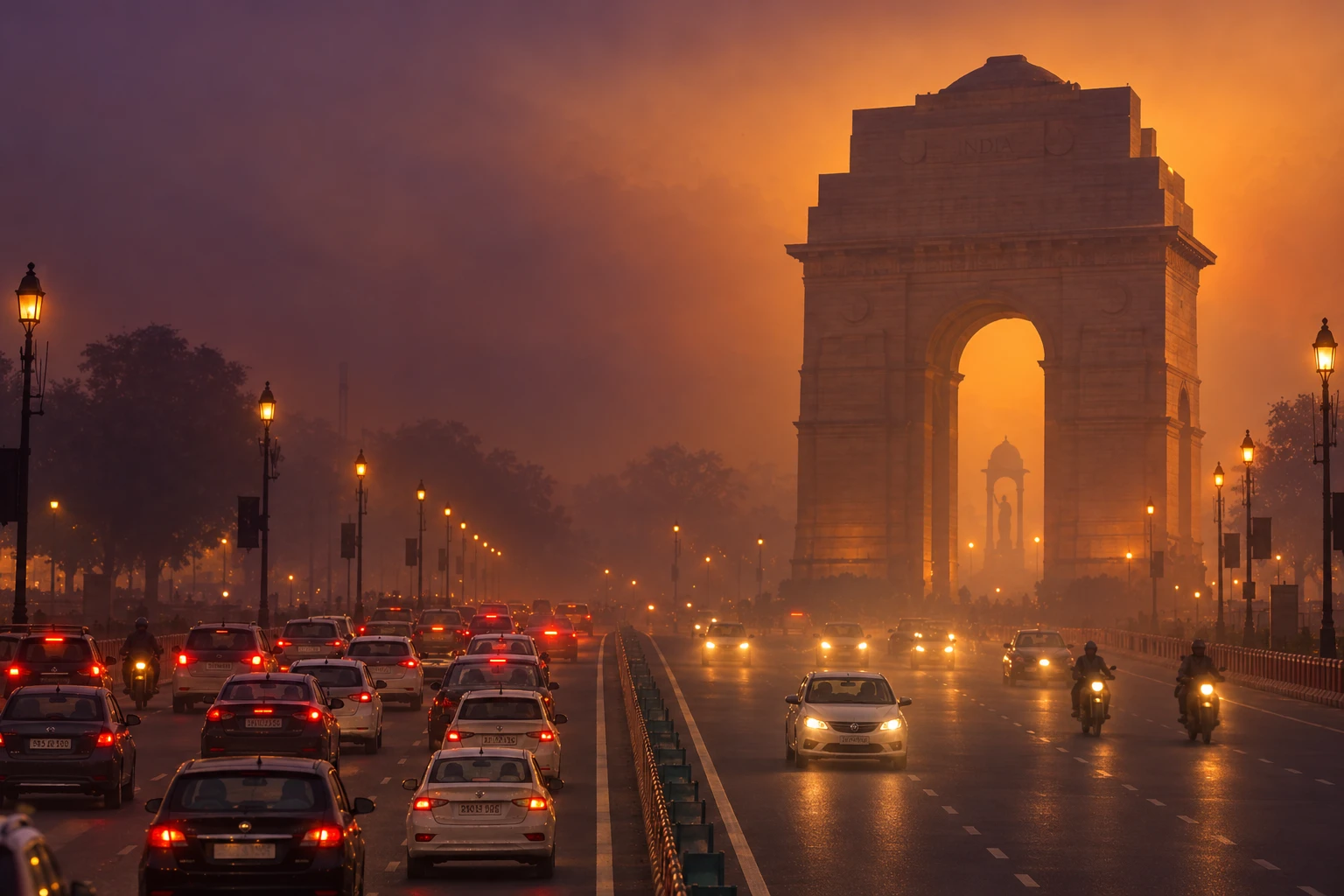
Until this calendar, the city’s winter kit lived inside the Graded Response Action Plan, the emergency ladder run by the Commission for Air Quality Management. Stage I covers AQI 201 to 300, Stage II 301 to 400, Stage III 401 to 450, and Stage IV above 450. Construction stops, office cuts and vehicle filters used to arrive when the index, or a forecast, crossed those lines.
CAQM issued a revised GRAP schedule of November 2025 that pulled several of those steps forward. Staggered office hours moved into Stage II. Fifty percent work from home moved into Stage III, one rung earlier than before. The Supreme Court had pressed the commission to act before the air finished collapsing, not after.
Last winter still ran on that ladder. Stage I came in on October 14, 2025 and Stage II on October 19. Stage III was invoked on November 11 and lifted on November 26, then Stage IV on December 13 and lifted on December 24. Stage IV returned on January 17, 2026 and was pulled back on January 20. The new Delhi calendar now switches several of those same tools on by date, even if the index is still sitting in the 200s.
WHAT THE CALENDAR TAKES FROM GRAP
| Measure | How GRAP used to trigger it | What Delhi now dates in advance |
|---|---|---|
| Dust-heavy outdoor construction | Tightened as stages rose | Banned November 1 to January 31, essential public works excepted |
| Complete construction stop | Stage IV, AQI above 450 | December 10 to January 20, urgent government and emergency work excepted |
| 50 percent work from home | Stage III after the 2025 revision | November 1 to February 28, essential services excepted |
| Staggered office hours | Stage II after the 2025 revision | MCD 8:30 am to 5 pm; Delhi government 10 am to 6:30 pm |
| Older outstation vehicles | Stage-linked entry curbs | Non-BS-VI vehicles registered outside Delhi barred November 1 to January 31 |
| Parking price | Not a GRAP stage item | Authorised lots doubled November 1 to February 28; Metro lots exempt |
GRAP remains live. If the index still spikes, CAQM can stack tighter regional steps on the dated Delhi rules. The change is the floor, not the ceiling.
Who Loses Work When Sites Go Dark?
A complete freeze from December 10 to January 20 is 42 days with almost no building. The outdoor dust ban around it runs from November 1 to January 31. That is the cold stretch when daily-wage crews most need cash for rent and heat, and it is the same stretch the government now wants to police for biomass fires.
Last winter the city already tested that bargain. Labour minister Kapil Mishra announced Rs 10,000 in one-time relief for registered construction workers after GRAP Stages III and IV stopped sites. The Delhi Building and Other Construction Workers Welfare Board later showed 2.46 lakh workers on its books and 30,183 payments, about 12.3 percent, totalling Rs 30.2 crore.
Bitto, a tile worker in Mangolpuri, earned Rs 800 to 850 a day until the halt. “When work stopped, our lives stopped too,” he said. The transfer arrived in early January, after weeks of borrowing.
In August, Harsh Vardhan Bansal, president of NAREDCO’s Delhi chapter, wrote to Gupta asking her to reopen the blanket stop. He said the industry backed practical air measures, then warned what a long freeze does to migrant crews.
Whenever construction activity is suspended, many migrant workers return to their native places. Experience has shown that a significant number do not return immediately, which could lead to loss of livelihoods.
Harsh Vardhan Bansal, president, NAREDCO Delhi, letter to the chief minister
The letter asked for a clear list of what may still run, and for talks before a freeze with that kind of payroll cost. Sirsa’s September readout did not add a new compensation figure for the dated 42-day stop. Heating spots with electric heaters are planned so people do not burn wood or coal for warmth, which is a dust-and-smoke control aimed at the same households that lose wages when scaffolds come down.
Older Outstation Cars Will Stop at the Border
Vehicles are the other half of the dated kit. From November 1 to January 31, motor vehicles registered outside Delhi that do not meet BS-VI will be barred from entering or plying, with CNG, electric, ambulance, fire, police and other notified classes exempt. That filter used to appear as a GRAP entry curb. It is now a seasonal border rule.
PUC enforcement tightens in the same season. Petrol, diesel and CNG outlets are to sell fuel only to vehicles with a valid certificate, a rule Sirsa said will run in mission mode, and the government has set an October 1 drive against invalid certificates. About 2.5 lakh vehicles are to go through fitness checks at three automated testing stations, with a fourth due to open, and cameras at 500 ANPR petrol pumps are to be rechecked.
THE VEHICLE AND PARKING RULES
- Border filter: Outstation vehicles below BS-VI stay out from November 1 to January 31, with CNG, electric and emergency fleets exempt.
- No PUC, no fuel: Retail outlets must refuse fill-ups without a valid certificate, with a citywide drive from October 1.
- Parking tariff: Authorised lots charge double from November 1 to February 28; Delhi Metro lots stay on the old rate, and electric cars face no extra parking fee.
- Office load: Government and private offices keep no more than 50 percent of staff on site through February 28, with hospitals, transport, power, water, sanitation, disaster and pollution crews exempt.
- Material trucks: Loads of sand, stone, bricks, cement, ready-mix and debris are kept out during the December 10 to January 20 stop, with exemptions for national and emergency works.
MCD offices will open at 8:30 am and close at 5 pm. Delhi government offices will run 10 am to 6:30 pm. Private firms are told to add car-pools, shared buses and their own staggered hours. The parking hike is the one lever that is not a GRAP inheritance, and it is the one that lands on anyone who still drives in and pays at a municipal lot. Metro park-and-ride is spared so that choice stays cheaper.
The loud complaint after the September readout was that a seasonal parking bill and a border filter on older cars will squeeze commuters while farm smoke still blows in. That objection has a point on shares, which is why the dated bans cannot be read as a full winter cure.
The Source Mix Is Broader Than Construction Dust
A site freeze is easy to announce because a gate can be locked. Winter PM2.5 is not mostly that gate. After the Supreme Court on January 6, 2026 told CAQM to name sources more clearly, the environment ministry placed the experts’ winter ranges on record in a Rajya Sabha reply on July 30, 2026.
WHERE WINTER PM2.5 COMES FROM
| Source (CAQM experts, winter) | Share of Delhi PM2.5 |
|---|---|
| Secondary particles from gases | 24-28 percent |
| Transport | 19-24 percent |
| Biomass, including waste, kitchens and crop residue | 17-23 percent |
| Dust from roads, soil and construction | 10-18 percent |
| Industry, including power plants | 8-10 percent |
Those dust figures already bundle roads and soil with demolition. The 2018 TERI-ARAI study, still the detailed split officials cite, put construction at 1 percent of winter PM2.5 in Delhi and 6 percent of PM10, with road dust at 4 percent and 8 percent. TERI also found that only 36 percent of winter PM2.5 was from Delhi’s own emissions, so a city-only freeze leaves the rest of the basin untouched.
Secondary particles, the largest winter slice, form from gases that come off traffic, industry and smoke. A dated construction stop does not cut that chemistry. Transport at 19 to 24 percent is the slice the parking hike, the PUC gate and the BS-VI border are meant to nick. Biomass at 17 to 23 percent is the slice heating spots, waste patrols and farm-fire policy have to handle, and most of that farm-fire load sits outside the municipal limit.
The same reply records dust at 10 to 18 percent of winter PM2.5 when roads, soil and demolition are counted together. That is a real share, and it is not the majority share. A calendar that goes hardest at scaffolds and outstation engines is a calendar aimed at the parts of the mix a city can padlock.
Delhi Adds Buses While Sites Stay Quiet
Sirsa’s September list also tried to show work that is not a ban. Delhi now runs 5,088 electric buses and will add 150 more for last-mile routes. The Sarathi Metro app is to be pushed. Ministers, MPs and MLAs, including Gupta and Yadav, are to walk AQI and congestion hotspots. Of 62 listed hotspots, 42 are described as under control. Crews are mapping crematoriums, dumps and cement yards inside a 3 km ring of the rest.
Road dust is supposed to fall as the pavement programme catches up. The 2026 target is 3,065 km of redevelopment; 1,193 km were done by September 20, leaving 1,872 km. Deep cleaning is scheduled every 15 days. Ninety-eight mechanical sweepers are in use, with orders out for the rest. Teams are assigned to stop garbage fires. RWAs, housing societies and contractors are liable if waste, leaves or plastic burn on their ground, and drones are part of the watch.
THE PARALLEL BUILD
- Electric buses: 5,088 in service, with 150 more to be added for last-mile routes.
- Road works: 1,193 km of a 3,065 km 2026 redevelopment target finished by September 20.
- Hotspots: 42 of 62 listed sites described as brought under control, with elected officials told to visit the rest.
- Sweepers: 98 mechanical machines running, and work orders issued for the remaining fleet.
October is reserved for a public campaign. November is when PUC centres are to be upgraded. End-of-life vehicles are to be chased at the 500 camera-equipped pumps. None of that waits on an AQI alert, which is the point of the June gazette. Sirsa put the year-round claim in writing after the Yadav meeting.
Providing clean air and a healthy environment to the residents of Delhi is our responsibility, and this responsibility is not limited to any one season. The Delhi government is continuously working in a technical and scientific manner, 365 days a year, 24×7, for pollution control.
Manjinder Singh Sirsa, Delhi environment minister, on X, September 28, 2026
The calendar will still meet the same physics that beat GRAP on still, cold nights. Secondary particles and basin-wide smoke do not punch out on November 1 because a crane is taped off. What the gazette does change is who is idle, and from which date, before the index has a chance to argue.

A CubeSat Will Age Whisky That Never Comes Home

A Charity Quote Cost Shia LaBeouf the FKA twigs NDA

Looker Turned a Model’s Body Into Ad Inventory

Infinity Ward Bets a Paid DMZ Will Stick This Time

Disney Sidesteps a Kimmel Renewal as Failla Cites Losses

How to Get Pre Boarding on Southwest – Skip the Line with These Tricks

False AI Intel Nearly Put US Crews on a Chinese Ship

Tim Cook’s $4.6 Trillion Apple Still Runs on One Phone

OpenAI Posts a Navier-Stokes Proof Clay Has Not Touched

Dunes Air Sues Nora Fatehi Over Its Luxury Jet
-
 TRAVEL3 years ago
How to Get Pre Boarding on Southwest – Skip the Line with These Tricks
-
 NEWS1 month ago
False AI Intel Nearly Put US Crews on a Chinese Ship
-
 BUSINESS2 months ago
Tim Cook’s $4.6 Trillion Apple Still Runs on One Phone
-
 NEWS2 months ago
OpenAI Posts a Navier-Stokes Proof Clay Has Not Touched
-
 ENTERTAINMENT2 months ago
Dunes Air Sues Nora Fatehi Over Its Luxury Jet
-

 LIFESTYLE3 years ago
How Often Do You Have to Change a Monkey’s Diaper? The Truth About Pet Monkeys
-

 NEWS2 months ago
Australia Treats Cloud Software Payments as Taxable Royalties
-

 LIFESTYLE3 years ago
How Long Does It Take for Armpit Hair to Grow? The Stages of Hair Growth and How to Shave It