
LIFESTYLE
DUSU Elections Open 12 Days After the PG Collapse
Delhi University students vote for DUSU 12 days after a Satya Niketan PG killed seven, under a High Court threat to stay counting.

Delhi University students began voting on September 18 for four Students’ Union posts, 12 days after a paying-guest building near South Campus killed seven people. Polling for the Delhi University Students’ Union, or DUSU, covers president, vice-president, secretary and joint secretary, plus college representatives, in a field of 20 candidates.
Counting is listed for September 19 at the Multipurpose Hall of the University Sports Stadium. A Delhi High Court bench has told the university and the police it can still freeze that count if Friday’s status reports on campaign violence fall short.
Voting Opens Under a Court Clock
Day-class students vote from 8:30 a.m. to 1 p.m., and evening colleges from 3 p.m. to 7:30 p.m. University officials put 151,842 students on the roll across 52 centres and 158 booths, with 12 control rooms and technical staff on call for machine faults.
THE POLLING CLOCK
- Eligible roll: Students admitted on or before September 9, 2026, at 5 p.m. may vote.
- What to carry: Second- and third-year students need a college identity card; first-year students without a card can use a verified fee receipt, a bonafide certificate with a photograph, and a government identity card.
- The machines: Officials deployed 1,000 electronic voting machines, 960 on booths and 40 in reserve.
- The roads: Vehicle movement is restricted on Chhatra Marg, Probyn Road and University Road on September 18 and 19 until results are declared.
Chief Election Officer Raj Kishore Sharma, a chemistry professor, said that once polling ends the machines will go by police escort to North Campus, to be opened only at the count. Rajesh Singh, the university librarian, is chief returning officer. Colleges have been told to send machines to the hall through Gate No. 2 after the last vote. The university’s own notices on polling and counting set that chain in writing.
THE NUMBERS ON THE TABLE
- 151,842 voters: The 2026 central-panel roll, close in size to the 1.53 lakh registered list in 2025.
- 20 candidates: Seven for president, five for vice-president, four for secretary, four for joint secretary.
- 1,000 EVMs: 960 in use, 40 held back.
- 7,210 hostel beds: The university’s own count of rooms against 251,474 regular students.
The court clock is not a figure of speech. On September 17, Chief Justice Devendra Kumar Upadhyaya and Justice Tejas Karia listed status reports from Delhi University, the Union government and Delhi Police for noon on polling day, and said they could stay counting and the result if those papers did not satisfy them.
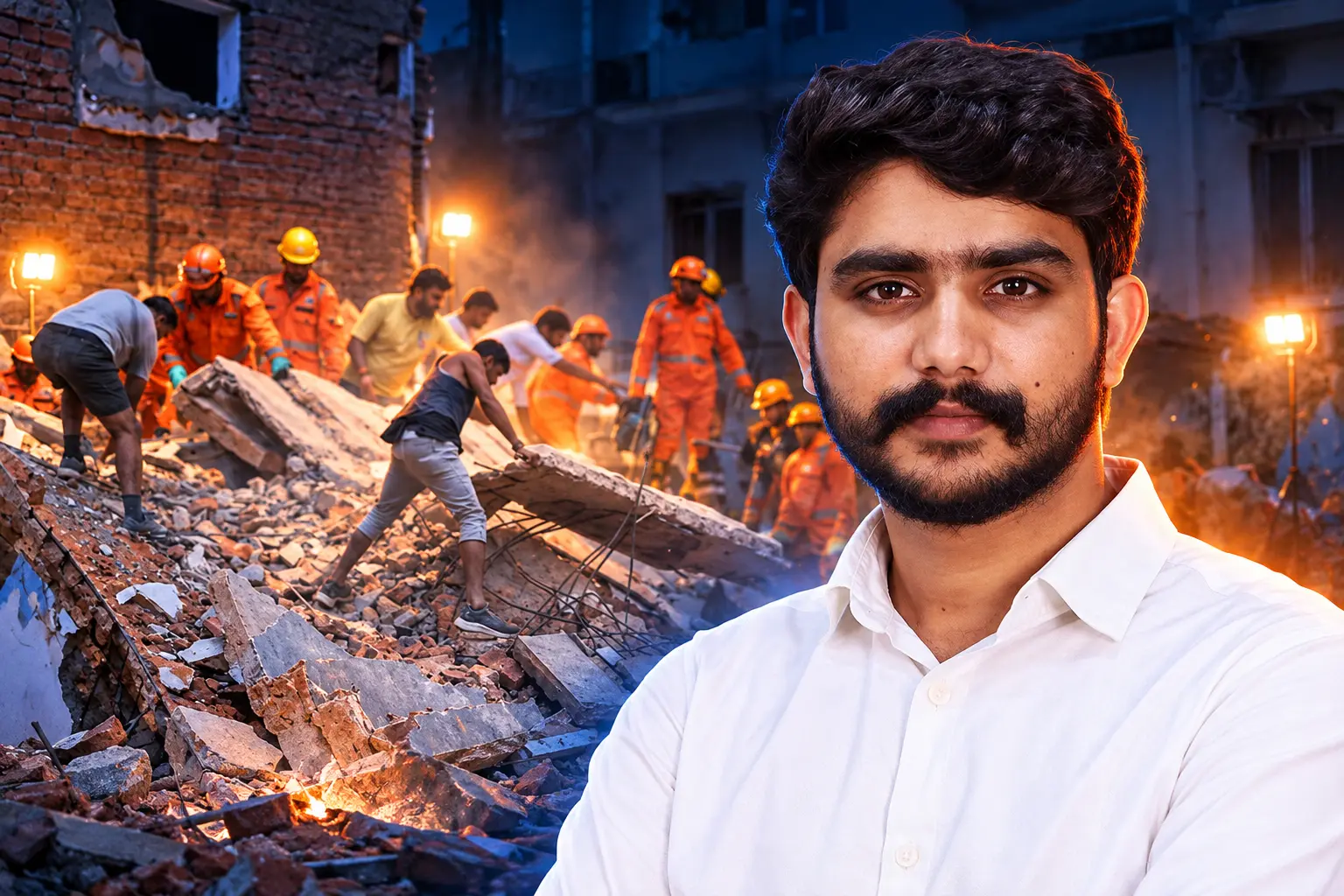
Twelve Days After Hostel Daze Came Down
On September 6, a Sunday of a long weekend, the five-storey boys’ paying-guest house called Hostel Daze in Satya Niketan went down around 1:30 p.m. while basement repair work was under way. The neighbourhood sits about 2 kilometres from South Campus, a strip of private rooms that exists because college hostels do not.
Amit Choudhary, 20, was waiting at the Nigori tea stall a few steps away. He said the ground shook, a cloud of dust blinded him for two or three minutes, and the building had become a heap of slabs, bricks and twisted metal. Cries came from underneath. Live wires were down. Students in the packed women’s building next door froze at the windows because that block was shaking too.
Locals say 35 to 40 students lived there as paying guests. Because it was a long weekend, fewer of them were inside. Students and shopkeepers started the first pulls by hand. Choudhary said it took about an hour to break one slab. Delhi Fire Service logged the first distress call at 1:33 p.m.; the lanes are so narrow that crews walked the last stretch with hammers, shovels and cutters. Assistant Divisional Officer Santosh Kumar said one trapped man had only his legs visible, and that it took more than 30 minutes to free him while a heartbeat was still audible. The last survivor came out at noon on September 7.
Seven people died. Five were Delhi University students who had come from small towns: Abhishek, 20, from Sonbhadra in Uttar Pradesh; Yuvraj Soni, 20, from Durg in Chhattisgarh; Pawan, 17, from Auraiya in Uttar Pradesh; Arpit Jahaj, 19, from Dewas in Madhya Pradesh; and Akshat Singh Yadav from Katni in Madhya Pradesh. Surinder Singh, 75, a labourer, also died, as did another young man who was not named in the first police list. Twelve people were pulled out alive.
Arpit had celebrated Raksha Bandhan and Janmashtami at home, flown back, and called his mother Pushpa Jhajj from the PG at 8 a.m. and again on video at about 11:30 a.m. “Who would have known that was the last time we would speak,” she said at the AIIMS Trauma Centre, about 7 kilometres from the site, after identifying him by a mole on his chest because his face was too damaged.
Municipal officials said the building had no sanctioned plan, no fire no-objection certificate and no occupancy certificate, and that the civic record showed no inspection or enforcement against the extra floors. Police say Hostel Daze had been stretched from its original structure, with work in the basement and on the ground floor. Chief Minister Rekha Gupta pointed to water in the basement plus that repair work. The owner family, Hariram Gupta, his wife Urmila and their son Mahesh, were arrested. In 2022 a three-storey building in the same neighbourhood collapsed during a conversion into a PG, killing two labourers.
By evening, students in nearby PGs were packing. Some slept on the footpath under the Durgabai Deshmukh South Campus Metro station. One student from Guwahati spent the night on a classroom floor. Sitting DUSU president Aryan Maan reached the debris while the search was still on, and the argument that followed was not about bye-laws. It was about which student group got to stand in front of the cameras. Replies to that footage treated the rescue as a campaign stop, which is the register this election has not left.
THE 12 DAYS FROM THE RUBBLE
- September 6, 2026: Hostel Daze collapses around 1:30 p.m.; fire crews are called at 1:33 p.m.
- September 7, 2026: The last survivor is pulled out at noon; the death toll reaches seven; the High Court orders citywide PG inspections; the owner family is arrested.
- September 10-11, 2026: Nominations close and panels are named; the university says it will add hostel seats over five years.
- September 16, 2026: The High Court holds that membership of a student wing does not, by itself, bar a candidate.
- September 17, 2026: The same bench warns it may stay counting if violence files are weak, and lists those reports for September 18.
- September 18, 2026: Central-panel polling.
- September 19, 2026: Counting from 8 a.m., unless the court stops it.
The Satya Niketan case is next listed on September 25. That hearing, not Saturday’s tally, is where a hostel policy could actually be forced.
7,210 Beds for 251,474 Students
DUSU does not allot rooms, license a PG, or sign a municipal file. The union can march, petition and put housing on a manifesto. The beds sit with the university, the colleges and private landlords. Official data released after the collapse put current hostel capacity at 7,210 seats, 3,422 in university hostels and 3,788 in college hostels, against 251,474 regular students in the 2024-25 annual report (210,907 undergraduate, 34,520 postgraduate, 6,047 in certificate and diploma courses).
That is fewer than three hostel seats for every 100 students. More than half the university’s students come from outside Delhi. South Campus colleges in particular send undergraduates into Satya Niketan and Anand Niketan because several of those colleges have little or no undergraduate housing of their own.
HOSTEL BEDS AGAINST THE ROLL
| Stock | Now | After planned additions |
|---|---|---|
| University hostels | 3,422 | 7,344 |
| College hostels | 3,788 | 5,410 |
| Combined seats | 7,210 | 12,754 |
| Share of 251,474 students | under 3 in 100 | about 5 in 100 |
Vice-Chancellor Yogesh Singh asked principals to speed unfinished hostel work. The university listed an Institute of Eminence hostel of 1,450 seats near completion at the Dhaka Complex, a 1,000-seat women’s block called Nirbhaya Residential Accommodation, and a 1,050-seat studio complex. The additions total 5,544 seats over five years. Even then, combined capacity would be 12,754, or about five seats in a hundred on the present roll.
Lakshya Raj Singh, the ABVP joint-secretary candidate, said after the collapse that the administration can house only around 7,000 to 8,000 students. ABVP held candlelight marches. NSUI ran an accountability walk on North Campus. AISA-SFI put affordable rooms and hostels at the centre of a campaign it calls alternative politics. None of those groups can pour the concrete.
Rents in the private stock around South Campus run from a few thousand rupees for a bed in a shared room with a crowded toilet to about ₹25,000 for a single bed plus a large deposit. Twin-sharing in Satya Niketan has been quoted near ₹14,000 a month. The monthly bill often exceeds a year’s college fee, which is why a five-storey walk-up with no occupancy certificate still fills.
Who Is on the Central Panel?
The final list has 20 names. The contest that will be counted, if it is counted, sits among three full panels and a scatter of AAP-backed, independent and smaller-outfit candidates. ABVP has put up Yash Dabas for president, Ishu Maurya for vice-president, Riya Chhawdi for secretary and Lakshay Raj Singh for joint secretary. Dabas, from Kanjhawala in Delhi, is a Buddhist Studies student and an international-level tennis player who has played ITF events in Spain, Australia and Serbia. Maurya and Lakshay Raj Singh are Campus Law Centre students; the latter has played handball for India. Chhawdi is a Sri Aurobindo College student and an inter-college basketball player.
NSUI has named Vijay Shankar Meena, an Adivasi student from Rajasthan in the same Buddhist Studies department, for president, with Vir Chatrath for vice-president, Namrata Chaudhary for secretary and Gopal Choudhary for joint secretary. The panel’s polling-day code is 6-4-1-2. NSUI said on September 17 that Meena’s Instagram account had been withheld the night before the vote.
Vote 4 Change in DUSU.
Vote 6-4-1-2. ✊🏻🗳️ pic.twitter.com/CHfa9KMmzR— NSUI (@nsui) September 18, 2026
AISA and SFI are running a joint ticket: Ananya Raturi of PGDAV College for president, Akshat Shikhar of Motilal Nehru College for vice-president, Stanzin Deskyong of Hindu College for secretary and B Parijat of Hansraj College for joint secretary. Raturi, from Uttarakhand, has worked on sexual-harassment complaints. Shikhar was in the NEET-UG protest line. Deskyong, a first-year MSc mathematics student from Leh and a former Ramjas vice-president, is billed by the alliance as the first Ladakhi on a DUSU central panel. Parijat is a first-year MA English student.
THE THREE MAIN PANELS
| Post | ABVP | NSUI | AISA-SFI |
|---|---|---|---|
| President | Yash Dabas | Vijay Shankar Meena | Ananya Raturi |
| Vice-president | Ishu Maurya | Vir Chatrath | Akshat Shikhar |
| Secretary | Riya Chhawdi | Namrata Chaudhary | Stanzin Deskyong |
| Joint secretary | Lakshay Raj Singh | Gopal Choudhary | B Parijat |
The other presidential names are Ashmit Kumar of PGDAV College, Ejaj Mansuri of Campus Law Centre, Samarth Beniwal of Buddhist Studies (an NSUI rebel running independent) and Sameer Kumar of Ramjas College. On the vice-president list, Deepanshu Shokeen, another NSUI rebel from Buddhist Studies, has been one of the more visible independents, and Aranya Singh Rathore is the ASAP nominee from SPM College. Pankaj Kumar of Campus Law Centre, the ASAP secretary candidate, is described as the first visually impaired nominee on a DUSU central panel. Vishesh Yadav is the Samajwadi Chhatra Sabha-backed independent for joint secretary.
Yash Dabas, asked about Satya Niketan, said: “All of us are deeply saddened by it. Such an accident should never have happened. But we will ensure that a safety audit is conducted, and going forward, no such incident occurs in the future.” A safety audit is a municipal and university job. The president of DUSU cannot sign it.
Buddhist Studies Sends Three Presidential Candidates
Open the college column on the official-style list and one department repeats. Yash Dabas, Vijay Shankar Meena and Samarth Beniwal are all listed from the Department of Buddhist Studies for president, three of the seven names in that race. Vir Chatrath and Deepanshu Shokeen are listed from the same department for vice-president. Namrata Chaudhary is listed there for secretary. Gopal Choudhary and Vishesh Yadav are listed there for joint secretary.
That is eight of the 20 central-panel candidates from one postgraduate department. Campus Law Centre supplies another cluster, including Ishu Maurya, Lakshay Raj Singh, Ejaj Mansuri and Pankaj Kumar. The pattern is not a secret manifesto. It is where Lyngdoh-era eligibility, which favours enrolled students of a certain age and stage, pushes people who want a central-panel ticket.
Polling-day talk on X slid off that map and off Satya Niketan. The posts that circulated were ballot codes, not bed counts. NSUI’s 6-4-1-2 graphic did more work than any housing paragraph. A voter who wanted neither ABVP’s line on UGC and reservation nor NSUI nor the Left still had to pick a button. The collapse is the reason this election should have been about rooms. The feed treated it as a colour on a poster.
ABVP Took Three of Four Posts in 2025
ABVP comes in holding three of the four central posts. In 2025 Aryan Maan won the presidency with 28,841 votes against 12,645 for NSUI’s Joslyn Nandita Choudhary, a margin of 16,196. Kunal Chaudhary took secretary with 23,779 against 16,117. Deepika Jha took joint secretary with 21,825 against 17,380. NSUI’s Rahul Jhansla won vice-president with 29,339 against 20,547. Turnout was 39.36 percent, 60,272 votes from a registered list of 1.53 lakh.
THE 2025 CENTRAL PANEL
- President: Aryan Maan (ABVP), 28,841 votes.
- Vice-president: Rahul Jhansla (NSUI), 29,339 votes.
- Secretary: Kunal Chaudhary (ABVP), 23,779 votes.
- Joint secretary: Deepika Jha (ABVP), 21,825 votes.
A year earlier NSUI’s Ronak Khatri had taken the presidency with 20,207 votes against 18,864 for ABVP’s Rishabh Chaudhary, a margin of 1,343, the first NSUI president since Rocky Tuseed in 2017. ABVP still took vice-president and secretary that year. The Left alliance drew a blank on the 2025 panel; its presidential candidate Anjali took 5,385 votes. Tushar Dedha of ABVP had won in 2023 with 23,460.
The union has a long afterlife in national politics, from Arun Jaitley and Vijay Goel to Ajay Maken and Nupur Sharma. That pedigree is why national student wings still spend on North Campus. It is also why a PG collapse in Satya Niketan can be turned into a panel slogan without a single extra bed being promised on a date.
The Spending Cap Is Still Rs 5,000
On September 16 the High Court rejected a plea that would have barred NSUI and ABVP candidates as political-party proxies. Membership of a student wing, the bench said, is not by itself association with a political party under the Lyngdoh Committee student election guidelines. Political parties and their members, it added, still have no role in DUSU. It asked the chief election officer to watch an AAP student-wing post that showed a party name and symbol.
On September 17 the same judges, hearing advocate Prashant Manchanda’s older defacement case, looked at a different file: unplated cars with candidate names, alleged guns and screwdrivers, teachers beaten, walls painted. Additional Solicitor General Chetan Sharma said the 2026 campaign had been 80 to 90 percent more orderly. The bench asked how many FIRs had been registered, and did not treat the percentage as an answer.
Students unions in the universities or colleges are said to be nurseries of democracy. And therefore, the democratic process involving such student unions needs to be strengthened which will go a long way in strengthening our own democratic system in the society. However, permitting elections of students unions to take a colour as depicted in the material placed on record is unacceptable at any cost.
Chief Justice Devendra Kumar Upadhyaya and Justice Tejas Karia, Delhi High Court, September 17, 2026
The judges said they were not staying the vote, then said they could stay the count. “Enough is enough,” they said. “You are thrashing your own teachers in the name of being creative. Brandishing guns.” They told the university that if it could not control the campus it should say so. Status reports were due at noon on September 18, with student-union counsel ordered to be present. No excuses, they said, would be accepted.
The rulebook those orders keep citing is 20 years old. The Lyngdoh Committee, chaired by former Chief Election Commissioner J.M. Lyngdoh, reported in May 2006. The Supreme Court made the recommendations binding that September. Handmade posters are allowed only at notified spots. Printed posters, vehicles and loudspeakers for canvassing are not. Processions need permission. The Rs 5,000 limit per candidate is still the cap, and the money is supposed to come only from voluntary student contributions.
Deepanshu Shokeen said the cap is too small to campaign under and that he wants it rewritten. Ashutosh Singh, a former ABVP national media convenor, said a 2005-06 ceiling is not practical in 2026. The campus in the days before the poll still filled with printed paper, SUVs and cars without registration plates, which is the record the High Court said it had in front of it.
WHAT WE KNOW
- The vote: Polling is on September 18 in two shifts; 151,842 students are on the list; 20 candidates are in the central race.
- The count: September 19 from 8 a.m. at the Multipurpose Hall, unless the court stays it.
- The deaths: Seven people died at Hostel Daze on September 6, five of them DU students.
- The beds: 7,210 hostel seats now, 12,754 if five-year plans are finished, against 251,474 regular students.
WHAT IS UNCONFIRMED
- The stay: Whether Friday’s status reports satisfy the High Court, and whether counting proceeds on September 19.
- The turnout: No verified figure has been issued while polling is open.
- The rooms: No dated delivery schedule for the 5,544 planned hostel seats has been tied to this election.
Sharma’s instruction is physical: when the last evening vote is in, the machines move under police guard and sit until Saturday. The High Court can still tell him not to open them. The students who died in Satya Niketan will not be on any panel, and the union that comes out of those machines will not be able to license the next PG that takes their place.

A CubeSat Will Age Whisky That Never Comes Home

A Charity Quote Cost Shia LaBeouf the FKA twigs NDA

Looker Turned a Model’s Body Into Ad Inventory

Infinity Ward Bets a Paid DMZ Will Stick This Time

Disney Sidesteps a Kimmel Renewal as Failla Cites Losses

How to Get Pre Boarding on Southwest – Skip the Line with These Tricks

False AI Intel Nearly Put US Crews on a Chinese Ship

Tim Cook’s $4.6 Trillion Apple Still Runs on One Phone

Dunes Air Sues Nora Fatehi Over Its Luxury Jet

OpenAI Posts a Navier-Stokes Proof Clay Has Not Touched
-
 TRAVEL3 years ago
How to Get Pre Boarding on Southwest – Skip the Line with These Tricks
-
 NEWS1 month ago
False AI Intel Nearly Put US Crews on a Chinese Ship
-
 BUSINESS2 months ago
Tim Cook’s $4.6 Trillion Apple Still Runs on One Phone
-
 ENTERTAINMENT2 months ago
Dunes Air Sues Nora Fatehi Over Its Luxury Jet
-
 NEWS2 months ago
OpenAI Posts a Navier-Stokes Proof Clay Has Not Touched
-

 LIFESTYLE3 years ago
How Often Do You Have to Change a Monkey’s Diaper? The Truth About Pet Monkeys
-

 NEWS2 months ago
Australia Treats Cloud Software Payments as Taxable Royalties
-

 LIFESTYLE3 years ago
How Long Does It Take for Armpit Hair to Grow? The Stages of Hair Growth and How to Shave It