
BUSINESS
A Two-Month China Truce Meets 2007-Level Yields
Trump and Xi listed $30 billion of goods each way, but a 10-year yield at 2007 highs now prices the AI race they agreed only to discuss.

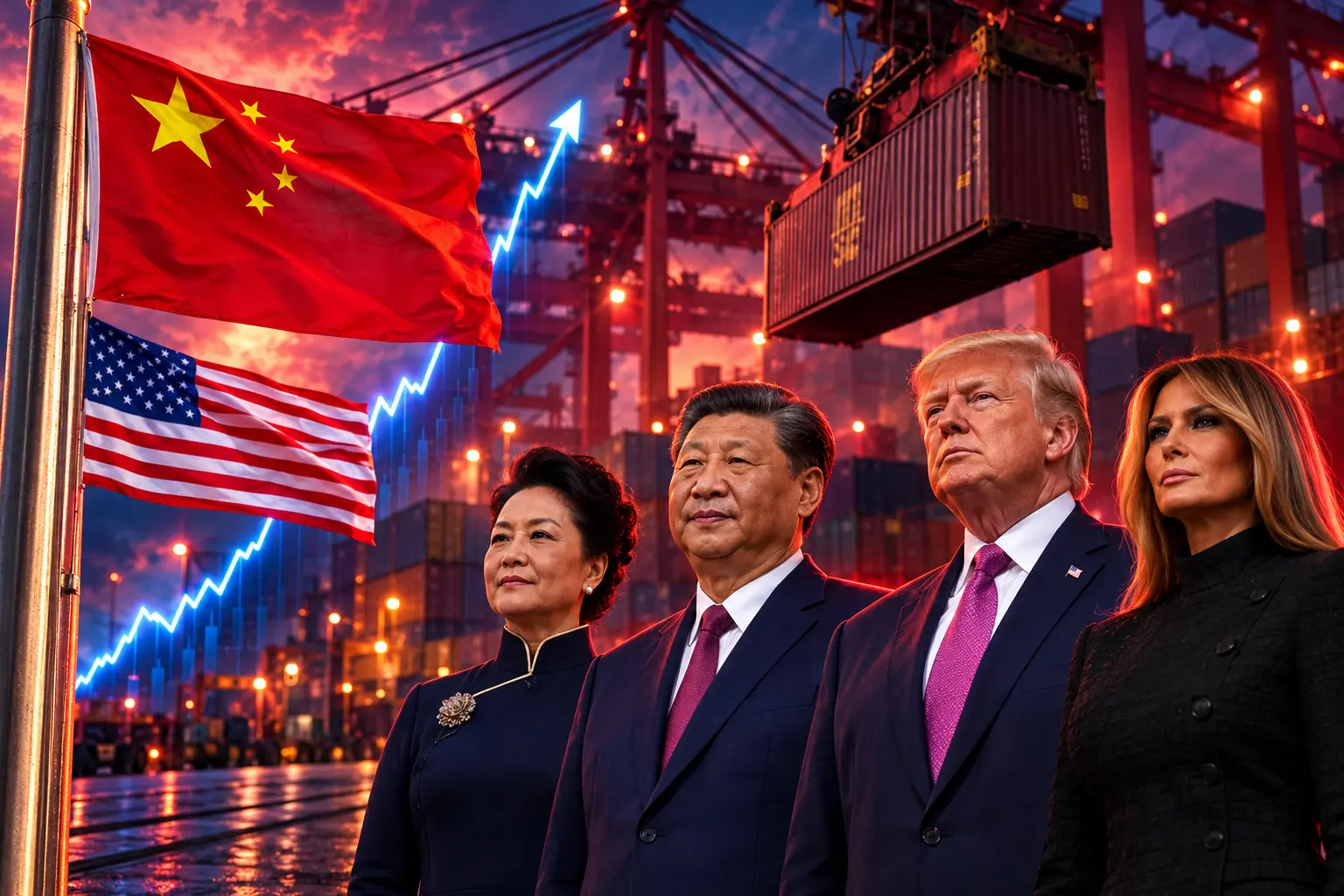
The 10-year Treasury yield touched 5.2297% on Sept. 25, the highest since 2007, as Washington posted China tariff lists and rejected Iran’s Hormuz offer. Chinese President Xi Jinping left a three-day visit that ended on Sept. 25 with a pause that runs to January 10 and with product lists covering $30 billion of goods each way.
Those lists still need an implementing order before a single duty changes at the dock. The rate that prices mortgages, corporate bonds and the AI buildout both governments just agreed to discuss did not come down with them.
Washington Published Lists, Not Duty Cuts
The White House on Sept. 27 posted recommended lists for reduced tariffs under a 30-for-30 framework drawn up by the U.S.-China Board of Trade. U.S. Trade Representative Jamieson Greer said each side had put forward $30 billion of “non-sensitive” trade that “could benefit from more favourable tariff treatment in the future.”
The United States and China will consider the lists “with a view toward providing reduced tariff treatment to those goods in a reciprocal manner, consistent with their respective domestic laws and processes,” the White House said. That is a recommendation, not a new duty schedule. Customs brokers spent Sept. 28 telling clients the same thing: product eligibility, final rates and effective dates still need a separate action before landed-cost models should change.
THE TWO BASKETS
| Basket | Line items | Notional value | What sits on the list |
|---|---|---|---|
| U.S. goods into China | 1,619 | $30 billion | Corn, wheat, sorghum, meat, dairy, seafood, wood, cosmetics, medical devices |
| Chinese goods into the U.S. | 77 | $30 billion | Toys, small appliances, tableware, holiday decorations, children’s car seats, fireworks |
Greer said the U.S. side would unlock improved market access for about 30% of American exports to China. China’s commerce ministry said about 90% of products in each basket could move to most-favored-nation rates, though it also said the two sides would discuss the framework “aiming to reach a consensus.” Chips, electric vehicles and batteries are not on either list. Connected toys with Wi-Fi or Bluetooth are out as well.
Peter Alexander, Shanghai-based managing director at Z-Ben Advisors, said there was not complete agreement on everything, describing “a fraught relationship where neither side is willing to give way, at least not at this juncture.”
The Truce Runs Only to January 10
The lists arrived with a clock. China’s commerce ministry said on Sept. 28 that a two-month extension of the trade truce through January 10 would give both sides room to evaluate the current arrangement. The ministry called that window a “relatively stable and predictable policy environment” for companies.
The ceasefire that started after a meeting in South Korea last year had been due to lapse on Nov. 10. Analysts going into the Washington visit had looked for at least six months. They got 61 days. Treasury Secretary Scott Bessent had already sketched the January 10 date before the product lists went up.
THE TRADE CLOCK
- 2025: Washington and Beijing strike a year-long tariff ceasefire, later set to lapse on Nov. 10, 2026.
- May 2026: The two sides form the U.S.-China Board of Trade after talks in Beijing.
- Sept. 24-25, 2026: Xi makes a three-day state visit to Washington, his first there since 2015.
- Sept. 27, 2026: The White House posts the 30-for-30 product lists.
- January 10: The extended truce is due to expire.
On Sept. 28 the CSI 300 slid more than 2% to a one-year low. Technology stocks there fell on a bipartisan U.S. push to ban Chinese components from data centers, a reminder that the same capitals now talking about AI still treat each other’s hardware as a security problem. U.S. stock futures slipped as the new week opened.
Trump Turns Down Iran’s Seven-Day Offer
The other truce did not even get a date. Iranian Foreign Minister Abbas Araghchi put a seven-day plan on the table at the U.N. General Assembly: reopen the Strait of Hormuz and restart nuclear talks if Washington lifted its naval blockade, waived oil sanctions, released frozen Iranian assets estimated at $12 billion, and folded in a wider ceasefire that included Lebanon.
President Donald Trump rejected it on Sept. 26 as he left the White House.
I’m rejecting their deal. They want to make a deal where they open the strait immediately. We’re winning tremendously. We have total control of the Hormuz Strait. That deal would not be acceptable.
Donald Trump, at the White House, Sept. 26
U.S. Ambassador to the United Nations Mike Waltz said Tehran wanted “everything up front with a promise that they would then talk.” Araghchi, on NBC’s Meet the Press on Sept. 27, said Tehran was ready for a “doomsday” war with the United States but was still pursuing diplomacy so as not to “miss any chance for peace.” He also said Iran was waiting for a “definitive” answer through Qatari and Pakistani mediators, even after the public rejection.
The International Energy Agency puts average 2025 shipments at 20 million barrels a day through Hormuz, around 25% of the world’s seaborne oil trade, with about 80% of that oil headed to Asia. Trump’s claim of control sits beside a waterway that still holds the oil price in triple digits. Brent crude traded at $106.12 a barrel on Sept. 28 after the rejection. The U.S.-Israeli war with Iran has run since late February, a stretch that has kept a lid on supply and a foot on inflation.
Xi and Trump did agree that Iran should not develop nuclear weapons and that no country should impose transit tolls on international waterways. That sentence did not reopen the strait.
Why 2007 Yields Now Price the AI Race
Gennadiy Goldberg, head of U.S. rates strategy at TD Securities, has tied the backup in Treasuries to a mix of Fed hike bets, higher growth and oil, fiscal supply, and hyperscaler issuance. Ian Lyngen, head of U.S. rates strategy at BMO Capital Markets, said the market remains unconvinced that global energy supply is about to normalize, and that daily momentum in bonds is still bearish.
That is the second bill from the same week of diplomacy. Washington and Beijing launched a channel for AI-related incidents and scheduled a follow-up dialogue for November. They did not cheapen the money that pays for the plants, chips and power those talks are about.
THE MONEY THAT NOW PRICES THE RACE
- 10-year yield: Touched 5.2297% on Sept. 25, the highest since 2007.
- 30-year yield: Touched 5.5319% the same session, the highest since 2004.
- Hyperscaler spending: The five largest cloud builders are on course to spend around $820 billion in 2026 against $750 billion of operating cash flow.
- Brent crude: $106.12 a barrel on Sept. 28.
Union Bancaire Privée’s Filipe Alves da Silva, head of fixed income advisory, wrote that Microsoft, Amazon, Alphabet, Meta and Oracle will spend around $820 billion on capex this year, more than they earn in operating cash, so the gap has to be financed. He put off-balance-sheet leases, purchase commitments and guarantees near $3 trillion. Microsoft, Alphabet, Amazon and Meta could, on his numbers, issue another $400 billion without threatening their ratings. The constraint is buyer appetite: those five names plus Nvidia already account for 4.6% of the U.S. investment-grade index, and the extra yield investors demand has been rising with each large sale.
Oracle is more levered, and about half of its order book depends on OpenAI. The four big cloud vendors are sitting on about $2.3 trillion of contracted revenue that has not yet been billed, a slice of it owed by private labs. If those bills slip, the renegotiation lands in 2027 and 2028, just as capital spending is supposed to cool. A 10-year at a 2007 high makes that rollover dearer before a single watt is added.
Soybeans Miss the Cut, Coal Gets a Quota
The farm file shows how little of the hard trade moved. China’s list covers corn, wheat, sorghum, meat, dairy, oils and meals, a mix the White House says is meant to help Beijing toward a $17 billion agriculture-purchase commitment. Soybeans, still the largest U.S. farm export to China, are not on the new tariff-cut list except as planting seed.
That is a separate track from last year’s buy. China has already resumed large-scale soybean purchases under a deal to take 25 million metric tons a year. Leaving beans off the 30-for-30 list does not cancel that quota. It does mean the new “favourable treatment” the two sides advertised does not run through the crop that has been the political core of the farm fight.
Energy got a number the farm list did not. The White House said China would import at least 10 million metric tons of coal from the United States in 2027 and again in 2028, roughly 2% of China’s coal imports each year. China’s commerce ministry called that a supplement to its own market and a source of income and jobs for U.S. mines. Liquefied natural gas and oil were not on the list.
An agriculture working group under the Board of Trade is due to meet before year-end on two-way market access. Regular talks on investment barriers are supposed to follow. Those are process. They are not purchase orders.
What the Summit Left on the Table
The visit produced personal theater that the bond market did not need. Trump greeted Xi at the airport, a rare gesture, and more than 100 people, mostly from the U.S. government and business, sat at a state dinner. The paper that came out of the rooms is thinner than the guest list.
STILL OPEN AFTER WASHINGTON
- Semiconductors: Beijing wanted relief from U.S. export controls on advanced chips used to train models. No easing was announced.
- Rare earths: The White House said both sides would keep working on shortages “with the goal of ensuring shipment levels return to appropriate levels.” No new volume was set.
- The name of the thing: The U.S. fact sheet said the two leaders agreed to call the technology “super intelligence.” China has kept saying AI.
- Binding farm totals: The new lists skip soybeans. The $17 billion agriculture target and the 25 million metric ton soybean buy sit on older paper.
Scott Kennedy, senior adviser at the Center for Strategic and International Studies, called the outcomes on trade, rare earths, refined oil, investment and AI “quite limited and tentative.” Trump told reporters the United States is “not going to be putting on brakes” on AI. Xi said the technology must remain under human control. They scheduled the next AI meeting for November and said they would also meet at APEC in Shenzhen and later at the G20 at Trump National Doral in Miami.
China will examine approvals for foreign financial firms, including those with U.S. capital, to open branches. Direct flights remain a talking point. That is not a semiconductor license or a rare-earth quota.
January 10 Meets the Midterm Calendar
Daniel Kritenbrink, a partner at The Asia Group and a former U.S. diplomat, put the risk in a single sentence after the visit.
I’m concerned that this kind of diplomacy and this fragile detente is really unsustainable if it doesn’t result in more tangible outcomes or in addressing in some way the strategic challenges that are clearly manifest across the entire relationship, from the strategic relationship to economics.
Daniel Kritenbrink, partner at The Asia Group, on Squawk Box Asia
The trade pause now expires on January 10. The AI channel is due to meet in November, in the same month as the U.S. midterm elections, the date Trump has used when asked about restarting strikes on Iran. Araghchi said it would be better to settle before those elections and also said Iran was “not in a hurry.”
Until one of those dates produces a live duty cut, a Hormuz opening, or a 10-year yield that has actually fallen, the price of the AI race both capitals put on the agenda will be set in the Treasury market, not at the dinner.
Disclaimer: This article is news reporting and market analysis for information only. It is not investment advice, a recommendation to buy or sell any security, commodity or currency, or a forecast of returns. Readers should consult a licensed financial adviser or investment professional before making decisions based on yields, oil prices, trade policy or company financing plans. Figures and diplomatic statuses reflect the official statements, market prints and research cited here as of Sept. 28, 2026, and can change with the next auction, the next communique, or the next session in the Strait of Hormuz.

A CubeSat Will Age Whisky That Never Comes Home

A Charity Quote Cost Shia LaBeouf the FKA twigs NDA

Looker Turned a Model’s Body Into Ad Inventory

Infinity Ward Bets a Paid DMZ Will Stick This Time

Disney Sidesteps a Kimmel Renewal as Failla Cites Losses

How to Get Pre Boarding on Southwest – Skip the Line with These Tricks

False AI Intel Nearly Put US Crews on a Chinese Ship

Tim Cook’s $4.6 Trillion Apple Still Runs on One Phone

OpenAI Posts a Navier-Stokes Proof Clay Has Not Touched

Dunes Air Sues Nora Fatehi Over Its Luxury Jet
-
 TRAVEL3 years ago
How to Get Pre Boarding on Southwest – Skip the Line with These Tricks
-
 NEWS1 month ago
False AI Intel Nearly Put US Crews on a Chinese Ship
-
 BUSINESS2 months ago
Tim Cook’s $4.6 Trillion Apple Still Runs on One Phone
-
 NEWS2 months ago
OpenAI Posts a Navier-Stokes Proof Clay Has Not Touched
-
 ENTERTAINMENT2 months ago
Dunes Air Sues Nora Fatehi Over Its Luxury Jet
-

 LIFESTYLE3 years ago
How Often Do You Have to Change a Monkey’s Diaper? The Truth About Pet Monkeys
-

 NEWS2 months ago
Australia Treats Cloud Software Payments as Taxable Royalties
-

 LIFESTYLE3 years ago
How Long Does It Take for Armpit Hair to Grow? The Stages of Hair Growth and How to Shave It