
NEWS
Shaped Light Flips Nine-Layer Magnets Without a Field
A shaped femtosecond beam switches nine-layer platinum-cobalt films without a magnet, then collides with the chip-scale laser problem the field still has not solved.

UC San Diego engineers reversed magnetism in a nine-layer platinum-cobalt stack with a shaped femtosecond laser and no external field. The optical beam shaping induced reconfigurable magnetic domains study appeared in Nature Communications on 15 September 2026.
The group changed the writing beam so a familiar magnetic multilayer would switch. The specialized ultrafast laser that made the physics work still cannot be built into a computer chip.
The Bet Was to Leave the Magnet Out of the Write
Hard drives store bits as tiny magnetic regions that point one way or the other. Writing those bits usually means applying an external magnetic field, which burns energy and caps how fast a head can switch a cell. Light can dump energy into a small patch on a femtosecond clock, which is why labs have chased all-optical switching for almost two decades.
Abdoulaye Ndao, an associate professor of electrical and computer engineering at the UC San Diego Jacobs School of Engineering, put the density claim in one line. “The smaller the size of the beam, the smaller and more dense the optical memory,” he said. His group estimates the optical route could be more than 1,000 times faster than writing with an external field. That figure is a projection, not a stopwatch reading from this run.
Instead of designing a new material to enable optical switching, we redesigned the light itself and showed new properties that were not previously thought to be possible.
Abdoulaye Ndao, associate professor of electrical and computer engineering, UC San Diego
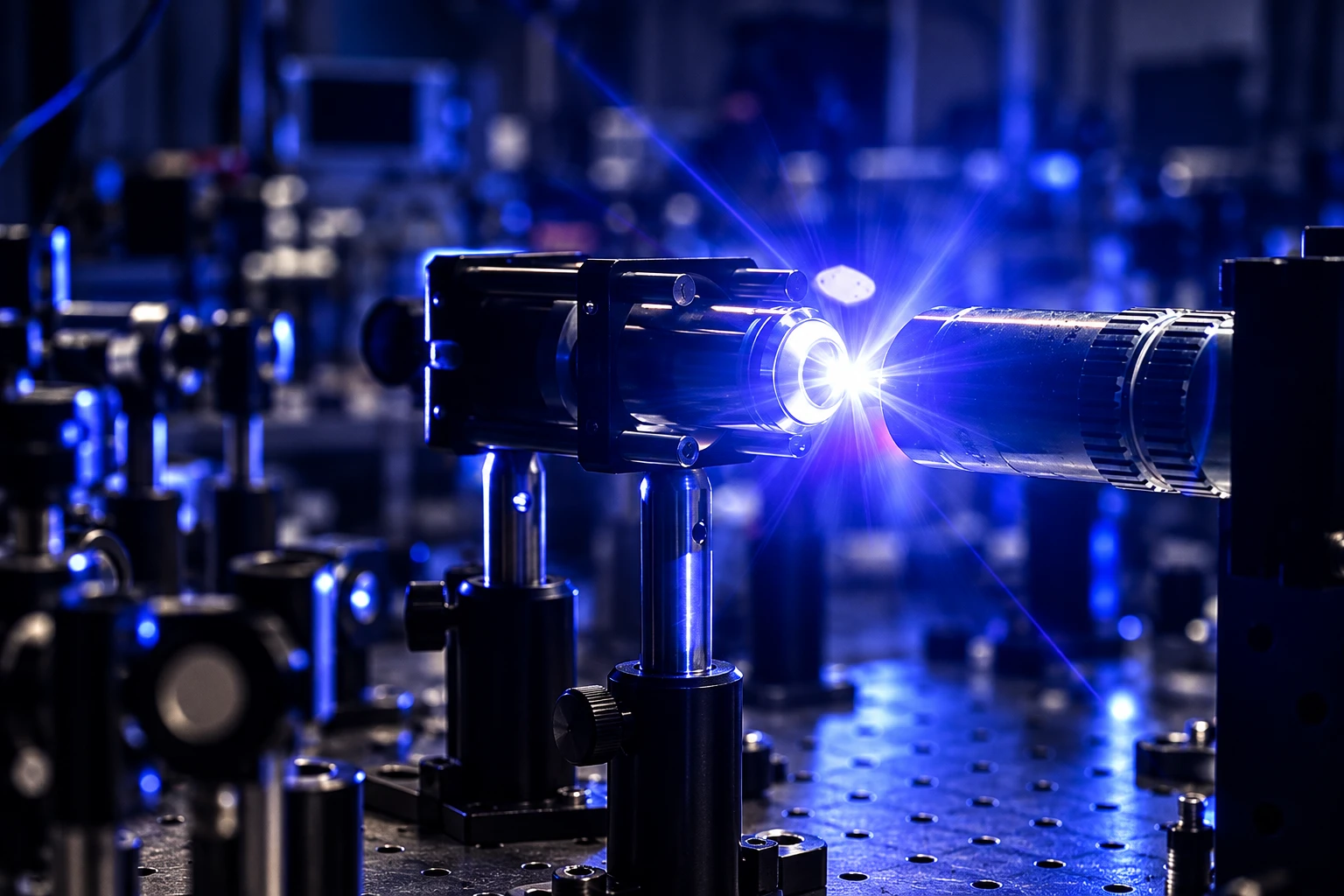
Muhammad Waleed Khalid, an electrical and computer engineering Ph.D. student in Ndao’s Nano-Devices and Applied Optics lab, is first author. “We’ve optically engineered the light to change the physics that’s happening in the material at the micro- and nanoscale,” Khalid said. Fellow student Koffi-Emanuel Sadzi shares the optical bench in the lab photographs the university released on 25 September 2026.
A Tiny Hot Spot Grows Into a Stable Domain
The write does not land as one clean flip. The team concentrates the beam onto a small patch and fires multiple ultrafast pulses. At that scale the first shots heat a speck enough to nucleate a reversed magnetic region. Later shots grow that region until it holds.
HOW THE PULSES BUILD A BIT
- Shape the beam: A specialized femtosecond laser is optically engineered so its spot and profile are set in the lab, not left as a stock Gaussian.
- Nucleate a reverse patch: Early pulses heat a tiny volume until a reversed magnetic area appears, with no coil providing a write field.
- Grow it until it locks: Later pulses expand that patch until the switched domain is stable enough to read as a bit.
“Working with a specialized laser allowed us to optically engineer the beam to have a certain shape and size,” Khalid said. “That gave us the room to explore more fundamental physics, which cannot be done with conventional beam lasers.”
The Nature Communications abstract is blunter about what the shaping buys. In stand-alone [Pt/Co]N multilayers, beam design can drive the film either into helicity-dependent, multishot domain-wall motion or into helicity-independent reversal, with no material rewrite and no bias field. Selectivity moves from the magnet’s recipe to the light’s polarization map and focus.
Nine Layers Where Three Used to Be the Ceiling
Earlier optical switching in ferromagnets tended to die once stacks grew past three magnetic layers, and it often needed a chosen polarization. “Past experiments had found that increasing the material’s thickness beyond three layers suppressed optical switching,” Ndao said. “That put a constraint on the overall thickness of the magnetic material and thus, its ability to retain memory in the long term.”
Thicker films are not a vanity spec. A thin stack can reverse on a lab bench and still fail as memory because there is not enough magnetic volume to keep a bit stable. The San Diego samples are nine alternating layers of platinum and cobalt. The same shaped beam also dropped the need to rely on polarization to get a switch.
That matters because platinum-cobalt is a workhorse for perpendicular magnetic recording research, not a one-off alloy cooked only for optics. In 2017, Jon Gorchon and colleagues showed single-shot optical switching of Co/Pt, but only when the ferromagnet was exchange-coupled to GdFeCo, with the Co/Pt layer reversing within 7 picoseconds. The San Diego claim is that a stand-alone [Pt/Co]N film can be driven by the beam’s shape alone.
The lineage starts earlier. In 2007, C. D. Stanciu and colleagues at Radboud University reversed GdFeCo with a single 40 femtosecond circularly polarized laser pulse and no applied magnetic field. Helicity set the bit. Labs have spent the years since trying to move that trick onto the ferromagnetic stacks the storage industry already knows how to grow.
FOUR WAYS TO WRITE A MAGNETIC BIT WITH LIGHT
| Experiment | Material | What writes | Polarization | On a chip? |
|---|---|---|---|---|
| Stanciu et al., 2007 | GdFeCo | Single 40 fs pulse, no field | Circular helicity sets the bit | Free-space bench |
| Typical HD-AOS ceiling | Thin ferromagnet, at most three magnetic layers | Repeated optical pulses | Chosen polarized light required | Free-space bench |
| Khalid, Ndao et al., 2026 | Nine alternating Pt/Co layers | Shaped femtosecond beam, multi-pulse growth | Not required; helicity-independent mode shown | Specialized laser, not chip-integrated |
| Li, Simons, Koopmans et al., 2025 | Co/Gd Hall cross on Si3N4 | Guided femtosecond pulses in a waveguide | Linear, TE-mode coupling | Magnetic device on a photonic chip; laser still edge-coupled |
Khalid said the effects looked so unusual that the team had to repeat the runs to convince others they were not a one-time fluke. Ndao noted that optics groups and magnetic-materials groups rarely share a bench. This one did.
On-Chip Photonics Already Flip a Different Stack
UC San Diego is clear about the remaining hardware problem. The experiment uses a specialized ultrafast laser that cannot yet be readily integrated into computer chips. One fallback is to hunt magnetic materials that switch under lasers that electronics can host. Another is to keep shrinking the spot, perhaps to a few hundred nanometers, with optical structures that confine light even tighter.
The paper’s own abstract still talks about “a scalable pathway for integrating ultrafast spintronic functionality with on-chip photonics.” That sentence and the university’s hardware caveat can both be true: the physics now lives in ordinary Pt/Co, and the light engine does not.
A separate 2025 paper from Eindhoven University of Technology already took the integration step on a different magnet. Pingzhi Li, Gijs W. A. Simons, Bert Koopmans and colleagues patterned a Co/Gd Hall cross on a silicon nitride waveguide made with LioniX TriPleX technology. Femtosecond pulses at 720 nm were coupled into the guide through on-chip edge couplers. Electrical readout through the anomalous Hall effect showed deterministic toggle switching with up to 90% contrast in 500 nm-wide devices on silicon nitride.
Larger crosses lost contrast and went stochastic, which the Eindhoven group ties to uneven absorption and domain-wall pinning. Their stack is Ta (2 nm)/Pt (2 nm)/Co (1 nm)/Gd (3 nm)/TaN (5 nm)/Pt (2 nm). The proof used a 1 Hz pulse train. The laser was still a bench source focused onto the edge coupler. The magnet sat on the photonic chip. The femtosecond engine did not.
So the field now has two half-solutions that do not yet snap together. San Diego can switch a thicker platinum-cobalt memory film by sculpting free-space light. Eindhoven can toggle a Co/Gd bit with guided light on silicon nitride. Nobody has published the combination the product wants: a nine-layer Pt/Co cell written by a chip-scale pulse.
Western Digital and a French Switching Pioneer Are on the Paper
The author list is the map of who has skin in this. Ndao’s optics group joined Eric Fullerton, who holds the endowed chair at UC San Diego’s Center for Memory and Recording Research and appointments in electrical and computer engineering and in chemical and nano engineering. CMRR has been a magnetic-recording research home for decades. Sheena K. K. Patel and Sergio A. Montoya are listed through that center.
WHO SIGNED THE NATURE COMMUNICATIONS PAPER
- Muhammad Waleed Khalid: First author, electrical and computer engineering Ph.D. student in Ndao’s group.
- Koffi-Emanuel Sadzi: Electrical and computer engineering graduate student on the optical setup.
- Eric E. Fullerton: Thin-film magnetics lead, CMRR endowed chair, co-author on both the 2026 paper and the 2025 CLEO precursor.
- Mohammed Salah El Hadri: Western Digital Corporation, San Jose, also on the May 2025 CLEO Pt/Co Bessel-Gauss talk.
- Stéphane Mangin: Institut Jean Lamour, CNRS, Université de Lorraine in Nancy, a long-running all-optical switching group.
El Hadri’s affiliation is the industrial tell. Western Digital already ships magnetic storage. A co-author from that campus does not make a product, but it means a drive maker is inside the experiment, not reading it after the fact. Mangin’s name ties the work back to the European groups that have treated all-optical switching as a materials problem since the GdFeCo years.
In May 2025 at CLEO in Long Beach, Khalid, Qingyang Yu, El Hadri, Fullerton and Ndao reported tightly focused femtosecond circularly polarized Bessel-Gauss beams for wavelength-scale magnetization switching in Pt/Co films, with better focus and energy use than a Gaussian beam. The 2026 journal paper is the broader claim: beam shaping, not a new alloy, as the control knob, including a helicity-independent path.
Funding sits in the open. The authors cite a 2023 Beckman Young Investigator Award, a 2024 Alfred P. Sloan Research Fellowship, the Moore Foundation PAIR UP Imaging Science Program, and Air Force Office of Scientific Research MURI award FA9550-22-1-0312. The NSF UC San Diego Materials Research Science and Engineering Center (DMR-2614051) and the San Diego Nanotechnology Infrastructure (ECCS-2025752) also supported the work. Ndao returned to UC San Diego as faculty in 2023 after three years at Boston University. In 2026 his lab page lists a Kavli Fellowship and a CMRR Faculty Fellowship on top of the Sloan and Beckman awards.
They Want a Writing Spot a Few Hundred Nanometers Across
The next hardware move, as the university frames it, is to shrink the beam further, potentially to a few hundred nanometers, and to test optical structures that squeeze light into still smaller volumes. The stated goal is to learn how engineered light controls magnetism as the spot keeps falling. That is a research program, not a drive roadmap.
WHAT STILL BLOCKS A PRODUCT
- The laser: A specialized ultrafast source wrote these bits; it is not a chip component.
- The material fork: Either find magnets that switch under easier lasers, or keep the Pt/Co stack and invent a smaller on-chip light engine.
- The missing hybrid: Guided-wave Co/Gd switching and free-space nine-layer Pt/Co switching have not been shown in one device.
Ndao has said he wants to stay on the fundamental side for now and leave a startup path to a student who wants it. Fullerton’s center is where magnetic recording research already lives. El Hadri’s employer already sells the product category this physics is aiming at. The nine-layer switch is real. The writing lamp is still on the table.
Frequently Asked Questions
What is all-optical switching of magnetization?
All-optical switching is the reversal of a magnet’s north-south orientation by a laser pulse, with no write coil. The 2007 Radboud experiment that opened the field used one 40 femtosecond circularly polarized pulse on GdFeCo; helicity chose the final direction, and the pulse both heated the spin system and acted like a magnetic field.
Why does magnetic film thickness affect data retention?
A bit is a volume of aligned spins. If that volume is too small, thermal agitation can randomize it over time, which is why Ndao ties the old three-layer cap to long-term retention. Nine alternating platinum-cobalt layers add magnetic material without forcing a new alloy, which is the retention argument for going thicker.
Does this method still need circularly polarized light?
No. Prior ferromagnetic optical switching often required a specific polarization. The San Diego beam-shaping work shows a helicity-independent reversal mode in stand-alone [Pt/Co]N films, as well as a helicity-dependent multishot domain-wall mode, both without an external bias field.
Who funded the UC San Diego optical switching experiment?
The 2023 Beckman Young Investigator Award, the 2024 Sloan Research Fellowship, the Moore Foundation PAIR UP Imaging Science Program, and AFOSR MURI award FA9550-22-1-0312 are listed, plus NSF MRSEC grant DMR-2614051 and nanofabrication support under NSF ECCS-2025752 at the San Diego Nanotechnology Infrastructure.
The next useful result is not another press estimate of speed. It is a platinum-cobalt cell that switches under light a chip can actually route.

A CubeSat Will Age Whisky That Never Comes Home

A Charity Quote Cost Shia LaBeouf the FKA twigs NDA

Looker Turned a Model’s Body Into Ad Inventory

Infinity Ward Bets a Paid DMZ Will Stick This Time

Disney Sidesteps a Kimmel Renewal as Failla Cites Losses

How to Get Pre Boarding on Southwest – Skip the Line with These Tricks

False AI Intel Nearly Put US Crews on a Chinese Ship

Tim Cook’s $4.6 Trillion Apple Still Runs on One Phone

Dunes Air Sues Nora Fatehi Over Its Luxury Jet

OpenAI Posts a Navier-Stokes Proof Clay Has Not Touched
-
 TRAVEL3 years ago
How to Get Pre Boarding on Southwest – Skip the Line with These Tricks
-
 NEWS1 month ago
False AI Intel Nearly Put US Crews on a Chinese Ship
-
 BUSINESS2 months ago
Tim Cook’s $4.6 Trillion Apple Still Runs on One Phone
-
 ENTERTAINMENT2 months ago
Dunes Air Sues Nora Fatehi Over Its Luxury Jet
-
 NEWS2 months ago
OpenAI Posts a Navier-Stokes Proof Clay Has Not Touched
-

 LIFESTYLE3 years ago
How Often Do You Have to Change a Monkey’s Diaper? The Truth About Pet Monkeys
-

 NEWS2 months ago
Australia Treats Cloud Software Payments as Taxable Royalties
-

 LIFESTYLE3 years ago
How Long Does It Take for Armpit Hair to Grow? The Stages of Hair Growth and How to Shave It