
NEWS
India Names Pakistan’s Army as the UNGA Target
Petal Gahlot’s UNGA reply skipped Sharif as a peer and named Pakistan’s army, lifelong immunity, and last year’s strikes as the cost of terrorism.

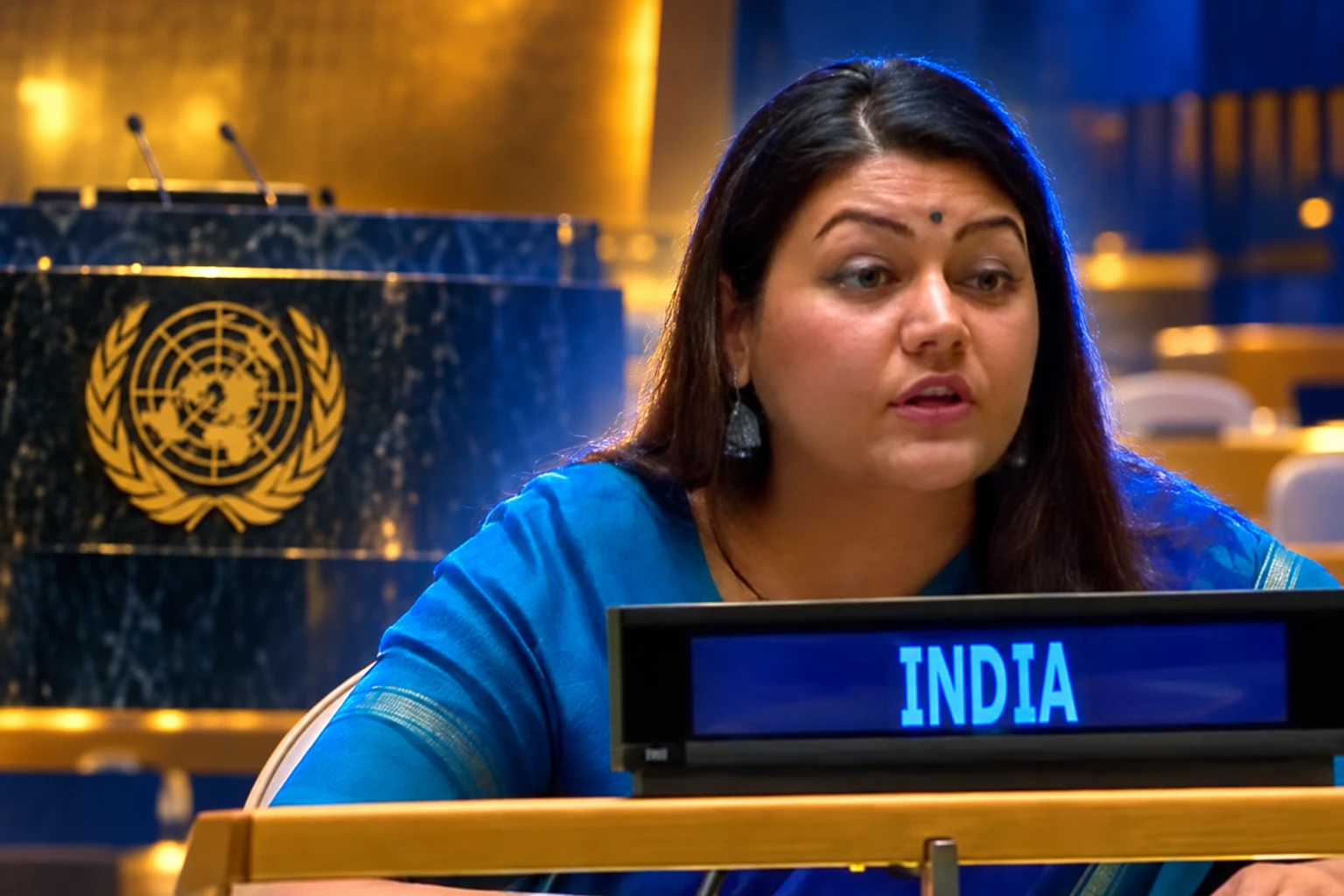
First Secretary Petal Gahlot told the UN General Assembly on September 25 that terrorism by Pakistan will have consequences. She was answering Prime Minister Shehbaz Sharif after his address to the 81st General Assembly, and she did not treat him as the man in charge.
She called his government a Form 47 cabinet, a regime of the army, and pointed at the 27th Amendment that gave its real ruler lifelong legal cover. The Kashmir lines were familiar. The addressee was not.
What the 27th Amendment Gave Asim Munir
Gahlot, first secretary in India’s Permanent Mission to the UN, said the hall had heard “hypocritical homilies about democratic rights and human values from a regime whose capital at this very moment is being fortified against its own people.” She then named the institution she said actually governs.
This is a regime of the army, by the army, and for the army. Their puppets may come and go, but let us have no illusion about who calls the shots. The reality of Pakistan is expressed in its 27th Amendment and the lifelong immunity granted to its real ruler.
Petal Gahlot, First Secretary, right of reply at the UN General Assembly
Parliament in Islamabad passed that amendment in November 2025. Field Marshal Asim Munir, army chief since November 2022 and already promoted after the May clash with India, became Chief of Defence Forces, with the army, navy and air force under one office. The Chairman of the Joint Chiefs of Staff Committee was written out. Five-star rank, uniform and privileges stay for life. So does lifelong immunity from criminal proceedings, drawn from the same shield the constitution gives the president.
A new Federal Constitutional Court took constitutional cases away from the Supreme Court, with its first judges named by the president. Within hours of the law, Justice Athar Minallah resigned and wrote that the constitution he had sworn to defend “is no more.” Justice Mansoor Ali Shah said the amendment had torn the Supreme Court to pieces. Michael Kugelman, former director of the Wilson Center’s South Asia Institute, called the result a post-hybrid system in which “the civil-military imbalance is about as imbalanced as it could possibly be.”
Sharif’s own government shepherded the bill. Gahlot’s reply still spoke as if the prime minister were the messenger. That is the point India wanted on the record: the man at the podium is not the man the warning is for.
Sharif Credits Trump and Calls Water an Act of War
Sharif spoke for 24 minutes and 21 seconds by the UN’s own audio clock. He told the hall that a year earlier Pakistan had faced “external aggression from India under a false pretext” and had used Article 51 of the UN Charter. He thanked President Donald Trump for “resolute and visionary leadership” and said a “timely intervention” had saved hundreds of millions of lives when two nuclear-armed neighbours stood “at the brink of an all-out war.”
India has said no third party arranged the halt. That split is now a fixture. Pakistan needs Trump in the story. New Delhi will not put him there.
Sharif also revived Kashmir as “Pakistan’s jugular vein,” promised diplomatic and moral support until a plebiscite, and tied peace in South Asia to a “just and fair solution.” He praised his armed forces for having “silenced the enemy, repulsed its attacks and taught it a lesson it shall never, ever forget.” Then he turned to the Indus system and said any attempt to stop, impede or divert Pakistan’s share of the waters would be treated as an act of war.
THE CLAIMS IN THE HALL
| Sharif at the podium | India’s reply the same day |
|---|---|
| Trump’s intervention saved hundreds of millions of lives | India says the halt was not arranged by a third party |
| Kashmir is Pakistan’s jugular vein and still awaits a UN vote | Jammu and Kashmir is an integral part of India; look at Rawalakot |
| India’s pause of the water treaty has no legal basis | The pause followed the Pahalgam attack and is tied to terrorism |
| Pakistan’s forces silenced the enemy in May 2025 | Last year’s strikes left terrorists nowhere to run or hide |
Gahlot called his Kashmir and rights passages “bizarre remarks” from a government Pakistanis themselves call a Form 47 government. She said reiterating falsehoods year after year does not make them true.
Nowhere to Run and Nowhere to Hide
The military fact under the diplomacy is last year’s sequence, which India now recites as policy rather than as a one-off raid. On April 22, 2025, gunmen killed 26 civilians in Pahalgam in Jammu and Kashmir. The Cabinet Committee on Security answered the next day. Foreign Secretary Vikram Misri said the Indus Waters Treaty of 1960 would be held in abeyance until Pakistan took “credible and irrevocable” steps to end support for cross-border terrorism. On April 24, Debashree Mukherjee, secretary in the Ministry of Jal Shakti, wrote to her Pakistani counterpart that India had held the 1960 water treaty in abeyance with immediate effect, citing “sustained cross-border terrorism” aimed at Jammu and Kashmir.
On May 7, 2025, India launched Operation Sindoor against what it described as terror infrastructure in Pakistan and in Pakistan-occupied Kashmir. A four-day clash followed. Munir’s field marshal rank came after that fighting. Sixteen months later, Gahlot put the same operation into UN language.
THE 16 MONTHS TO THIS REPLY
- April 22, 2025: Gunmen kill 26 civilians in Pahalgam.
- April 23, 2025: India announces the Indus Waters Treaty will be held in abeyance.
- April 24, 2025: Mukherjee’s letter notifies Islamabad of the pause.
- May 7, 2025: Operation Sindoor hits terror sites across the line.
- May 2025: Four days of fighting; Munir is named field marshal.
- November 2025: The 27th Amendment grants him command of all three services and immunity for life.
- June 2026: Protests and a crackdown in Rawalakot.
- September 25, 2026: Sharif speaks at UNGA; Gahlot exercises the right of reply.
“At the heart of the issue is the long-standing practice of cross-border terrorism by Pakistan,” she said. “We demonstrated last year that terrorists will have nowhere to run and nowhere to hide. Our right to defend ourselves against terrorism will be exercised and continued. Terrorism by Pakistan will have consequences.” The sentence that followed reached past the strikes to the older bargains between the two states: continued terrorism “will understandably call into question what were premised on friendship and goodwill.”
Why India Pointed at the Army Academy
She placed Sharif’s speech two weeks after New York marked the 25th anniversary of the September 11 attacks. September 11 to September 25 is 14 days, and she used that span on purpose. The mastermind of those attacks, she said, “was living right on the doorstep of the Pakistani Army’s premier academy,” the same institution that had been “the subject of such deep genuflection before us today by the representative of Pakistan.”
Osama bin Laden was found in Abbottabad in 2011, beside the Pakistan Military Academy at Kakul. Gahlot did not need to retell the raid. She only needed the geography, because Sharif had just praised the army that still owns that ground. “They claim to uphold security during the day; they actually carry out terrorism at night,” she said.
That is why the Form 47 line moved faster than the Kashmir paragraph. It is a local insult for a cabinet that exists on an election form, and she used it in the UN hall to say the praise of the army was the most honest part of the speech. The rights lecture, she argued, came from “those with a long record of bigotry and hatred,” from a state whose “mainstay is blasphemy laws.” “The world knows how minorities are treated in Pakistan,” she said. “No pious platitude can mislead it.”
Ask the People of Rawalakot
On Jammu and Kashmir she gave the standing Indian line first: the Union territory “is an integral and inalienable part of my country and will always remain so.” Then she inverted the subject. “If we must talk about Kashmir, let us turn our attention to the Pakistan-occupied Jammu and Kashmir. Ask the people of Rawalkot about the wanton killings, the brutal violence and the denial of basic rights that they have long experienced.”
Rawalakot, in Poonch, has been the centre of a protest campaign by the Jammu Kashmir Joint Awami Action Committee against 12 seats reserved in the 45-member legislative assembly for refugees who live elsewhere in Pakistan. The group wanted those seats abolished so that only people who live in the territory fill the house. After talks failed, authorities banned the JAAC on June 5, 2026, under a counterterror law, and arrested organisers ahead of a long march toward Muzaffarabad.
WHAT RAWALAKOT HAS SEEN
- The seats: Twelve of 45 assembly places are reserved for refugees settled in other parts of Pakistan, a share large enough to shape who governs the territory.
- The ban: The JAAC was proscribed on June 5, 2026, days before a planned march, and its offices were sealed.
- The June toll: Clashes in Rawalakot in early June killed at least 11 people, with more than 70 injured, after a funeral crowd met security forces.
- The vote: The territorial election was split into phases from July 27 as the unrest continued, and the refugee constituencies still went to the poll.
Casualty counts later in the summer diverge by source and by week, which is why the June figure is the one that can be stated with a date attached. Gahlot did not recite those numbers. She only named the town, and in a hall used to hearing Pakistan speak for Kashmir, that was the turn she wanted.
Treaties Built on Friendship and Goodwill
The water warning was the other half of Sharif’s India file, and it is the half that gives Gahlot’s “friendship and goodwill” line a concrete object. The Western Rivers to Pakistan, Eastern Rivers to India split, signed in 1960 with the World Bank as a signatory, assigned the Indus, Jhelum and Chenab westward and the Ravi, Beas and Sutlej eastward, with limited uses on the other side. It survived wars that other bargains did not. India has not said it has terminated the treaty. It has said the treaty sits in abeyance until the terrorism condition is met, and it has talked of storing and using more of the flow on its own side.
Water must never be weaponized. Rivers should nourish nations, not divide them. Therefore, any attempt to stop, impede or divert Pakistan’s share of the waters will be treated as an act of war. India must make no mistake about it.
Shehbaz Sharif, Prime Minister of Pakistan, UN General Assembly, September 25, 2026
Gahlot did not debate hydrology. She tied the older bargains to the same charge she had already made about the army and about Pahalgam. If the terrorism continues, she said, it will call those bargains into question. “We are confident that this Assembly will recognise Pakistan and its policies for what they really are, not what its representative mendaciously projects it to be.” Pakistan’s “terrorism, deceit and duplicity,” she closed, “will neither benefit it nor the world.”
Sharif left the hall with Trump in his story, Kashmir on the ledger, and water raised to the language of war. Gahlot left it with the army named, immunity cited, and last year’s strikes restated as a standing reply. The two accounts now sit on the same UN record, and neither side used the podium to close the gap.

A CubeSat Will Age Whisky That Never Comes Home

A Charity Quote Cost Shia LaBeouf the FKA twigs NDA

Looker Turned a Model’s Body Into Ad Inventory

Infinity Ward Bets a Paid DMZ Will Stick This Time

Disney Sidesteps a Kimmel Renewal as Failla Cites Losses

How to Get Pre Boarding on Southwest – Skip the Line with These Tricks

False AI Intel Nearly Put US Crews on a Chinese Ship

Tim Cook’s $4.6 Trillion Apple Still Runs on One Phone

OpenAI Posts a Navier-Stokes Proof Clay Has Not Touched

Dunes Air Sues Nora Fatehi Over Its Luxury Jet
-
 TRAVEL3 years ago
How to Get Pre Boarding on Southwest – Skip the Line with These Tricks
-
 NEWS1 month ago
False AI Intel Nearly Put US Crews on a Chinese Ship
-
 BUSINESS2 months ago
Tim Cook’s $4.6 Trillion Apple Still Runs on One Phone
-
 NEWS2 months ago
OpenAI Posts a Navier-Stokes Proof Clay Has Not Touched
-
 ENTERTAINMENT2 months ago
Dunes Air Sues Nora Fatehi Over Its Luxury Jet
-

 LIFESTYLE3 years ago
How Often Do You Have to Change a Monkey’s Diaper? The Truth About Pet Monkeys
-

 NEWS2 months ago
Australia Treats Cloud Software Payments as Taxable Royalties
-

 LIFESTYLE3 years ago
How Long Does It Take for Armpit Hair to Grow? The Stages of Hair Growth and How to Shave It