
BUSINESS
Nageswaran Says India’s FDI Image Fix Will Not Pay
Nageswaran said FDI reforms will not restore cheap-money inflows after US investment into India fell over 76 per cent in the first quarter.

Chief Economic Adviser V. Anantha Nageswaran said on September 25 that a cleaner pitch for foreign direct investment will not make the money arrive on cue. He told a New Delhi policy forum that India should still do more to welcome capital, then added that ticking every reform box will not restart the inflows that near-zero global rates once delivered.
The same day’s print from the Department for Promotion of Industry and Internal Trade showed equity inflows up 6 per cent in April-June, even as money from the United States fell by more than 76 per cent.
The Quarterly Print Rose While American Money Left
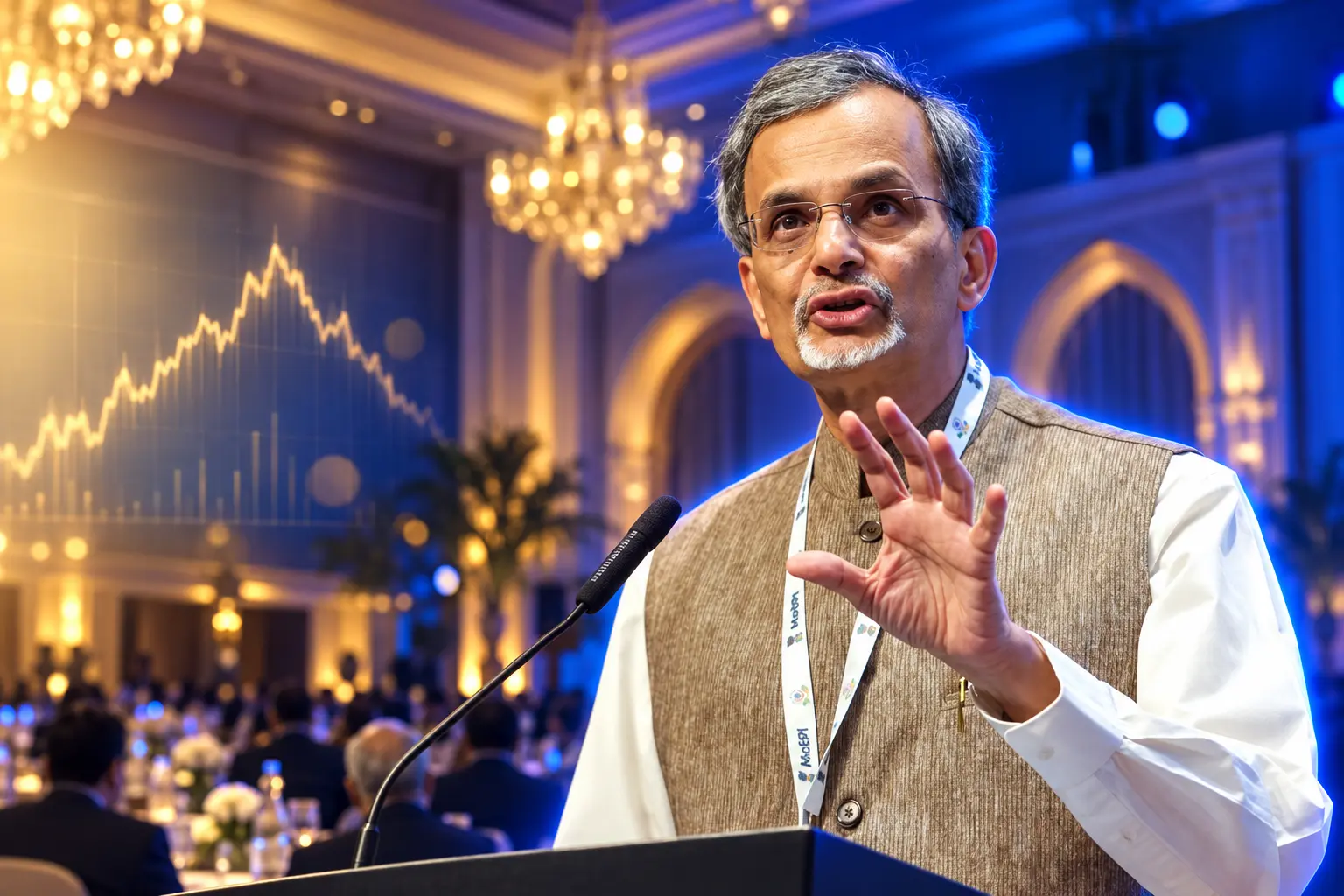
Nageswaran spoke at the 13th PAFI Annual Forum in New Delhi, held on September 24 and 25 at the Taj Mahal Hotel on Man Singh Road under the banner India 3.0. His session sat under a blunt title: India’s next growth decade in a disrupted world. The DPIIT sheet that landed the same Friday put first-quarter equity at $19.81 billion, against $18.62 billion a year earlier.
Count the sources and the rise looks less like a vote from Washington. Japan led the quarter. The United States, still named among the large sources in the thin first write-ups, sat fifth.
Q1 FDI EQUITY BY SOURCE
| Source | April-June 2026-27 | Note |
|---|---|---|
| Japan | $5.71 billion | Largest source |
| Singapore | $5.22 billion | Second |
| Mauritius | $2.31 billion | Third |
| Netherlands | $1.38 billion | Fourth |
| United States | $1.34 billion | Down from $5.61 billion |
| UAE | $868 million | Down from $1 billion |
The quarter was also front-loaded. Inflows nearly doubled in April to $12.1 billion from $6.6 billion, then dropped to $2.8 billion in May and $4.91 billion in June. Include reinvested earnings and other capital and the broader total rose about 22 per cent to $30.65 billion. Tamil Nadu took $5.95 billion, ahead of Maharashtra at $4.22 billion, Delhi at $2.67 billion, Karnataka at $2.11 billion and Gujarat at $1.3 billion.
That is a higher headline with a different map. American equity did not underwrite it.
Cheap Money Covered India’s Imperfections
“When we talk about what India should be doing on FDI, the general perception is that we should do more, and yes, we should always aim to do better and more,” Nageswaran said. He did not stop there. “With all the imperfections we had, we were still able to attract more FDI in the second decade and a large part of the reason was interest rates were close to zero everywhere.”
DPIIT’s own year-wise equity series matches the memory. Inflows were $21.38 billion in 2010-11 and $49.98 billion in 2019-20, more than doubling across the years when advanced-economy policy rates sat near the floor. The next leap, to $59.64 billion in 2020-21, still belonged to that cheap-capital window. After rates rose, equity slipped to $46.03 billion in 2022-23 and $44.42 billion in 2023-24 before recovering.
Last year the recovery was real. The department’s factsheet through March 2026 records full-year equity inflows of $58.85 billion, up 18 per cent from $50.02 billion, and cumulative FDI since April 2000 of $1.17 trillion. Nageswaran’s point was that those later numbers do not prove the old machine still works. “It is not that we are not doing things to improve our FDI receptivity but the world is constantly shifting. Therefore, what we need to do also increases but it does not mean even if we tick boxes the money will start flowing tomorrow.”
He went further with the politics of disappointment. “You can do everything right, the public will see that there is no result and will therefore be clamouring for more but the point is global context has shifted.” Higher rates abroad, he said, will lift the cost of capital at home and move funds across borders. Indian policy rates have not risen as far as G7 rates, he added, but markets may not give emerging economies credit for that gap. Investors still want 200 to 300 basis points more than they earn in rich countries, and India has to grind that premium down.
What the Graham Act Forces India to Price
The shifted context is not only a rate cycle. Nageswaran said geopolitics, trade, technology and energy now push countries toward competing blocs. He called the US Graham Act, tariffs and other trade curbs “sustained coercion” aimed at forcing a choice. India, he said, cannot make that choice.
The statute is already on the books. President Donald Trump signed H.R. 5334 on September 18, 2026, and it became Public Law 119-111. The House had agreed to the Senate changes by 262 to 159. Congress’s own summary says the President must raise the duty by up to 100 per cent ad valorem on all goods from a country that was among the five largest buyers of Russian crude or gas if that country knowingly makes new purchases after the law’s enactment. A legal briefing on the enrolled text dates that purchase test to October 18, 2026, thirty days after the signing, and notes a national-interest waiver if the White House certifies one to Congress.
THE GRAHAM ACT CLOCK
- September 16, 2026: House agrees to the Senate amendments, 262 to 159.
- September 18, 2026: The President signs H.R. 5334; it becomes Public Law 119-111.
- October 18, 2026: New purchases of Russian-origin crude or gas by a top-five buyer can trigger tariffs of up to 100 percent on that country’s goods entering the United States.
India remains among the largest buyers of Russian crude, which is why the Act sits inside an FDI speech at all. A 100 per cent duty is a ceiling, not a tariff already on Indian cargo. The President still has to name the countries, set a rate, and send Congress a written justification at least ten days before any duty lands. Top-five lists are then meant to be reviewed every 180 days.
WHAT WE KNOW
- The statute: The tariff power is law, not an executive memo a court can easily vacate.
- The trigger: New purchases after October 18, 2026, by a top-five buyer of Russian oil or gas.
- The waiver: The President can set the duty aside with a national-interest certification to Congress.
WHAT IS UNCONFIRMED
- The rate: No country-specific duty on India has been announced.
- The list: Washington has not published the first official top-five determination under the Act.
Nageswaran did not wait for that list. “Given India’s size, location, India cannot afford to choose. Therefore, the answer is hedging,” he said. Then he priced the hedge.
Japan Filled a Gap the United States Left
If American boards are already writing India risk into sourcing sheets, the first-quarter sheet shows who still wrote cheques. Japan overtakes United States in India first quarter FDI on the DPIIT ranking, $5.71 billion against $1.34 billion. That Japanese total in three months is already larger than the $3.75 billion DPIIT recorded from Japan for the whole of 2025-26.
Tokyo has been a slow, compounding presence rather than a boom-bust one. The foreign ministry’s bilateral brief puts cumulative Japanese equity of $48.14 billion from April 2000 to March 2026, about 6 per cent of India’s stock, with factories clustered in automobiles, electrical equipment, telecom, chemicals, insurance and drugs. Singapore, still the great conduit, was only a step behind Japan in the quarter at $5.22 billion. Mauritius added $2.31 billion.
The mix matters for Nageswaran’s warning. A quarterly rise funded by Japan, Singapore and reinvested earnings is not the same event as a return of US greenfield money. He also tied capital to the shop floor. “Most important for industry is global competitiveness,” he said, calling that the quid pro quo for subsidies and tax breaks. India still runs a manufactured-goods deficit, he noted, and building plants at home still requires imported machines and know-how. Indigenisation, in his telling, is not a closed border.
The Signals Investors Are Told to Trust
If the money will not move just because a rulebook is tidier, what does he want investors to watch? Macro first, he said, and patience only after that. “Steady growth of 7 percent higher, declining inflation and fiscal prudence that has earned credit rating upgrades” are “the most important and durable signal.” Investor protection, tax certainty, skilled staff and logistics still count, but he said backers wait less if the macro is wobbly.
WHAT HE SAID INVESTORS WATCH
- Growth bar: Steady expansion of 7 per cent or higher, the floor he named on September 25.
- Prices: Inflation that is still moving down, not a one-month print.
- The books: Fiscal caution that rating agencies can see, not only budget speeches.
- The rest: Legal protection, stable taxes, trained people, and working logistics.
Those upgrades are not hypothetical. On September 2 the finance ministry said Japan Credit Rating Agency lifted India to A- from BBB+, with a stable outlook, and raised the country ceiling to A. JCR cited growth near 7 per cent, GST and digital public infrastructure, and cleaner bank books. MoSPI’s figures, quoted in that note, put real GDP growth at 7.8 per cent in 2025-26 and again at 7.8 per cent in the April-June quarter, the same three months as the FDI print. The central government’s deficit, JCR said, narrowed from 4.7 per cent of GDP in 2024-25 to 4.4 per cent in 2025-26. Morningstar DBRS, S&P Global and Japan’s R&I had already moved India up during 2025.
The 7 per cent Nageswaran named is the bar he wants the world to treat as durable. The 7.8 per cent MoSPI printed is the latest actual reading. They are not the same claim. One is a pitch. The other is a score.
Hedging Is Now a Line Item for Firms
The line that travelled from the forum was not a request for better brochures. It was the cost of staying unaligned while a US statute turns oil purchases into tariff risk, and while American equity into India has already shrunk to $1.34 billion from $5.61 billion.
Given India’s geography and size and its quest to be a swing power, simply means hedging will have significant costs, and that has to be factored into our decision-making, both in the public and private sector.
V. Anantha Nageswaran, Chief Economic Adviser, 13th PAFI Annual Forum
That is a bill for companies, not only for South Block. A factory that needs US buyers, Russian barrels, Japanese tools and Singapore holding companies now has to price the hedge the CEA described: possible duties, slower capital, and a risk premium that still sits 200 to 300 basis points above rich-country yields. The first-quarter sheet already shows the split. The total can rise while one large source walks away.
Nageswaran said the government will take the argument into the Economic Survey due in January, including how public policy and private investment may need to be rethought over the next 20 years. Until then the instruction is plain enough. Keep improving the pitch. Do not confuse a tidier pitch with money in the account.

A CubeSat Will Age Whisky That Never Comes Home

A Charity Quote Cost Shia LaBeouf the FKA twigs NDA

Looker Turned a Model’s Body Into Ad Inventory

Infinity Ward Bets a Paid DMZ Will Stick This Time

Disney Sidesteps a Kimmel Renewal as Failla Cites Losses

How to Get Pre Boarding on Southwest – Skip the Line with These Tricks

False AI Intel Nearly Put US Crews on a Chinese Ship

Tim Cook’s $4.6 Trillion Apple Still Runs on One Phone

Dunes Air Sues Nora Fatehi Over Its Luxury Jet

OpenAI Posts a Navier-Stokes Proof Clay Has Not Touched
-
 TRAVEL3 years ago
How to Get Pre Boarding on Southwest – Skip the Line with These Tricks
-
 NEWS1 month ago
False AI Intel Nearly Put US Crews on a Chinese Ship
-
 BUSINESS2 months ago
Tim Cook’s $4.6 Trillion Apple Still Runs on One Phone
-
 ENTERTAINMENT2 months ago
Dunes Air Sues Nora Fatehi Over Its Luxury Jet
-
 NEWS2 months ago
OpenAI Posts a Navier-Stokes Proof Clay Has Not Touched
-

 LIFESTYLE3 years ago
How Often Do You Have to Change a Monkey’s Diaper? The Truth About Pet Monkeys
-

 NEWS2 months ago
Australia Treats Cloud Software Payments as Taxable Royalties
-

 LIFESTYLE3 years ago
How Long Does It Take for Armpit Hair to Grow? The Stages of Hair Growth and How to Shave It