
LIFESTYLE
What Does Birch Beer Taste Like?
What Does Birch Beer Taste Like? Sweet wintergreen in the glass, and the best brands split by vanilla, cane sugar, and whether the label names birch oil.

Birch beer is the Northeast soda that sits next to root beer and tastes like sweet wintergreen. The first sip is cool mint, then sugar, then a woody herbal finish that is lighter than a vanilla-heavy root beer. People who grew up with it already know that edge. A first bottle is where the mint catches you off guard.
Red, white, and brown are weak guides to that sip. Vanilla, the sweetener, and whether the label names birch oil change the glass more than the dye does. This page covers the taste, the label lines that predict it, what the colors mean, which widely sold brands match a creamy pour or a sharper one, the float and the black cow, and why a soft drink still carries the name beer.
The Wintergreen Taste in Birch Beer
Smell the glass before you drink. The nose is cool mint, closer to wintergreen gum than to cola, and the middle of the sip is straightforward sugar. Brands split at the finish. Vanilla and cane sugar leave a rounder end, and a plainer wintergreen bottle leaves a cleaner, sharper end. You are drinking sweet soda water flavored with an oil, not a mouthful of raw sap.
That oil comes from sweet birch, also called black birch (Betula lenta), a tree of the Northeast. Natural sweet birch oil runs 93.24 to 99.84 percent methyl salicylate, the same cooling compound that flavors wintergreen candy, in the 2022 sweet birch oil survey published in the journal Plants. Methyl salicylate is why birch beer and wintergreen gum smell like relatives even though one is a soda and the other is candy.
None of the 27 commercial sweet birch oils in that survey contained the minor compounds that mark oil distilled from real Betula lenta bark. Markers in the samples pointed to wintergreen oil, synthetic methyl salicylate, or castor oil instead. The test covered bottles of essential oil, not cans of soda, so it does not grade any brand on this page. It does explain a label puzzle: two sodas can both smell like wintergreen candy while one names birch oil and the other names a flavor blend.
Root beer is built on a different idea. Older recipes leaned on sassafras, and commercial root beer moved off sassafras oil because of safrole, a compound in that oil that U.S. regulators restricted. The root beer most shelves carry now leans on vanilla and spice. Birch beer keeps the bubbles, and in plenty of brands the brown-soda look, with wintergreen in front. A sharp root beer and a mild birch beer can land near each other. A creamy root beer and a plain birch beer do not.
What Does a Birch Beer Label Tell You?
The word birch on the neck names the category. The recipe is three lines on the back, and those lines are what you can check in the store without trusting a color name.
WHAT THE LABEL DECIDES
- The flavor line: Pure birch oils or vanillin means the bottler is naming birch or a cream note. Natural and artificial flavor is a blend the panel does not itemize. Artificial flavors alone do not claim birch oil.
- The sweetener: Cane sugar and high fructose corn syrup are different sweeteners, and the brand table below shows which bottle uses which. The corn-syrup bottles drink more like a mainstream soda.
- The color additives: Red 40 and caramel color explain a red or brown liquid. A label that lists neither is the clear pour, the one sold as white birch beer.
Read those three lines before you trust the color on the front. The bottles below are the ones with public labels you can compare side by side, and the calories are printed for each brand’s own serving. Those servings are not the same size, so a smaller number is not automatically a lighter recipe.
| Brand | Serving on the label | Calories | Sugars | Sweetener | Flavor wording |
|---|---|---|---|---|---|
| Boylan Creamy Red | 12 fl oz | 170 | 42 g | Cane sugar | Pure birch oils, natural and artificial flavors, vanillin |
| Foxon Park White Birch | 12 fl oz | 140 | 34 g | Sugar | Natural and artificial flavor |
| Kutztown Birch Beer | 8 fl oz | 100 | 26 g | Pure cane sugar | Natural and artificial flavor |
| Pennsylvania Dutch | Not listed on the panels checked | Not listed | Not listed | High fructose corn syrup | Natural and artificial flavor |
Boylan is the only row that names birch oil and vanillin. Foxon Park and Boylan can be compared directly, because both panels are for 12 fl oz, and Foxon Park is the lower sugar line of the two. Kutztown’s 100 calories are for 8 fl oz. Pennsylvania Dutch is the corn-syrup bottle, with Red 40 and caramel color on current retail labels, and with no calorie panel in the listings checked here.
What Do Red, White, and Brown Birch Beer Mean?
Clear birch beer, sold as white, is the style more common in New England. Red birch beer, dark and opaque, is the style more common in the Mid-Atlantic. Brown bottles sit in the root beer lookalike spot, and Pennsylvania Dutch is the dark one grocery distribution is most likely to carry outside that region. Other colors, including blue, exist. Red, brown, and clear are the three with a regional habit behind them.
The liquid is not that color because the tree was red. In 2014, Andy Schlegel, then manager of Kutztown Bottling Works, said birch oil would pour clear on its own. Caramel color goes in at the end, he said, and red, brown, and clear versions are not guaranteed to taste different. Kutztown’s brown birch beer still lists caramel color. Boylan’s red lists Red 40 and caramel color. Foxon Park’s white birch lists no dye. A clear bottle is the one place the color name matches the liquid. A red or brown name tells you a dye was added, and the flavor line tells you the rest.
Drinkers who want the wintergreen uncovered reach for white birch and treat vanilla as the ingredient that softens the mint. That split shows up from diner to diner, which is why two people can argue about birch beer after tasting different taps. One had a creamy red. The other had a clear pour with nothing rounding the wintergreen.
Which Birch Beer Brand Matches Your Taste?
Once the label lines are clear, the brands sort by what you want in the finish. Start with the widely shipped sweet brown if you want the diner classic. Move to cane sugar and a named oil or vanillin if you want a sharper or creamier craft pour. The stories below use each maker’s own words plus the panel in the table.
Pennsylvania Dutch Birch Beer
Pennsylvania Dutch is the bottle that travels when someone leaves the region. Retail labels for the regular birch beer list carbonated water, high fructose corn syrup, caramel color, natural and artificial flavor, acacia, and Red 40. Some two-liter labels also list salt. Sellers describe a dark soda with a rich, creamy, bold birch flavor, which fits a sweet, dyed, corn-syrup birch beer.
- Best first bottle: Buy it when the other brands are not in the store and you want the sweet dark version people already know.
- What you give up: The panel does not name birch oil, and the sweetener is high fructose corn syrup.
- What you get: A creamy, minty soda in the brown-root-beer shape, and one wholesale listing calls it caffeine free.
Treat it as the mainstream of the category. If this glass tastes too much like a sweet cola cousin, the next step is a cane-sugar bottle, not a second can of the same brand.
Boylan Original and Creamy Red Birch Beer
Boylan’s original birch beer is the drink pharmacist William Boylan mixed in 1891 in his Paterson, New Jersey, apothecary. The company still describes strong notes of sweet birch and wintergreen oil. He sold cups from a barrel in the back of a wagon, and the firm dates its bottling partnership with John W. Sturr to 1900.
Boylan’s creamy red birch beer is that house style plus a hint of vanilla. The company says the vanilla makes it creamy, with notes of sweet birch and wintergreen oil. The current 12 fl oz grocery label matches the table: cane sugar, pure birch oils, natural and artificial flavors, vanillin, citric acid, sodium benzoate, Red 40, and caramel color, at 170 calories and 42 grams of sugar, all of it added sugar.
- Original: Choose it when you want the pharmacy birch, cane sugar, and wintergreen without a cream billing.
- Creamy red: Choose it when you like root beer and want the mint softened before any ice cream goes in.
During Prohibition the company sold birch beer in unused beer barrels. The recipe you buy is still a soft drink. The barrel was a package, not a sign that the bottle in the cooler contains alcohol.
Foxon Park White Birch Beer
Foxon Park white birch soda is the clear Connecticut bottle, from a family company in East Haven that marks its start as 1922. The product page calls the taste a subtle wintergreen and credits an Alaskan birch. That is a different plant story from Betula lenta, the northeastern sweet birch in the oil research. The grocery ingredient line only says filtered carbonated water, sugar, citric acid, natural and artificial flavor, and sodium benzoate.
THE CLEAR POUR
- No dye: This is the bottle to buy when you want to see the soda, with no caramel color in the glass.
- Same-size compare: At 12 fl oz it is 140 calories and 34 grams of sugar, under Boylan’s creamy red at the same size.
- Sweetener: The panel says sugar. The company says its sodas use cane sugar, and a retailer flag on this bottle says no high fructose corn syrup.
Serve it very cold. The mint shows up once the sweetness is not warm, and the lack of vanillin on the label is your clue that nobody rounded this one toward a cream soda. It is also sold as caffeine free.
Kutztown Birch Beer
Kutztown’s cane sugar birch beer is the Berks County soda with the wintergreen turned up. The company says it uses birch oil and pure cane sugar, and that you get a strong wintergreen nose, then the same note on the tongue, in a soda that is less creamy than root beer. The ingredient panel says triple-filtered carbonated water, pure cane sugar, caramel color, natural and artificial flavor, citric acid, sodium benzoate, yucca extractives, and acacia. Birch oil is in the description at the top of the page and not in the ingredient list by that name.
READ THE SERVING, NOT THE BOTTLE
- Panel serving: 100 calories and 26 grams of sugar are printed for 8 fl oz.
- What the shop sells: The product page is for 24 oz bottles, and 24 divided by 8 is three servings.
- Whole bottle: Three servings come to 300 calories if you drink the 24 oz bottle at the printed 100 calories per 8 fl oz.
Schlegel has said Kutztown’s oil usually comes from sap, supplied out of Maryland, mixed with sweetener and preservatives, with color added last. The company page now says the birch beer has no caffeine. Buy this one when you want cane sugar and a wintergreen the bottler is willing to call strong, and when you will read 100 calories as a glass.
Sioux City, made by White Rock, is the cane-sugar birch beer you are more likely to see once you leave the Northeast. Its ingredient line is purified carbonated water, pure cane sugar, artificial flavors, caramel color, citric acid, sodium benzoate, and Red 40. There is no birch oil on that label. Treat it as a sweet colored soda in the birch beer slot, useful when it is the only bottle in town, and a poor reference for how sweet birch itself tastes.
What to Ask at a Diner
A menu that only says birch beer is not a brand. The tap can be any of the styles above, and the server’s two answers tell you which glass is coming.
- Ask whether the birch beer is red, brown, or white, and whether the fountain calls it creamy.
- Hear creamy or vanilla as the softer pour, closer to root beer, in the Boylan creamy red direction.
- Hear white or plain as the sharper wintergreen pour, in the Foxon Park direction.
- If the only option is a Pennsylvania Dutch can, expect a sweet dark soda from corn syrup.
That short exchange saves you from judging the whole category by one tap. A creamy red and a clear white can share a name and still taste like different sodas, which is the main reason first reviews of birch beer disagree.
How to Serve Birch Beer as a Float
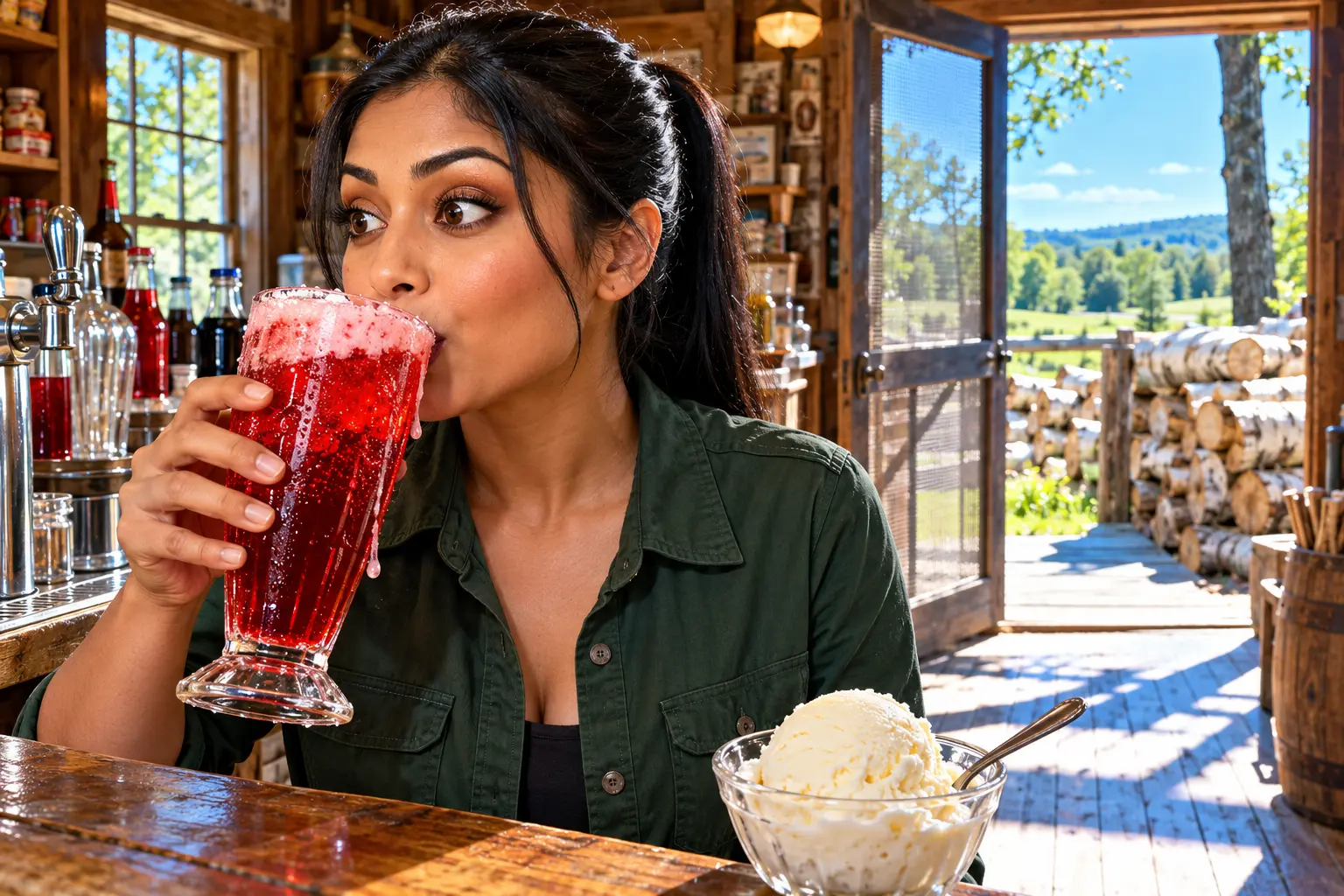
In the dairy country of southeastern and central Pennsylvania, a birch beer float is vanilla ice cream in birch beer. The same soda with chocolate ice cream is a black cow. Wintergreen cuts the dairy fat, so the creamy red and the sweet brown are the fountain matches. A very sharp clear birch beer tastes more like mint on ice cream than like a classic float.
- Chill the birch beer until it is fully cold. Warm soda goes flat on contact with the ice cream.
- Put one or two scoops in a tall glass, vanilla for a birch beer float or chocolate for a black cow.
- Pour the soda down the side of the glass until the foam crowns the rim, then drink it before the foam falls.
Use a cane-sugar creamy red when you want the float to taste like a soda-fountain dessert. Use Pennsylvania Dutch when you want the sweet diner version and that is the can on hand. Skip the sharpest white birch for this job unless you already know you want mint in the dairy.
Where Does Today’s Birch Beer Soda Come From?
The name is older than the soda aisle. In 1707, John Mortimer’s The Whole Art of Husbandry gave a birch sap recipe: a pound of refined sugar for every gallon, a boil of about a quarter-hour to a half-hour, a cool-down, and a little yeast so the sap would ferment. He described it as a drink for people who were not buying imported ale. That glass was a fermented sap drink. It is not the bottle in a cooler.
The soda you buy comes from the pharmacy fountain, when herbal syrups were carbonated and sold as alcohol-free drinks. Boylan began bottling in 1900. During Prohibition the firm put birch beer in unused beer barrels, and Schlegel has said the Kutztown plant, which had bottled beer, turned to soda in that same period, with birch beer the most popular of the new line. Foxon Park opened in East Haven in 1922, in that soda era.
Older trade descriptions start with bark that is distilled into birch oil, and the oil is dosed into sweetened carbonated water. Kutztown’s account starts with sap. Either path ends at a flavoring, then sugar, then bubbles, then dye if the bottler wants a red or brown. Yeast is not on the modern labels in the table. The alcohol stayed with the old sap recipe.
Sweet birch grows in the Northeast, and the bottlers that kept the soda are still regional: Boylan in New Jersey, Foxon Park in Connecticut, Kutztown in Pennsylvania, and Pennsylvania Dutch as a grocery brand from that food culture. The drink is also tied to Newfoundland. National cola companies did not carry it across the country, which is why a first taste, for a lot of adults, happens on a trip or from a case someone mailed.
Frequently Asked Questions
Is Grocery Birch Beer Alcoholic?
The birch beer in a grocery cooler is a soft drink, not an alcoholic beer. Yeast and fermentation belong to the older sap recipe, and that printed recipe warned the drink could break bottles if it was not kept cold. None of the modern labels covered here list alcohol.
Does Birch Beer Have Caffeine?
Kutztown states that its birch beer has no caffeine, and Foxon Park sells its white birch as caffeine free. The Boylan and Pennsylvania Dutch ingredient lines checked for this guide do not list caffeine. A fountain syrup can differ from the bottled soda, so use the list on the can or the tap in front of you.
Is Birch Beer the Same as Sarsaparilla?
Sarsaparilla is a different soda, named for a different plant, and it drinks creamier and closer to a classic root beer. Kutztown draws that line on its own birch beer, which it describes as less creamy than sarsaparilla or root beer, with wintergreen in front. The two can share a fridge without tasting like the same drink.
Can You Drink Birch Beer With an Aspirin Allergy?
Skip birch beer if you have been told to avoid aspirin or salicylates, and ask your clinician before you try a bottle. The wintergreen taste comes from methyl salicylate, a cousin of aspirin, even though the soda uses a flavoring amount rather than a spoon of essential oil. This is a flavor guide, not medical advice, and the pure oil is not something to drink.
Why Is Birch Beer Hard to Find Outside the Northeast?
The bottlers that kept birch beer are still regional, centered on Pennsylvania, New Jersey, and Connecticut, and the drink is also tied to Newfoundland. National cola brands did not carry the flavor across the country. Pennsylvania Dutch is the bottle that travels, because grocery distribution already moves it, which is why it shows up when family sends a taste of home.
Start with the flavor line, not the color on the cap. A creamy red with vanillin, a clear bottle with no dye, and a corn-syrup brown can share a shelf and still taste like three sodas. Chill the one that matches the finish you want, then decide whether wintergreen belongs in the fridge.

A CubeSat Will Age Whisky That Never Comes Home

A Charity Quote Cost Shia LaBeouf the FKA twigs NDA

Looker Turned a Model’s Body Into Ad Inventory

Infinity Ward Bets a Paid DMZ Will Stick This Time

Disney Sidesteps a Kimmel Renewal as Failla Cites Losses

Southwest Preboarding: Who Qualifies and What to Do

False AI Intel Nearly Put US Crews on a Chinese Ship

How Often Do You Have to Change a Monkey’s Diaper?

Tim Cook’s $4.6 Trillion Apple Still Runs on One Phone

Dunes Air Sues Nora Fatehi Over Its Luxury Jet
-
 TRAVEL3 years ago
Southwest Preboarding: Who Qualifies and What to Do
-
 NEWS2 months ago
False AI Intel Nearly Put US Crews on a Chinese Ship
-
 LIFESTYLE3 years ago
How Often Do You Have to Change a Monkey’s Diaper?
-
 ENTERTAINMENT2 months ago
Dunes Air Sues Nora Fatehi Over Its Luxury Jet
-
 BUSINESS2 months ago
Tim Cook’s $4.6 Trillion Apple Still Runs on One Phone
-
 LIFESTYLE3 years ago
How Long Does It Take for Armpit Hair to Grow?
-

 NEWS2 months ago
OpenAI Posts a Navier-Stokes Proof Clay Has Not Touched
-

 TRAVEL2 years ago
Smallest Airlines in the US: Niche Carriers and Unique Flights