SPORTS
Is Dance a Hard Sport?
Is dance a hard sport? Competitive rounds push you near your oxygen peak with only short rests between dances, while a weekly class is a lighter load.

Someone has told you that dance does not count as a sport. If you train most nights, that line feels lazy, and you want a test that does not depend on who talks loudest at the table.
Is dance a hard sport? Competitive dancesport is a hard sport on the measures labs use for hard work: a high aerobic ceiling, a large share of it used in the round, and a lactate rise from anaerobic bursts. A weekly class is real physical effort with a lighter shape, and elite competition numbers are the wrong yardstick for it.
You will see what a competition round costs, why the pause between dances matters, and how to place Standard, Latin, ballet, breaking, and the class on your own calendar.
What Counts as a Hard Sport in Dance?
A useful test has two parts, and both have to be present. The activity needs organized skill, rules, and a body that can run events, and it needs a physical load that would look familiar in a sports lab. DanceSport has the first part on the record: the World DanceSport Federation’s history marks full IOC recognition in 1997 at the 106th Session in Lausanne.
The second part is the one arguments skip. From the seats, a couple can look smooth while both people are working near the top of their oxygen use. The same shrug shows up when people explain why marching band gets called not a sport, and it ignores the strain that never makes the photo.
Judges can score artistry in the same minute the heart is near its high range. The artistic score adds a job, which is to keep the lines clean while the load is already high. Breaking later stood on the Olympic program under that same federation, which settled the governance question for one style without turning every recital into a meet.
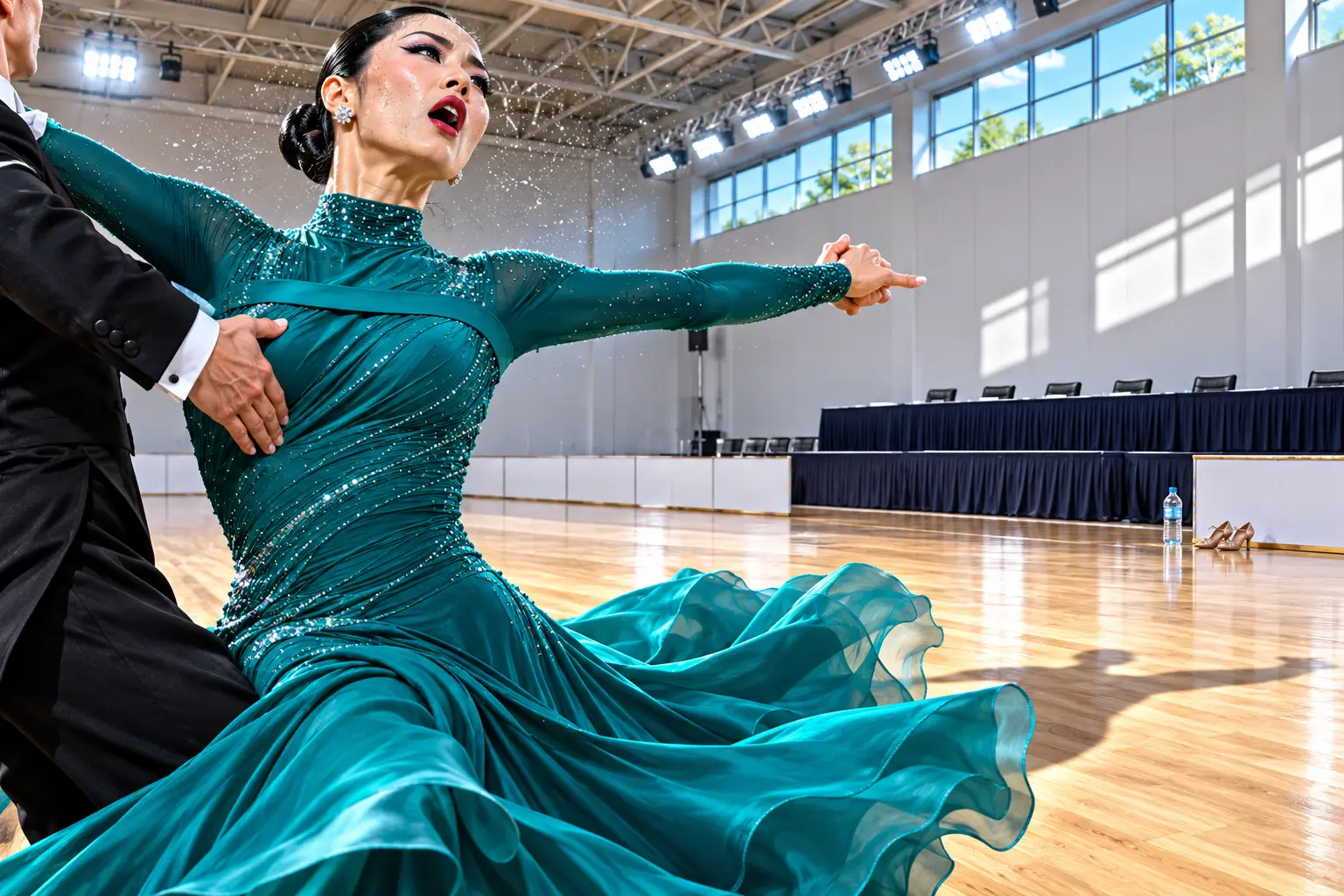
How Hard Is a DanceSport Competition Round?
The clearest window is still the 2011 lab and floor tests of elite couples. Latin men reached 84.2 ± 11.2% of peak oxygen uptake in the simulated competition, a larger share than Standard men in that session. Peak oxygen uptake is the oxygen you can use at an all-out effort, scaled to body weight, so that percentage is how much of your ceiling the dancing actually took.
For the women in the same tests, the share of peak oxygen did not differ between Latin and Standard. Blood lactate rose after both styles. Lactate climbs when the muscles lean on short-burst energy, so the round was never an easy aerobic cruise. Read each row on its own, because averaging the styles hides the gap the men showed.
| Group | Lab peak oxygen uptake (mL/kg/min) | Share of that peak in simulation (%) | Peak lactate after simulation (mM) |
|---|---|---|---|
| Standard men | 60.9 ± 6.0 | 75.7 ± 10.6 | 6.50 ± 2.1 |
| Latin men | 59.2 ± 7.0 | 84.2 ± 11.2 | 7.95 ± 2.1 |
| Standard women | 53.7 ± 5.0 | 72.5 ± 12.8 | 6.91 ± 2.6 |
| Latin women | 52.3 ± 5.0 | 70.8 ± 13.8 | 6.04 ± 2.5 |
Lactate does not crown one style for every dancer. Latin men had the highest lactate of the four groups, and Latin women had the lowest. A harder look on one measure is not a higher lactate number for the whole couple. The 2011 conclusion still stands for both styles: high demand, aerobic and anaerobic, in phases that follow each other quickly.
If you compete, use the row as a picture of the round, not as a score to hit in every class. A practice that runs the full set, with the real pause, tells you more than a fitness test you take in sneakers on a separate day.
How Do Short Rests Change the DanceSport Load?
One dance can be survived on nerve. A round is a chain, and the chain is what makes the sport hard. Competition rules described in a 2026 study of elite Latin dancers set the clock this way.
THE SHAPE OF A ROUND
- The set: Five dances make one round.
- The length: Each dance lasts about 1.5 to 2 minutes.
- The pause: About 20 seconds separates the dances.
- The break: At least 20 minutes separates rounds, down to a final of six couples.
That pause is the detail that changes the math. Breathing and the muscles that hold your frame need longer than the gap you are given, so the next dance starts on leftover fatigue. The 2011 description of short recovery between high-demand phases is this clock, not a vague warning.
You should expect a heart-rate climb across a Latin round. Separate simulations found the highest rates in the last dances, the Paso Doble, the Jive, or the Quickstep, and in the last round of the event. Your rating of effort can lag that line, which is why a round can look controlled while the heart is still rising.
Style also changes where you sit against the anaerobic threshold, the effort where short-burst energy starts to take more of the work. A 2014 test of three dancesport styles found Latin more intensive than Standard and Ten Dance, most of all for women. Standard dancers tended to stay under that threshold, and Latin dancers went over it. Ten Dance sat on the line, which means both jobs land in one event.
Try one practice that copies the constraint. Dance the five dances in order, keep the pause near the real length, and note the first dance where the frame breaks. That dance is the one to rehearse when you are already tired.
Which Kind of Dance Matches Your Week?
Once the round has a shape, match it to the dancing you actually do. The lab couples were elite dancesport athletes. Your week might be that life, or a company rehearsal, a battle, or a Tuesday class, and the answer changes with the week.
Standard and Latin DanceSport
- Standard: Waltz, tango, Viennese waltz, foxtrot, and quickstep travel the floor, and they still take a large share of peak oxygen with a lactate rise.
- Latin: Samba, cha-cha, rumba, paso doble, and jive use sharper actions, and the men in the 2011 simulation spent a larger share of peak oxygen here than in Standard.
- Ten Dance: You dance both sets in one event, so the under-threshold work and the over-threshold work land on the same day.
If you compete in any of these, the table is about your event, not about dancers as a symbol. Build the base that lets you repeat the set, and practice the bursts inside each dance, because the pause will not give you a full reset.
Ballet and Other Concert Dance
A company day is not five judged dances separated by about 20 seconds. You take class, you rehearse, and the hard spikes arrive inside choreography: jumps, balances, and partnered lifts done while the line still has to look quiet. The dancesport table does not describe that day, and the day is still athletic work spread over many hours.
CHECK THE WEEK, NOT THE LABEL
- The schedule: Count how many days you dance on tissue that has not recovered.
- The spike: Notice which steps make you lose the phrase, not which steps look impressive from the wings.
- The wrong chart: Do not use a ballroom lactate number to decide if a rehearsal was hard.
Concert dance fails an organized-winner test when nobody is competing, and it can still wreck a foot. Hard on the body and sport status are related questions. They are not the same question, so answer them separately for the room you are in.
Breaking on a Competition Floor
Breaking entered the Olympic program at the Paris Games on 9 and 10 August 2024, under the federation that governs dancesport. Battles are explosive and stop-start, and a bracket gives them a sport format. They are not a Standard round.
- The frame: A judge, a bracket, and an Olympic program put breaking on the sport side of the line.
- The gap: The oxygen figures in the table come from ballroom styles, so they are a poor target for a battle unless you have a breaking-specific test.
A Weekly Studio or Social Class
A class is built so you can learn. You stop, you watch, you try a phrase, and you reset. That pattern can leave you sweaty and proud without copying a final.
- Long stops: You wait while a combination is shown.
- Short efforts: The hardest phrase ends, and you get a real pause.
- No judge: Nobody scores whether you hid your breathing.
- Your choice: You can sit out the next song at a social dance.
If that list sounds like your week, keep the class and call it skilled exercise, not elite dancesport. The hour can be worth it without the harder label, and borrowing an elite number will only make a good class look like a failure.
What Does the Performance Ask You to Hide?
DanceSport scoring rewards a couple that looks harmonious while the round gets harder. You hold the frame, hit the music, and match a partner who is also tiring. The work is supposed to disappear from the audience’s view, which is a skill on top of the fitness.
That disappearing act fools the argument about whether dancers are athletes. People point at a quiet face, or at a body that does not look like a weight room, and they treat the picture as the whole load. Look for the load in the oxygen share and the short pause. A calm photograph will not show it.
Partners make the hiding stricter. You adjust your step to another person’s timing while your heart rate climbs through the round. A solo athlete can grimace and keep competing. A couple that grimaces drops the quality the judges came to see, so the sport asks for control at the moment control is hardest.
When Should You Stop Dancing and Get Checked?
Feet and ankles carry a large share of dance injuries, in shoes built for the line rather than for cushioning. Among dancesport athletes, a reported lifetime injury prevalence is 80%. That figure belongs to competitive dancers, not to everyone in a weekly class, so do not treat it as your personal odds.
Stop and see a clinician who knows dancers if pain changes your footing, if you cannot hold a balance you could hold last month, or if you are finishing rounds by overriding a sharp pain. Muscle soreness after new material is part of learning. Pain that rewrites your technique needs a check before you add more rounds.
Plan rest on purpose. The pause inside a round is not a recovery day, and extra heats on tired legs are how a hard sport becomes a long layoff. A lighter week after a heavy competition weekend is part of taking the load seriously.
Frequently Asked Questions
Should You Compare a Class Heart Rate With Elite Figures?
No. Those oxygen and lactate figures describe simulated competition in trained dancesport couples, so they are the wrong yardstick for a beginner class or a social night. Use them to see what a judged round costs, then judge your class by how long you can keep the steps clean.
Does a Higher Oxygen Score Win DanceSport Titles?
No. Among 30 international-level couples, a higher maximal oxygen uptake did not track with a higher international ranking. The aerobic engine helps you finish the round, and the placement still comes from what the judges score.
How Many Rounds Come Before a DanceSport Final?
The number of rounds depends on how many couples enter. You get at least 20 minutes between rounds, which is a real break next to the pause inside a round, and you still repeat the hard set several times in one event.
Is Social Dancing Hard Exercise If It Is Not a Sport?
Yes, a fast social night can be hard exercise, and it still is not a competition load. You can sit out a song, nobody scores your face, and you are not stacking five judged dances with tiny pauses. Keep the night, and do not treat an elite lactate reading as the standard for it.
Match the standard to the room you are actually in. A judged round that starts the next dance before your breathing settles is a hard sport, so train it like intervals with clean lines, and treat a learning hour as practice on a human scale.
Disclaimer: This guide is educational and informational only. It is not medical advice, sports-medicine advice, or a personal training plan. See a qualified clinician or a dance-aware sports medicine professional before you change training or dance through pain. The figures here reflect the studies and federation pages reviewed and can be updated as new research appears.


A CubeSat Will Age Whisky That Never Comes Home

A Charity Quote Cost Shia LaBeouf the FKA twigs NDA

Looker Turned a Model’s Body Into Ad Inventory

Infinity Ward Bets a Paid DMZ Will Stick This Time

Disney Sidesteps a Kimmel Renewal as Failla Cites Losses

Southwest Preboarding: Who Qualifies and What to Do

False AI Intel Nearly Put US Crews on a Chinese Ship

How Often Do You Have to Change a Monkey’s Diaper?

Dunes Air Sues Nora Fatehi Over Its Luxury Jet

Tim Cook’s $4.6 Trillion Apple Still Runs on One Phone
-
 TRAVEL3 years ago
Southwest Preboarding: Who Qualifies and What to Do
-
 NEWS2 months ago
False AI Intel Nearly Put US Crews on a Chinese Ship
-
 LIFESTYLE3 years ago
How Often Do You Have to Change a Monkey’s Diaper?
-
 ENTERTAINMENT2 months ago
Dunes Air Sues Nora Fatehi Over Its Luxury Jet
-
 BUSINESS3 months ago
Tim Cook’s $4.6 Trillion Apple Still Runs on One Phone
-

 NEWS2 months ago
OpenAI Posts a Navier-Stokes Proof Clay Has Not Touched
-
 LIFESTYLE3 years ago
How Long Does It Take for Armpit Hair to Grow?
-

 TRAVEL2 years ago
Smallest Airlines in the US: Niche Carriers and Unique Flights