
LIFESTYLE
Hair Follicle Test for Alcohol: How Long It Stays Detectable
A hair follicle test for alcohol reads months of hair, not one night. An EtG at or below 5 pg/mg does not contradict abstinence; 30 pg/mg suggests heavy use.

A hair follicle test can detect alcohol, but not the way a breath test does, because the lab is not looking for ethanol left in the strand. It measures markers your body makes only after you drink, then reads them across months of growth.
Yes, a hair follicle test for alcohol can pick up drinking when the order includes those markers. The result is a level compared with set cutoffs, and those cutoffs sort a claim of abstinence, repeated drinking, and heavy daily use.
The rest of this page covers what the markers are, how far back a normal sample looks, what the EtG number means, and what hair treatments or a urine test would change about your situation.
What Do EtG and EtPa Measure in Hair?
When you drink, most of the ethanol is broken down and leaves the body. A small share becomes ethyl glucuronide, shortened to EtG, and a family of fatty acid ethyl esters. The ester a hair report usually names is ethyl palmitate, or EtPa. Both are direct markers: they are formed because ethanol was present, not because of an unrelated illness.
Ethanol itself is a poor target in hair. It evaporates, and it can also land on the hair from the outside, so a real alcohol hair test reports EtG, EtPa, or both. The words hair follicle test on a form do not, by themselves, mean alcohol was on the order. Many of those forms are drug panels.
EtG is the marker used first when the question is abstinence. EtPa can support that reading, and the same guidance says not to judge abstinence from EtPa alone. If your paperwork never names EtG or EtPa, the test in front of you is answering a different question.
How Long Does Alcohol Stay in Hair?
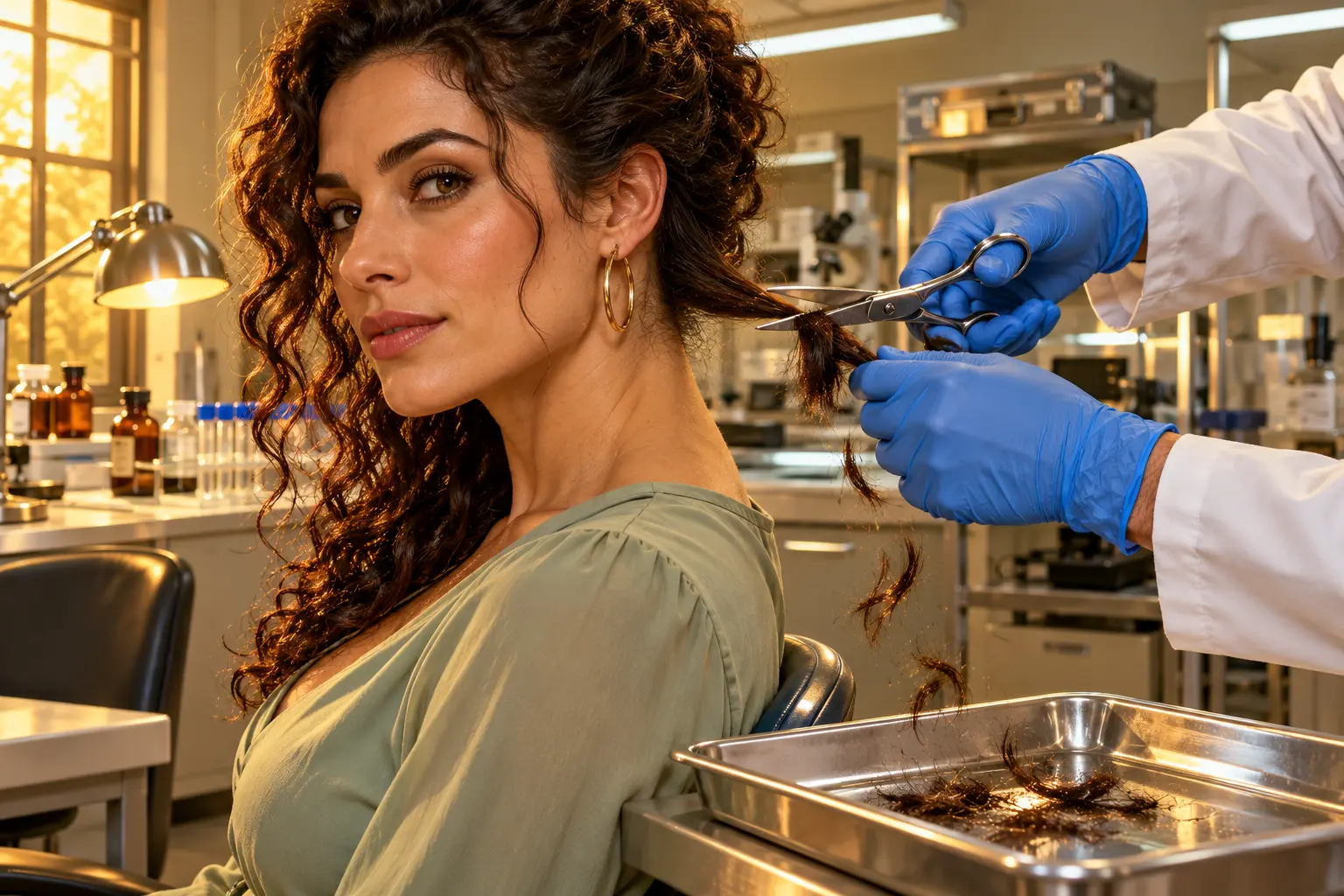
Scalp hair grows about 1 cm a month, which is the rate labs use when they turn a measured length into months. The cutoffs below are written for the piece closest to the scalp, from 3 cm up to 6 cm. At that growth rate, 3 cm covers about three months and 6 cm covers about six months.
SAMPLE LENGTH AND WHAT IT COVERS
- The 3 cm piece: About three months of growth, reported as one result for the whole length.
- The 6 cm piece: About six months of growth, still one combined result rather than a month-by-month diary.
- Other lengths: A sample under 3 cm or over 6 cm should be read with caution, because the cutoffs were built for the 3 to 6 cm range.
That single number cannot tell you which week you drank, or whether you cut back halfway through the months in the envelope. Segmentation of the hair can add detail in some labs, but the ordinary alcohol report is an overview of the whole piece.
The strand also has to leave the scalp before anyone can cut it. One laboratory that dates its windows this way starts every period seven days before collection, which is the time it allows for hair to grow out far enough to sample. Drinking over the last few days is a question for breath, blood, or urine.
Some collection sites ask for about 1.5 inches of hair and call that window 90 days. That request is aimed at the same recent months as a 3 cm piece, not at a longer history. When the report names centimeters, read it against the 3 cm or 6 cm rules rather than against the round 90-day phrase.
What Do the EtG Cutoffs on a Hair Test Mean?
The line that decides the report is a concentration, in picograms of EtG per milligram of hair. For a 3 to 6 cm piece of head hair, the meaning falls into three bands. The wording is narrower than a plain positive or negative.
| EtG in 3 to 6 cm of head hair | What the result supports |
|---|---|
| 5 pg/mg or lower | Does not contradict self-reported abstinence for that period |
| Above 5 pg/mg and below 30 pg/mg | Strongly suggests repeated alcohol consumption |
| 30 pg/mg or higher | Strongly suggests chronic excessive alcohol consumption |
A reading at or below 5 pg/mg does not contradict a claim of abstinence for the months in that piece, and occasional drinking still cannot always be ruled out. The low band is a check on the claim, not a certificate that every day was dry.
Above 5 pg/mg, the result strongly suggests repeated drinking across that period. It does not, on its own, mean the drinking was excessive. At or above 30 pg/mg, the result strongly suggests chronic excessive drinking, defined as an average of 60 grams or more of pure ethanol a day over several months. In the United States, what counts as a standard drink is about 14 grams of pure alcohol, so 60 grams is a little more than four standard drinks a day, held at that pace for months. A wedding or one heavy night is not the pattern that cutoff was built to flag.
EtPa has its own bands, and the length of the sample changes them.
- Low EtPa: At or below 120 pg/mg in a 0 to 3 cm piece, or at or below 150 pg/mg in a 0 to 6 cm piece, the result does not contradict abstinence.
- Middle EtPa: Above 120 pg/mg in the shorter piece, or above 150 pg/mg in the longer piece, the result strongly suggests repeated drinking.
- High EtPa: At or above 350 pg/mg in a 0 to 3 cm piece, or at or above 450 pg/mg in a 0 to 6 cm piece, the result strongly suggests chronic excessive drinking.
If EtG and EtPa disagree, the file needs the hair-treatment notes, not a coin flip between the two lines. The full bands are set out in the 2019 consensus on alcohol markers in hair. A 2026 revision, which the Society of Hair Testing lists as its current alcohol-marker consensus, states the same EtG lines of 5 pg/mg and 30 pg/mg, and the same high EtPa lines of 350 pg/mg and 450 pg/mg, in its summary.
What Can Change a Hair Alcohol Test Result?
Chemical and heat treatments can move both markers. Bleaching, dyeing, and perming are the examples named in the consensus, and a treatment that lowers EtG can make heavier drinking look lighter. The collector is supposed to write down those treatments at the visit, so arrive ready to list them rather than hoping the lab will guess.
Ethanol in hairspray, gel, wax, oil, or grease is a different problem. EtG concentrations appear not to be influenced by those products. EtPa may rise when ethanol hair products are used, which is one reason a high EtPa beside a low EtG sends the reader back to the bathroom shelf.
A rarer path to a high EtG does not require drinking at all. In 2013, Arndt and colleagues documented EtG found in herbal hair tonics, measuring it in 7 of 11 products from shops. A separate case of EtG in a hair lotion started with a person who denied drinking. After that lotion was applied to a volunteer’s hair for six weeks, the hair measured 72 pg/mg, above the heavy-drinking line.
Natural hair color does not create this kind of bias. Incorporation of EtG and EtPa is not biased by natural hair color, which is a separate issue from the melanin questions that come up on some drug tests.
A single heavy session is also easy to over-read on a scalp overview. The beard hair study after one heavy session followed three volunteers who each drank between 153 and 200 grams of ethanol in one sitting. The authors expected the routine 3 cm scalp test, at the repeated-use cutoff then set at 7 pg/mg, to come back negative with high probability, because hair from the sober days in that length dilutes one session. Beard clippings in that experiment did show EtG. The scalp overview is a coarser net.
How Does a Hair Alcohol Test Compare With Urine and Blood?
Hair answers a question about months. Breath and blood alcohol answer a question about the last hours, and whether you are affected right now. Urine EtG sits between them and is used when the worry is drinking in recent days, which is why a check aimed at last weekend is a urine question rather than a hair question.
A dried-blood marker called phosphatidylethanol, or PEth, is what some testing programs add when they want about the prior month. Hair is too slow for that window, and urine is too short. None of these tests dates a single glass to a calendar day.
A hair sample collected tomorrow still misses the newest days of growth, while a urine sample collected tomorrow misses the months before that. The right sample is the one that matches the period someone is actually asking about.
Which Result Fits the Way You Drink?
The same cutoff page lands differently once you know which pattern you have to explain. Use the row that matches the drinking, the hair, and the order you were given.
MATCH THE RESULT TO YOUR CASE
- One night out: A 3 cm overview is a weak way to catch a single occasion, because sober days in that length dilute it.
- Weekly drinking: Repeated drinking is the pattern the middle EtG band is worded to suggest, and the report still will not name the weeks.
- An abstinence case: Ask for EtG, keep alcoholic drinks and swallowed alcohol products off the schedule, and read a low result as not contradicted rather than as proof.
- Daily heavy use: The top band is tied to an average of 60 grams of ethanol a day across months, not to a short binge.
- Treated hair: List bleach, dye, perms, and heat straightening at collection, because those treatments can move the level.
- Body hair only: Scalp hair from the back of the crown is preferred, armpit hair is excluded from the scalp cutoff, and pubic hair can show a single occasion that scalp hair would dilute.
Bring the report to the person who ordered the test before you argue the number in a custody case, a license review, or a medical decision. A general guide can show you what the bands mean. It cannot replace the file those decisions are actually based on.
Frequently Asked Questions
Will Mouthwash or Hand Sanitizer Fail a Hair Alcohol Test?
Alcohol you swallow is part of the abstinence definition used for this test, including liquid medicine and mouthwash you drink rather than spit out. Ethanol hair spray is a known problem for EtPa, while EtG in hair is described as not influenced by ordinary ethanol hair products. Hand sanitizer used on the hands and allowed to dry is not the exposure that guidance ties to hair EtG, though you should still tell the collector about anything you use often.
Is Alcohol Part of a Standard Hair Follicle Drug Test?
A standard hair drug test looks for drugs such as cannabis, cocaine, and opioids, not for drinking. Alcohol markers are ordered on their own, usually as EtG with or without EtPa. Unless the form names those markers, a negative hair drug result does not speak to alcohol at all.
Can Armpit Hair Use the Same Cutoff as Scalp Hair?
Armpit hair is excluded from the scalp EtG cutoff. For an abstinence check, other body hair can use the same EtG cutoff as head hair, while pubic hair is especially sensitive, because a negative EtG result there is described as a strong abstinence check and even one drinking occasion can show. The heavy-drinking cutoff is not applied the same way to armpit or pubic hair.
How Much Hair Does the Collector Take, and From Where?
The sample should come from the posterior vertex, the back of the crown, cut as close to the scalp as possible, in a length of 3 cm up to 6 cm when those cutoffs are going to be used. The collector should record bleaching, dye, perms, and heat straightening at that same visit. Shaving your head or bleaching the week before does not make the test fairer, and bleaching can lower EtG.
How Long After You Quit Will the Hair Segment Catch Up?
New hair has to replace the piece being tested. At about 1 cm of growth a month, a 3 cm sample still includes hair from before you quit until about three months have passed. An earlier test can serve as a baseline. It cannot show that every centimeter in the envelope grew after the last drink.
The practical read is three checks. Confirm that alcohol markers were ordered, note whether the length was about 3 cm or about 6 cm, and see where EtG sits against 5 pg/mg and 30 pg/mg. Those three facts tell you what this test is allowed to say about the months in the sample.
Disclaimer: This article is an educational guide to how hair alcohol tests are read, and it is informational only. It is not medical advice, legal advice, or a reading of any person’s lab report. Talk with a qualified clinician or the lawyer handling your case before you rely on a result for treatment, a license, custody, or work. Cutoffs and testing rules reflect the Society of Hair Testing documents and the studies cited here as reviewed, and they may change.

A CubeSat Will Age Whisky That Never Comes Home

A Charity Quote Cost Shia LaBeouf the FKA twigs NDA

Looker Turned a Model’s Body Into Ad Inventory

Infinity Ward Bets a Paid DMZ Will Stick This Time

Disney Sidesteps a Kimmel Renewal as Failla Cites Losses

Southwest Preboarding: Who Qualifies and What to Do

False AI Intel Nearly Put US Crews on a Chinese Ship

How Often Do You Have to Change a Monkey’s Diaper?

Tim Cook’s $4.6 Trillion Apple Still Runs on One Phone

Dunes Air Sues Nora Fatehi Over Its Luxury Jet
-
 TRAVEL3 years ago
Southwest Preboarding: Who Qualifies and What to Do
-
 NEWS2 months ago
False AI Intel Nearly Put US Crews on a Chinese Ship
-
 LIFESTYLE3 years ago
How Often Do You Have to Change a Monkey’s Diaper?
-
 BUSINESS2 months ago
Tim Cook’s $4.6 Trillion Apple Still Runs on One Phone
-
 ENTERTAINMENT2 months ago
Dunes Air Sues Nora Fatehi Over Its Luxury Jet
-
 LIFESTYLE3 years ago
How Long Does It Take for Armpit Hair to Grow?
-

 NEWS2 months ago
OpenAI Posts a Navier-Stokes Proof Clay Has Not Touched
-

 SPORTS3 years ago
Is Marching Band a Sport?