
ENTERTAINMENT
Looker Turned a Model’s Body Into Ad Inventory
Looker had models scanned, paid, then killed so ads could run without them. Union replica rules and New York’s 2026 ad law now police that trade.

Michael Crichton’s Looker opened on October 30, 1981, and grossed $3.3 million in the United States and Canada. The Ladd Company had spent $8 million to $12 million getting it onto Warner Bros. screens.
Digital Matrix, the film’s ad-tech shop, scans models, promises them $200,000 a year for life, then has them killed so the copy can work without the woman. That bargain, not the neon or the light gun, is what the movie still has to say.
A Paycheck for Life, Then a Scan
Dr. Larry Roberts, a Beverly Hills plastic surgeon played by Albert Finney, keeps fixing tiny defects on television models. Lisa Convey’s nose and cheekbones move by fractions of a millimeter. Then his patients start falling from balconies, and the police call the deaths suicides.
The paper trail leads to Digital Matrix Inc. Jennifer Long, played by Leigh Taylor-Young, walks Roberts through the firm’s scoring system. Lisa hits 92.7 before surgery and 99.4 after, which the computer treats as the limit of a video scan. When she moves, the score drops back to 92.9. Perfect stills, imperfect people.
So the firm changes the deal. Cindy Fairmont, played by Susan Dey, is told the computer will finish her commercial. In the scanning room she asks the question the rest of the plot answers in blood.
“And I get paid $200,000 a year?” she says. “That’s the standard modeling fee, yes.” She asks if she has to do anything. “Not once the model is made. The computer does everything.”
Long puts the sales pitch in one line: the company can now make commercials entirely by computer, with no live actors at all, once the model is made. Reston Industries, run by James Coburn’s John Reston, does not want to keep writing those checks. The living women become a cost sitting on top of an asset the lab already has.
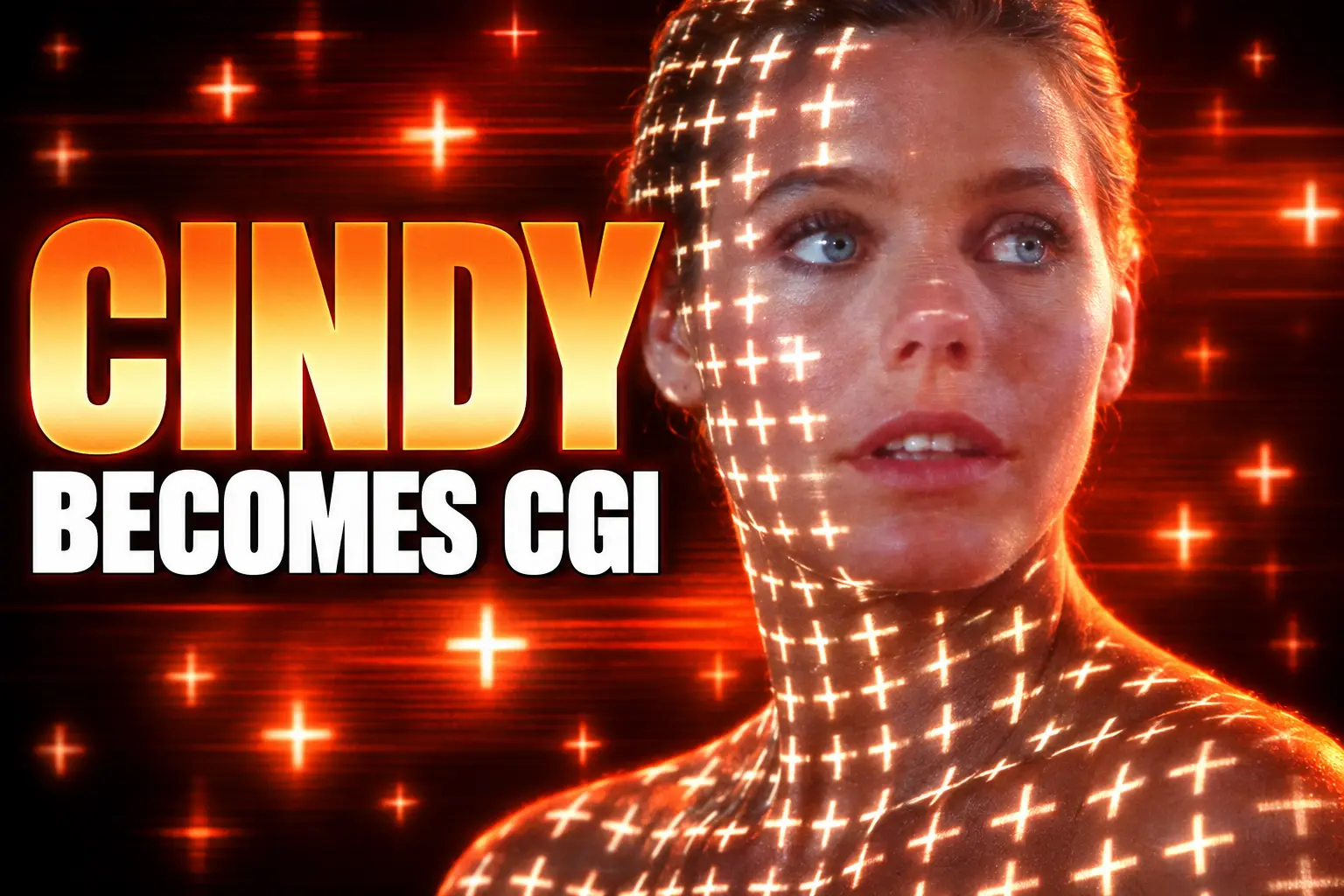
Cindy Fairmont’s Body Became the First CGI Human
Looker is 94 minutes of PG-rated chase and nightclub lighting, and it is also a software demo. Information International Inc. built the Cindy scan, a shaded three-dimensional figure taken from a digitized body. Feature films had not shown that trick yet. Tron arrived months later, in 1982, with a bigger effects budget and a cleaner legend.
The scan scene is the movie’s one unblinking idea. Cindy undresses, the lab turns measurements into a figure, and her voice is synthesized beside it. After that, the person is optional. Reston’s later gala is a sales meeting for computer-generated actors, with a live audience staring at a woman who is no longer required to be in the room.
Crichton had been chewing on the subject since 1975. He visited a Los Angeles computer firm to ask how commercials might copy people without looking foolish, and he found a Texas shop already doing it with tomography. The future he put on screen was a vendor list, not a dream.
Animation Houses Did Not Laugh at the Pitch
He later said he had not set out to write a policy paper. He had set out to write a gag.
From the beginning, I tried to write what I thought was a ridiculous story where people were enticed by computer-animated images. It was meant to be a comedy originally. Then when we went around to animation houses asking for bids, this odd thing happened, which was that nobody we talked to said, ‘what a bizarre idea’ or ‘how silly.’ Finally we had a guy who said, ‘Well, of course you know everyone’s doing this work … this is the hot new field.’
Michael Crichton, writer-director, 1981
On his official site he still frames Looker as meant to be a comedy originally, then as “below-the-belt” advertising for products and for politics. The animation houses did the clarifying. If nobody in the room thinks your nightmare is strange, you no longer have a farce. You have a production schedule.
The shoot itself kept brushing the labor story it was dramatizing. The project moved from Twentieth Century-Fox to Paramount to the Ladd Company, and principal photography, delayed by the 1980 SAG strike, began on October 27, 1980, in Los Angeles and wrapped in January 1981. The union that stopped the cameras would, decades later, bargain the scan.
FROM A 1975 GAG TO AN AD STATUTE
- 1975: Crichton starts asking computer firms how ads might copy a person.
- October 27, 1980: Looker begins shooting after the Screen Actors Guild strike delays the start.
- October 30, 1981: Warner Bros. opens the film. It takes $1,142,186 in 887 theaters that weekend and finishes at $3.3 million.
- May 2025: SAG-AFTRA members ratify commercials contracts that set consent and pay rules for digital replicas in ads.
- December 11, 2025: New York signs bills on postmortem replicas and synthetic performers in advertising.
- June 9, 2026: The state’s ad-disclosure law takes effect.
Leonard Maltin called the finished picture a turkey with an intriguing premise, and he was not wrong about the handling. Opening weekend still put it fifth, then the run died. Fans who now circulate clips tend to praise the concept and then admit the thriller never quite moves. The usual alibi is the footage Coburn said hit the floor. The sharper read is that Crichton trusted the lab more than the chase.
What a Digital Replica Rider Demands Now?
A producer who wants a performer’s digital replica in a union commercial must describe the use, wait as long as 48 hours, get a separate signature, and pay for the copy as its own job. The 2025 Commercials Contract is the closest working document to Digital Matrix’s offer, minus the balcony.
SAG-AFTRA’s bulletin on that deal requires clear and conspicuous written consent before a replica is created or used, plus a reasonably specific account of what the copy will do. If the performer is asked to record solely so a replica can be built, that time is work time. Extra written consent is required before the copy is aged, revoiced, or shown nude. Minimum pay for a replica performance the person would otherwise have given in the room is 1.5 times the scale session fee, plus use and holding fees at scale.
FROM LOOKER TO THE REPLICA RIDER
| Term | Looker, 1981 | 2025 commercials contract |
|---|---|---|
| Pay for the copy | $200,000 a year, forever | 1.5 times scale, plus use fees, per commercial |
| Consent | A modeling contract in a lab | Separate writing, 48-hour notice, use spelled out |
| After the scan | The living model is murdered | The person, or an estate, still has to say yes |
| The ad itself | No live actors once the model exists | A replica is a paid performance, not a free extra |
The union’s broader AI statement is blunter than any rider. SAG-AFTRA says every person has an inalienable right to their name, voice, and likeness, and that a synthetic substitute should cost at least as much as hiring the human. Reston’s business plan fails that test on purpose. The whole point of killing the models is to make the copy cheaper than the woman.
New York Now Labels Synthetic Performers in Ads
On December 11, 2025, Gov. Kathy Hochul signed two SAG-backed bills in the union’s New York office. One updates the state’s postmortem right of publicity so a deceased person’s digital replica cannot be dropped into an audiovisual work without consent from an authorized representative. The other amends the general business law so ads must say when the face on screen is not a person.
That second statute, Senate bill 8420-A, took effect on June 9, 2026. It requires a person who produces an advertisement to conspicuously disclose a synthetic performer in the ad itself when they know one is there. A synthetic performer, in the bill’s language, is a digitally created asset meant to give the impression of a human performance by someone who is not recognizable as any identifiable natural performer. First offense: $1,000. Each one after: $5,000.
WHAT THE NEW YORK AD RULE ACTUALLY COVERS
- The trigger: An ad, in any medium, that contains a synthetic performer the maker knows is there.
- The label: A conspicuous disclosure inside the advertisement, not in a privacy page or a terms sheet.
- The carve-out: Promos for films, television, streaming, and games can skip the label when the fake face is already part of the work being sold.
- The gap: Audio-only ads, and ads that use AI only to translate language, are outside the duty.
Hochul called it a simple, honest disclosure that protects consumers and the people who still show up to work. “In New York, we are setting the rules of the road instead of letting AI run the show,” she said. Looker never bothered with a label. Reston’s climax is a roomful of buyers put under by a commercial they cannot look away from, which is the other half of Crichton’s warning: first you replace the model, then you replace the viewer’s will.
The Kilmer Estate Licensed a Posthumous Performance
The replica that Looker treats as a murder weapon now shows up with lawyers attached. First Line Films said in March 2026 that a generative AI version of Val Kilmer would co-star in As Deep as the Grave, an independent drama he had signed onto before his health collapsed. Kilmer died in April 2025, at 65, of pneumonia after years of throat cancer. The estate gave permission, took pay, and handed over photos and audio. Mercedes Kilmer, his daughter, said he had always looked at new tools with optimism, as a way to expand storytelling.
That is the polite version of Cindy’s contract. The copy works, the family is paid, and nobody has to fall off a balcony. It is also the version the 1981 script keeps undercutting. Once the scan exists, the incentive is to stop calling the person. Reston does not murder models because he is a cartoon. He murders them because a perpetual fee for a file is an accounting problem, and a dead woman is not.
People circulating Looker in 2026 often ask why nobody remakes it. A remake would only restage a rate card. The last act already happens on a commercial stage, with real actors mixed among animated ones, and that is the sequence that still works. The light gun, L.O.O.K.E.R., for light ocular-oriented kinetic emotive responses, is the gag that dates. It flashes, hours vanish, and the victim does not know the time is gone. The lab is the part that did not need the gag.
James Coburn Said the Movie Was About Control
Coburn was unhappy with what survived the cut. In 1991 he said his part had been pretty much left on the floor, and that they had Finney running around in a security guard’s uniform until the picture stopped making sense. He also said what the movie was for.
It could have been a good picture. It was about how television controls. It was about how commercials manipulate people to buy products, politicians, whatever. But, they cut the film up for a television print. I don’t know why they did that. They spent some bread on the picture too. It was a $12 million production.
James Coburn, actor, 1991
The television print is the version that went out. The control thesis is the version that kept coming true. Crichton wrote a company that wanted a perfect, unpaid, infinitely reusable body, and he wrote a gun that stole hours from anyone who looked. Union riders now price the body. New York now makes the ad admit when the face is fake. The gun is still sitting in the viewer’s hand, and it does not need a lab coat.

Looker Turned a Model’s Body Into Ad Inventory

Infinity Ward Bets a Paid DMZ Will Stick This Time

Perseverance Maps Three Fluids Through Jezero’s Carbonate Rim

Verity Beats Tom Cruise as October Movies Crowd Theaters

Ulefone Omni Sentinel Puts Idle Armor Phones on Watch

How to Get Pre Boarding on Southwest – Skip the Line with These Tricks

Tim Cook’s $4.6 Trillion Apple Still Runs on One Phone

Dunes Air Sues Nora Fatehi Over Its Luxury Jet

Australia Treats Cloud Software Payments as Taxable Royalties

OpenAI Posts a Navier-Stokes Proof Clay Has Not Touched
-
 TRAVEL3 years ago
How to Get Pre Boarding on Southwest – Skip the Line with These Tricks
-
 BUSINESS1 month ago
Tim Cook’s $4.6 Trillion Apple Still Runs on One Phone
-
 ENTERTAINMENT4 weeks ago
Dunes Air Sues Nora Fatehi Over Its Luxury Jet
-
 NEWS4 weeks ago
Australia Treats Cloud Software Payments as Taxable Royalties
-
 NEWS4 weeks ago
OpenAI Posts a Navier-Stokes Proof Clay Has Not Touched
-

 LIFESTYLE3 years ago
How Often Do You Have to Change a Monkey’s Diaper? The Truth About Pet Monkeys
-

 LIFESTYLE3 years ago
How Long Does It Take for Armpit Hair to Grow? The Stages of Hair Growth and How to Shave It
-

 NEWS4 weeks ago
China’s Supreme People’s Court Gives AI Apps Safe Harbor