
BUSINESS
Trump Gets a New 100% Tariff Lever on India
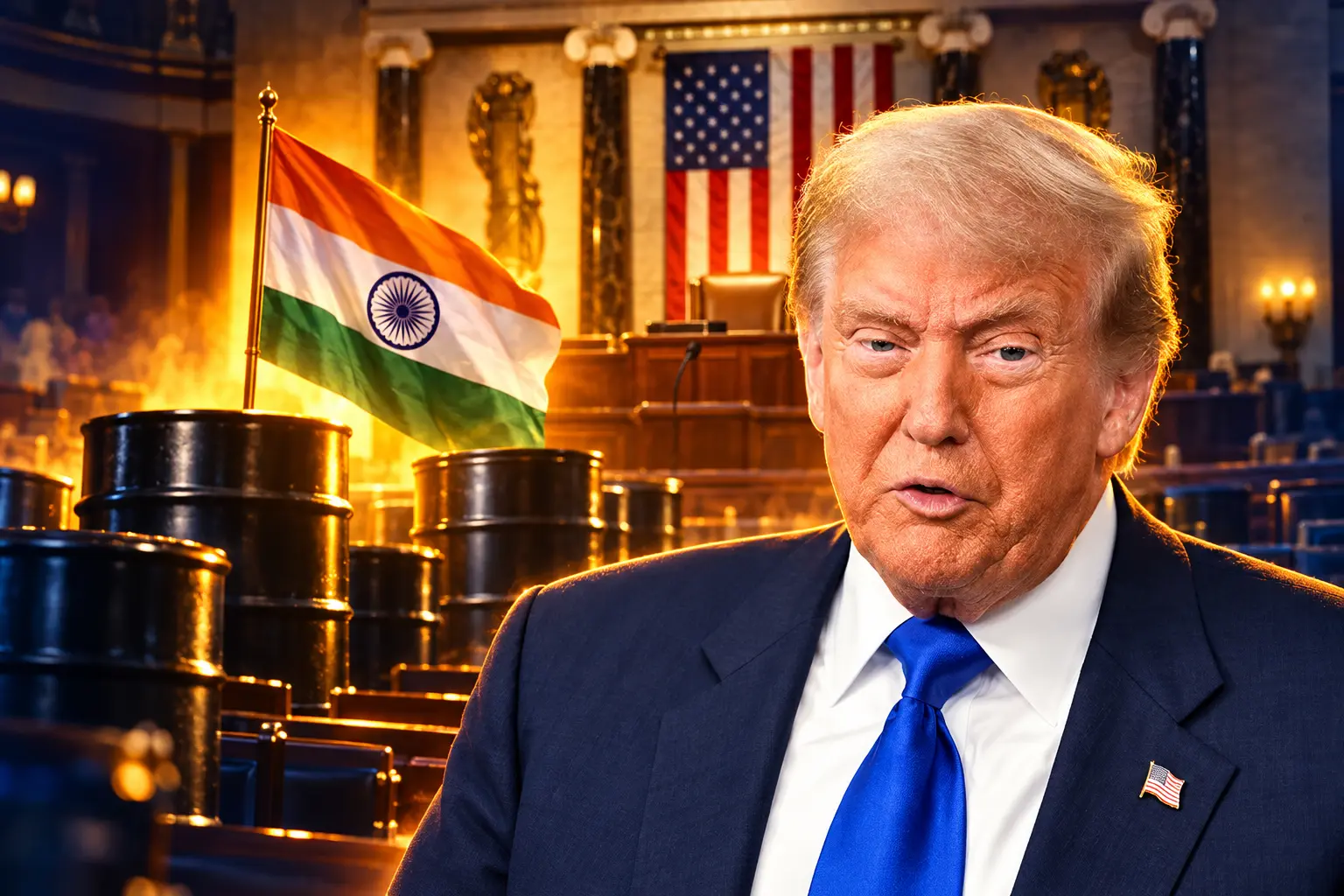
Congress sent Trump a duty that can exceed zero and reach 100 percent on Indian goods if Russian oil buying continues, after he already lifted a 25 percent levy.

The U.S. House voted 262-159 on September 16 to send President Donald Trump a Russia bill that can lift duties on Indian goods to 100 percent. The measure still needs his signature, and it does not post a rate on its own.
India’s foreign ministry said on September 17 that New Delhi will keep sourcing crude for energy security for its 1.4 billion people and will protect its trade. The fight now is whether Trump uses a tool he has already picked up and put down.
Congress Handed Trump a New Duty on Indian Goods
The House cleared the Lindsey O. Graham Sanctioning Russia and Iran Act of 2026 on its last day in session before lawmakers leave until after Election Day. The Senate had passed the same package 86-11 on August 7. Trump has signaled he will sign it.
Fifty-eight House Democrats voted yes and 152 voted no. Seven Republicans voted no, including Thomas Massie of Kentucky, Chip Roy of Texas, and Tom McClintock of California. House Democrats split over giving this White House more tariff power, even as many of them back Ukraine.
Speaker Mike Johnson said the bill gives the administration “every tool in the toolbox” to help end Russia’s war. Minority Leader Hakeem Jeffries voted no, saying it “gives extraordinary power to Donald Trump.” Rep. Michael McCaul, a Texas Republican, called the tariffs “the teeth of this bill.”
HOW THE HOUSE AND SENATE VOTED
| Chamber | Date | Result | Notable split |
|---|---|---|---|
| Senate | August 7, 2026 | 86-11 | Broad bipartisan yes |
| House | September 16, 2026 | 262-159 | 58 Democrats yes; 7 Republicans no |
The bill carries the name of Sen. Lindsey Graham, the South Carolina Republican who spent more than a year pushing it and died in July. Ukrainian President Volodymyr Zelenskyy lobbied for the package when he came to Washington for Graham’s funeral. The White House had resisted a version that tied Trump’s hands on Russia; Graham secured backing shortly before his death.
What the Bill Requires If India Keeps Buying
The Congressional Research Service summary of H.R. 5334 says the president must raise the duty up to 100 percent on all goods from a country that was among the five largest importers of Russian-origin crude oil or natural gas if that country knowingly makes new purchases after the law takes effect. That is a trigger plus a cap, not a posted 100 percent rate.
Ways and Means Committee Chairman Jason Smith said the House text also directs tariffs of up to 500 percent on all Russian goods. On third countries, his committee said the duty must be greater than zero and up to 100 percent for top buyers that keep purchasing after enactment, and for the top five countries that help Russia dodge oil sanctions. The U.S. Trade Representative can add names every 180 days.
WHAT THE PACKAGE ACTUALLY DOES
- Primary Russia duty: The president is directed to raise tariffs on Russian goods to a rate as high as 500 percent.
- Secondary buyer duty: Top-five oil and gas buyers that make new purchases after enactment face a duty above zero and up to 100 percent on all their goods.
- Evasion list: The same duty band applies to the top five countries judged to facilitate oil-sanctions evasion, with a 180-day review.
- People and ships: The bill adds sanctions on Russian officials, oligarchs, banks, and the shadow fleet of tankers used to move oil outside Western controls.
- Iran extension: It extends the Iran Sanctions Act of 1996 through 2031 and expands a teacher-expense tax deduction to early childhood educators, the vehicle the Senate used.
Daniel Fried, a former State Department sanctions coordinator writing for the Atlantic Council, pointed to Section 113(b), which lets the rate move if a country cuts Russian oil or gas. He said his worry is not that the White House will hammer the European Union. It is that officials will “simply issue waivers and not use the tough provisions much at all.”
February’s Pledge Already Bought One Reprieve
Trump has already used a Russia-oil tariff on India, then taken it off. Executive Order 14329, dated August 6, 2025, put an extra 25 percent duty on Indian goods while India was taking Russian oil. On February 6, 2026, he signed Order 14384 and eliminated India’s extra 25 percent duty at 12:01 a.m. eastern time on February 7.
India has committed to stop directly or indirectly importing Russian Federation oil, has represented that it will purchase United States energy products from the United States, and has recently committed to a framework with the United States to expand defense cooperation over the next 10 years.
Donald J. Trump, Executive Order 14384, February 6, 2026
The same order tells the commerce secretary to watch whether India resumes those imports. If that finding is made, the secretary of state is to recommend whether the 25 percent duty should come back. That monitor is still on the books. The Graham bill sits on top of it as a larger, statutory overlay.
THE TARIFF CLOCK ON INDIA’S RUSSIAN OIL
- August 6, 2025: Executive Order 14329 adds a 25 percent duty on Indian goods over Russian oil purchases.
- February 6, 2026: Order 14384 cites a pledged halt, U.S. energy buys, and a 10-year defense framework, and lifts that extra duty the next morning.
- June and July 2026: Oil-flow data show India taking about 2.6 million barrels a day of Russian crude, about 54 percent of seaborne intake.
- August 7, 2026: The Senate passes the Graham package 86-11.
- September 16, 2026: The House concurs 262-159 and sends the bill to Trump.
- September 17, 2026: India’s foreign ministry says energy security still leads, and trade interests will be defended.
Seven months after the lift, Congress is handing him a duty that can run four times as high, if he signs and if India stays on the buyer list.
Russian Crude Still Dominated India’s Summer Slate
The February order described a halt. Cargo data did not. After Gulf supplies tightened around the Strait of Hormuz, Indian refiners leaned harder on Russian barrels, then on Venezuela, Brazil, and West Africa as well.
Kpler figures compiled by the Kyiv School of Economics Institute put Indian unloadings of Russian crude at about 2.6 million barrels a day in both June and July, about 54 percent of seaborne crude. August ran at 2.08 million barrels a day, about 45 percent of the total, still the core of the slate. In the first 14 days of September, Russian arrivals fell to about 1.42 million barrels a day, about 30 percent below August’s average of about 2.1 million, after attacks on Russian oil plants cut available barrels.
INDIA’S RUSSIAN CRUDE RUN, 2026
| Period | Russian volume | Share or note |
|---|---|---|
| June 2026 | 2.6 million bpd | About 54 percent of seaborne crude |
| July 2026 | 2.6 million bpd | About 54 percent of seaborne crude |
| August 2026 | 2.08 million bpd | About 45 percent of total oil imports |
| September 1-14, 2026 | 1.42 million bpd | About 30 percent below August’s average |
| U.S. crude, September 1-14 | About 137,000 bpd | A thin substitute for heavy Russian grades |
| Venezuelan crude, August high | About 350,000 bpd | A heavy-grade alternative, then slower in early September |
The Global Trade Research Initiative, a Delhi trade desk, put Russian crude at $40.8 billion of India’s $134.7 billion crude import bill in FY2026, or 30.3 percent across the full year. The summer months ran much hotter than that average. U.S. barrels do not swap cleanly for Urals-grade crude, because many Indian plants are set up for heavier oil. Venezuelan supply helped, then cooled in early September.
Nayara Energy’s Vadinar plant, nearly half owned by Rosneft and already under European and British sanctions, took only Russian crude in June, oil-flow tracking showed. That stream is the hardest to replace. A 12-month lookback that includes June and July would still place India among the five largest buyers even if September stays soft.
More Than $100 Billion of Exports Would Face the Duty
The secondary tariff does not land on tankers in the Indian Ocean. It lands on Indian goods at U.S. ports. In 2025, U.S. goods imports from India totaled $103.8 billion, up 18.9 percent, or $16.5 billion, from 2024, according to the U.S. Trade Representative. U.S. goods exports the other way were $45.4 billion. The goods deficit was $58.4 billion.
INDIA-U.S. GOODS TRADE, 2025
- U.S. imports from India: $103.8 billion, the base a 100 percent duty would tax.
- U.S. exports to India: $45.4 billion, up 9.1 percent.
- Goods deficit: $58.4 billion, up 27.8 percent.
- Goods and services together: $239.6 billion, up 12.1 percent.
India’s Commerce Ministry said shipments to the United States rose 6.17 percent to $42.79 billion in April-August 2026, from $40.31 billion a year earlier. The United States remained India’s largest goods market in that stretch. Engineering goods, petroleum products, chemicals, and textiles led the August export list.
A duty that must run above zero, and can run to 100 percent, would hit that pipeline. The last line of the ministry note in New Delhi is the one Indian exporters will read twice. It says the government will work with trade bodies on the fallout, which is another way of saying firms should plan for a smaller U.S. door if the rate is set high. Reciprocal U.S. tariffs, or a pause in the trade talks, would be a political choice sitting behind that sentence, not a step already taken.
The Waiver Turns the Tariff Into a Trade Talk
The bill is a lever in a negotiation that is already open. Commerce and Industry Minister Piyush Goyal is due at the G20 trade ministers’ meeting in Wisconsin on September 30 and October 1, and Commerce Secretary Rajesh Agrawal said Goyal is expected to meet U.S. Trade Representative Jamieson Greer there. Fried’s ramp-down clause is the legal hook for a deal that cuts Russian barrels over time rather than overnight, the same pattern Washington once used on Iranian oil.
As stated on several earlier occasions, India remains firmly committed to ensuring energy security for its 1.4 billion people. It will continue to do so through diversified sourcing and on the basis of evolving market dynamics.
Ministry of External Affairs, New Delhi, September 17, 2026
The ministry added that the oil issue has been raised “at high levels in recent months with various U.S. interlocutors,” and that “potential implications for not just the bilateral relationship but also the international energy market have been very clearly articulated.” It said India will “take all necessary measures to protect its trade and economic interests.”
That is a refusal spoken in diplomatic English. It does not promise a halt. It does not match the February order’s claim that India had committed to stop. It tells Trump the energy slate is not a bargaining chip he can price at 100 percent without a fight in the goods market.
The unsigned bill now sits with a president who already traded a 25 percent duty for a pledged halt that did not hold through the summer. If he signs, the lookback, the greater-than-zero floor, and the waiver become the next round of the same argument, with Goyal and Greer in the room in Wisconsin before October starts.

A CubeSat Will Age Whisky That Never Comes Home

A Charity Quote Cost Shia LaBeouf the FKA twigs NDA

Looker Turned a Model’s Body Into Ad Inventory

Infinity Ward Bets a Paid DMZ Will Stick This Time

Disney Sidesteps a Kimmel Renewal as Failla Cites Losses

How to Get Pre Boarding on Southwest – Skip the Line with These Tricks

False AI Intel Nearly Put US Crews on a Chinese Ship

Tim Cook’s $4.6 Trillion Apple Still Runs on One Phone

OpenAI Posts a Navier-Stokes Proof Clay Has Not Touched

Dunes Air Sues Nora Fatehi Over Its Luxury Jet
-
 TRAVEL3 years ago
How to Get Pre Boarding on Southwest – Skip the Line with These Tricks
-
 NEWS1 month ago
False AI Intel Nearly Put US Crews on a Chinese Ship
-
 BUSINESS2 months ago
Tim Cook’s $4.6 Trillion Apple Still Runs on One Phone
-
 NEWS2 months ago
OpenAI Posts a Navier-Stokes Proof Clay Has Not Touched
-
 ENTERTAINMENT2 months ago
Dunes Air Sues Nora Fatehi Over Its Luxury Jet
-

 LIFESTYLE3 years ago
How Often Do You Have to Change a Monkey’s Diaper? The Truth About Pet Monkeys
-

 NEWS2 months ago
Australia Treats Cloud Software Payments as Taxable Royalties
-

 LIFESTYLE3 years ago
How Long Does It Take for Armpit Hair to Grow? The Stages of Hair Growth and How to Shave It