
BUSINESS
Seva Sankalp Turns a Birthday Into a State Workplan
District collectors, state ad budgets and a 2015 court photo exception now run Prime Minister Narendra Modi’s birthday month as Seva Sankalp Abhiyan opens.

Prime Minister Narendra Modi turned 76 on September 17, 2026. BJP-run states opened Seva Sankalp Abhiyan the same day, a month of camps, lamps and foundation stones.
The date on the banner is a birthday. The people who will spend the money sit in collectorates and Information Departments, and a 2015 Supreme Court exception still lets only one serving politician’s face fill a taxpayer-funded ad.
Deputy Commissioners Draw the First Cheque
Haryana has allocated Rs 10 lakh to every deputy commissioner for Seva Sankalp Abhiyan. The state has 23 districts, including Hansi, which was notified as the 23rd late in 2025, so that instruction puts about Rs 2.30 crore in district hands before a single lamp is lit.
On September 16, 2026, Chief Minister Nayab Singh Saini reviewed the month with senior officers and the district chiefs. The campaign in Haryana runs from September 17 to October 17. It opens with Aashirwad ka Diya, a Namo Marathon in Ambala, and the second phase of Deen Dayal Lado Lakshmi Yojana from Mahendragarh, aimed at women in households earning up to Rs 1.80 lakh a year.
Collectors are the last mile of Indian administration, the officers who already run revenue, disaster work and polling. For a month they also run a named seva calendar tied to the prime minister’s birth date and to October 7, 2001, the day he first took oath as Gujarat’s chief minister. That is 25 years as the head of a government on October 7, 2026. The birthday is the start gun. The oath anniversary is the second marker, and the district office is where both become work orders.
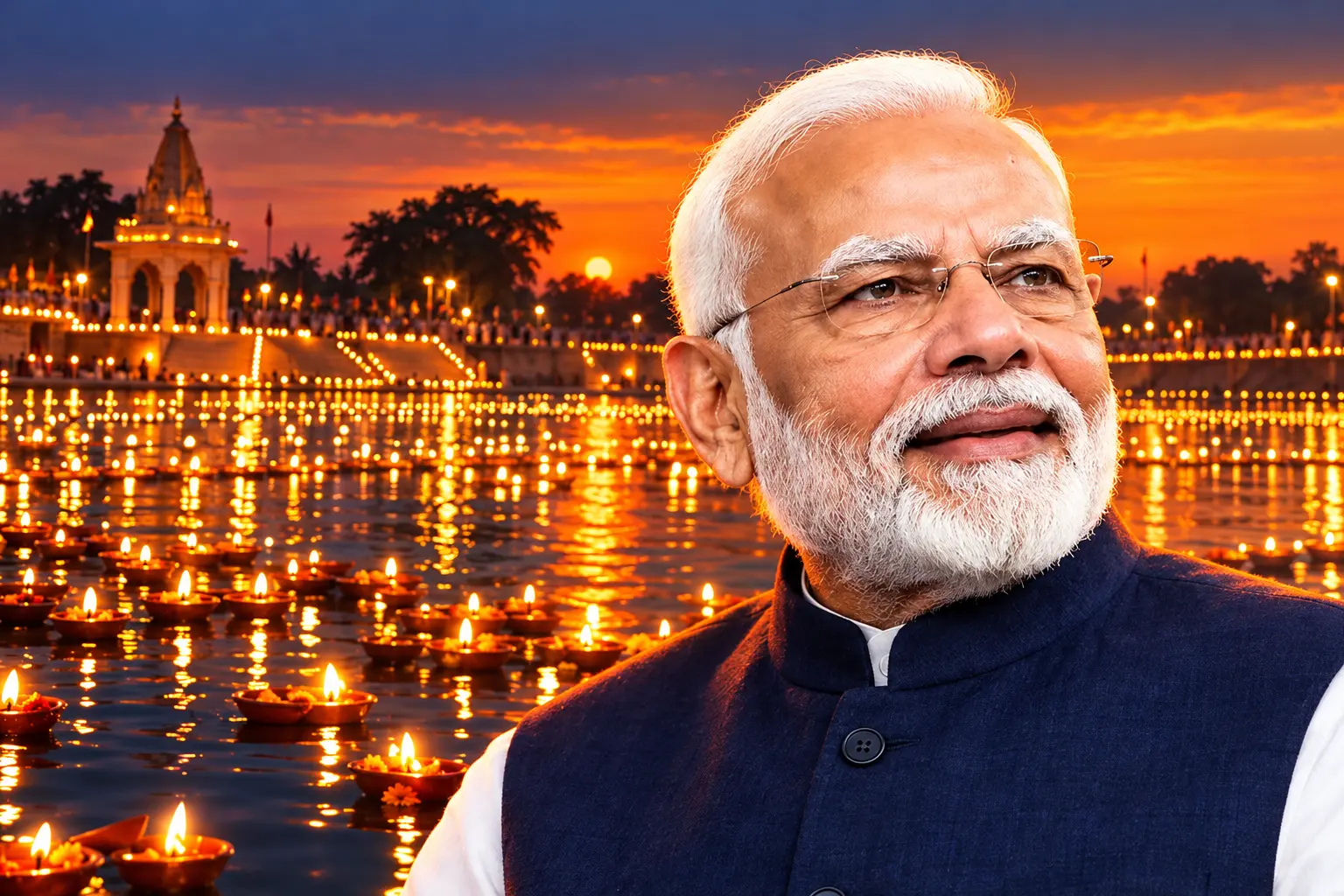
At Kurukshetra’s Brahma Sarovar, the plan on opening day was 1.25 lakh diyas and a 500-drone show of state and national schemes, with Saini as the chief guest. Service camps at block and municipal level are supposed to fix scheme gaps on the spot. The welfare is real. So is the fact that the clock for it is a personal calendar, funded from the state and executed by IAS officers whose ordinary job is not festival management.
What Delhi Will Inaugurate During Seva Sankalp
Delhi’s version runs from September 17 to October 18, 2026, 32 days if both ends count. Chief Minister Rekha Gupta and Delhi BJP president Harsh Malhotra announced it together on September 14. The government and the party shared the stage for a programme titled Seva Sankalp Abhiyan, Jan Seva Hi Prabhu Seva Hai, built around Modi’s birthday and 25 years of public service.
Gupta said development projects worth around Rs 13,820 crore would be opened or have foundation stones laid across the capital. That figure is project value, not an advertising budget, and it is the number that will travel with the campaign. Named slices under it include about Rs 8,000 crore tied to the Yamuna, about Rs 2,800 crore under public works, Rs 1,500 crore in power, Rs 365 crore in irrigation and flood control, and Rs 77 crore in tourism. Those named lines add to Rs 12,742 crore. The rest of the 13,820 was not broken out at the presser.
DELHI’S OPENING MONTH, AS ANNOUNCED
- Blood and health: A drive on September 17 is to collect 2,500 units, with check-ups planned for about 25,000 older residents and for construction workers.
- Seva Setu camps: Three-day camps in all 70 Assembly seats are to register people for Central and Delhi schemes.
- Yamuna and plants: Cleanliness drives sit beside the river works, plus planting toward a target of 70 lakh trees and saplings.
- Schools and anganwadis: Mere Sapno Ka Bharat is to reach about five lakh students in nearly 5,000 schools; Aangan Ka Milan felicitates anganwadi workers.
- Party overlay: Malhotra said the Delhi BJP would run blood camps across 14 organisational districts, cleanliness at 2,500 sites, street plays at 1,280 locations, and Aangan Milan Seva at 4,095 anganwadis from September 25 to October 7.
SOTTO, the state’s organ and tissue transplant platform, is also due to launch in this window. That is not a cake cutting. All of it is timed to a birthday, announced by a chief minister standing next to a party president.
Gujarat’s Nine-Day Vikas Saptah Cost Rs 14.05 Crore
Gujarat has been rehearsing this calendar for years. The Chief Minister’s Office says Vikas Saptah is observed every year from October 7 to 15, timed to Modi’s 2001 oath, as a week of programmes, openings, foundation stones and publicity of schemes. Last October it marked 24 years of that tenure.
An Assembly reply to Congress MLA Jignesh Mevani put the state’s spend on that nine-day event at Rs 14.05 crore. That is about Rs 1.56 crore a day for publicity around a week that the government already describes as governance. The year before, to mark 23 years of what the state branded successful and capable leadership, Gujarat spent Rs 8.81 crore on advertisements alone, a figure disclosed under the Right to Information Act.
HOW A PERSONAL CALENDAR BECAME A STATE CALENDAR
- October 7, 2001: Narendra Modi takes oath as Gujarat’s 14th chief minister.
- May 13, 2015: The Supreme Court limits photographs in government ads to the President, the prime minister and the Chief Justice of India.
- October 7 to 15, 2024: Gujarat runs the 23-year leadership ad campaign at Rs 8.81 crore.
- October 7 to 15, 2025: Vikas Saptah for 24 years costs Rs 14.05 crore in state spend.
- September 17, 2026: Seva Sankalp Abhiyan opens on Modi’s 76th birthday, ahead of the 25-year mark on October 7.
On the closing day of the 2025 week, Chief Minister Bhupendra Patel opened and dedicated 488 projects worth Rs 2,885 crore from 12 departments at Mahatma Mandir in Gandhinagar. The CMO said projects worth Rs 5,000 crore were dedicated across the week. Appointment letters went to 57,502 young people hired through 658 private-sector recruitment fairs, and financial help above Rs 600 crore reached 5.30 lakh farmers. Citizens could take the Bharat Vikas Pratigya online and download a certificate. The openings were ordinary state work. The wrapping was a leadership anniversary.
Zero Agencies and a Rs 108.80 Crore Publicity Year
Rs 14.05 crore did not sit alone. A separate Assembly reply to Congress MLA Dr Kiritkumar Chimanlal Patel said Gujarat’s Information and Broadcasting Department spent Rs 108.80 crore on publicity in the year ending December 31, 2025, through print, digital and social media, about Rs 29.8 lakh a day. Vikas Saptah’s bill was part of that total. The department sits under the chief minister. The reply gave no split of the Rs 108.80 crore across media.
Patel also asked how many agencies had been selected for government publicity, and how many print, digital and social media agencies had been paid in the year. The government’s answer to both questions was zero. On Vikas Saptah, the Information Department said it had not written to any other department seeking payment against bills, and that no department had deposited the full or partial amount. Money was spent. The contracting trail, on the floor of the House, went dark.
Election year is when the same department swells. In 2022-23, the year Gujarat held Assembly elections in December 2022, it spent Rs 305.37 crore against an allocation of Rs 317.82 crore, leaving Rs 12.45 crore unspent, about Rs 83.66 lakh a day. The year before, 2021-22, allocation was Rs 166.33 crore and spend was Rs 163.43 crore, about Rs 44.77 lakh a day, with Rs 2.90 crore unspent. That jump from Rs 163.43 crore to Rs 305.37 crore is nearly 87 percent.
GUJARAT INFORMATION DEPARTMENT PUBLICITY BILLS
| Period | Amount spent | Daily average | What sat in the year |
|---|---|---|---|
| 2021-22 (financial year) | Rs 163.43 crore | Rs 44.77 lakh | Rs 2.90 crore left unspent |
| 2022-23 (financial year) | Rs 305.37 crore | Rs 83.66 lakh | Assembly election, December 2022 |
| 2025 (calendar year) | Rs 108.80 crore | Rs 29.8 lakh | Includes Vikas Saptah Rs 14.05 crore |
The buyers in this market are not mysterious in the abstract. The Central Bureau of Communication, the old DAVP, is the Union’s nodal body for paid advertisements for ministries, with regional and field outreach bureaus and a standing panel of outdoor agencies for hoardings. States run their own information departments on the same model. Newspapers, channels and poster contractors live on those rate cards. When an Assembly reply says zero agencies were selected and zero were paid, the hidden stakeholder is not a slogan. It is the missing name on the invoice.
A 2015 Ruling Still Governs the Photographs
On May 13, 2015, Justices Ranjan Gogoi and Pinaki Chandra Ghose, deciding Common Cause v. Union of India, tried to stop taxpayer ads from building a personality cult. Photographs of ministers, chief ministers and party leaders were kept out of government advertisements. The exceptions were the President, the prime minister and the Chief Justice of India, who would decide for themselves whether their pictures ran.
Photographs, therefore, have the potential of developing the personality cult and the image of a one or a few individuals which is a direct antithesis of democratic functioning.
Supreme Court of India, Common Cause v. Union of India, May 13, 2015
The court said a legitimate ad could do its job without any functionary’s photograph, and it called a personality cult a direct antithesis of democratic functioning. Delhi’s Directorate of Information and Publicity still circulates those rules: government ad material must not mention the party in government by name, must not carry party symbols, and must not aim to win support for a party or candidate. Ads are also not to be used to patronise media houses.
The prime minister is the politician the 2015 bench left on the hoarding. A birthday month that fills government events with that face does not need to break the letter of the order. It uses the exception. Chief ministers, who were kept off the ads, still run the openings. The party, which the circular says must stay out of the copy, still co-hosts the launch in Delhi. The legal leftover from 2015 is now an operating advantage, and the information departments know it.
How a GST Savings Festival Cost Rs 88.74 Crore
The same habit shows up when the milestone is a tax change rather than a birth date. After the 56th GST Council meeting on September 3, 2025, rates on about 375 items were cut from September 22. The government branded the window GST Bachat Utsav and ran it from September 4 to October 28, 2025. Ads thanking the prime minister were part of the scenery.
On March 9, 2026, Minister of State for Finance Pankaj Chaudhary told the Lok Sabha, in a written reply to Unstarred Question 2560 from Jagdish Chandra Barma Basunia, that total government spend on advertising for GST Bachat Utsav was Rs 88.74 crore. He said CBIC was watching prices of packaged food and medicines, that trade bodies had been asked to pass on the cuts, and that FAQs went up for the National Consumer Helpline and the INGRAM portal.
A campaign about household savings was itself a public-money media buy, large enough to dwarf Gujarat’s nine-day Vikas Saptah bill. That is the standing template. GST Diwas, Ayushman and Ujjwala anniversaries, Jan Dhan tallies, Mann Ki Baat’s 100th episode, even a count of days in office, each becomes a reason to buy space. Seva Sankalp Abhiyan is that template stretched across a birthday and an oath anniversary at once, with collectors as field staff.
Kashi, Vadnagar and the Month Still Ahead
The month is not a two-state story. BJP national president Nitin Nabin, announcing the drive in New Delhi, tied it to 25 years of public service completing on October 7, 2026, and to a line about moving from public service to national service. On the ground the map filled in fast.
WHERE THE BIRTHDAY MONTH IS BEING RUN
- Kashi to Vadnagar: BJP regional president Ashok Chaurasia said a 500-bike Seva Sankalp Yatra would leave Varanasi on September 17 for Vadnagar, covering 10 states, 193 districts, 773 tehsils and 1,159 villages, with Defence Minister Rajnath Singh, Uttar Pradesh Chief Minister Yogi Adityanath, Andhra Pradesh Chief Minister N. Chandrababu Naidu and Union minister Chirag Paswan listed for the flag-off.
- Odisha: Chief Minister Mohan Charan Majhi opened a mega blood donation camp as the state campaign began, with programmes listed through October 17.
- Arunachal Pradesh: BJYM ran a voluntary blood camp at R.K. Mission Hospital in Itanagar under the same seva banner.
- The app layer: The NaMo App offered AI Shubhkamna, a generated selfie and e-card with the prime minister, as a birthday product inside the campaign.
The objection that cuts through the noise is not the blood. Camps collect units and scheme desks enrol people who already qualify. The fight is the lamp hour, the instruction to households to light a diya in a named window for a sitting prime minister, a civic ritual that other republics usually reserve for the dead or for children. Nehru’s birth date was folded into Children’s Day. This drive asks for a blessing lamp on a working day in September, then keeps the state on that clock until mid-October.
Vikas Saptah will come around again from October 7 to 15 on the 2001 oath date, inside the same month Seva Sankalp Abhiyan already occupies. Collectors still have their Rs 10 lakh. Gujarat still has last year’s Rs 14.05 crore as the published price of nine days. The invoices, if the last Assembly reply is a guide, may again name nobody.

A CubeSat Will Age Whisky That Never Comes Home

A Charity Quote Cost Shia LaBeouf the FKA twigs NDA

Looker Turned a Model’s Body Into Ad Inventory

Infinity Ward Bets a Paid DMZ Will Stick This Time

Disney Sidesteps a Kimmel Renewal as Failla Cites Losses

How to Get Pre Boarding on Southwest – Skip the Line with These Tricks

False AI Intel Nearly Put US Crews on a Chinese Ship

Tim Cook’s $4.6 Trillion Apple Still Runs on One Phone

OpenAI Posts a Navier-Stokes Proof Clay Has Not Touched

Dunes Air Sues Nora Fatehi Over Its Luxury Jet
-
 TRAVEL3 years ago
How to Get Pre Boarding on Southwest – Skip the Line with These Tricks
-
 NEWS1 month ago
False AI Intel Nearly Put US Crews on a Chinese Ship
-
 BUSINESS2 months ago
Tim Cook’s $4.6 Trillion Apple Still Runs on One Phone
-
 NEWS2 months ago
OpenAI Posts a Navier-Stokes Proof Clay Has Not Touched
-
 ENTERTAINMENT2 months ago
Dunes Air Sues Nora Fatehi Over Its Luxury Jet
-

 LIFESTYLE3 years ago
How Often Do You Have to Change a Monkey’s Diaper? The Truth About Pet Monkeys
-

 NEWS2 months ago
Australia Treats Cloud Software Payments as Taxable Royalties
-

 LIFESTYLE3 years ago
How Long Does It Take for Armpit Hair to Grow? The Stages of Hair Growth and How to Shave It