
BUSINESS
NSE Lists on BSE as Sellers Cash Out at ₹1,785
NSE’s ₹22,568.94 crore IPO is a pure offer for sale that lists only on BSE, with Day 1 bids at 22% and sellers, not the exchange, taking the cash.

The National Stock Exchange opened its ₹22,568.94 crore IPO on September 17, with bids covering 22% of the public issue by 11:40 a.m. The shares will trade only on BSE. NSE itself will not receive a rupee from the sale.
Existing holders are selling up to 12,64,36,650 shares in a 100% offer for sale, priced at ₹1,700 to ₹1,785. At the cap, the book values the exchange at ₹4.42 lakh crore. The grey-market premium had already slid to about 7% by the morning the book opened.
The Exchange That Cannot List on NSE
Most Indian mainboard IPOs list on both large exchanges. This one cannot. Managing director and CEO Ashishkumar Chauhan told the Delhi press conference on September 15 that an exchange is not allowed to police its own stock.
The stock exchange cannot regulate itself
Ashishkumar Chauhan, MD and CEO, NSE, Delhi IPO press conference
The bar sits in the rules that bar an exchange from self-listing, the SECC framework that treats stock exchanges as market infrastructure institutions. BSE’s own shares have traded only on NSE since 2017 under the same logic. NSE did not ask SEBI for a waiver to put its stock in a “permitted to trade” window on its own matching engine.
So the country’s dominant venue will debut on the smaller one. Listing fees, the ticker, and day-to-day surveillance of the NSE stock all sit with BSE. Because the shares are not an NSE listing, they also do not show up on NSE’s own board of new issues.
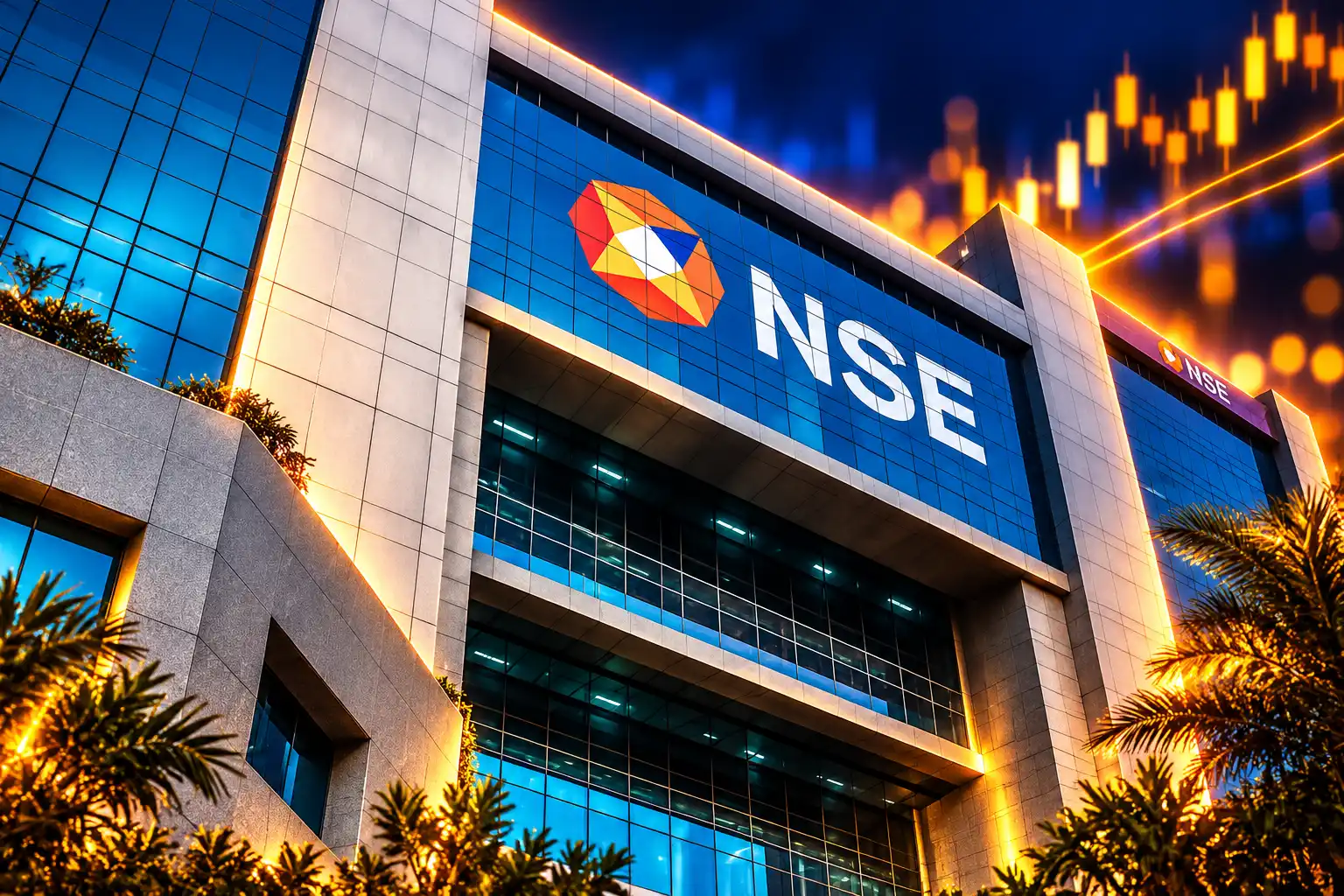
Day 1 Bids Cover 22% of the Public Issue
NSE data showed bids for 1,90,60,480 shares against 8,86,42,911 shares in the public book as of 11:40 a.m. on September 17. Non-institutional investors had taken 29% of their quota. Retail had taken 24%. Qualified institutional money, as often happens on day one of a large book, had barely arrived.
DAY 1 SNAPSHOT, 11:40 A.M.
- Overall book: 22% of the public issue, or 0.22 times.
- Non-institutional: 29% of that quota filled.
- Retail: 24% of that quota filled.
- Retail cheque: 8 shares a lot, ₹14,280 at the cap, ₹13,600 at the floor.
The public window runs through September 21. Allotment is due on September 22, with trading on BSE expected on September 24. Up to 50% of the net offer is reserved for qualified institutional buyers, including the anchor slice already placed, with at least 15% for non-institutional bids and 35% for retail.
Grey-market quotes put the premium at ₹218 on September 11 and ₹125 on the morning of September 17, a 43% drop that prices a 7% pop over ₹1,785. That is thin compensation for money blocked until listing, which is why a lot of short-term bids look easier to skip than to chase. Pre-IPO holders also sit on a six-month lock-in, so another slug of stock can still reach the tape in early 2027.
SBI Sells Stock It Bought at 80 Paise
Chauhan has been blunt that the company is not raising money for itself. The red herring prospectus filed with SEBI is an offer for sale. Proceeds, after issue expenses, go to selling shareholders. The draft in June had contemplated 14.89 crore shares. The final offer is about 15% smaller.
Life Insurance Corporation of India, which holds 10.72% and is larger than the entire offer, is not selling. It was the biggest name in the anchor book instead. On September 16 the exchange allotted 3,77,93,739 shares at ₹1,785 to 189 anchors, raising ₹6,746.18 crore. LIC took 22,42,584 shares worth ₹400.3 crore. Norway’s Government Pension Fund Global, the Monetary Authority of Singapore, ADIA, and Societe Generale’s offshore desk were in the same list. Offshore accounts took 43% of the book, or ₹2,883 crore. Twenty-nine domestic mutual funds, across 98 schemes, took nearly 37%, or ₹2,494.99 crore.
The sellers who are coming out paid very different prices.
LARGEST DISCLOSED SELLERS AT ₹1,785
| Seller | Shares on offer | Cost basis (WACA) | Proceeds at cap |
|---|---|---|---|
| State Bank of India | 1,59,69,410 | ₹0.80 | ₹2,851 crore |
| Canada Pension Plan Investment Board | 1,18,74,060 | ₹324.13 | ₹2,120 crore |
| Aranda Investments (Mauritius) | 1,12,46,336 | ₹62.38 | ₹2,007 crore |
| MS Strategic (Mauritius) | 1,10,00,000 | ₹66.54 | ₹1,964 crore |
| New India Assurance | 1,05,00,000 | ₹0.32 | ₹1,874 crore |
| SBI Capital Markets | 87,80,590 | ₹0.38 | ₹1,567 crore |
SBI is the largest seller by proceeds. It also came back through group entities in the anchor book, alongside SBI Mutual Fund, SBI Life, and SBI Pension Fund. New India Assurance is exiting paper picked up at 32 paise. CPPIB paid ₹324.13, the richest disclosed basis among the big names, and still more than quintuples that cost at the cap. Employees have a ₹70 crore reservation at a ₹170 discount to the final price.
Faster Growth at a Smaller Exchange
BSE is not a rounding error in this deal. It collects the listing, and it has been taking options activity that used to sit almost entirely on NSE. For the three months ended June 2026, NSE still had 93.05% of the cash market, 99.72% of equity futures, 100% of exchange-traded currency futures, and 100% of currency options, with 68.48% of equity options on premium turnover. For full-year FY26, its options share was 74.7%. By the fourth quarter that figure was about 73%, with BSE around 27%, after 12.6% in FY25.
The scale gap is still wide. The growth gap is not.
FY26, NSE VERSUS BSE
| Metric | NSE | BSE |
|---|---|---|
| Revenue from operations | ₹16,601 crore | ₹4,834 crore |
| Profit after tax | ₹10,302 crore | ₹2,497 crore |
| Options market share (Q4FY26) | about 73% | about 27% |
| FY26 P/E at ₹1,785 / trailing | 42.9 times | about 53 times |
NSE remains more than three times BSE on revenue and about four times on profit. BSE’s FY24-FY26 revenue compound rate was 88%, against 4% at NSE, and its options average daily turnover compounded at 202.5% while NSE’s fell 3.4%. At ₹1,785, NSE is still cheaper than BSE on a trailing multiple, and still several times larger. The market is paying up for BSE’s growth from a smaller base, and paying NSE as a mature utility.
How Options Still Pay NSE’s Bills
Transaction charges were ₹13,057 crore in FY26, about 79% of operating revenue. Options contributed about ₹9,998 crore, roughly 60% of operating revenue and about 77% of those transaction charges. Cash-market share of 93% looks like a fortress until you see that cash is a thin-toll business next to options.
Unique registered investors on NSE rose from 9.2 crore in FY24 to 12.9 crore in FY26. Mutual fund assets were about 31.2% of bank deposits in 2026, against 19.7% in 2020, on AMFI and RBI figures. Equities and funds still look small next to household savings in the US and Canada, per Bain Capital. That long runway is real. It does not cancel a year in which operating revenue fell 3% from ₹17,141 crore and profit fell 15% from ₹12,188 crore, after SEBI tightened the derivatives market.
SEBI CHANGES THAT HIT THE TOLL
- Contract size: Larger minimum contracts cut casual leverage in index options.
- Weekly expiries: Each exchange is limited to one weekly benchmark index-options contract, on Tuesday or Thursday.
- Upfront premium: Buyers pay the full premium up front, which lowers the churn that used to pad volumes.
- Closing auction: The Closing Auction Session, started in August 2026, has scrambled expiry-day flow; a Jefferies note put August index-options premium ADTO down 20% month on month to ₹53,900 crore.
BSE moved its weekly index-options expiry to Tuesday in early 2025 and then kept a structurally better calendar under the new rules. NSE still monetises options more richly, at about 22 basis points of yield against about 10 at BSE. The risk is that rule changes keep moving activity before that yield gap closes.
The ₹1,785 Cap Leaves Little Slack
Prasenjit Paul, fund manager at 129 Wealth and head of research at Paul Asset, said NSE is a cash-generating franchise with a clear edge, and that buyers should still stare at the multiple. “At Rs 1,785, the valuation is around 43 times FY26 earnings, which looks justified, though not cheap,” he said. On reported profit of ₹10,302 crore that print is 42.9 times. He wants growth from deeper participation, cash-market activity, new products, data, indices, and GIFT City, not from grabbing more share that NSE already owns. The dependency on options fees, he said, is the risk to watch after listing.
WHERE ANALYSTS SPLIT ON PRICE
- Paul Asset: Paul treats 43 times FY26 earnings as fair for the franchise, not a bargain, and would track earnings, cash volumes, and options activity rather than headline turnover.
- Religare Broking: An IPO note assigned a Neutral rating at 42.9 times, saying the multiple prices in the market position and leaves limited room if earnings miss, with SEBI’s options rules still hanging over volumes.
Religare also flagged system risk, cyber risk, and third-party intermediaries, plus any further change in product rules. Adjusted EBITDA was ₹12,657 crore in FY26, a 76% margin on the same research deck, so the operating engine is still fat. The multiple assumes that fat holds while options share is no longer a one-way street.
A Ten-Year Wait Ends With No Fresh Cash
NSE first filed for a listing in 2016. A whistleblower’s co-location complaint, then dark-fibre orders, SAT appeals, and a long fight with SEBI froze the IPO while the business kept compounding. SEBI issued a no-objection certificate on January 30, 2026. The exchange filed a fresh draft on June 17. The Supreme Court accepted the SEBI settlement on September 3. SEBI cleared the issue on September 4. The settlement figure on the co-location and dark-fibre cases is ₹1,491.21 crore, with ₹714.74 crore as cash outflow and the rest already with the regulator, provided for in FY26 books.
THE ROAD TO THE BSE TAPE
- December 2016: Files the first draft prospectus; co-location probes halt the plan.
- June 2025: Files settlement applications covering co-location and dark fibre.
- January 30, 2026: SEBI issues the no-objection certificate required of a market infrastructure institution.
- June 17, 2026: Files a new draft for a pure offer for sale of 14.89 crore shares.
- September 3-4, 2026: Supreme Court accepts the settlement; SEBI approves the issue.
- September 16, 2026: Places ₹6,746.18 crore with 189 anchors at ₹1,785.
- September 17-21, 2026: Public book open; listing due on BSE on September 24.
The wait produced a public company that still will not take public capital. Sellers who bought at paise multiples get a rupee price set for a top-15 Indian market-cap name. BSE gets the listing of the venue that still clears most of India’s cash and futures trades. And the first morning of bidding, with 22% of the public book filled and a 7% grey-market premium, looked like a franchise being priced as a known quantity, not a scarce one.
Disclaimer: This article is news reporting and analysis of the NSE initial public offering for information only. It is not investment advice, a bid recommendation, or an offer to buy or sell securities, and it does not tell any reader whether to apply in the issue. Consult a SEBI-registered investment adviser or a qualified financial planner who can review your own objectives, risk limit, and holding period before you bid, hold, or skip. Subscription figures, grey-market premiums, and allotment outcomes can change through the close of bidding on September 21, 2026, and unofficial premiums are not a forecast of the BSE listing price.

A CubeSat Will Age Whisky That Never Comes Home

A Charity Quote Cost Shia LaBeouf the FKA twigs NDA

Looker Turned a Model’s Body Into Ad Inventory

Infinity Ward Bets a Paid DMZ Will Stick This Time

Disney Sidesteps a Kimmel Renewal as Failla Cites Losses

How to Get Pre Boarding on Southwest – Skip the Line with These Tricks

False AI Intel Nearly Put US Crews on a Chinese Ship

Tim Cook’s $4.6 Trillion Apple Still Runs on One Phone

OpenAI Posts a Navier-Stokes Proof Clay Has Not Touched

Dunes Air Sues Nora Fatehi Over Its Luxury Jet
-
 TRAVEL3 years ago
How to Get Pre Boarding on Southwest – Skip the Line with These Tricks
-
 NEWS1 month ago
False AI Intel Nearly Put US Crews on a Chinese Ship
-
 BUSINESS2 months ago
Tim Cook’s $4.6 Trillion Apple Still Runs on One Phone
-
 NEWS2 months ago
OpenAI Posts a Navier-Stokes Proof Clay Has Not Touched
-
 ENTERTAINMENT2 months ago
Dunes Air Sues Nora Fatehi Over Its Luxury Jet
-

 LIFESTYLE3 years ago
How Often Do You Have to Change a Monkey’s Diaper? The Truth About Pet Monkeys
-

 NEWS2 months ago
Australia Treats Cloud Software Payments as Taxable Royalties
-

 LIFESTYLE3 years ago
How Long Does It Take for Armpit Hair to Grow? The Stages of Hair Growth and How to Shave It