
NEWS
Rajbhar Bets His Votes on a Purvanchal CM Chair
UP minister Om Prakash Rajbhar calls a four-state split inevitable and makes a Rajbhar Purvanchal chief minister a 2027 alliance condition.

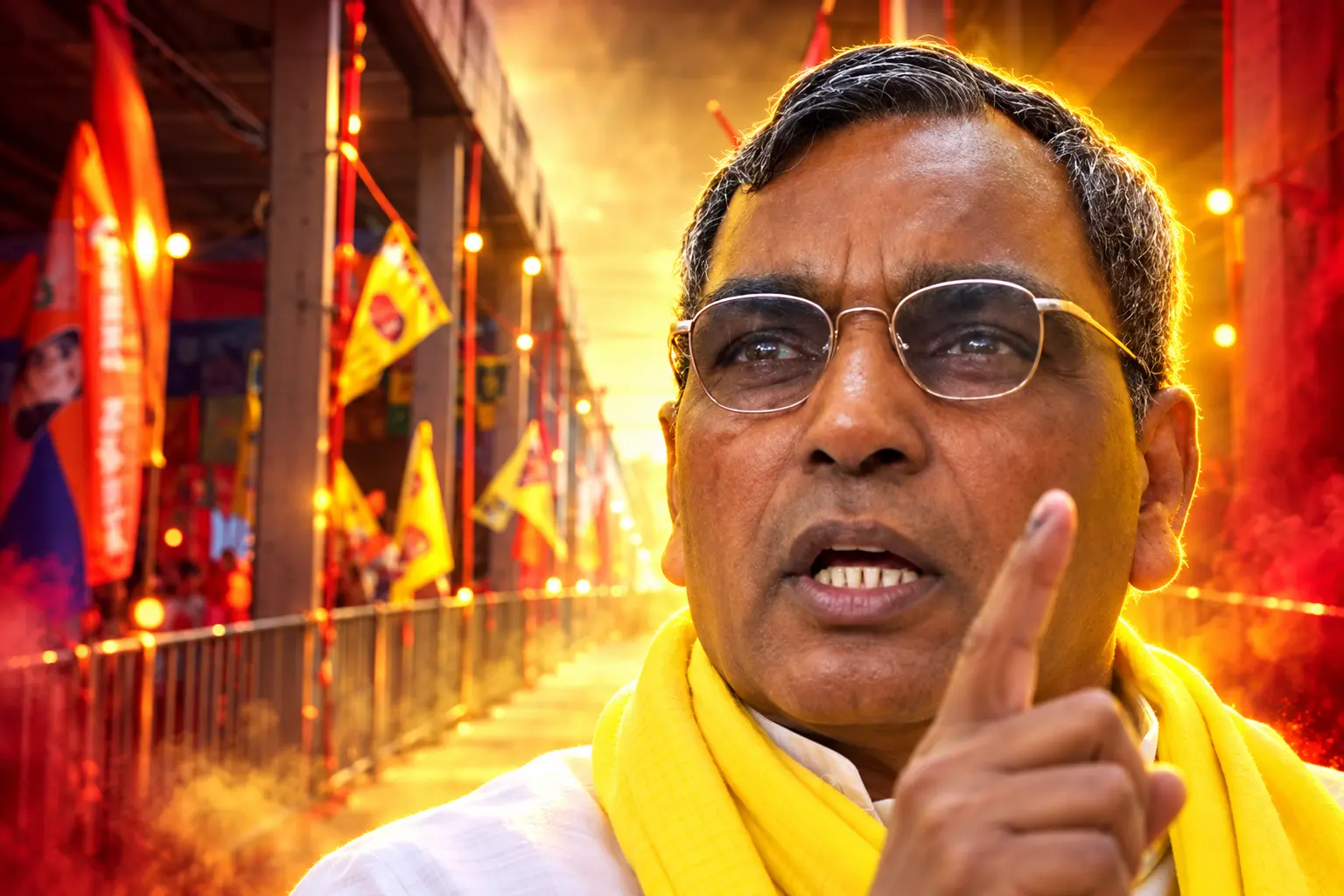
Uttar Pradesh cabinet minister Om Prakash Rajbhar said on September 21, 2026, that splitting the state into four is inevitable. He then named his price: any future alliance must accept a Rajbhar as chief minister of a Purvanchal state that does not exist.
The Suheldev Bharatiya Samaj Party chief is an NDA ally in Chief Minister Yogi Adityanath’s cabinet. He made the pitch in Ambedkar Nagar, a day after a Deoria rally where he also tied the split to a caste census and a talk he says he had with Prime Minister Narendra Modi. No public confirmation of that conversation has been issued. Fellow NDA minister Sanjay Nishad called the line misleading.
A Minister Prices a Chief Minister’s Chair
Rajbhar did not table a white paper, a district list, or a draft Bill. He set a bargaining chip. Speaking in Ambedkar Nagar, he said the Rajbhar community holds the largest vote share across Purvanchal, “starting from Ambedkar Nagar,” and that this fact should lock the top job in a state still on a poster.
The division of the state is inevitable.
Om Prakash Rajbhar, SBSP chief and Uttar Pradesh cabinet minister, in Ambedkar Nagar
He named four regions, Purvanchal, Madhyanchal, Bundelkhand, and Harit Pradesh, then made the chair the condition. “For any party entering into an alliance, it will be a predetermined condition that the Chief Minister of the future Purvanchal state will be from the Rajbhar community,” he said. The sentence is written for 2027, when Uttar Pradesh elects a new Assembly, not for a file in the Union home ministry.
He has used the same chair before. On March 17, 2026, at a Maharajganj rally, he already said that if Purvanchal were carved out, its chief minister would be from the Rajbhar community. The new move is to call the split inevitable and to hang the chair on “any party” that wants an alliance, including, by implication, the one he sits with now.
The Eastern Math Behind the Demand
Rajbhar’s leverage is not a statewide majority. It is density. The Rajbhar community is a Most Backward Class group concentrated in eastern Uttar Pradesh, and he treats that belt as a block that can move seats if it moves together. In July 2026 he said Rajbhar voters account for 12% to 22% in nearly 100 constituencies. That is his figure, not a census table, and he has used it while warning other backward groups that a Samajwadi Party government would leave Yadavs “calling the shots.”
The party that carries those votes is small in Lucknow and loud in Purvanchal. SBSP has hopped between the two big camps that actually form governments.
SBSP’S SEAT HOPS
| Year | Alliance partner | Seats given | Seats won |
|---|---|---|---|
| 2017 | BJP-led NDA | 8 | 4 |
| 2022 | Samajwadi Party | 17 | 6 |
After the 2017 win he entered the Adityanath cabinet, the first time a Rajbhar leader had held that rank. He later walked out, fought 2022 with Akhilesh Yadav’s Samajwadi Party, and took six seats, including his own Zahoorabad. In that round the BJP lost all seven assembly seats in Ghazipur, a district where Rajbhar numbers are thick. In July 2023 he rejoined the NDA, and he is again a cabinet minister as the 2027 campaign comes into view.
The four names he recited are the old regional map, not a new survey. Purvanchal is the east, dense, with long out-migration. Madhyanchal, also called Awadh Pradesh in earlier drafts, would take the centre, including Lucknow and Kanpur. Bundelkhand is the dry south. Harit Pradesh, also called Paschim Pradesh, is the west, closer to the National Capital Region, with a stronger farm base. None of those borders is in force.
A Census First, Then a Split, He Says
The Ambedkar Nagar line was the second day of the same pitch. On September 20, 2026, at SBSP’s Samajik Samrasta Maha Rally in Deoria, Rajbhar told workers the state would be divided into four parts after a caste census, and he put the Prime Minister in the story.
He said he had raised 27% OBC reservation and a fairer split of that quota. In his telling, Modi replied, “Om Prakash ji, your point is justified, but some people are opposing it,” then offered a census as the way through. “I will conduct a caste census, and once we have counted the castes, there will be no difficulty,” Rajbhar quoted him as saying. He asked the crowd whether they should trust the prime minister or the Samajwadi Party, the Bahujan Samaj Party, and Congress.
He then fixed the local prize. “The day a separate Purvanchal state is created, the first Chief Minister will be a son of the Rajbhar community. Keep this in mind while working. Do not be misled into joining the SP, BSP or the Congress.” The census, the quota, the map, and the chair were sold as one bundle, aimed at keeping his workers inside the NDA tent.
Sanjay Nishad, who heads the Nishad Party and also sits in the Adityanath cabinet, cut the bundle the same day. He called Rajbhar’s remarks misleading and said his party does not want a reorganisation.
There had been a demand to divide UP earlier, but now the state is progressing rapidly in all spheres. Further, special development funds have been allocated for regions like Bundelkhand and Purvanchal that needed handholding.
Sanjay Nishad, Nishad Party chief and Uttar Pradesh minister
WHAT WE KNOW
- The public claim: Rajbhar said the split is inevitable and that a Rajbhar Purvanchal chief minister is a preset alliance condition.
- The ally split: Nishad rejected a reorganisation and pointed to special funds already going to Bundelkhand and Purvanchal.
- The legal file: The 2011 Assembly resolution went to the Centre and stopped there; no new Bill has been moved.
WHAT IS UNCONFIRMED
- The Modi talk: Rajbhar’s account of a private assurance has not been matched by a public statement from the Prime Minister’s Office.
- The map: No official district list, capital plan, or boundary commission is attached to this week’s remarks.
- The timeline: A caste census does not, by itself, create a state.
The gap between a rally quote and a presidential reference is the whole story. Rajbhar is spending Modi’s name to hold a caste bloc. Nishad is spending development funds to say the map can stay.
How New States Are Made in India
A minister cannot split Uttar Pradesh from a stage in Ambedkar Nagar. Article 3 of the Constitution says Parliament may by law form a new State by separation of territory from an existing one, or change a state’s area, boundaries, or name. A Bill for that purpose cannot even be introduced without the President’s recommendation. Where a state’s area, boundaries, or name would change, the President must first send the Bill to that state’s legislature for its views, within a time the President sets.
THE ARTICLE 3 SEQUENCE
- The switch: Only Parliament can pass the law that creates a state.
- The gate: The President must recommend the Bill before either House sees it.
- The letter: The Uttar Pradesh legislature would be asked for its views, not for a veto the Centre is bound to obey.
- The silence: No such Bill is on the floor now, and Rajbhar did not claim one is being drafted.
The last time Lucknow tried to force the issue, it learned how little a state vote weighs. On November 15, 2011, Mayawati’s cabinet approved a four-way split. On November 21, 2011, she moved a one-line resolution in the Assembly to divide the state into Poorvanchal, Bundelkhand, Awadh Pradesh, and Paschim Pradesh and send it to the Centre. It passed by voice vote in 10 minutes amid a din, and the House was then adjourned sine die. The Centre took no further action. Rajbhar is reciting that unfinished file as if the next census will finish it.
The 1955 Book and the 2011 Vote
The idea is older than SBSP, and older than the four names. B.R. Ambedkar, writing in Thoughts on Linguistic States on December 23, 1955, treated Uttar Pradesh as too large for a fair Union. He recorded Uttar Pradesh at 6.32 crore people and argued that the north’s giant Hindi states dwarfed the south. His fix was to cut Uttar Pradesh, Bihar, and Madhya Pradesh, not to hand any one caste a chief minister’s chair.
He wanted three units out of Uttar Pradesh, each near a working size he set in the same book: the three States should have a population of approximately two crores. He placed their capitals at Meerut, Cawnpore (Kanpur), and Allahabad. That is a different map from Rajbhar’s four, and a different reason. Ambedkar was writing about the weight of a giant state in national politics, not about a Purvanchal alliance clause.
THE SPLIT FILE
- December 23, 1955: Ambedkar publishes the three-state plan for Uttar Pradesh, with capitals at Meerut, Kanpur, and Allahabad.
- November 9, 2000: Uttarakhand (then Uttaranchal) is carved out, the last time the Uttar Pradesh map actually moved.
- October 2007: Mayawati, then chief minister, calls for a three-way split into Bundelkhand, Harit Pradesh, and Poorvanchal, and writes to the Centre.
- November 21, 2011: Her government passes a four-state Assembly resolution; the Centre never converts it into a Bill.
- October 2018: Rajbhar, already in this argument, says the state can be developed only after it is divided into four parts.
- January 25, 2021, and January 25, 2025: Adityanath rejects a split and says the state’s strength is to stay united.
- September 20 and 21, 2026: Rajbhar calls the split inevitable and makes a Rajbhar Purvanchal chief minister a preset alliance condition.
Mayawati’s 2011 push came months before an Assembly election, and the opposition treated it as a campaign device. The resolution still sits as the only formal Lucknow vote on a four-way split. Rajbhar is now running a similar calendar, with early 2027 polls on the wall, and adding a caste lock the 2011 paper never carried.
80 Lok Sabha Seats and a Unity Line
The man who would have to live with a broken map has already said he does not want one. On January 25, 2025, at the Maha Kumbh in Prayagraj, Adityanath was asked about Mayawati’s old four-state pitch. “UP is UP in itself and this is its potential. I think UP should achieve its goals by staying united and I think that is its strength. That is its identity and its respect,” he said. He tied that unity to a target of a $1 trillion state economy by 2029. On January 25, 2021, he had used a shorter line: “We believe in uniting not dividing,” and pointed to the Purvanchal and Bundelkhand expressways as the government’s answer to regional neglect.
THE WEIGHT OF ONE MAP
- Assembly: Uttar Pradesh elects 403 members, the largest House in the country.
- Lok Sabha: It sends 80 MPs, the most of any state, into a 543-member House.
- Last full result: In 2022 the BJP won 255 assembly seats and the Samajwadi Party 111.
- 2024 warning: The BJP’s Uttar Pradesh Lok Sabha tally fell from 62 in 2019 to 33, while the Samajwadi Party took 37 and Congress 6.
That 2024 drop is why small OBC allies are being worked again in the east. It is also why a sitting BJP leader moved so fast to bag Rajbhar’s line as campaign talk. In Gonda on September 21, 2026, Brij Bhushan Sharan Singh said, “We understand that this is an election slogan, and the gentleman who made this statement should know that today, Uttar Pradesh has a strong influence in the politics of the entire country. This is because 80 Lok Sabha seats come from here.” The number is the argument. A four-way split would cut the single largest bloc in the Lok Sabha into four lesser ones. Congress leader Udit Raj made the same institutional point from the other side: until the Centre wants a split, the remark stays a remark.
Adityanath governs as if Purvanchal is a region to be held, not excised. In August 2026 in Gorakhpur he said eastern Uttar Pradesh had moved from “mafias and mosquitoes” to a medical hub, and he still talks of balanced growth across Purvanchal, the west, the centre, and Bundelkhand inside one state. Rajbhar’s four names match those same regions. The fight is over whether they remain zones of a single government or become four capitals with four chiefs.
He Is Shopping the Chair Before the Polls
The Purvanchal chair is also a way to fight Akhilesh Yadav’s PDA pitch, the Samajwadi Party’s bid to hold backward classes, Dalits, and minorities as one pile. A day before the “inevitable” line, Rajbhar went at Yadav over Dalit promotion quota. “Akhilesh ji, it is good that you are holding a press conference. But when the Samajwadi Party was in power, it made several decisions impacting Dalits. They ended reservation in promotions for Dalits, affecting many employees. They are the same old people; they haven’t changed,” he said.
That swipe and the CM condition are the same operation. He is telling Rajbhar, Nishad-adjacent, and other extremely backward groups that the NDA will pay in status, a census, a share of the 27% OBC quota, and, if the map ever moves, the first chair in the east. He is telling the BJP that those votes are not free, and that “any party” can bid. He has already sold them twice, in 2017 and 2022, and changed the shop sign in 2023.
A split of Uttar Pradesh would need the President, Parliament, and a political will in New Delhi that Adityanath has spent five years arguing against. Rajbhar still said the division is inevitable, then named the only job he wants written into the deal. The chair is for sale. The state under it has not been drawn.

A CubeSat Will Age Whisky That Never Comes Home

A Charity Quote Cost Shia LaBeouf the FKA twigs NDA

Looker Turned a Model’s Body Into Ad Inventory

Infinity Ward Bets a Paid DMZ Will Stick This Time

Disney Sidesteps a Kimmel Renewal as Failla Cites Losses

How to Get Pre Boarding on Southwest – Skip the Line with These Tricks

False AI Intel Nearly Put US Crews on a Chinese Ship

Tim Cook’s $4.6 Trillion Apple Still Runs on One Phone

OpenAI Posts a Navier-Stokes Proof Clay Has Not Touched

Dunes Air Sues Nora Fatehi Over Its Luxury Jet
-
 TRAVEL3 years ago
How to Get Pre Boarding on Southwest – Skip the Line with These Tricks
-
 NEWS1 month ago
False AI Intel Nearly Put US Crews on a Chinese Ship
-
 BUSINESS2 months ago
Tim Cook’s $4.6 Trillion Apple Still Runs on One Phone
-
 NEWS2 months ago
OpenAI Posts a Navier-Stokes Proof Clay Has Not Touched
-
 ENTERTAINMENT2 months ago
Dunes Air Sues Nora Fatehi Over Its Luxury Jet
-

 LIFESTYLE3 years ago
How Often Do You Have to Change a Monkey’s Diaper? The Truth About Pet Monkeys
-
 NEWS2 months ago
Australia Treats Cloud Software Payments as Taxable Royalties
-

 LIFESTYLE3 years ago
How Long Does It Take for Armpit Hair to Grow? The Stages of Hair Growth and How to Shave It