
BUSINESS
India Wins Duty-Free Access as New Zealand Dairy Stays Out
The India-New Zealand FTA starts 20 October with 100 percent duty-free Indian exports, while core New Zealand dairy remains excluded from India’s market.

India and New Zealand will start their free trade agreement on 20 October 2026, with 100 percent of Indian export lines entering New Zealand duty-free. Commerce and Industry Minister Piyush Goyal set that date in New Delhi on 21 September 2026, after both sides finished ratification.
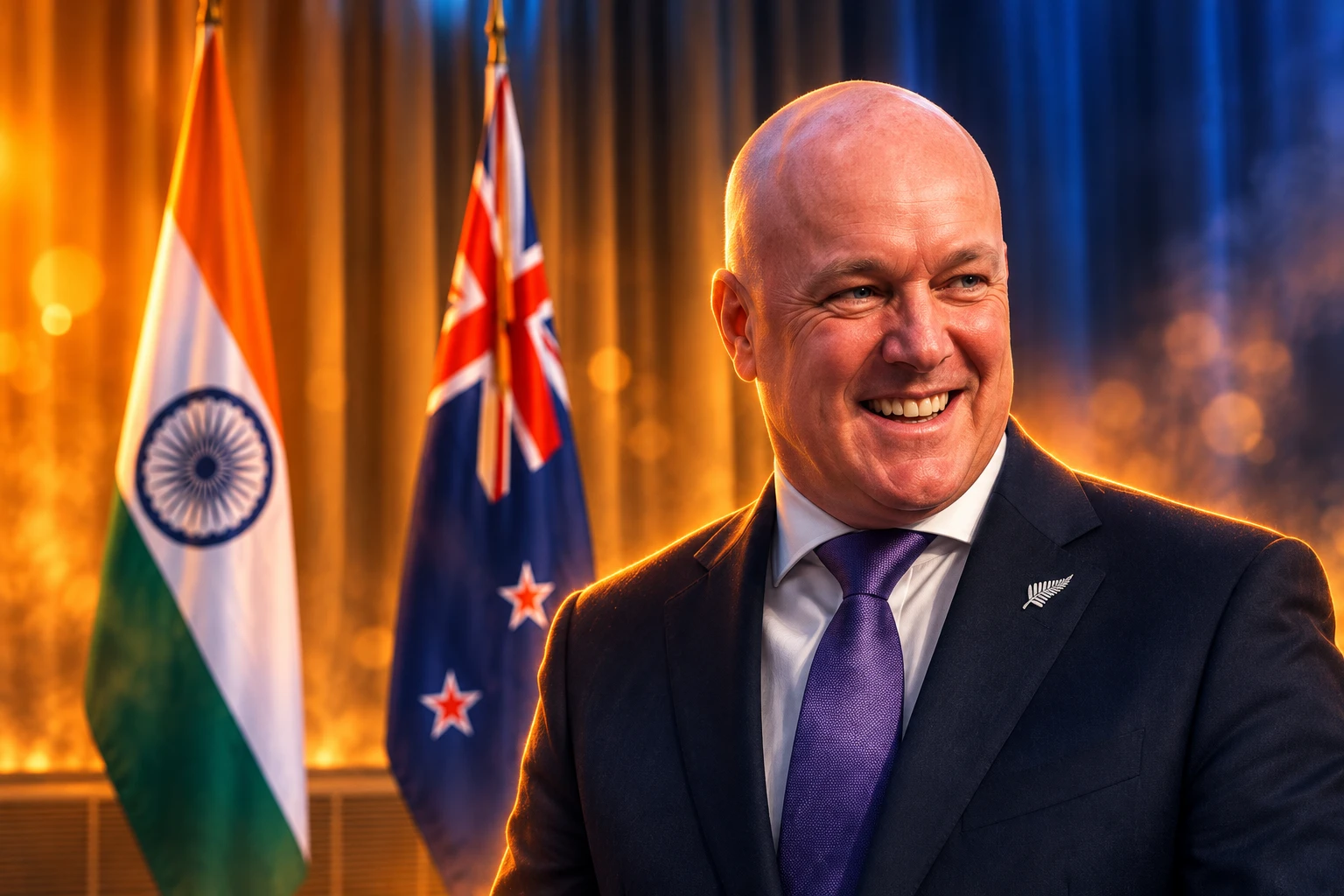
Prime Minister Christopher Luxon sold the pact as a door to 1.4 billion Indian consumers. The legal text still keeps milk, cheese, butter and a long farm list outside India’s tariff cuts.
India Kept 29.97 Percent of Lines Closed
New Zealand drops every tariff on Indian goods the day the deal starts. Peak rates of up to 10 percent on ceramics, carpets, cars and auto parts go to zero, matching the access other New Zealand partners already have.
India cuts or removes duties on 70.03 percent of its tariff lines, a share the commerce ministry says covers 95 percent of two-way goods trade by value. It left 29.97 percent of tariff lines out of any concession, a block built to protect farmers and domestic plants.
The excluded list is dairy in all common forms, plus onions, chana, peas, corn, almonds, sugar, artificial honey, edible oils, spices, rubber, gems and jewellery as an import class, and selected copper and aluminium goods. That is why 95 percent of current trade can sit inside the deal while almost 30 percent of the tariff book stays shut: the products New Zealand most wanted to grow are the ones that barely move now.
THE TARIFF SPLIT AT ENTRY INTO FORCE
| Direction | Lines opened | Day-one duty-free | Held out |
|---|---|---|---|
| Indian goods into New Zealand | 100 percent of lines | All lines | None |
| New Zealand goods into India | 70.03 percent of lines (95 percent of trade value) | 30.00 percent of lines, including wood, wool, sheep meat and raw hides | 29.97 percent, including dairy, sugar and several farm goods |
Another 35.60 percent of India’s lines phase out over three, five, seven and 10 years. A further 4.37 percent, including wine, some drugs, polymers and specified metals, get cuts rather than elimination. Only 0.06 percent sit in tariff-rate quotas.
Indian factories also gain duty-free inputs from New Zealand, including wooden logs, coking coal and metal scrap. Textiles, apparel, leather, footwear, gems and jewellery, engineering goods and processed foods are the export lines New Delhi has named as the employment prize.
Fonterra Says Core Dairy Access Did Not Arrive
Fonterra Co-operative Group, New Zealand’s dairy exporter, did not wait for ratification to record the hole. On 22 December 2025, the day talks closed, Simon Tucker, group director of global external affairs, put the verdict on the company’s own notice board.
It is disappointing that the negotiations with India were unable to secure any significant new core dairy access opportunities for New Zealand into the Indian dairy market.
Simon Tucker, Fonterra Group Director Global External Affairs, 22 December 2025 statement
Tucker added that the outcome was no significant new core dairy access surprise, given India’s long-standing dairy sensitivities. The co-op said it would still work the narrow dairy clauses that did survive.
Those clauses are small beside milk, cream, whey, yoghurt and cheese, which stay outside market access. Bulk infant formula and some high-value dairy preparations win duty-free treatment over seven years. Albumins, including milk albumin, get a quota that starts at 1,000 MT and rises to 3,000 MT by year five, at 11 percent duty, half of the 22 percent rate now. Dairy ingredients meant for making and re-export can enter India duty-free from day one, a supply-chain route rather than a supermarket one.
Green Party MP Steve Abel argued the opposite fear in Wellington’s third reading: that New Zealand butter could still hit India’s small herds. He put the Indian dairy count at about 80 million farmers, most with two or three cows, some with one, many without land. India’s exclusion list is written for that constituency. New Zealand’s dairy companies are writing around it.
Kimberly Crewther, executive director of the Dairy Companies Association of New Zealand, called the India chapter unfinished business after a decade of thin dairy results in other pacts. Meat, horticulture, seafood and forestry keep seeing tariffs fall, she said, while dairy still faces walls of 10 percent or more across most of world consumption.
Lamb, Logs and Kiwifruit Carry the New Zealand Side
Wellington’s goods win sits in products India would already buy. New Zealand’s foreign ministry says 57 percent of current exports to India become duty-free on day one, rising to 82 percent once the schedule is fully in, with sharp cuts on a further 13 percent, covering 95 percent of current exports. The average tariff on those shipments falls from 10 percent to 3 percent.
On present trade, the ministry puts exporter savings at NZ$43 million in the first year and NZ$62 million a year when the cuts finish. India, in return, forgoes about NZ$15 million a year in duties on New Zealand’s own imports, because every Indian line enters free from day one.
The immediate list is the farm New Zealand can actually ship. The ministry records tariffs removed immediately on sheep meat, wool, coal and more than 95 percent of forestry shipments. Most seafood, including mussels and salmon, phases to zero over seven years. Wine comes down over 10 years. Cherries, avocados, blueberries and persimmons go to zero over the same decade.
Fruit is fenced with quotas and floor prices, so Indian growers keep a seasonal buffer. New Zealand is the first country, on the ministry’s own account, to win preferential apple access in an Indian free trade pact, and the first kiwifruit shipper to win in-quota duty-free treatment plus a 50 percent cut outside the quota.
FRUIT, HONEY AND ALBUMIN QUOTAS
| Product | Duty now | Quota path | In-quota duty | Floor price |
|---|---|---|---|---|
| Apples | 50 percent | 32,500 MT in year 1, rising to 45,000 MT in year 6 (1 April to 31 August) | 25 percent | US$1.25/kg |
| Kiwifruit | 33 percent | 6,250 MT in year 1, rising to 15,000 MT in year 6 (1 April to 15 October) | 0 percent | US$1.80/kg |
| Manuka honey | 66 percent | 200 MT a year | Falls over 5 years to 16.5 percent | US$20/kg in-quota, US$30/kg out-of-quota |
| Albumins | 22 percent | 1,000 MT in year 1, rising to 3,000 MT in year 5 | 11 percent | None listed |
India already takes 31,392.6 MT of New Zealand apples and 5,840 MT of kiwifruit. The year-one apple quota sits just above that apple flow. The kiwifruit quota starts close to current volume and more than doubles by year six. Manuka is the other way round: New Zealand now ships 14.2 MT, against a 200 MT quota, while the duty only reaches 16.5 percent in year five.
Quota volumes for apples, kiwifruit and manuka are tied to agriculture productivity plans and a Joint Agriculture Productivity Council. Centres of excellence, planting material, orchard practice and post-harvest work are the Indian farmer-facing swap for letting more fruit in.
5,000 Indian Workers Get a Three-Year Door
Goods are only half the bargain New Delhi took home. New Zealand’s national-interest analysis records 5,000 Temporary Employment Entry visas a year, each for up to three years, plus a Working Holiday Scheme of 1,000 places for Indians aged 18 to 30.
New Zealand also opened 118 services sectors to India and gave most-favoured-nation treatment in about 139 sub-sectors, including computer services, professional work, construction, education, finance and tourism. Indian students may work up to 20 hours a week during term. STEM bachelor’s and master’s graduates can stay for post-study work of up to three years, doctoral graduates up to four, with no numerical cap on those study routes.
THE PEOPLE CHAPTER
- Temporary Employment Entry: 5,000 places a year, stays of up to three years, covering Green List shortage jobs plus a smaller set of Indian occupations such as AYUSH practitioners, yoga instructors, Indian chefs and music teachers.
- Working Holiday Scheme: 1,000 young Indians a year, aged 18 to 30, for up to 12 months of work while travelling.
- Students: up to 20 hours of work a week during study, then post-study work of up to three years for STEM bachelor’s and master’s graduates and up to four years for doctoral scholars.
That people chapter is the clause Wellington’s critics keep returning to. Replies under Luxon’s parliamentary-vote post treated the pact as an immigration opening dressed as trade, with capital pointed at India rather than at New Zealand farms. The visa numbers are small beside India’s labour pool, and they are still the most concrete new right in the deal for Indian households that do not export textiles or jewellery.
New Zealand, for its part, will promote investment into India with the aim of adding US$20 billion over 15 years from entry into force. Goyal told Indian industry the pledge “will give capital to many of our manufacturing sectors, along with technology.” The foreign ministry’s analysis frames it as promotion and an aim, not a cheque written by the New Zealand Treasury.
Wellington and New Delhi Closed a File Open Since 2009
New Zealand first opened FTA talks with India in 2009. Those rounds died in 2015, still stuck on farm access. The file sat quiet until Luxon made an India pact a first-term National promise after the 2023 election, then travelled to India in March 2025 to relaunch talks.
Negotiations were launched on 16 March 2025, on the eve of Luxon’s meeting with Prime Minister Narendra Modi. Five formal rounds and several inter-sessional meetings closed the text on 22 December 2025, nine months after the restart, one of India’s fastest pacts with a developed economy. Goyal and Trade and Investment Minister Todd McClay signed it on 27 April 2026 at Bharat Mandapam in New Delhi.
FROM THE 2009 FILE TO 20 OCTOBER
- 2009: New Zealand and India open FTA talks.
- 2015: Those talks end without a deal, with dairy still the block.
- 16 March 2025: Talks launch again on the eve of the Modi-Luxon meeting.
- 22 December 2025: Negotiators announce a concluded text after nine months and five formal rounds.
- 27 April 2026: Goyal and McClay sign the agreement in New Delhi.
- 16 September 2026: New Zealand’s Parliament passes the implementing bill 93 to 29.
- 21 September 2026: Both governments complete ratification and name 20 October 2026 as the start date.
- 20 October 2026: The agreement will enter into force.
The 16 September vote paired National and ACT with Labour. New Zealand First, the Greens and Te Pati Maori voted no. McClay thanked Labour on the third reading and called the pact good for exporters and for New Zealand. Labour’s Damien O’Connor said his party was for it “on balance,” with leftover worry about migrant exploitation.
Luxon treated the vote as proof that a deal people called impossible had been delivered in his first term. He posted again on 21 September 2026, after ratification, tying the October start to jobs and higher incomes at home.
Almost exactly three years ago, I committed that National would secure a free trade deal with India within our first term if elected.
And today, we finalised the deal, which comes into force next month.
It is exciting to think of how many businesses will grow as a result of… pic.twitter.com/WQt04FNHXi
— Christopher Luxon (@chrisluxonmp) September 21, 2026
Two-way trade is still small against those claims. New Zealand’s foreign ministry puts it at NZ$3.95 billion a year, goods and services together. India’s commerce ministry puts goods trade at about USD 1.3 billion in 2024-25. During a July 2026 visit to Auckland, Modi restated the shared target of doubling bilateral trade to NZD 7 billion (INR 35,000 crore) by 2030. That is a doubling of a modest base, not a sudden jump to a continental market.
What Changes for Indian Exporters on 20 October
Goyal timed the start to Dussehra. “I’m delighted that we are taking forward the next important milestone in our bilateral economic partnership: the entry into force of the India-New Zealand Free Trade Agreement, which will come into force on the auspicious occasion of Dussehra on 20th of October, 2026,” he said, speaking in New Delhi with McClay on the link.
From that morning, Indian shipments face no New Zealand duty on any line. New Zealand lamb, wool, logs and coal should clear India at zero. Kiwifruit and apples move under the quotas and floor prices in the tables above. Wine, some metals and drugs begin their slower cuts. Dairy for the Indian fridge does not.
Commerce Secretary Rajesh Agrawal called the goods result a level playing field for Indian exporters in New Zealand. McClay, at the April signing, called it a once-in-a-generation opening. Both can be true on paper and still leave Fonterra’s core catalogue outside the Indian tariff wall that 16 years of talks were meant to crack.
Indian Customs, under the pact, is to release all goods within 48 hours and to try for 24 hours on perishable cargo and express consignments. That clock, the visa quota, and the zero rate on Indian exports are the parts that actually switch on in October. Milk powder still needs a later political decision New Delhi has not made.
Frequently Asked Questions
Does the India-New Zealand FTA Open India’s Dairy Market?
Core consumer dairy stays out, including milk, cream, whey, yoghurt and cheese. The narrow yes is elsewhere: bulk infant formula and some high-value dairy preparations become duty-free over seven years, albumins get a 1,000 MT quota rising to 3,000 MT at 11 percent, and dairy ingredients for manufacturing and re-export can enter duty-free from day one. If India later opens dairy to a comparable partner, it has agreed to consult New Zealand on similar treatment.
How Is the 5,000 Temporary Employment Entry Quota Split?
New Zealand’s national-interest analysis assigns 4,400 of the 5,000 TEE visas to Immigration New Zealand’s Green List of recognised skill shortages, including IT, engineering, health, education and construction, and 600 to iconic Indian occupations such as chefs and yoga teachers. Each visa runs up to three years. Wellington intends to withhold partner work rights and domestic student status for dependent children on those visas.
How Fast Must Indian Customs Release New Zealand Goods?
India has committed to release all goods within 48 hours of arrival and to endeavour to do so within 24 hours for perishable goods and express consignments. Those time limits sit in the customs chapter, separate from the tariff schedules, and are meant to cut the non-duty cost of landing fruit, meat and seafood.
Which New Zealand Parties Voted Against the FTA Bill?
New Zealand First, the Green Party and Te Pati Maori voted against the implementing bill on 16 September 2026. National, ACT and Labour voted for it, producing the 93 to 29 result. Labour’s support came with a public caveat on migrant-worker protections rather than on dairy.
Is the US$20 Billion a Payment From the New Zealand Government?
No. The national-interest analysis says New Zealand will promote private investment into India with the aim of increasing that stock by US$20 billion over 15 years from entry into force. Goyal has described it as an FDI commitment that can bring capital and technology into Indian manufacturing. It is a facilitation target, not a line in Wellington’s budget.

A CubeSat Will Age Whisky That Never Comes Home

A Charity Quote Cost Shia LaBeouf the FKA twigs NDA

Looker Turned a Model’s Body Into Ad Inventory

Infinity Ward Bets a Paid DMZ Will Stick This Time

Disney Sidesteps a Kimmel Renewal as Failla Cites Losses

How to Get Pre Boarding on Southwest – Skip the Line with These Tricks

False AI Intel Nearly Put US Crews on a Chinese Ship

Tim Cook’s $4.6 Trillion Apple Still Runs on One Phone

Dunes Air Sues Nora Fatehi Over Its Luxury Jet

OpenAI Posts a Navier-Stokes Proof Clay Has Not Touched
-
 TRAVEL3 years ago
How to Get Pre Boarding on Southwest – Skip the Line with These Tricks
-
 NEWS1 month ago
False AI Intel Nearly Put US Crews on a Chinese Ship
-
 BUSINESS2 months ago
Tim Cook’s $4.6 Trillion Apple Still Runs on One Phone
-
 ENTERTAINMENT2 months ago
Dunes Air Sues Nora Fatehi Over Its Luxury Jet
-
 NEWS2 months ago
OpenAI Posts a Navier-Stokes Proof Clay Has Not Touched
-

 LIFESTYLE3 years ago
How Often Do You Have to Change a Monkey’s Diaper? The Truth About Pet Monkeys
-

 NEWS2 months ago
Australia Treats Cloud Software Payments as Taxable Royalties
-

 LIFESTYLE3 years ago
How Long Does It Take for Armpit Hair to Grow? The Stages of Hair Growth and How to Shave It