
BUSINESS
Jaishankar Co-Chairs P4M to Work Around a Stuck UN
Jaishankar co-chaired New York’s P4M summit, urging like-minded coalitions as the group’s own text named UN80 office reform, not Council seats.

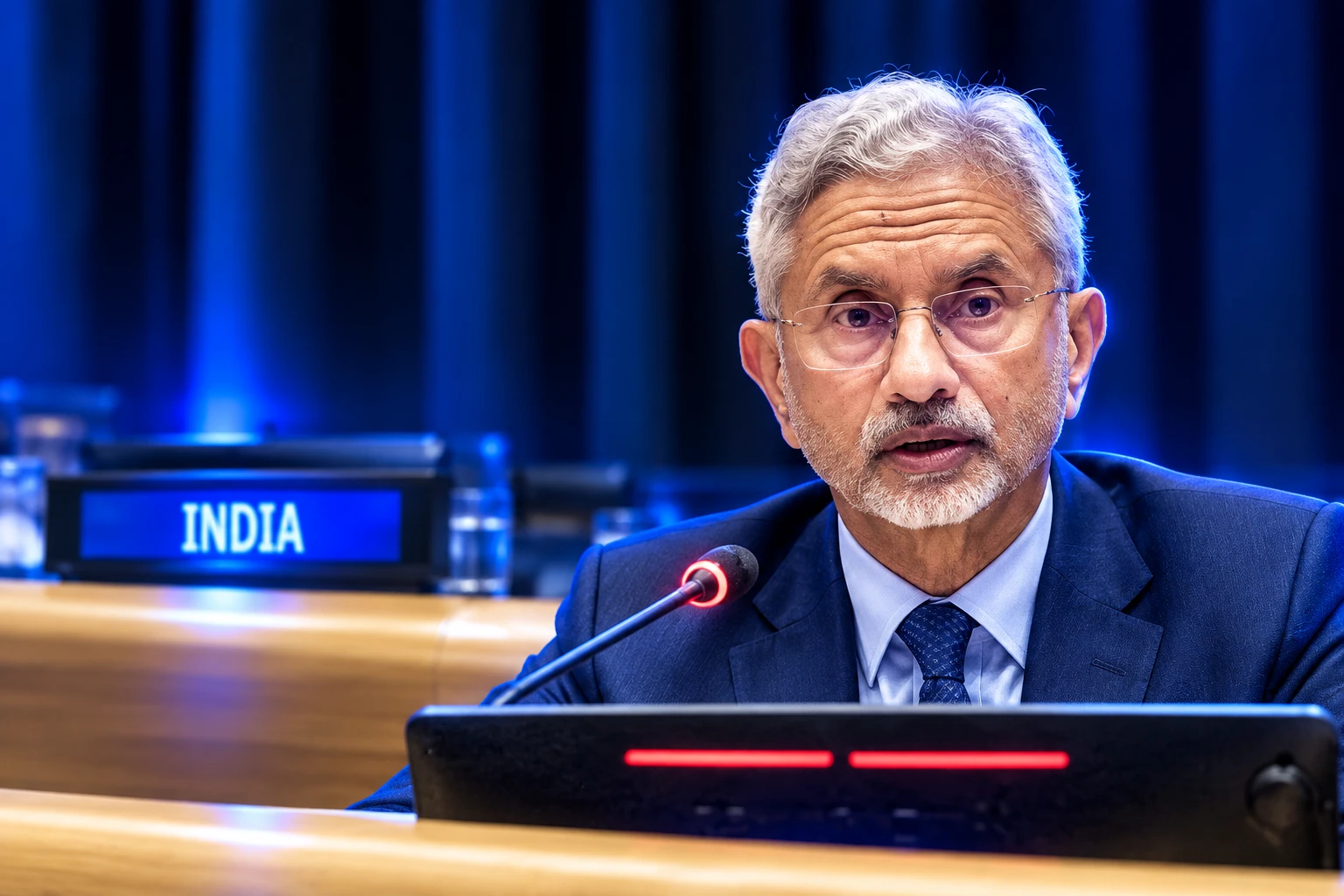
On September 21, External Affairs Minister S. Jaishankar co-chaired the first Partners for Multilateralism summit in New York and told partners to gather when the UN stalls. He put a 4F crisis of fuel, food, fertiliser and finance on the table, then called for de-risking around chokepoints and for like-minded states to come together.
Seven governments signed a text that same day. The written reform they named is UN80, a plan to slim and merge UN offices, not to reopen the Security Council.
India Co-Chairs a Club It Did Not Found
The Partners for Multilateralism, International Law, Peace and Prosperity summit, shortened to P4M, sat on the margins of the 81st United Nations General Assembly. European Council President António Costa convened it with Jaishankar as co-chair, after India joined as a co-sponsor rather than as one of the four capitals that wrote the founding essay.
That essay came from Costa, Brazilian President Luiz Inácio Lula da Silva, Kenyan President William Ruto and Canadian Prime Minister Mark Carney. The later New York text listed the seven initial co-sponsors of the declaration: Australia, Barbados, Brazil, Canada, the European Union, India and Kenya.
WHO SAT UNDER THE P4M LABEL
| Co-sponsor | Role on September 21 | On the founding essay |
|---|---|---|
| European Union | Costa co-chairs the summit | Yes |
| India | Jaishankar co-chairs as co-sponsor | No |
| Brazil | Founding capital | Yes |
| Canada | Founding capital | Yes |
| Kenya | Founding capital | Yes |
| Australia | Co-sponsor; Anthony Albanese spoke | No |
| Barbados | Co-sponsor; Mia Mottley listed as a convener | No |
The European Council’s event note listed Prime Minister Narendra Modi among those convening the meeting. India sent the foreign minister instead, and Jaishankar’s first line in the room was that India was glad to join as a co-sponsor. Australia used the same session to talk up a Security Council campaign for the 2029-30 term, which is a reminder that the Council’s membership fight was live even as the new club talked about something else.
The 4F Crisis and the Like-Minded Clause
Jaishankar did not open with a seat on the Council. He opened with stress on the global order, a long rebalancing that had turned, in his words, into extreme competition, geopolitical tensions and actual conflicts. If that mix ran on unchecked, he said, it would call into question the spirit of international cooperation.
The load-bearing lines sat further down. He said the 4F crisis could not be left to itself, that new tools needed guardrails, and that chokepoint dominance had to be answered with de-risking and diversification. Then came the clause that does the real work: where the cause is strong, the like-minded should have the confidence to come together.
THE PLAYBOOK INSIDE THE SPEECH
- The 4F crisis: Fuel, food, fertiliser and finance are treated as live shocks, not slogans, and he said they cannot be left to run.
- Chokepoints: Where one country or a small set of countries can squeeze a route or a market, partners should de-risk and spread their sources.
- Like-minded clubs: When the case is compelling, willing capitals should gather even if the wider UN cannot move.
The founding essay had already named a maritime example. Global sea chokepoints such as the Strait of Hormuz, constrained by conflict, can freeze supply chains far from the shooting. Jaishankar’s 4F list is the Indian reading of that same squeeze, covering energy, food, farm inputs and money at once.
The 4F crisis of Fuel, Food, Fertiliser and Finance cannot be left to itself. Where there is a threat of chokepoint dominance and disruption, de-risking and diversifying must be encouraged. And where there is a compelling cause or a powerful case, the like-minded must have the confidence to come together.
S. Jaishankar, External Affairs Minister of India, P4M Summit, New York
He added that multilateralism is best served when international law, rules and norms are scrupulously observed, and that reformed multilateralism is essential because more participative talks and more transparent decision-making are overdue. That is the UN-reform sentence. The operating instructions sit in the three lines above it.
He later posted a three-point readout of the co-chair session, putting de-risking and diversification beside the reform slogan.
A pleasure to join @eucopresident António Costa in co-chairing the Partners for Multilateralism, International Law, Peace & Prosperity (P4M) Summit. Took the opportunity to:
✅ Stress the essentiality of multilateralism today to preserve the spirit of international cooperation… pic.twitter.com/0AWJjijNDt
— Dr. S. Jaishankar (@DrSJaishankar) September 22, 2026
65 Conflicts and a $2.887 Trillion Arms Bill
The founders cited a brutal 2025 to explain why they were building a new room. Peace Research Institute Oslo, using Uppsala Conflict Data Program figures, counted 65 conflicts recorded in 35 countries, the highest number since records began in 1946. Interstate wars doubled from 4 in 2024 to 65 wait.
Interstate wars doubled from 4 in 2024 to 8 in 2025. Siri Aas Rustad, PRIO’s research director and the paper’s lead author, called the return of fighting between states at that scale deeply worrying, and pointed to rivalry, border disputes and regional spillover, including in the Middle East.
The Stockholm International Peace Research Institute, in a 27 April 2026 release, put record world military spending in 2025 at $2.887 trillion, up 2.9 per cent in real terms and the 11th straight annual rise. The world’s military burden reached 2.5 per cent of output, the highest share since 2009. Spend outside the United States still grew 9.2 per cent, because a drop in US outlays masked a 14 per cent jump in Europe to $864 billion.
THE 2025 RECORD THE FOUNDERS WALKED IN WITH
| Measure | 2025 figure | Compared with |
|---|---|---|
| State-based conflicts | 65 | Highest since 1946 |
| Countries hosting them | 35 | Many host more than one war |
| Interstate conflicts | 8 | Double the 2024 count of 4 |
| World military spending | $2.887 trillion | 11th straight annual rise |
The United States, China and Russia spent a combined $1.480 trillion, or 51 per cent of the world total. India, sitting at the P4M table as a co-sponsor, was the fifth-largest military spender at $92.1 billion, up 8.9 per cent. A peace-and-prosperity club that includes a top-five arms budget is not a gathering of small bystanders.
Global military spending rose again in 2025 as states responded to another year of wars, uncertainty and geopolitical upheaval with large-scale armament drives. Given the range of current crises, as well as many states’ long-term military spending targets, this growth will probably continue through 2026 and beyond.
Xiao Liang, Researcher, SIPRI Military Expenditure and Arms Production Programme
The founding essay rounded the same SIPRI year to $2.9 trillion and set it beside $35 trillion in global trade and 6 billion people on the internet, almost three-quarters of humanity. The point they wanted was the split: goods, data and money still cross borders, while politics runs the other way.
P4M’s Written Reform Is a UN Office Overhaul
The signed New York text says the UN Charter system remains indispensable and must now answer a more contested, more multipolar world. It also says economic interdependence is increasingly used as leverage, disrupting trade, supply chains, investment and development finance. The reform sentence that follows is specific. The signatories agree to work together to reform the United Nations through initiatives such as UN80.
UN80 is not a bid to add India, Brazil or Germany to the Security Council. Secretary-General António Guterres launched it in March 2025 as an 80th-anniversary overhaul. The UN’s own FAQ describes a UN80 plan of 87 actions in 31 work packages across 3 workstreams, aimed at simpler offices, shared back rooms and fewer duplicate reports. The same page says the UN system’s resource base is projected to shrink by $16 billion from 2024 to 2026, a drop of nearly 25 per cent, and that UN80 is not designed to solve that money crisis on its own.
WHAT THE PAPER TRAIL DID IN THREE DAYS
- March 2025: Guterres launches UN80 as a system-wide efficiency and structure drive.
- September 21, 2026: Costa, Lula, Ruto and Carney publish the P4M essay; seven co-sponsors sign the New York declaration naming UN80; Jaishankar and Costa open the inaugural summit.
- September 22, 2026: Jaishankar posts the co-chair readout that pairs de-risking with reformed multilateralism.
That sequence matters because India’s spoken ask in the room was more participative deliberations and more transparent decision-making. Those words have, for years, been how New Delhi talks about a Council that still runs on five vetoes. The document the seven signed points at a different machine: cutting overlap, moving posts, merging back offices. Both can be called UN reform. They do not move the same lever.
The founders were careful about branding. They offered a flexible open framework across political divides, and they said they would not build another exclusive bloc or another international bureaucracy. Regular exchanges, open to partners from all regions, are the method they put on paper. No secretariat, no treaty, no vote.
The Founders Are Hedging Superpower Limits
The essay quotes Guterres saying superpowers are discovering their limits, then argues that the rest of the world should rediscover collective action. None of the seven co-sponsors is among the three capitals that accounted for 51 per cent of military spending in 2025. The club is a place to work when Washington, Beijing and Moscow are busy with their own contests, and when the Council they dominate does not move.
The declaration’s worry list is blunt: polarisation, the spread of conflict, violations of international law, and a turn to power politics, protectionism, coercion and the threat or use of force. SIPRI’s Diego Lopes da Silva, a senior researcher on the 2025 spend figures, said US allies in Asia and Oceania are spending more in part because of growing uncertainty over US support and pressure from the Trump administration to raise military budgets. That is the weather system around UNGA this year, even when no one names it from the P4M podium.
Jaishankar’s like-minded clause fits that weather better than a hymn to the Charter. It gives permission to build issue clubs on fuel, food, fertiliser, finance, AI guardrails and sea lanes without waiting for a veto. Costa’s line that cooperation is a practical necessity, not an act of idealism, is the European version of the same bet. The Indian discussion around the speech stayed on the reform slogan. The useful reading is the operating list: de-risk, diversify, gather.
Jaishankar Already Runs This Play in Other Rooms
India did not need a new initials group to practice issue-based coalitions. In May, at a Quad foreign ministers meeting in New Delhi, Jaishankar put supply-chain resilience, connectivity chokepoints, manufacturing concentration and gaps in critical infrastructure on the table with the United States, Japan and Australia. That is the chokepoint doctrine in a smaller, sharper room.
BRICS and the G20 are the finance and Global South rooms. The Quad is the Indo-Pacific security and supply room. P4M now gives India a UN-adjacent room that also holds Brazil, Kenya, Canada, the EU, Australia and Barbados, without the branding of an anti-China alliance and without a new bureaucracy to defend. The same minister can talk reformed multilateralism at the UN in the morning and de-risking with a tighter set of partners in the afternoon, and both lines are in the September 21 remarks.
He listed the stakes as peace and international security, climate action and climate justice, emerging technologies and development finance, counterterrorism, supply-chain strength, disaster resilience and pandemic readiness. All of those, he said, depend on a will to cooperate. The will he described is selective. It is the will of countries that share a problem, not the will of 193 votes.
The Security Council’s veto rules did not change on September 21. P4M leaves the door open for more capitals to sign the same text and start work in the gaps.

A CubeSat Will Age Whisky That Never Comes Home

A Charity Quote Cost Shia LaBeouf the FKA twigs NDA

Looker Turned a Model’s Body Into Ad Inventory

Infinity Ward Bets a Paid DMZ Will Stick This Time

Disney Sidesteps a Kimmel Renewal as Failla Cites Losses

How to Get Pre Boarding on Southwest – Skip the Line with These Tricks

False AI Intel Nearly Put US Crews on a Chinese Ship

Tim Cook’s $4.6 Trillion Apple Still Runs on One Phone

OpenAI Posts a Navier-Stokes Proof Clay Has Not Touched

Dunes Air Sues Nora Fatehi Over Its Luxury Jet
-
 TRAVEL3 years ago
How to Get Pre Boarding on Southwest – Skip the Line with These Tricks
-
 NEWS1 month ago
False AI Intel Nearly Put US Crews on a Chinese Ship
-
 BUSINESS2 months ago
Tim Cook’s $4.6 Trillion Apple Still Runs on One Phone
-
 NEWS2 months ago
OpenAI Posts a Navier-Stokes Proof Clay Has Not Touched
-
 ENTERTAINMENT2 months ago
Dunes Air Sues Nora Fatehi Over Its Luxury Jet
-

 LIFESTYLE3 years ago
How Often Do You Have to Change a Monkey’s Diaper? The Truth About Pet Monkeys
-

 NEWS2 months ago
Australia Treats Cloud Software Payments as Taxable Royalties
-

 LIFESTYLE3 years ago
How Long Does It Take for Armpit Hair to Grow? The Stages of Hair Growth and How to Shave It