
BUSINESS
Saudi Intercepts Hit the Oil Route Hormuz No Longer Gives
Saudi air defenses stopped six Houthi missiles aimed at Yanbu, the Red Sea oil door that matters because Hormuz is already disrupted.

Saudi air defenses destroyed six ballistic missiles aimed at Taif and the Red Sea oil port of Yanbu on Thursday, the kingdom’s Yemen coalition said. Sirens sounded from the holy city of Makkah to Tabuk. Crude jumped about 3%, then gave some of it back when talk of reopening the Strait of Hormuz returned.
The missiles were not a random raid on two western cities. They landed on the backup export path Saudi Arabia had just started to reopen, which is why a stopped attack still moved the oil market and pulled in foreign troops.
Six Missiles and Five City Alerts
Maj. Gen. Turki Al-Maliki, spokesman for the Coalition to Support Legitimacy in Yemen, said Royal Saudi Air Defense Forces intercepted and destroyed six ballistic missiles before they reached Taif and Yanbu. “Escalations and violations by the terrorist Houthi militia will be dealt with firmly,” he said.
Saudi Civil Defense had already pushed early-warning sirens into five governorates and cities. It later said the danger had passed in all five, and told people to stay off balconies, keep away from glass, and call 998 if they needed help.
THE SIREN CITIES
- Makkah: The holy city went under the same alert as the oil port.
- Jeddah: The Red Sea commercial hub sat on the warning list with Yanbu.
- Taif: Coalition officials named this western city as one of the two missile aims.
- Yanbu: The alert covered the terminal that loads crude that no longer has an easy run through Hormuz.
- Tabuk: Civil Defense later cleared this northern region with the other four.
The Houthis, through military spokesman Yahya Saree, described a wider strike. They said they had fired on “a sensitive target” in Riyadh and on Saudi Aramco facilities in Yanbu, and separately claimed dozens of ballistic missiles and drones against Jazan province. A Greek security source said a Patriot battery run by Greek personnel in the wider Yanbu area shot down a ballistic missile and a drone the same day.
WHAT WE KNOW
- The intercept claim: The coalition says all six ballistic missiles aimed at Taif and Yanbu were destroyed.
- The all-clear: Civil Defense said the threat had passed in Makkah, Jeddah, Taif, Yanbu and Tabuk.
- The Houthi claim: The group says it attacked Riyadh and Aramco sites in Yanbu, and later described a large Jazan barrage.
WHAT IS UNCONFIRMED
- Damage on the ground: No official casualty or facility-damage toll has been published for Taif or Yanbu.
- Burning tanks: Social posts of fires at Yanbu storage have not been matched by a coalition or Aramco confirmation.
- Where each missile was aimed: Riyadh, Jazan, Taif and Yanbu are all in the competing claims, and the public record does not sort them warhead by warhead.
A missile at Riyadh on September 19 was also intercepted, according to the coalition. Thursday’s wave still forced a nationwide duck-and-cover drill over the one port that is supposed to make a Hormuz shutdown survivable.
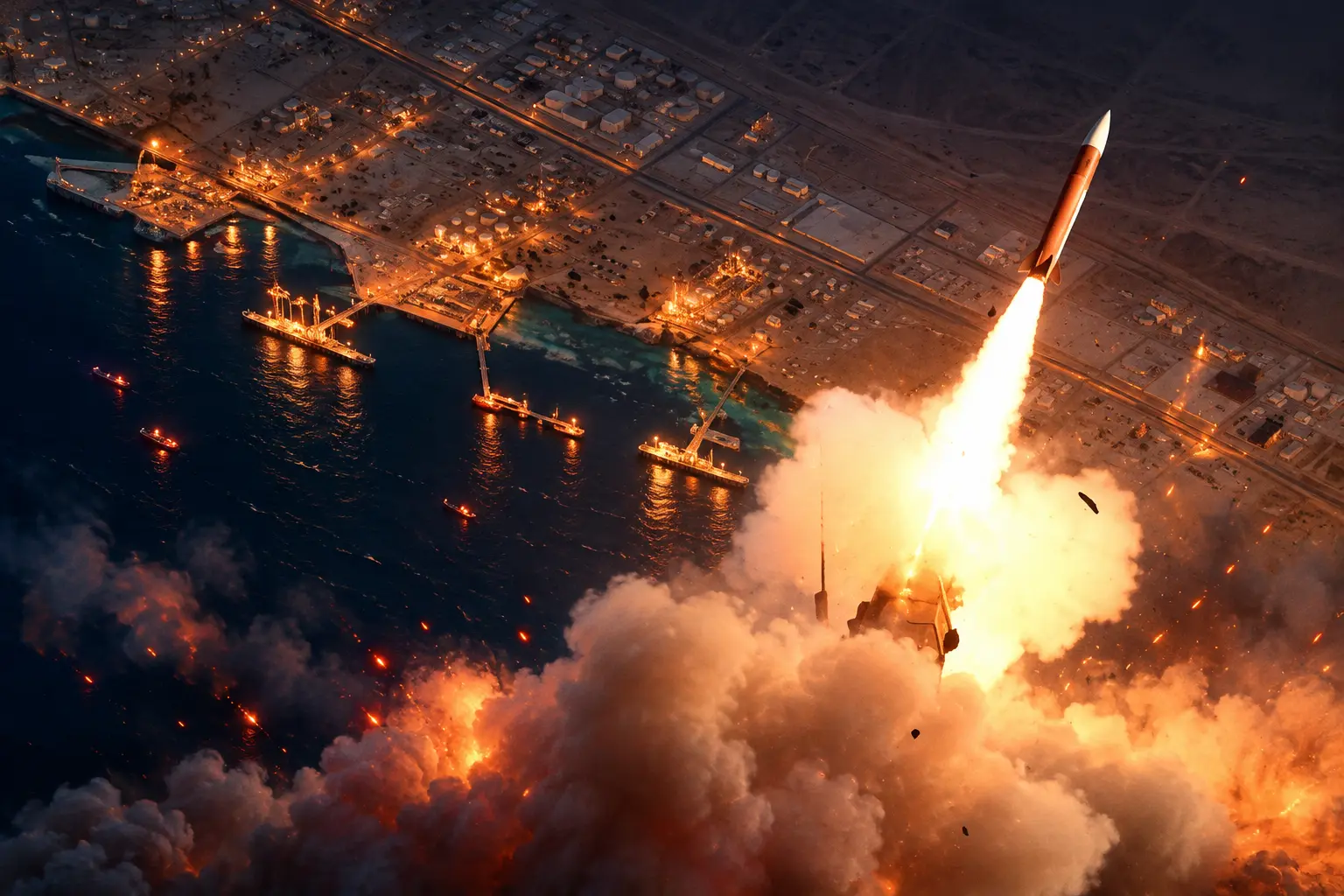
Yanbu Is the Door Hormuz No Longer Provides
For decades the oil market treated the Strait of Hormuz as the chokepoint that mattered. U.S. Energy Information Administration figures put 20.9 million barrels a day through Hormuz in the first half of 2025, about 20% of global petroleum liquids. The Iran war that began in late February cut that path to pieces.
The same EIA series shows Hormuz flows falling from 21.6 million barrels a day in the fourth quarter of 2025 to 4.9 million in the second quarter of 2026. Over those two periods, Bab el-Mandeb volumes rose from 5.4 million barrels a day to 8.1 million. Saudi Arabia and the United Arab Emirates together have only about 4.7 million barrels a day of pipeline capacity that can skip Hormuz.
That is the map Thursday’s missiles hit. Yanbu is where the East-West line dumps crude on the Red Sea. If that port is under fire, the barrels that were meant to walk around Hormuz still have to run south past Yemen, or north toward Suez, or sit in tanks.
THE OIL ROUTES UNDER PRESSURE
| Route | Recent volume | What changed |
|---|---|---|
| Strait of Hormuz | 4.9 million bpd in Q2 2026, down from 21.6 million in Q4 2025 | Still the primary Gulf exit, and still badly constrained |
| East-West line to Yanbu | About 4 million bpd before the Sept. 13 shutdown | Restarted at a low rate on Sept. 22, then came under missile fire on Sept. 24 |
| Bab el-Mandeb | 8.1 million bpd in Q2 2026, up from 5.4 million | Houthi gains on Yemen’s Red Sea coast now sit on the Asian exit from Yanbu |
The kingdom told OPEC that output fell from 10.9 million barrels a day in February to 6.2 million in August. Having crude in the ground does not move a cargo if the pipe, the port and the strait are all in the fight.
How the East-West Pipeline Became a Target
The East-West pipeline, also called Petroline, runs about 1,200 km from the eastern fields to Yanbu. Before this war it was insurance. After Hormuz seized up, it became the main way Saudi barrels reached the Red Sea, moving about 4 million barrels a day.
Drone strikes in mid-September wrecked that workaround. The line was shut on September 13 and Yanbu loadings stopped. Industry sources said pumping resumed on September 22 at a low rate, with Aramco trying to climb back toward 4 million barrels a day and a full recovery still weeks away. Brent had dropped toward $98 on that restart news. Two days later the port was back on a missile alert.
THE PATH TO THURSDAY’S ALERTS
- July 20, 2026: Houthis declare a maritime blockade of Saudi shipping in the Red Sea and warn ships serving Saudi ports.
- August 7, 2026: Saudi Arabia, Turkey and Pakistan sign the Mecca Joint Defense Agreement in the holy city.
- September 13, 2026: Drone strikes shut the East-West pipeline and halt crude loadings at Yanbu.
- September 22, 2026: The pipeline restarts at a low pumping rate, and a cargo is lined up for China.
- September 24, 2026: The coalition says it intercepts six ballistic missiles; France’s president says he will protect Yanbu.
- September 25, 2026: The three Mecca-pact allies announce an urgent chiefs of staff meeting.
Houthi messages to shippers in July said vessels were banned from loading or discharging cargo at any Saudi port, and that ships carrying Saudi cargo could be targeted anywhere inside the group’s reach. Some tankers already turned north toward Suez rather than run south through Bab el-Mandeb. Thursday’s sirens told the same market that the land end of that detour is now a target set too.
Mocha, the Islands and the Bab el-Mandeb Perch
The missiles came after a Houthi push down Yemen’s Red Sea coast. The group took the port city of Mocha and strategic islands this month, a perch on the Bab el-Mandeb strait that links the Red Sea to the Gulf of Aden. From there, a tanker leaving Yanbu for Asia is running past guns the Houthis did not hold in the spring.
They still say the blockade applies to Saudi shipping and that other commercial traffic is not the target, while warning other countries not to step in. The internationally recognized government in Aden does not buy the split. Its forces spent Wednesday night fighting to hold Hejat al-Abd, the steep mountain pass that is the last road into Taiz from Aden, and the only way many residents can leave the country.
The United Nations says more than 700 people have been killed in the latest fighting, with thousands wounded. UNHCR counts about 230,000 people newly uprooted since the start of September, on top of about 5.2 million already displaced inside Yemen. The oil market sees a strait. On the ground it is a coastal war closing around a city and a port.
France Puts Troops on a Port the Pact Has Not
Riyadh’s answer to the missile wave was not only Patriots. It was a phone book of allies, and they are not moving at the same speed.
The Attack-on-One Clause
Saudi Foreign Minister Prince Faisal bin Farhan Al Saud met Pakistan’s deputy prime minister and foreign minister, Ishaq Dar, and Turkish Foreign Minister Hakan Fidan in New York on Thursday. A foreign ministry statement said the three men were arranging an urgent chiefs of staff meeting to discuss support for the kingdom under the Mecca Joint Defense Agreement.
Crown Prince Mohammed bin Salman, President Recep Tayyip Erdogan and Prime Minister Shehbaz Sharif signed that pact on August 7. It says an armed attack on any one of the three is an attack on all three. Their foreign and defense ministers and military chiefs met in Istanbul on August 31, agreed to put a secretariat in Saudi Arabia, and began turning a political vow into staff work. Thursday’s statement also condemned attacks that had targeted Makkah and civilian and economic sites, and restated the kingdom’s right to defend itself under Article 51 of the UN Charter.
WHAT THE PACT HAS DONE SO FAR
- The clause: An armed attack on Saudi Arabia, Turkey or Pakistan is to be treated as an attack on all three.
- The machinery: A secretariat in Saudi Arabia, plus committees and working groups, were set in motion in Istanbul on August 31.
- The next meeting: Chiefs of staff are to meet on an unnamed date to discuss support for the kingdom.
- The gap: No public order has put Pakistani or Turkish combat units on the Yanbu jetty.
Pakistan’s own officials have been wary of being pulled into a war that already runs from Iran to the Red Sea. Turkey’s foreign minister, Hakan Fidan, said on September 20 that Ankara could meet Saudi technical military needs. A chiefs of staff session can still produce air defenses, staff officers, or nothing that a tanker captain can see.
Soldiers and Radars for a Narrow Mandate
The government that did announce a deployment is not in the Mecca pact. President Emmanuel Macron said France would send military assets to protect Yanbu.
We are going to send military assets, meaning soldiers, radars and defence systems to protect this site.
Emmanuel Macron, President of France, interview with TF1
He framed the mission as site protection, not an entry into the wider war, and did not rule out extra air power. Greek crews are already on a Patriot battery in the Yanbu area. The United States has stayed out of this Yemen fight while remaining in contact with the Houthis. The result is an odd stack: a NATO member that never signed the August pact is putting soldiers on the oil terminal, while the two partners who did sign it are still scheduling a meeting.
That is the political second blow of Thursday’s salvo. The missiles tested Saudi air defense. They also tested who actually shows up when the backup oil port is the target.
A Warning From Yemen’s Vice President at the UN
The same Thursday, Abdullah Abdulkader Al Alimi-Bawzer, vice president of Yemen’s Presidential Leadership Council, spoke to the 81st session of the UN General Assembly. He marked 12 years since what he called the Houthi coup, said the group had rejected a Saudi-Omani peace roadmap, and described Red Sea and Bab el-Mandeb attacks as service to an Iranian agenda.
Protecting this strategic waterway is a shared regional and international responsibility which Yemen cannot shoulder alone.
Abdullah Abdulkader Al Alimi-Bawzer, Vice President of Yemen’s Presidential Leadership Council, Yemen’s address to the General Assembly
He said the Houthis’ use of navigation security as blackmail holds the global economy hostage, and that “ensuring security at sea begins with eliminating the source of the threat on land.” In New York, Foreign Minister Afrah Al Zouba pressed the same point with U.S. Assistant Secretary of State Donald Blome, asking partners to keep weapons out of Houthi hands and treating Bab el-Mandeb as a platform for pressure in parallel with Hormuz.
About 80 governments condemned the return of large-scale fighting, according to a statement at the UN. The speech still left the practical question hanging. If the strait is a shared duty, the shared duty on Thursday night was a French announcement, a Saudi interceptor, and a three-power meeting with no date on it.
Crude Climbed, Then Slipped on Hormuz Talk
Oil did what a dual-strait scare does in a single session. Prices jumped about 3% on the missile reports, enough to mark a one-week high, then came off as reports spread that the United States and Iran had discussed reopening Hormuz. In Friday Asian trade, crude edged lower on those talks even as the Houthi claim on Riyadh and Yanbu stayed on the wire.
Traders are still treating a Hormuz headline as the bigger switch, which is rational if that strait is where most Gulf barrels want to go. It is a poor reading of Thursday. The shots were aimed at the port that exists because Hormuz already failed. A deal that put more tankers back into the Gulf would ease one choke. It would not move Mocha off the Bab el-Mandeb shore, and it would not put the East-West line out of drone range.
The chiefs of staff meeting has no public date. French soldiers, radars and defense systems have been promised, not landed. The pipeline is pumping at a reduced rate toward a terminal that went to sirens on Thursday, and no official has said whether a tank, a jetty or a person was hit.
Disclaimer: This article is news reporting and analysis of military events and energy-market moves. It is informational only and is not investment advice, a recommendation to buy or sell crude, refined products, tanker shares, or any other security, and it is not a forecast of prices. Readers who are considering energy-related trades or portfolio changes should consult a licensed financial adviser or commodities broker who can judge their own position. Figures, alert statuses, and diplomatic claims reflect the official statements and market prints cited here as of September 25, 2026, and those facts can change with the next loading, intercept, or round of talks.

A CubeSat Will Age Whisky That Never Comes Home

A Charity Quote Cost Shia LaBeouf the FKA twigs NDA

Looker Turned a Model’s Body Into Ad Inventory

Infinity Ward Bets a Paid DMZ Will Stick This Time

Disney Sidesteps a Kimmel Renewal as Failla Cites Losses

How to Get Pre Boarding on Southwest – Skip the Line with These Tricks

False AI Intel Nearly Put US Crews on a Chinese Ship

Tim Cook’s $4.6 Trillion Apple Still Runs on One Phone

Dunes Air Sues Nora Fatehi Over Its Luxury Jet

OpenAI Posts a Navier-Stokes Proof Clay Has Not Touched
-
 TRAVEL3 years ago
How to Get Pre Boarding on Southwest – Skip the Line with These Tricks
-
 NEWS1 month ago
False AI Intel Nearly Put US Crews on a Chinese Ship
-
 BUSINESS2 months ago
Tim Cook’s $4.6 Trillion Apple Still Runs on One Phone
-
 ENTERTAINMENT2 months ago
Dunes Air Sues Nora Fatehi Over Its Luxury Jet
-
 NEWS2 months ago
OpenAI Posts a Navier-Stokes Proof Clay Has Not Touched
-

 LIFESTYLE3 years ago
How Often Do You Have to Change a Monkey’s Diaper? The Truth About Pet Monkeys
-

 NEWS2 months ago
Australia Treats Cloud Software Payments as Taxable Royalties
-

 LIFESTYLE3 years ago
How Long Does It Take for Armpit Hair to Grow? The Stages of Hair Growth and How to Shave It