
LIFESTYLE
How Often Do You Have to Change a Monkey’s Diaper?
How often do you have to change a monkey’s diaper? Several times a day if it is soiled, plus the legal and disease limits on keeping a pet monkey.

If you live with a monkey, you change the diaper several times through the day, and you change it the moment it is wet or soiled. You also leave stretches with the diaper off so the skin can dry. That is the short answer behind the search.
A diaper only manages mess on furniture and in a car. Macaques, capuchins, and the other monkeys people try to keep are wild primates, and zoo and sanctuary groups say a private house is a poor place for them. Your city may already forbid the setup, and a macaque adds a virus risk that a diaper does not remove.
This page covers the daily change, the tail hole and the tail wrap, rash care, the legal line, and what to do if a monkey is already in your home.
When to Change a Pet Monkey’s Diaper
Posted routines from people who keep monkeys are looser than a clinic chart, and they still cluster in a narrow band. Read them as household logs, then let a soiled diaper override the clock.
| What keepers describe | How to use it |
|---|---|
| About every 3 hours | The gap one long-running home uses while a diaper is on |
| About 3 to 4 times a day | The daily count those same kinds of posts also give |
| More than 40 years | How long that home says it has kept the chore going |
| Sooner if soiled | The rule that beats the clock, for urine or stool |
The every-3-hour line and the 3-to-4 count can describe one waking day if nobody is changing on a timer through the night. Follow the shorter gap while the diaper is on, and do not wait for the next planned check after stool. A dry diaper on healthy skin can wait for the next pass you already planned.
You check when you get up, again around the middle of the day, again before evening, and any time you smell stool or see a wet leg. That pattern matches the posted routines without pretending every monkey runs on one clock. Time with the diaper off is part of the same day, not a reward you skip when you are busy.
Keep the supplies in one spot so the change stays short: unscented wipes or a bowl of warm water, a towel, a fresh diaper, and a cover the monkey cannot unsnap. Keeper notes name scented wipes as a repeat cause of rash. Gloves and a hand wash belong in the kit once the monkey is a macaque, for reasons covered below, and they are sensible for any species after you handle waste.
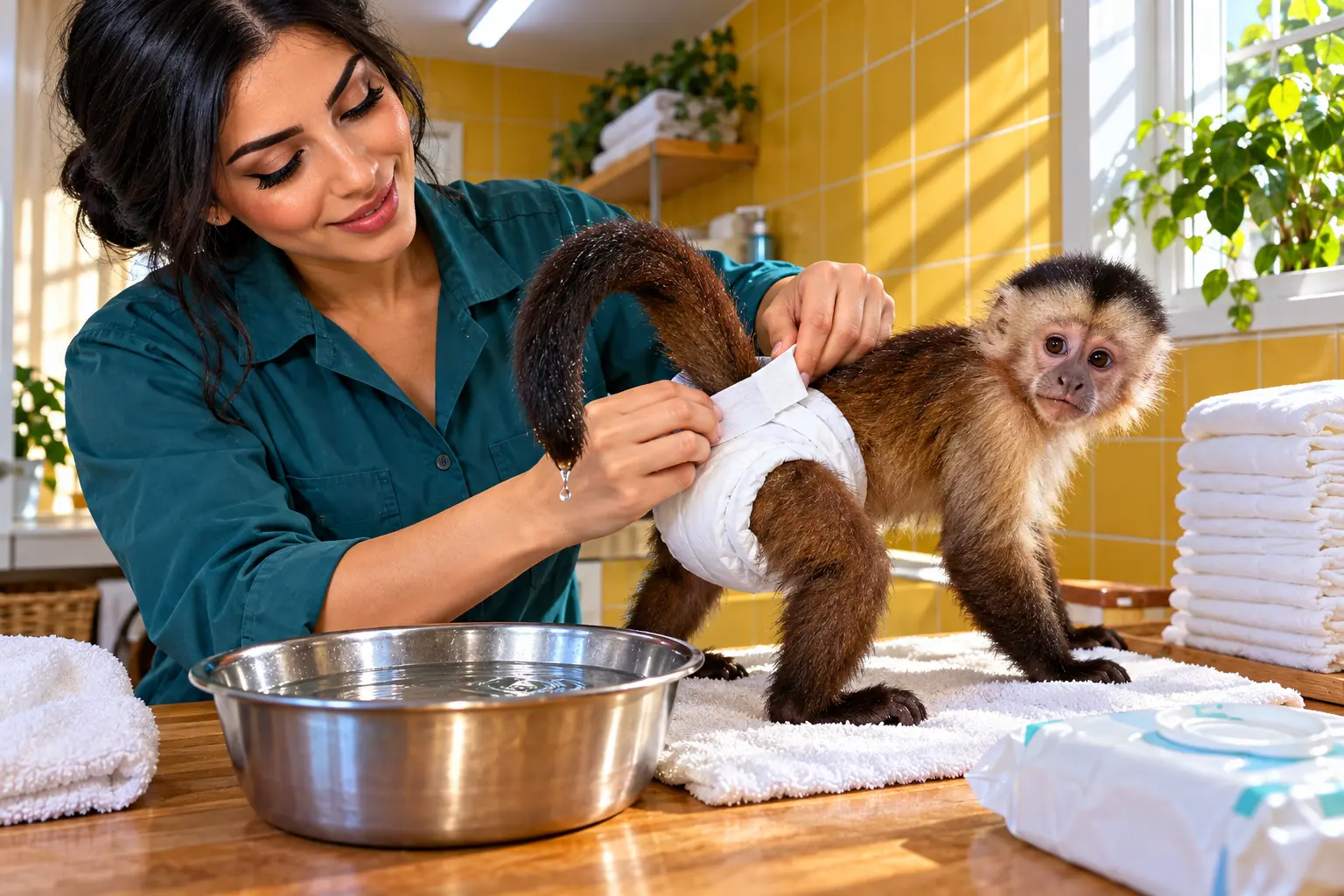
Check the fit every time. The tabs sit where the hands cannot reach them, the leg elastic is pulled out so urine does not run down the fur, and the diaper goes on backward from a human baby so the taped end is hard to peel. Once that check is habit, the next choice is which of the two tail methods you are using.
Tail Hole and Tail Wrap Methods
Among primate owners, the older approach is the tail hole, and more of them have moved to the tail wrap. A keeper guide dated March 2015, written after that author asked other owners, is the clearest lay-out of why people pick one or the other. Later home videos follow the same two patterns on capuchins and other long-tailed monkeys.
How to Put On a Tail Wrap
- Hold the monkey at the base of the tail so it cannot bolt mid-change.
- Take an infant diaper and place the end that would be the front on a baby toward the tail.
- Wrap that panel around the base of the tail, close to the body, and cross the tabs over the lower back so a small pouch sits under the tail.
- Tuck loose corners so there is nothing to grab, and pull the leg elastic out so urine stays inside.
- Add a diaper cover. Some keepers run a small pet collar through the cover loops and close it with a tiny lock.
The wrap comes off when you unsnap it, so you do not drag a dirty diaper the length of a long tail. Owners who prefer it say the pouch keeps stool off the skin and the air space cuts down on wetness. Because you never cut the diaper, gel beads stay inside instead of spilling where a monkey can eat them. The tail can still grip and climb; the wrap is a fastener, not a splint.
How Does the Tail Hole Method Compare?
Keepers who have used both methods describe the tradeoffs in practical terms, not as a lab test. The hole is a cut you make so the tail can pass through.
| Point of comparison | Tail hole | Tail wrap |
|---|---|---|
| Speed | Faster for people who already use it | Slower until the cross is a habit |
| Leak at the tail | Can leak around the cut | Owners report no leak at the tail |
| Under clothes | Less bulky and easier to hide | A visible pouch |
| Small monkeys | Keepers say it fits smaller primates better | Can look bulky on a tiny infant |
| Stuffing | A cut can spill beads | No cut, so beads stay inside |
For the hole, you cut about a third of the way along the diaper, thread the tail, and still put the diaper on in reverse while you hold the base of the tail. A stump-tailed macaque barely has a tail to thread, so the hole is not the issue; the tabs and the cover still are. Long-tailed macaques and capuchins are the animals these two methods were built around. A neat fit still fails if the skin stays wet, which is the rash problem.
Diaper Rash, Wipes, and Naked Time
A rash is a wet-skin problem, and the plain advice in that 2015 keeper guide is to leave the monkey without a diaper until the rash clears. Sealing a cream under a cover holds the moisture you are trying to get rid of.
Some keepers reach for zinc oxide products such as Triple Paste or Boudreaux’s Butt Paste. The same guide notes that zinc oxide is low in toxicity and still a danger if the monkey eats larger amounts over time. A monkey will lick whatever you spread on its skin, so naked time beats a thick coat of cream.
Scented wipes show up in those owner reports as a trigger. Warm water, or an unscented wipe such as the sensitive versions of Pampers or Huggies, then a full dry, is the routine they describe. No single diaper brand won the informal poll behind that guide. Huggies and Pampers were named several times for both methods, and some hole-method users preferred Parents Choice because the beads did not fall out of a cut.
If the monkey shreds disposables, the stuffing can block the gut. Cloth diapers are the workaround those keepers describe when a monkey will not leave a disposable alone. A cover stops some removal, and it does not stop digging, which is why a collar and a small lock through the cover loops show up in the same notes.
WHEN THE SKIN BREAKS
- Blisters or blood: Stop layering cream and call a veterinarian who treats primates.
- Hard to find: Sanctuary groups warn that a vet with real primate experience can be difficult to locate, which is one reason a house is a weak plan.
- While you wait: Keep the area clean and dry, and do not put the diaper back over broken skin.
Naked time is how the skin dries, including on days when the schedule is annoying. Put the diaper back on for the couch, the car, and any room you cannot wash. Even careful rash care assumes the diaper is a short chapter, and for most of these animals it is not.
Why Does a Monkey Still Need a Diaper?
Wild monkeys do not wear diapers. An infant is cleaned by its mother inside a group, and the group is the normal social world. The diaper exists because a monkey in a house urinates to mark and cannot be trusted on a sofa, a bed, or a guest’s lap.
Guides aimed at new owners treat the diaper like a baby-care hack you master and then outgrow. The chore is real, and it is also a sign the animal is being managed as a person. Sanctuary groups that are opposed to private ownership of primates put the mismatch in plain words.
Unlike dogs and cats, apes and monkeys are not domesticated animals. Non-human primates are extremely social animals whose normal development requires the company of others of their own kind.
North American Primate Sanctuary Alliance, position statement on private ownership
The same statement says that by the teen years, only a few years into a long life, these animals become too hard to handle. Bites follow, with strong jaws and sharp teeth, and the injuries can be serious and potentially fatal. Teeth are often removed in the pet trade so the animal is easier to hold, which also limits what it can chew. Before you stock a year of diapers, the first filter is whether you are allowed to have the monkey at all.
Can You Legally Keep a Pet Monkey?
Bringing a monkey into the United States to keep as a pet is illegal. Federal rules have said so since 1975, and they also block you from taking a pet monkey abroad and bringing it home. It is illegal to import a monkey as a pet under those rules, which cover apes, monkeys, and the offspring of an imported primate: those animals cannot be kept, sold, or passed on as pets, as a hobby, or for an occasional show to the public.
A person who breaks those import rules can be fined up to $100,000 and imprisoned for as long as a year, with a higher fine if someone dies. Organizations face higher caps. Those penalties belong to the import rules, not to a ticket for owning a monkey your state happens to allow.
Possession of a primate already inside the country is a different question. A May 28, 2025 account from the Association of Zoos and Aquariums says there is no federal law that regulates keeping primates such as lemurs, capuchins, or chimpanzees as personal pets. Your state, county, or city may ban primates, require a permit, or say very little on paper. Online lists of legal states disagree with one another, so read your state wildlife code and your city animal ordinance before you buy, breed, or travel. Where a macaque is still allowed, the health question is the next one.
B Virus Risk When You Change a Macaque
B virus lives in macaques. In primate housing, macaques are infected by the time they are adults, and they typically show no symptoms or only a mild illness. People get it from a bite, a scratch, or fluid on broken skin or in the eyes, nose, or mouth. Public health guidance on spread also places the virus in saliva, urine, and feces, which is what is on your hands during a diaper change.
Public health pages record 21 of 50 human B virus infections as fatal since the virus was identified in 1932. Infection is rare, and it can still lead to severe brain damage or death if you do not get treatment right away. Symptoms usually start within a month and can show in 3 to 7 days, first as a flu-like illness, then as small blisters where the monkey made contact. Trouble breathing and death can follow from one day to three weeks after symptoms start.
IF A MACAQUE BITES, SCRATCHES, OR SPLASHES YOU
- Eyes, nose, or mouth: Rinse with sterile saline or water, and do not wait to finish the diaper.
- Skin: Wash with povidone-iodine, chlorhexidine, or detergent soap.
- The clock: The published first aid is to rinse for 15 minutes, then tell a doctor you were exposed to a macaque that may carry B virus.
- No shot: There is no vaccine against B virus.
Other primates, including capuchins, can catch B virus from a macaque and frequently die of it. Recorded spread to people has come from macaques, not from those other species passing it on. A diaper day with a capuchin is still a bite and a hygiene problem. A diaper day with a rhesus, a long-tailed macaque, a pig-tailed macaque, or another macaque is a B virus problem on top of that. A clean change lowers one risk, and it does not meet the rest of what the animal is built for.
What Does a Macaque Need Besides a Diaper?
Pet-trade macaques include rhesus, long-tailed macaques sometimes called java macaques, pig-tailed, crested macaques sometimes called Celebes, and stump-tailed. They are group animals. One monkey in a diaper is missing the company of its own kind that sanctuary groups say normal development takes.
| Where the macaque lives | Lifespan on the NC3Rs record |
|---|---|
| In the wild | Median under 15 years, and under 5 percent reach 25 |
| In captivity | Median past 25 years, with a recorded maximum of 40 years |
That captive span is the captive macaque lifespan past 25 years figure on the NC3Rs macaque life-history page. A monkey you diaper now can still be in the house when you are planning retirement. Females can breed from about 3 or 4 years of age, the same window when sanctuaries say handling starts to fail.
Care sheets written for macaque keepers describe a base of monkey pellets plus vegetables and fruit, not a human plate of snacks. Climbing, foraging, and hours of movement are the rest of the day, and a living room does not supply them. Teeth pulled for easier handling make hard foods harder to eat on top of that. The standard is a group, a specialist vet, and a life measured in decades. Here is what to do if a monkey is already in the house anyway.
If You Already Share a House With a Monkey
If the monkey is already yours, today’s diaper schedule still applies. Do not drop the animal at a park, post it for sale on a whim, or take it through an airport. A trip out of the country can end with the animal taken away when you try to come back, even if it lived with you before the flight.
Find a veterinarian who will see a primate, and report any bite or scratch the same day using the rinse-and-wash steps above. If you cannot keep the animal, contact a primate sanctuary about surrender. Member sanctuaries are the placement those groups treat as the best case, and they are clear that many former pets never learn to live with other monkeys. An open spot is not something you can assume.
If you are still deciding whether to buy one, read that sanctuary statement before the diaper videos. A May 28, 2025 zoo-association account puts more than 15,000 nonhuman primates in the United States in poor conditions, and it notes the lack of a federal possession law. That gap is why a seller can look legitimate in one state and be illegal across the line.
Frequently Asked Questions
Can You Toilet Train a Monkey Out of Diapers?
You should not count on toilet training to retire the diaper. Homes that have kept monkeys for decades still describe daily changes, and care notes give no age when the diaper reliably stops. Time without a diaper is for dry skin, not a sign the sofa is safe.
What Size Diaper Fits a Baby Monkey?
Owner demonstrations use an ordinary infant disposable diaper. If the monkey can reach the tabs, or urine leaks at the legs, that size is wrong and you step down to a smaller infant diaper. The fit check matters more than the brand.
Should a Monkey Wear a Diaper Overnight?
Keep a diaper on overnight unless you are awake and the monkey is on a surface you can wash. Owner routines do not describe a dry night as the default. If you wake to a wet leg or a smell, change it then, because time in a soiled diaper is how rash starts.
Who Can Take a Monkey You Cannot Keep?
Call a primate sanctuary about surrender, and do not pass the animal to another private home. Sanctuary groups say former pets often have a hard time living with other monkeys, and an open spot is not guaranteed. A sale just moves the diaper and the isolation to someone else’s couch.
The change itself is a short sequence once the wrap or the hole is a habit, and the day is still built around it. A macaque that needs a clean diaper this morning can still need one decades from now, in a house that was never a group, under rules that can take the animal from you at a border. If you are shopping, stop at the sanctuary statement. If the monkey is already on your couch, keep the skin dry, keep your hands clean, and get a plan that is not another living room.
Disclaimer: This guide is educational and informational only. It is not veterinary advice, medical advice, or legal advice, and it does not say that keeping a primate is safe or lawful where you live. Talk with a veterinarian who treats primates before you change how you care for a monkey, and talk with a lawyer or your state wildlife agency before you buy, sell, transport, or surrender one. Health rules, state law, and city ordinances change, and the figures here reflect the public sources reviewed for this page.

A CubeSat Will Age Whisky That Never Comes Home

A Charity Quote Cost Shia LaBeouf the FKA twigs NDA

Looker Turned a Model’s Body Into Ad Inventory

Infinity Ward Bets a Paid DMZ Will Stick This Time

Disney Sidesteps a Kimmel Renewal as Failla Cites Losses

Southwest Preboarding: Who Qualifies and What to Do

False AI Intel Nearly Put US Crews on a Chinese Ship

How Often Do You Have to Change a Monkey’s Diaper?

Tim Cook’s $4.6 Trillion Apple Still Runs on One Phone

Dunes Air Sues Nora Fatehi Over Its Luxury Jet
-
 TRAVEL3 years ago
Southwest Preboarding: Who Qualifies and What to Do
-
 NEWS2 months ago
False AI Intel Nearly Put US Crews on a Chinese Ship
-
 ENTERTAINMENT2 months ago
Dunes Air Sues Nora Fatehi Over Its Luxury Jet
-
 LIFESTYLE3 years ago
How Long Does It Take for Armpit Hair to Grow?
-
 BUSINESS2 months ago
Tim Cook’s $4.6 Trillion Apple Still Runs on One Phone
-

 NEWS2 months ago
OpenAI Posts a Navier-Stokes Proof Clay Has Not Touched
-
 TRAVEL2 years ago
Smallest Airlines in the US: Niche Carriers and Unique Flights
-

 SPORTS3 years ago
Is Marching Band a Sport?