
BUSINESS
Al-Zara Collapse Kills 82 Miners in an RSF Gold Field
An informal gold mine collapse in RSF-held West Kordofan killed 82 miners, while the metal they dug still moves toward Dubai.

Rescuers pulled 82 bodies from the al-Zara gold mine in Sudan’s West Kordofan by the afternoon of September 16, 2026. Dozens of miners were still missing. The pit sits in country held by the Rapid Support Forces, the paramilitary group fighting Sudan’s army since April 2023, and the metal taken from shafts like these is what pays for that fight.
Suleiman Abu Hmeida of the Emergency Response Rooms, a volunteer network that tracks the war and helps civilians, said the 82 were on the ground by Wednesday afternoon. “But dozens remain unaccounted for,” he said. A local official, speaking without permission to use his name, gave the same recovered count.
One Forklift Against Shafts Deeper Than 30 Metres
The official said the first shaft failed on Sunday, September 13, then dragged down the linked wells beside it. Survivors reached by phone, and the Sudan Doctors Network, a medical group that logs war casualties, placed the main cave-in on Tuesday evening, September 15. Both accounts describe the same informal site in the Fouja area, northwest of Nuhud, on a strip of weak sandy ground more than 1 km long.
Only one privately owned forklift was on hand for the search. Khairal-Sayed Gabara, a miner who lived through the fall, said crews were trying to move soil and stone with the tools they already used to dig ore.
WHAT WE KNOW
- Recovered dead: 82 bodies were on the surface by the afternoon of September 16, after 60 came out in the morning and 22 later that day.
- Injured: An RSF administrator in the area, also unnamed, put the wounded at 50 and said an unknown number were still under the rubble.
- The site: Al-Zara is an informal pit with no basic safety gear, according to the Sudan Doctors Network, in RSF-held West Kordofan.
WHAT IS UNCONFIRMED
- The start: Officials describe a Sunday failure that spread; survivors describe a Tuesday evening collapse.
- Who is still below: Abu Hmeida said dozens were unaccounted for. No specialised rescue team had arrived, the Kordofan Observatory said.
- Anyone left alive: The Observatory, citing witnesses, said a survivor came up on Tuesday and reported others still breathing underground. That claim was not independently confirmed.
Video of the sandy workings moved across Sudanese timelines while the public count was still in the sixties. The men on those clips had gone out for wages. They were not a unit on a front. By September 17, public tallies had not moved past 82 recovered bodies.
Adjoining Wells Pulled Each Other Down
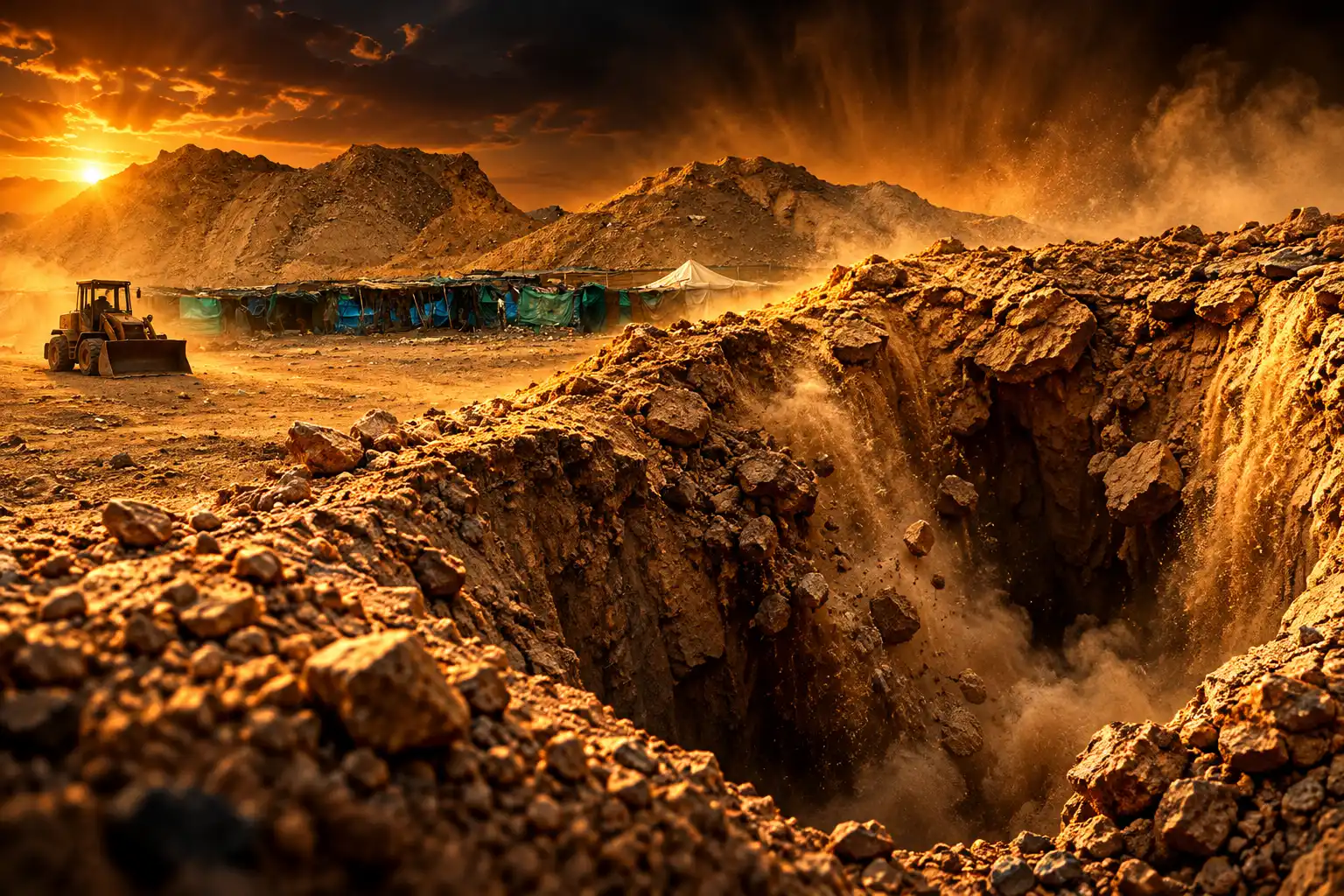
Amin Suleiman, another miner on the site, said the shafts sat so close that when one failed it took the next with it. The Observatory described a chain of adjoining wells rather than a single hole. That layout is common in Sudan’s informal fields, where crews chase a seam with hand tools and timber, then sink the next well a few metres away.
We do not have the machinery to lift dirt and stones and search for survivors at depths of more than 30 metres (98 feet). There were dozens of people working in the mine.
Khairal-Sayed Gabara, miner, reached by phone
Gabara said the collapse was huge and the situation very bad. The Doctors Network had logged 67 bodies earlier on September 16 and warned the number would rise. It called the deaths the product of neglect at a site that employed unregulated labour with no protective kit. The Observatory said residents were digging with ordinary tools in loose sand, and that no trained rescue crew had joined them.
West Kordofan has been inside the RSF’s map of the war for more than three years. Gold from Darfur and Kordofan is a known revenue line for the group, according to experts commissioned by the United Nations. The same war that makes that metal valuable also stripped the district of the pumps, shoring, and machines that keep a deep well from becoming a grave.
A Gold Sector Built on Informal Shafts
Sudan is one of Africa’s large gold producers. Most of the metal does not come from industrial plants. SWISSAID, in its African Gold Report country file, found that informal and small-scale mining made up 91.5 percent of total declared production in 2024. Official books put declared output that year at 64 tonnes after a slump when fighting started. SWISSAID’s own range for what the country actually yields is 70 to 90 tonnes a year.
The Sudanese Ministry of Minerals has put employment in the gold sector at 2 million people. A Minamata Convention assessment cited in the same SWISSAID file counted 44,296 mining wells across 244 sites in 14 of Sudan’s 18 states. Those wells are the country’s export engine. They are also where the dead at al-Zara were working.
SUDAN GOLD ON THE BOOKS
| Measure | Figure | Recorded by |
|---|---|---|
| Declared production in 2024 | 64 tonnes | Official series compiled by SWISSAID |
| Estimated true output | 70 to 90 tonnes a year | SWISSAID |
| RSF-area gold in 2024 | 10 tonnes ($860 million) | UN panel of experts |
| Gold smuggled from 2012 to 2024 | at least 400 tonnes | SWISSAID |
SWISSAID also holds that 50 to 70 percent of Sudan’s gold leaves the country outside official channels each year. Since April 2023, official production figures have excluded output from RSF-held ground, so the 64-tonne line is a partial count. The UN panel’s 10-tonne figure for RSF areas in 2024 is disputed, in part because the old Jebel Amer field in North Darfur has faded. Even at that lower number, the metal is worth more than most of the districts that dig it will ever see in machines or clinics.
The Buyers Sit in Dubai, Not Nuhud
Almost all of Sudan’s declared gold, and a large share of the undeclared stream, is sold into the United Arab Emirates. SWISSAID, using UN Comtrade releases later pulled from the public database, recorded 29 tonnes of gold directly from Sudan into the UAE in 2024, up from 17 tonnes in 2023. The same note logged 27 tonnes from Egypt, 18 tonnes from Chad, and 9 tonnes from Libya. Chad and Libya, SWISSAID said, function as exit points for metal under RSF control.
The UAE imported 748 tonnes of African gold in 2024. Marc Ummel, who leads SWISSAID’s raw-materials unit, called the Sudanese flows conflict gold and said both the RSF and the Sudanese Armed Forces fund their fighting with the trade. Between 2012 and 2022, SWISSAID had already estimated that the UAE took in 2,569 tonnes of illegal African gold, worth about $115 billion.
The UK government, in a July 16, 2026 notice, said official Sudanese gold exports were worth $1.5 billion in 2024 and again in 2025, and that the true value of the sector is several times higher because of smuggling. The metal is processed through concession firms, small smelters, and paper that strips the Sudanese origin before the bars hit Dubai. None of that chain stations a pump at Fouja.
Al-Zara’s ore was never going to pay for a second forklift. The point of an informal well in RSF country is to move gold out, cheaply, through men who can be replaced. That is why a collapse of this size can still meet a search party armed with hand tools.
How the RSF Takes a Cut From West Kordofan Mines
Ahmed Soliman of Chatham House and Suliman Baldo of the Sudan Policy and Transparency Tracker wrote that the war split the gold map: the army holds mines in Red Sea, Northern, River Nile, and South Kordofan states, with the RSF over mining areas in Darfur and West Kordofan. Production in RSF zones has stayed mostly informal. The researchers describe three ways the group extracts value from that ground.
RSF GOLD, THREE CUTS
- Own mining: Direct digging and waste treatment through the Dagalo family’s Al-Junaid companies at fields such as Songo in South Darfur, Jebel Amer in North Darfur, and Talodi in South Kordofan.
- Forced trade: Protection that obliges informal miners to sell through RSF channels rather than open markets.
- Unit-level digging: Individual RSF units mining and extorting on smaller plots where they can.
Routes run overland from Darfur through Chad toward N’Djamena and then by air to the UAE, with a second path through South Sudan. The UK package named Abu Dharr Abdul Nabi Habiballa Ahmmed as an RSF financier suspected of moving money and conflict gold through Dubai real estate and holding firms. It also listed Sudanese companies in the UAE used, the notice said, for procurement and logistics.
Army-held ground has its own gold companies. The same UK list named Omdurman Mining, Ariab Mining, and Sudamin as state firms suspected of feeding army revenues, with Sudamin also tied in the past to Al-Junaid. Both sides sell. Al-Zara happens to sit on the RSF side of that split, which is why the only heavy machine anyone could find was private, and why no state rescue unit appeared.
The Record of Collapses Since 2021
Deadly cave-ins are a known feature of Sudanese informal mining, not a one-off of the war. Safety rules are rarely applied. Shafts go deep, timber is light, and neighbouring wells share the same weak sand. Al-Zara is one of thousands of small sites scattered across the country.
RECENT SHAFT FAILURES
- 2021: A collapse killed 38 miners.
- 2023: Another failure killed 14.
- June 2025: The Sudanese Mineral Resources Company said 11 died at an artisanal shaft at the Kirsh al-Fil mine near Howeid, in Red Sea state, after the firm had already warned against work there.
- January 2026: The Sudan Doctors Network said 6 miners died and 12 were hurt when a pit failed at Abu Jubaiha in South Kordofan, with others still unaccounted for at the time of its statement.
The 2025 Red Sea failure was in army-held ground. The January 2026 South Kordofan pit was not al-Zara, but it was the same labour: informal crews, no rescue bench, a death count that moved as bodies came up. Al-Zara is larger. It is also the first of these recent cave-ins to land in a well-documented RSF gold belt with a public fight already underway over who buys the bars.
Armed Conflict Location and Event Data has counted at least 59,000 people killed in the wider war. That ledger does not include men buried in a well that was never registered. The Doctors Network asked those who control the ground to stop unregulated mining. Control, in West Kordofan, means the RSF, and the RSF’s interest in these pits is the gold, not the shoring.
London and Brussels Target the Gold Bars
Two months before al-Zara failed, Western governments moved against the metal, not the shafts. On July 13, 2026, the EU Council adopted a ban on gold originating in Sudan that had been exported after July 15, 2026. It also banned the sale of mercury and sodium cyanide to Sudan, the chemicals used to pull gold from ore, with carve-outs for humanitarian and public-health use. Related brokering and finance were caught too.
The next day, the UK announced sanctions on Sudan’s illicit gold networks, naming 11 people and firms that trade through Dubai and Hong Kong. Foreign Secretary Yvette Cooper tied the measures to the war chests on both sides and to the RSF build-up around El Obeid. Illicit gold, the notice said, would be a theme of a London finance summit in December 2026.
The people of Sudan continue to pay the price for a war fuelled not only by guns and fighters, but by illicit flows of gold and finance to fill the war chests on both sides. These sanctions are targeting Sudan’s war economy and they will shine a light on those who seek to profit from these illegal shadow networks.
Yvette Cooper, UK foreign secretary, July 16, 2026 government notice
A bar in Dubai does not carry the name of the well it came from. Origin is a paper trail, and Sudanese gold has been leaving through Chad, Libya, Egypt, and South Sudan for years. An EU import ban and a UK list of financiers can squeeze some of those desks. They do not put a second machine at Fouja, and they do not stop a crew from sinking the next well a few metres from the last one.
On September 16, the only machine at al-Zara was that private forklift. Gabara had already said it could not reach men more than 30 metres down. Dozens of miners were still unaccounted for.

A CubeSat Will Age Whisky That Never Comes Home

A Charity Quote Cost Shia LaBeouf the FKA twigs NDA

Looker Turned a Model’s Body Into Ad Inventory

Infinity Ward Bets a Paid DMZ Will Stick This Time

Disney Sidesteps a Kimmel Renewal as Failla Cites Losses

How to Get Pre Boarding on Southwest – Skip the Line with These Tricks

False AI Intel Nearly Put US Crews on a Chinese Ship

Tim Cook’s $4.6 Trillion Apple Still Runs on One Phone

OpenAI Posts a Navier-Stokes Proof Clay Has Not Touched

Dunes Air Sues Nora Fatehi Over Its Luxury Jet
-
 TRAVEL3 years ago
How to Get Pre Boarding on Southwest – Skip the Line with These Tricks
-
 NEWS1 month ago
False AI Intel Nearly Put US Crews on a Chinese Ship
-
 BUSINESS2 months ago
Tim Cook’s $4.6 Trillion Apple Still Runs on One Phone
-
 NEWS2 months ago
OpenAI Posts a Navier-Stokes Proof Clay Has Not Touched
-
 ENTERTAINMENT2 months ago
Dunes Air Sues Nora Fatehi Over Its Luxury Jet
-

 LIFESTYLE3 years ago
How Often Do You Have to Change a Monkey’s Diaper? The Truth About Pet Monkeys
-

 NEWS2 months ago
Australia Treats Cloud Software Payments as Taxable Royalties
-

 LIFESTYLE3 years ago
How Long Does It Take for Armpit Hair to Grow? The Stages of Hair Growth and How to Shave It