
BUSINESS
The Iran Energy Shock Hits the Bypass Around Hormuz
The Iran energy shock has moved from the Strait of Hormuz onto Saudi Arabia’s East-West bypass, squeezing diesel, LNG and oil demand.

Saudi Arabia’s East-West oil pipeline, the main wartime detour around the Strait of Hormuz, was shut after drone strikes on its pumping stations in mid-September. The Iran energy shock that began on February 28, 2026 has now reached the bypass built to survive it.
North Sea Dated crude reached $113.48 a barrel on September 9, the International Energy Agency said. ICE Brent later traded near $105, 45 percent above pre-war levels.
The Bypass That Kept Gulf Oil Moving
When the United States and Israel opened the war, Iran answered by threatening and hitting ships in the Strait of Hormuz, the only sea door out of the Persian Gulf. Insurers pulled back. Crews refused the run. For months the market’s working answer was overland pipe, not open water.
The U.S. Energy Information Administration describes Saudi Arabia’s 7 million-barrel-a-day East-West pipeline as the wartime reroute to Yanbu on the Red Sea, with about 5 million barrels a day of that capacity free for export. The UAE used the Habshan-Fujairah line, rated at 1.8 million barrels a day, to dump crude into the Gulf of Oman outside Hormuz.
Those two exits, plus a few other overland routes, were why crude never went to the $200 calls that circulated in March. They were also why the next round of strikes did not have to close Hormuz again to hurt. They only had to hit the spare door.
THE WAR THAT ATE THE BYPASS
- February 28, 2026: The United States and Israel begin military operations against Iran.
- March 4, 2026: Iranian forces declare the Strait of Hormuz closed and attack ships trying to transit.
- March 11, 2026: IEA members announce a collective release of emergency oil stocks.
- April 13, 2026: Washington imposes a naval blockade on Iranian oil.
- June 17, 2026: The United States and Iran sign a memorandum of understanding aimed at reopening the strait.
- July 14, 2026: The United States reinstates the blockade after the deal frays.
- September 10, 2026: Drones hit pumping stations on the East-West pipeline; Yanbu loadings later halt.
- September 14, 2026: Planned Iran-GCC talks on Hormuz are delayed after the pipeline attack.
Masha Kotkin, a fellow in energy security at the Center for Strategic and International Studies, wrote on September 18 that the war is in its seventh month. In the days around the pipeline hits, she wrote, Iran attacked 10 tankers near the strait, the United States destroyed five Iranian tankers, and Iran then targeted U.S. military sites in Jordan and Kuwait.
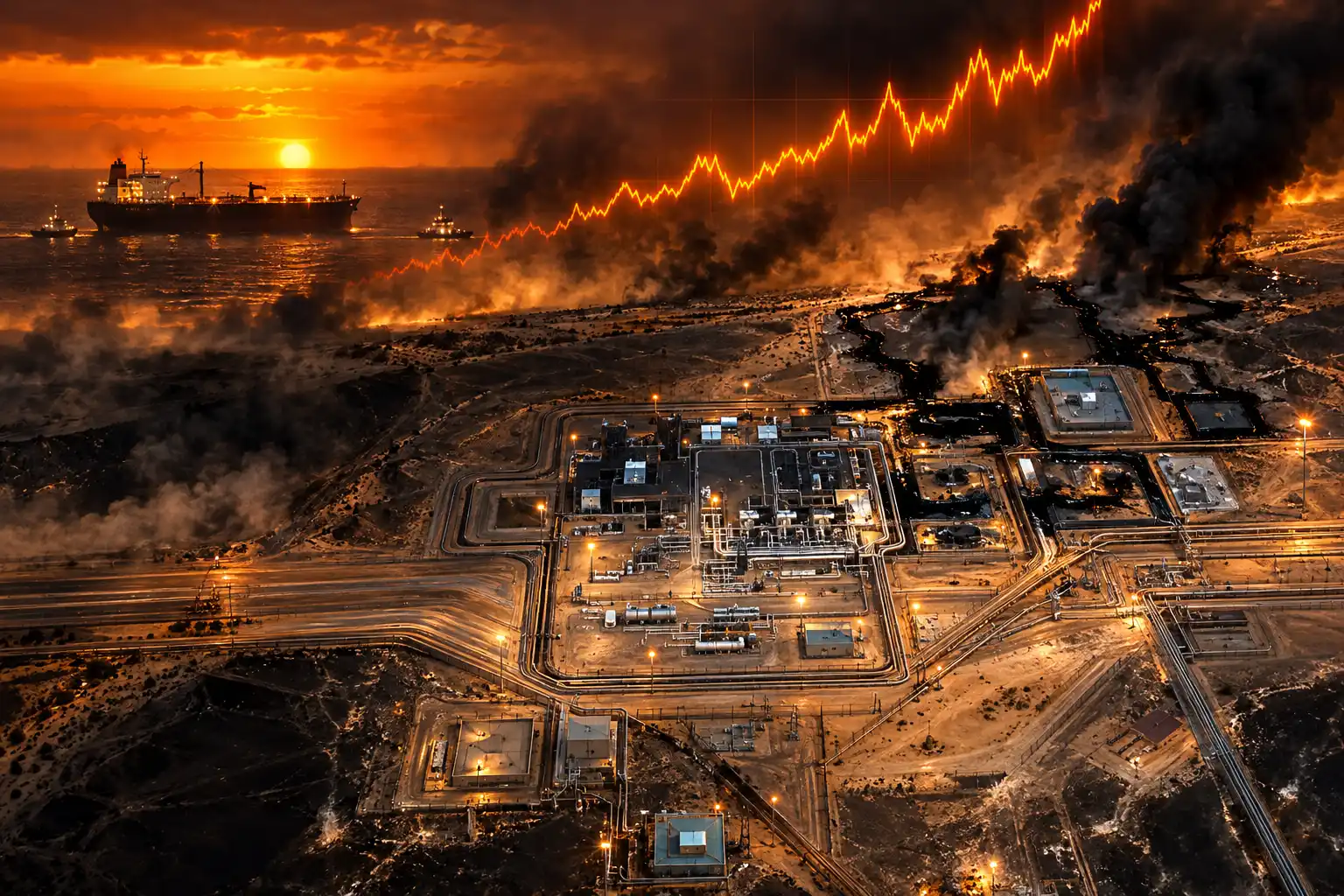
Hormuz Still Carries Far Less Than Before
The waterway did not go to zero for the whole war. U.S. escorts, dark transits and ship-to-ship reloads in the Gulf of Oman put some crude back on the water. That recovery is still a long way from the old load.
Toril Bosoni, head of the IEA’s oil industry and markets division, wrote on September 18 that 7.6 million barrels a day through Hormuz was the August average, 7.6 million barrels a day against a pre-war run rate 13.1 million barrels a day higher, or about 20.7 million. Cumulative export losses on that route were approaching 2.8 billion barrels.
GULF OIL AFTER SIX MONTHS
| Flow | August 2026 | Benchmark |
|---|---|---|
| Oil through Hormuz | 7.6 million b/d | 13.1 million b/d below pre-war |
| Yanbu and Fujairah bypass | 5.5 million b/d | 7.8 million b/d in June |
| Total Gulf oil exports | 13 million b/d | nearly half the pre-war level |
| Gulf diesel/gasoil net exports | 390,000 b/d | just over a quarter of pre-war |
U.S. Energy Secretary Chris Wright has said restored flows were “probably two-thirds or more of preconflict flows.” That figure is a blended recovery, escorts plus pipes plus shuttles. It is not the Hormuz waterway, which in August was running at roughly a third of its old volume. Adding Hormuz, the Red Sea and Yanbu into one 30-million-barrel hole also double-counts the same Saudi barrels. The IEA’s 13 million barrels a day of Gulf exports already nets the overlap, and it is still about half the pre-war Gulf total.
Bypass volumes from Yanbu and Fujairah rose from 4.1 million barrels a day in February to 7.8 million in June, then fell back to 5.5 million in August after Houthi attacks in the Red Sea. The IEA said those extra bypass barrels had offset more than 500 million barrels, about 2.8 million barrels a day, until the East-West line was shut in early September.
Houthi forces also claimed Perim Island and the Hanish Islands, tightening the Bab al-Mandab, the Red Sea gate Saudi and UAE cargoes have used since Hormuz seized up. Kotkin noted strikes on Abha, Jazan, Najran and Khamis Mushait that injured 73 people and again damaged a 400,000-barrel-a-day refining plant already hit in July and August.
Diesel Is the Shortage the Crude Tape Hides
Crude is the headline. Middle distillates are the pinch. Diesel, gasoil and jet are what trucks, farms, mines and airlines actually burn, and the Gulf is where a large share of the seaborne surplus used to come from.
THE TIGHT END OF THE BARREL
- U.S. diesel: Prices moved above $200 a barrel in early September, 94 percent above pre-war levels, the IEA said in its September Oil Market Report.
- Gulf diesel exports: Net diesel and gasoil shipments from Gulf countries averaged 390,000 barrels a day in August, just over a quarter of the pre-war level.
- Products versus crude: Refined products and LPG exports from the Gulf were still nearly 60 percent, or 3.7 million barrels a day, below February.
- Russia on top: Combined Gulf and Russian net diesel exports in August were 1.6 million barrels a day lower than in February, after Ukrainian strikes hit Russian plants.
The same U.S. diesel above $200 a barrel print sat beside ICE Brent near $105. That gap is the story inside the story. Atlantic Basin refining margins hit records in August on diesel cracks, while freight ate Singapore’s edge. Global refinery runs still reached 81.4 million barrels a day in August, 4.2 million lower than a year earlier.
West-coast Saudi plants at Yanbu feed Europe with gasoil, diesel and jet. When the East-West pumps stop, those plants lose feedstock even if Ras Tanura can still load crude onto shuttles for Asia. A crude barrel that finds a new jetty does not automatically become a diesel barrel in Rotterdam.
Qatar’s LNG Has No Road Around Hormuz
Crude had pipes. Qatar’s gas does not. Every cargo from Ras Laffan has to leave through Hormuz, and LNG is a poor candidate for the shuttle-and-reload trick oil traders have used off Oman.
THE QATAR BIND
- The cargo count: Qatar shipped 18 cargoes of LNG in the first six months of the war, against 509 in the same stretch of 2025, Kotkin wrote, citing the collapse in loadings.
- The old pace: About three LNG cargoes a day used to exit Hormuz, and Qatar supplied about a fifth of seaborne LNG.
- The reload problem: Ship-to-ship LNG transfers off Oman have been spotted only in ones and twos, while oil shuttles now move millions of barrels a day.
- The calendar: A few tankers pushed through in mid-September, including at least two Hormuz transits, with northern winter demand still ahead.
Oil can sit in a tank or on a dark VLCC for weeks. LNG cannot be stored that way at the same scale, and buyers in Asia and Europe are bidding for cargoes that never have to see the Gulf. Qatar has cut operating expenses by 30 percent, Kotkin wrote, while Saudi Arabia has gone to external borrowing and Kuwait has drawn on its sovereign fund.
Iran’s own barrels are not filling the hole. Kpler put August loadings near 260,000 barrels a day, against 1.7 million in August 2025. The IEA’s monthly table had Iranian supply at 2.16 million barrels a day in August, down from 2.72 million in July, while Saudi supply in the same survey dropped from 8.24 million to 5.97 million.
Demand Is Cutting Faster Than New Supply Can Grow
The reason crude is not at the March panic prints is not that 20 million Hormuz barrels came back. A lot of demand left the room. Bosoni’s team estimates global oil use over the past six months ran 5.8 million barrels a day below February, a cumulative cut of more than 1 billion barrels.
If Gulf supplies remain constrained in the coming months and commercial inventory buffers continue to deplete rapidly, higher prices and further demand reductions may be required to close the supply-demand gap.
Toril Bosoni, Head of Oil Industry and Markets Division, IEA commentary, September 18, 2026
China did the heaviest lifting. Apparent Chinese demand over those six months ran 1.7 million barrels a day below February and 1.1 million below the same period a year earlier. Seaborne crude imports into China fell from 11.5 million barrels a day in February to 6 million in June, which eased the scramble for other Asian buyers.
World demand fell 5.3 million barrels a day year on year in the second quarter, the first quarterly drop since Covid. Gasoil accounted for 1.2 million barrels of that decline, with naphtha, LPG and ethane together down 1.8 million. For 2026 as a whole the IEA now sees a drop of 2.5 million barrels a day, 940,000 a day steeper than its August report, with the Middle East and Asia carrying 80 percent of the loss. It sees a 2.6 million rebound in 2027.
Producers outside the Gulf added a cumulative 420 million barrels, about 2.3 million barrels a day, between February and August. The named gains were the United States at 520,000 barrels a day, Brazil at 470,000, Kazakhstan at 440,000, Venezuela at 300,000 and Nigeria at 200,000. That is a real offset. It is not 13.1 million barrels a day of missing Hormuz crude.
Even after those extra barrels and the demand hit, observed inventories still drew at 2.8 million barrels a day over six months. Stocks are 507 million barrels below the start of the war. IEA member governments have released more than 300 million barrels from the March 11 collective action. August alone took another 95 million barrels out of tanks, a 3.1-million-barrel-a-day draw, with oil on water down 65 million barrels after fresh attacks on tankers.
What Happens If Yanbu Stays Dark?
Kpler analyst Homayoun Falakshahi puts the base case at four to six weeks to repair the pumps and a return at about half the old rate, which would cut Yanbu exports by 2.5 to 2.7 million barrels a day if west-coast refineries get first claim on remaining crude. Satellite pictures of welders laying pipe around a smashed station match his note that Aramco is already building a bypass around the damaged pump house.
The line itself, he wrote, looks largely intact. The binding constraint is pumping kit and spare parts in a war zone. Before the strikes the Petroline was moving about 5.4 to 5.5 million barrels a day. Yanbu inventories sat near 9 million barrels, about three days of loadings, with another 16.5 million barrels at west-coast refineries, about nine days of runs.
KPLER’S THREE PATHS
- Base case, 50 percent: Pumps take up to six weeks, throughput comes back near half, and Yanbu exports fall 2.5 to 2.7 million barrels a day if domestic plants are fed first.
- Relief, 30 percent: A temporary pipe around the station restores full throughput in about 10 days, as in an April patch, and Red Sea loadings hold.
- Escalation, 20 percent: Repeated hits keep the line down for months, west-coast cover runs out, and Dubai premiums and Brent lurch higher until Washington eases the Iranian blockade.
Saudi loadings from Persian Gulf ports were already rising, to 2.46 million barrels a day month-to-date in Kpler’s tally, with Hormuz transits that skip ship-to-ship still only around 600,000 barrels a day. Moving 3 million barrels a day of Yanbu crude out through Ras Tanura would need about 25 extra VLCCs a month in the shuttle fleet. Bahri has the ships. The constraint Falakshahi flags is how much more Hormuz exposure Riyadh will accept, because every extra shuttle is another hull inside Iranian range.
September-to-date Yanbu loadings had actually risen to 3.6 million barrels a day, including a couple of cargoes after the attack. That bounce lives on tank inventory. It dies when the 9 million barrels at the terminal are gone.
Iran-GCC Talks Slip After the Pipeline Hits
Gulf governments had planned to sit down with Iran on September 14 about the strait. Those talks slipped after the Yanbu hits. Kotkin’s reading is that the longer the war runs, the more U.S. partners in the region will try to cut their own deal to protect export revenue, even if that deal leaves Washington’s terms on the table.
The European Central Bank, the U.S. Federal Reserve and the Bank of Japan have each raised rates by 25 basis points, she wrote, citing fuel inflation from the conflict. That is the second-round bill: dearer diesel becomes dearer credit. Global oil supply is now seen averaging 100.7 million barrels a day in 2026, down 5.7 million, with more than 10 million barrels a day of Gulf output still shut in during August, when world production fell to 100.1 million.
A few LNG hulls and a welded bypass will not refill a 507-million-barrel hole. IEA members have already poured more than 300 million barrels of emergency stock into the gap, and commercial tanks are still falling. The next lost pumping station has no second bypass behind it.
Disclaimer: This article is news reporting and analysis of energy markets and is for information only. It does not constitute investment, trading, or financial advice, and it should not be used on its own to buy or sell oil, fuel, tanker shares, or related contracts. Readers should consult a licensed financial adviser or an energy-risk professional before acting on prices or supply figures. Flows, prices, and official tallies change as fighting and shipping change, and the numbers here reflect the named agency and company sources as they were published.

A CubeSat Will Age Whisky That Never Comes Home

A Charity Quote Cost Shia LaBeouf the FKA twigs NDA

Looker Turned a Model’s Body Into Ad Inventory

Infinity Ward Bets a Paid DMZ Will Stick This Time

Disney Sidesteps a Kimmel Renewal as Failla Cites Losses

How to Get Pre Boarding on Southwest – Skip the Line with These Tricks

False AI Intel Nearly Put US Crews on a Chinese Ship

Tim Cook’s $4.6 Trillion Apple Still Runs on One Phone

OpenAI Posts a Navier-Stokes Proof Clay Has Not Touched

Dunes Air Sues Nora Fatehi Over Its Luxury Jet
-
 TRAVEL3 years ago
How to Get Pre Boarding on Southwest – Skip the Line with These Tricks
-
 NEWS1 month ago
False AI Intel Nearly Put US Crews on a Chinese Ship
-
 BUSINESS2 months ago
Tim Cook’s $4.6 Trillion Apple Still Runs on One Phone
-
 NEWS2 months ago
OpenAI Posts a Navier-Stokes Proof Clay Has Not Touched
-
 ENTERTAINMENT2 months ago
Dunes Air Sues Nora Fatehi Over Its Luxury Jet
-

 LIFESTYLE3 years ago
How Often Do You Have to Change a Monkey’s Diaper? The Truth About Pet Monkeys
-

 NEWS2 months ago
Australia Treats Cloud Software Payments as Taxable Royalties
-

 LIFESTYLE3 years ago
How Long Does It Take for Armpit Hair to Grow? The Stages of Hair Growth and How to Shave It