
BUSINESS
Old NSE Shareholders Cash Out as the IPO Closes 5.71 Times
SBI, Temasek and state insurers cash out as NSE’s Rs 22,569 crore IPO closes 5.71 times, with the exchange raising nothing and listing on BSE.

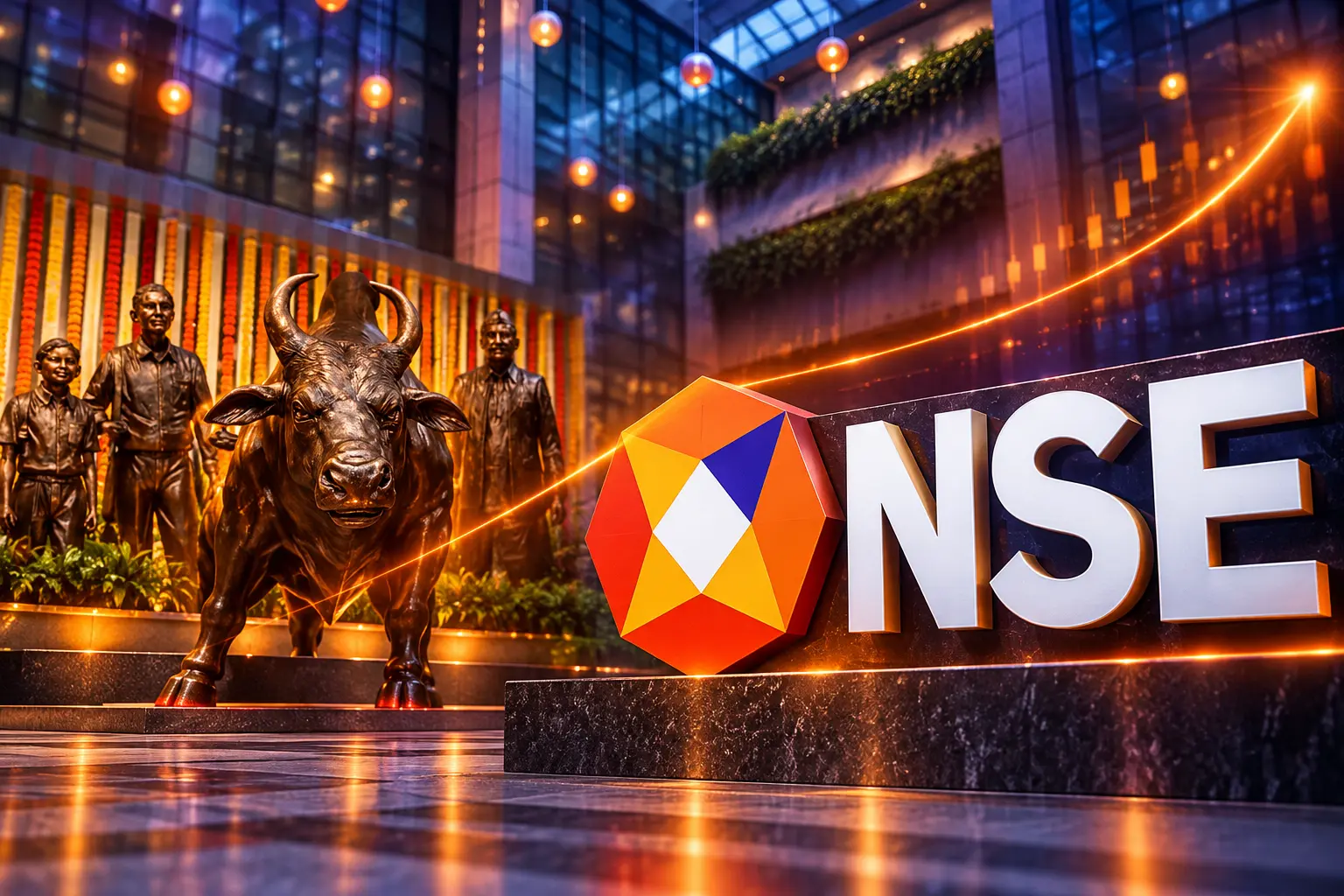
The National Stock Exchange of India closed its Rs 22,568.94 crore IPO on September 21 at 5.71 times, with qualified institutions carrying the book. Shares are due to list on BSE on September 24, ending a run that began with a draft filing in December 2016.
The issue is a pure offer for sale, so NSE itself receives no money. State Bank of India, Temasek’s Aranda unit, Canada Pension Plan Investment Board and New India Assurance are among the sellers, several of them unloading stock bought for less than a rupee.
SBI’s 80-Paise Shares Finally Get a Public Price
At the top of the price band of Rs 1,700 to Rs 1,785, the sale is worth Rs 22,568.94 crore, about $2.4 billion, India’s second-largest IPO after Hyundai Motor India’s Rs 27,870 crore issue in 2024. Existing holders are selling up to 126,436,650 shares, about 5.1% of equity. NSE issues no new stock and keeps none of the cash.
SBI is the largest named seller, offering up to 1,59,69,410 shares whose weighted average cost is Rs 0.80. At Rs 1,785 that stake is worth about Rs 2,850 crore, roughly 2,230 times cost. New India Assurance is selling 1.05 crore shares bought at Rs 0.32, about 5,580 times cost, for roughly Rs 1,874 crore.
Canada’s pension board is selling 1,18,74,060 shares bought at Rs 324.13, a more ordinary 5.5 times, for about Rs 2,120 crore. Aranda Investments, the Temasek vehicle, is selling 1,12,46,336 shares bought at Rs 62.38, about 29 times, for about Rs 2,007 crore. MS Strategic of Mauritius is selling 1.10 crore shares bought at Rs 66.54 for about Rs 1,964 crore.
THE SELLING SHAREHOLDERS AT RS 1,785
| Seller | Shares on sale | Average cost | Proceeds at Rs 1,785 |
|---|---|---|---|
| State Bank of India | 1.60 crore | Rs 0.80 | Rs 2,850 crore |
| Canada Pension Plan Investment Board | 1.19 crore | Rs 324.13 | Rs 2,120 crore |
| Aranda Investments (Temasek) | 1.12 crore | Rs 62.38 | Rs 2,007 crore |
| MS Strategic (Mauritius) | 1.10 crore | Rs 66.54 | Rs 1,964 crore |
| New India Assurance | 1.05 crore | Rs 0.32 | Rs 1,874 crore |
Life Insurance Corporation of India, the largest holder at 10.72% with 26.5275 crore shares, is not selling. LIC then showed up in the anchor book on September 16, when 189 investors took 37,793,739 shares for Rs 6,746 crore at Rs 1,785. Goldman Sachs, Fidelity, GIC Singapore, Abu Dhabi Investment Authority and Norges Bank were also in that group. The largest owner is cashing a different bet: stay on the register, then buy more before the open.
Eight holders cut the offer from 14.89 crore shares in the June draft to 12.64 crore in the final papers, a reduction of about 15%. Some of that looks like a wager that the listed stock will print higher than Rs 1,785. Unlisted deals had been nearer Rs 1,900 before the band was set.
Qualified Buyers Covered Their Slice 12.68 Times
Final exchange data showed bids for 505.81 million shares against 88.64 million in the public offer, or 5.71 times. Qualified institutional buyers took 12.68 times their 25.21 million reserved shares, with bids for 319.72 million. Foreign portfolio investors were the biggest slice of that book, bidding for 140.32 million shares.
Non-institutional buyers came in at 6.55 times, with 123.72 million shares bid against 18.90 million on offer. Bids above Rs 10 lakh were 7.78 times; the Rs 2 lakh to Rs 10 lakh slice was 4.09 times. Retail, which had not fully covered in the first two sessions, closed at 1.39 times, with 61.31 million shares bid against 44.10 million reserved. The employee portion was about 2.40 times, with a Rs 170 discount off the issue price.
THE FINAL BOOK
| Category | Shares reserved (million) | Shares bid (million) | Times |
|---|---|---|---|
| Qualified institutions | 25.21 | 319.72 | 12.68 |
| Non-institutional | 18.90 | 123.72 | 6.55 |
| Retail | 44.10 | 61.31 | 1.39 |
| Total public offer | 88.64 | 505.81 | 5.71 |
A 5.71-times headline on India’s second-largest IPO still hides a retail book that only crossed once on the last day. Prime Database put NSE’s retail bids third among Indian IPOs, behind Reliance Power and LG Electronics, which is a lot of applications on a Rs 14,280 lot and still not a frenzy. At 5:02 p.m. on September 21, bids including anchors had already reached Rs 96,476 crore ($10.07 billion) at the top of the band; the close multiple is the public book of 505.81 million shares.
Part of the retail pause is a bad comparison that spread widely while the issue was open: BSE’s share price near Rs 3,250 set against NSE at Rs 1,785, as if those two numbers were the same kind of object. They are not. NSE is several times BSE’s revenue and profit, and the Rs 1,785 price is a claim on a company valued at about Rs 4.42 lakh crore, not a like-for-like against BSE’s per-share quote. A grey-market premium that had been above Rs 200 earlier in the sale was down to about Rs 55 by the close, roughly 3% over Rs 1,785, which is thin pay for blocking Rs 14,280.
How a 2015 Whistleblower Froze the IPO for a Decade
NSE first asked SEBI for a listing in October 2016 and filed a draft in December that year. The file sat there because a 2015 whistleblower said some brokers got a faster look at NSE’s systems through co-location, the paid racks inside the exchange that cut the time to see prices and send orders.
SEBI later said the tick-by-tick data setup could be gamed if a firm logged in early to certain servers. A second probe looked at high-speed “dark fibre” lines leased to some members. Chitra Ramkrishna, then managing director, resigned on December 2, 2016. A 2022 SEBI order went after her sharing of inside information with an unnamed person and the appointment of Anand Subramanian. Criminal proceedings against former officials continue on a separate track, including a Delhi High Court ruling on the co-location case in July 2026 that allowed the corruption trial to proceed.
THE ROAD FROM CO-LOCATION TO A LISTING DATE
- 2009: NSE opens co-location, letting members put servers inside the exchange for a fee.
- 2015: A whistleblower alleges preferential access through those racks.
- December 2016: NSE files its first draft offer; Ramkrishna resigns the same month.
- April 2019: SEBI orders NSE to give up Rs 624.89 crore plus interest and bars market access for six months.
- January 2023: The Securities Appellate Tribunal sets aside the disgorgement, saying there was no finding that NSE made illicit gains or colluded, and instead directs Rs 100 crore for weak due diligence.
- October 2024: NSE and former officials pay Rs 643 crore to settle a separate Trading Access Point case.
- January 30, 2026: SEBI issues a no-objection certificate for listing.
- June 17, 2026: NSE files a fresh draft; the red herring prospectus and other offer papers follow in September.
- July 30, 2026: SEBI accepts a Rs 1,491.21 crore settlement of the co-location and dark-fibre cases, after Rs 776.47 crore already with the regulator and a further Rs 714.74 crore demanded.
- September 3, 2026: The Supreme Court accepts the settlement and disposes of SEBI’s appeals against NSE; a further order on September 18 lands while the IPO is open.
SEBI issued its observations on the offer on September 4. Chairperson Srinivas Injeti had already called the January no-objection a delight for the exchange. The company that runs India’s largest public market spent ten years locked out of that market by the same regulator, and it paid Rs 1,491.21 crore to close the two main files just weeks before the roadshow.
The Listing Lands on a Rival Exchange
NSE cannot list on itself. The shares are due to open on BSE, the smaller cash and derivatives venue that already lists its own stock on NSE. Allotment is expected on September 22, with credit and refunds the next day and trading on September 24.
The offer opened September 17 and closed September 21. The lot is eight shares, so a retail bid at the cap costs Rs 14,280. Employees get a Rs 170 discount. Face value is Re 1. MUFG Intime India is the registrar. Kotak Mahindra Capital, JM Financial, Morgan Stanley, Citigroup, HSBC, J.P. Morgan and a long bench of other banks ran the books.
WHAT THE OFFER DOES NOT CHANGE
- Fresh capital: NSE receives Rs 0 from the Rs 22,568.94 crore sale, because every share is old stock.
- Home listing: The stock debuts on BSE, so the rival books the listing and the tape on day one.
- Public float: Only about 5.1% of equity is in the offer, so the free float starts small even after a 5.71-times book.
- Control of the franchise: LIC stays the largest holder at 10.72%, and the selling banks and insurers remain on the register with residual stakes.
A listed NSE will have to print quarterly numbers in public. That is new discipline for a company that has been private through the years when its derivatives book ballooned, and it is the first time BSE will have a listed peer of this size on its own board.
NSE’s Options Premium Share Has Fallen to 68.5%
NSE still takes about 93% of cash-market turnover and 99.8% of equity futures. The fight is in options, where it makes most of its money. Options brought in Rs 9,997 crore in the year ended March 2026, 60% of operating revenue; futures added Rs 1,480 crore, or 9%. Together, futures and options were about 69% of the top line. Transaction charges were 78.6% of revenue from operations.
On premium turnover, NSE’s options share was 96.9% in the year ended March 2024, 87.4% a year later, 74.7% in the year ended March 2026, and 68.5% in the April-June 2026 quarter. That is a 28.4 percentage-point loss in a little over two years, most of it to BSE after SEBI cut weekly expiries, raised contract sizes, and made premium payable upfront. A SEBI review of equity derivatives turnover for 2025-26 put NSE’s index-options premium share at 72.1%, down from 85.9%, with BSE up to 27.9% from 14.1%.
The pool still grew. Combined options premium across both venues rose from Rs 63,912 crore a day in FY24 to Rs 77,184 crore in FY26 and Rs 93,967 crore in April-June 2026. NSE’s own options revenue in that quarter was Rs 2,744 crore, up 15.6% even as share fell, because the market got bigger faster than the leak. That is the comfort. The risk is that a listed NSE will now have to explain every further tick down in share against a BSE that already trades at a richer earnings multiple.
NSE earned Rs 16,601 crore of operating revenue and Rs 10,302 crore of profit in FY26, with earnings of Rs 41.62 a share. Rs 1,785 is about 43 times those earnings. BSE, with FY26 revenue of Rs 4,834 crore, has been changing hands at a higher multiple on a smaller, faster-growing options book. Global exchange groups such as CME and ICE have often traded nearer the low 20s. The IPO price is cheap only if the peer is BSE, and BSE is the peer that has been taking the options.
Allotment Is Due Tuesday, Trading Thursday
Grey-market quotes are unofficial and move with the mood. By the close they implied a listing near Rs 1,840, about Rs 55, or 3%, above the cap, after a premium that had been over Rs 200 earlier in the sale. That path matches a book in which institutions paid up and retail did not stretch. At 1.39 times, most retail bids should see some stock, which is the inverse of the usual Indian IPO, where a 50-times retail book leaves applicants with a lottery.
WHAT WE KNOW
- The close: 5.71 times overall, 12.68 times for institutions, 1.39 times for retail, on 505.81 million shares bid.
- The calendar: Allotment is expected on September 22, and trading on BSE on September 24.
- The cash: The Rs 22,568.94 crore goes to selling shareholders; NSE’s till does not move.
WHAT IS UNCONFIRMED
- Listing price: The Rs 55 grey premium is an unofficial quote, not a print, and it has already shrunk from more than Rs 200.
- After-listing float: How much stock actually trades in the first sessions depends on allotment, employee stock, and what residual holders do.
SBI’s 80-paise lot, New India’s 32-paise lot, and Temasek’s Rs 62 stock all get a public price on September 24. The exchange that hosted everyone else’s listing will open on someone else’s screen, with no IPO rupees in the bank and a derivatives book that already belongs a little less to it than it did two years ago.
Disclaimer: This article is news reporting and analysis of a completed share sale and a pending listing, and it is for information only. It is not investment advice, a recommendation to buy or sell NSE or BSE shares, or a forecast of listing gains. Readers should consult a SEBI-registered investment adviser or another qualified financial professional before acting on any IPO or secondary-market decision. Bid figures, grey-market premiums and valuations reflect the offer documents and exchange data cited and may change after allotment and listing.

A CubeSat Will Age Whisky That Never Comes Home

A Charity Quote Cost Shia LaBeouf the FKA twigs NDA

Looker Turned a Model’s Body Into Ad Inventory

Infinity Ward Bets a Paid DMZ Will Stick This Time

Disney Sidesteps a Kimmel Renewal as Failla Cites Losses

How to Get Pre Boarding on Southwest – Skip the Line with These Tricks

False AI Intel Nearly Put US Crews on a Chinese Ship

Tim Cook’s $4.6 Trillion Apple Still Runs on One Phone

OpenAI Posts a Navier-Stokes Proof Clay Has Not Touched

Dunes Air Sues Nora Fatehi Over Its Luxury Jet
-
 TRAVEL3 years ago
How to Get Pre Boarding on Southwest – Skip the Line with These Tricks
-
 NEWS1 month ago
False AI Intel Nearly Put US Crews on a Chinese Ship
-
 BUSINESS2 months ago
Tim Cook’s $4.6 Trillion Apple Still Runs on One Phone
-
 NEWS2 months ago
OpenAI Posts a Navier-Stokes Proof Clay Has Not Touched
-
 ENTERTAINMENT2 months ago
Dunes Air Sues Nora Fatehi Over Its Luxury Jet
-

 LIFESTYLE3 years ago
How Often Do You Have to Change a Monkey’s Diaper? The Truth About Pet Monkeys
-

 NEWS2 months ago
Australia Treats Cloud Software Payments as Taxable Royalties
-

 LIFESTYLE3 years ago
How Long Does It Take for Armpit Hair to Grow? The Stages of Hair Growth and How to Shave It