
BUSINESS
Bank Strike From September 28 Closes Branches for Five Days
A three-day UFBU bank strike from 28 September lands on a fourth Saturday and the half-year close, leaving two branch days that week.

Telangana’s State Level Bankers’ Committee has asked customers to finish branch work before a three-day bank strike from 28 September. The stoppage sits on a fourth Saturday and the banks’ 30 September half-year close, so teller counters can stay shut for five days.
The United Forum of Bank Unions has served notice for 28, 29 and 30 September, then a continuous strike from 26 October, over five-day banking that IBA and the unions already wrote into a 2024 settlement. Digital rails are meant to keep running. Cheques, lockers and loan papers are not.
Five Closed Days, Then Gandhi Jayanti
Monday, 28 September 2026, is the first strike day. Saturday, 26 September, is the fourth Saturday of the month, already a bank holiday. Sunday, 27 September, is closed as usual. If the notice holds, there is no ordinary branch counter from 26 through 30 September.
That five-day stretch is not the whole calendar trap. Friday, 2 October, is Gandhi Jayanti, a national holiday. In the week that begins on the first strike day, customer-facing branches are due to be open only on Thursday, 1 October, and on Saturday, 3 October, the first Saturday of the month, which is still a working day under the present roster.
THE WEEK AROUND THE STRIKE
| Date | Day | Branch counter |
|---|---|---|
| 26 September 2026 | Saturday | Fourth Saturday holiday |
| 27 September 2026 | Sunday | Closed |
| 28 September 2026 | Monday | UFBU strike |
| 29 September 2026 | Tuesday | UFBU strike |
| 30 September 2026 | Wednesday | Strike and half-year close |
| 1 October 2026 | Thursday | Open |
| 2 October 2026 | Friday | Gandhi Jayanti holiday |
| 3 October 2026 | Saturday | First Saturday, open |
The Finance Ministry, in a 21 September appeal, said 30 September is the half-yearly closing date for banks, the day used for reconciliation, provisioning, and treasury and market work. A staff walkout on that Wednesday does not only idle a queue. It lands on the books.
This is the second pulse in the same month. UFBU held a one-day nationwide strike on 11 September. That Friday, followed by the second Saturday, Sunday, and Ganesh Chaturthi in several states, had already taken branch counters out for four days.
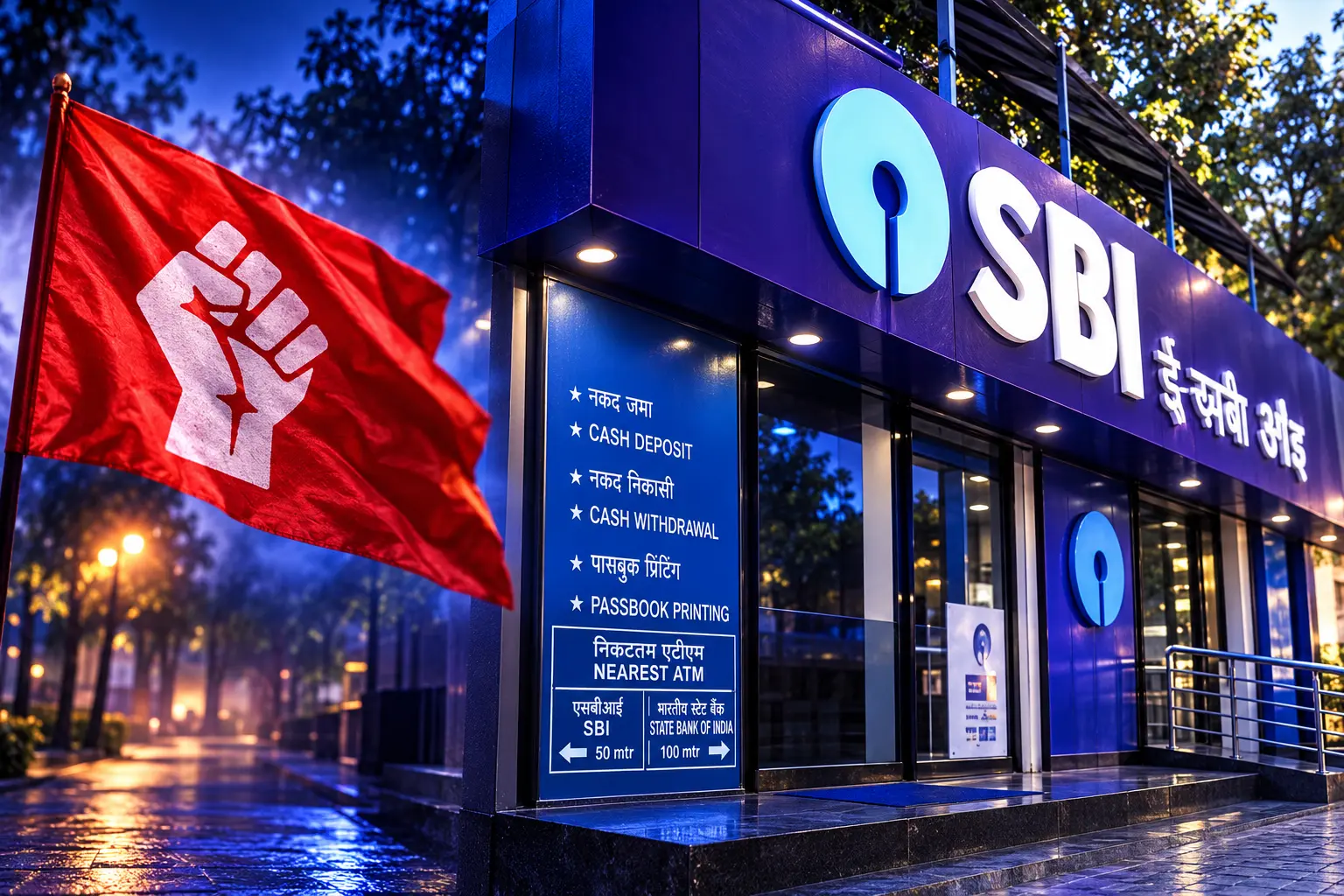
Which Services Survive a Three-Day Bank Strike?
State Bank of India, Union Bank of India and Indian Bank have told customers the same thing in separate advisories: finish anything that needs a desk before 28 September, then use machines and apps. SBI said it would try to keep essential services up and asked people to use ATMs and automated deposit and withdrawal machines for cash, Customer Service Points for a short list of jobs, and internet banking, YONO, mobile banking and UPI for the rest.
SLBC Telangana, which SBI convenes, said skeleton services would be attempted and still asked the public to move early. “Customers are requested to plan and complete banking transactions well in advance of the strike dates,” the committee said.
UPI and net banking do not need a teller, and scheduled digital payments can still move on those rails. The jobs that die when the roster walks out are the ones that still need a person, a stamp or a strong room.
WHAT STILL NEEDS A COUNTER
- Cheques and drafts: Deposit, clearing and demand drafts wait on branch staff and cannot be finished in YONO.
- Cash above the machine: Large deposits and withdrawals that will not fit an ATM or ADWM need a teller window.
- Loans and lockers: Home, vehicle and gold loan papers, plus locker access, stay on the branch desk.
- KYC and passbooks: Fresh identity checks, some account work and passbook updates still want a staffed counter.
Business correspondents and Customer Service Points are the planned rural and neighbourhood substitute. They do a slice of cash and basic account work. They do not replace a full branch on a half-year closing day.
A 40-Minute Bargain Still Sitting in Delhi
Five-day banking is not a new slogan. In 2015 the 10th bipartite settlement made the 2nd and 4th Saturdays of every month holidays and turned the other Saturdays into full working days. The remaining Saturdays were left for later.
On 7 December 2023, IBA and UFBU signed a memorandum that said IBA had already recommended five-day banking to the government and would chase a clearance. The 12th bipartite settlement and 9th Joint Note signed on 8 March 2024 put the weekly-off clause on paper. Remaining Saturdays would become holidays under the Negotiable Instruments Act. Unions agreed working hours would be increased by 40 minutes each day from Monday to Friday, so customer business hours would not shrink. The change still needs approval from the Union government and clearances from the government and the Reserve Bank of India.
That file is where the strike comes from. L. Chandrasekhar, general secretary of the National Confederation of Bank Employees, has pointed to the five-day week already used by the Central government, RBI, the insurance sector and SEBI, and has called the demand a bipartite agreement, not a fresh wish list.
Bank employees have waited long enough for the implementation of the five-day banking week, an issue that was agreed in the 2024 settlement. The continued delay, despite repeated representations and discussions, has left workers with no option but to intensify their struggle.
L. Chandrasekhar, general secretary, National Confederation of Bank Employees, UNI Global Union
The 10 September UFBU notice lists seven unions: AIBEA, AIBOC, NCBE, AIBOA, BEFI, INBEF and INBOC. The forum says it covers more than 90 percent of the banking workforce across public-sector, private, foreign, regional-rural and cooperative banks. Prem Makkar, general secretary of the Indian National Bank Officers’ Congress, said officers are working under acute pressure from business growth, staff shortages, compliance and targets, while a commitment made two years earlier remains unimplemented.
THE FIVE-DAY WEEK FILE
- 2015: Second and fourth Saturdays become holidays; other Saturdays become full working days.
- 7 December 2023: IBA-UFBU memorandum records the five-day recommendation to the government.
- 8 March 2024: Joint Note adds 40 extra minutes Monday to Friday in return for Saturday holidays, subject to government and RBI clearance.
- 8 and 9 September 2026: Conciliation with DFS and IBA produces no date and no deferment.
- 11 September 2026: One-day nationwide strike.
- 28 to 30 September 2026: Three-day strike notice, including the half-year close.
- 26 October 2026: Continuous, indefinite strike listed if the file still has no date.
RBI, LIC, GIC, NABARD, Central and state governments, and the stock, money and foreign-exchange markets already work a five-day week, the unions say. Banks already close two Saturdays a month. The fight is over the other two.
The Finance Ministry Asks Staff to Stand Down
On 21 September the Ministry of Finance appealed to employees of public-sector banks and regional rural banks to keep services running. It said UFBU and other unions had struck over two principal demands, five-day banking and withdrawal of the performance-linked incentive scheme, and that the government, after discussion, had decided to keep the PLI scheme in abeyance.
That pause, the ministry said, met one of the two main demands. Several conciliation rounds followed. Staff still walked out on 11 September, and the three-day strike plus the 26 October indefinite call remained on a single remaining demand, a five-day workweek.
The proposed 3-day strike period, from 28th to 30th Sept 2026, also coincides with the half-yearly closing of banks on 30th September, a date of particular significance for reconciliation, provisioning, and treasury and market operations.
Ministry of Finance, appeal dated 21 September 2026, Press Information Bureau
Combined with the preceding weekend, the ministry said, the stoppage would mean an effective five-day closure at a sensitive point in the financial calendar and would inconvenience customers, businesses, government transactions and international banking operations. It listed other staff measures, including a 56 percent rise in the Staff Welfare Fund in August 2024 and about 482,800 public-sector bank hires from 2014-15 through 2025-26, and said the next wage talks are meant to finish well before the November 2027 deadline.
Those measures do not include a date for five-day banking. The ministry said the remaining demand “continues to be examined.” Bank officers posting through 21 September read that line as a hold, not a timetable, and argued the 28-30 September stop should not be put off. Strike days are unpaid, so each closed counter is a pay cut the roster is choosing to take.
UFBU’s 10 September notice still named residual items beyond the week, including recruitment, a shift from the National Pension System to the old pension scheme, gratuity, pension updation and a uniform dearness allowance on pension. The ministry’s 21 September text treats five-day banking as the demand that is left. Both positions are on the table for the sitting listed on 22 September at the Chief Labour Commissioner’s office in Delhi.
DFS and IBA had already met the unions for conciliation on 8 and 9 September without a breakthrough. Union representatives said they would not defer the 11 September strike without acceptance or a firm timeline.
The Customers Who Still Need a Teller
The unions’ own case for five-day banking is that round-the-clock digital channels already exist. That is the same case banks now use to tell the public to stay home for five days. The people who cannot follow that advice are the ones still standing in the branch.
SLBC Telangana’s own count, updated to 30 June 2026, puts 6,801 public and private bank branches in the state. SBI runs 1,301 of them and convenes the committee. A three-day roster stop in that network hits cheque deposits, teller cash and the processing of home, vehicle and gold loans, the work SLBC had already flagged before the 11 September strike.
TELANGANA BRANCH LOAD
- Total branches: 6,801 public and private bank branches as of 30 June 2026, per SLBC figures.
- SBI in the state: 1,301 branches, and SBI is the SLBC convener.
- What the committee asked: Finish branch work before 28 September; expect inconvenience if normal operations are hit.
Rural cash still moves through business correspondents when a branch is dark, and UPI does not care which state you are in. A locker, a gold loan, a signed loan paper or a cheque that has to be presented is a different product. Those jobs bunch at month-end, and they bunch again when a bank is closing its half-year books.
New-generation private banks, whose officers are less tied to this UFBU notice, are the likely open doors if a customer can reach one. The lenders that have been sending exchange filings and customer notes are the public-sector names on the strike notice: SBI, Bank of Baroda, Union Bank, Indian Bank and their peers, plus regional rural banks whose unions have joined the call.
Unions Have Already Booked October 26
The three-day stop is the middle step, not the last one on the notice. UFBU has listed a continuous, indefinite strike from 26 October if five-day banking is still only a recommendation. That date sits after the half-year close and before the next wage cycle the ministry says it wants to finish ahead of November 2027.
WHAT WE KNOW
- The notice: Strikes on 11 September (already held), 28 to 30 September, and continuous from 26 October 2026.
- The deal: 8 March 2024 Joint Note, 40 extra minutes Monday to Friday, still waiting on government and RBI clearance.
- The rails: SBI, Union Bank and Indian Bank say ATMs, ADWMs, CSPs, YONO, UPI and net banking remain available.
- PLI: The ministry says the incentive scheme has been kept in abeyance.
WHAT IS UNCONFIRMED
- 22 September: Whether the Chief Labour Commissioner sitting produces a date or a deferment.
- Skeleton staff: How many public-sector branches will actually open with the staff who do not join.
- 26 October: Whether the indefinite call is withdrawn, delayed or kept.
Unless the 22 September sitting puts a date on five-day banking, the notice for 28 to 30 September still stands, and so does the walkout listed from 26 October. Customers who still need a teller have a shorter list of open days than the strike calendar first suggests.

A CubeSat Will Age Whisky That Never Comes Home

A Charity Quote Cost Shia LaBeouf the FKA twigs NDA

Looker Turned a Model’s Body Into Ad Inventory

Infinity Ward Bets a Paid DMZ Will Stick This Time

Disney Sidesteps a Kimmel Renewal as Failla Cites Losses

How to Get Pre Boarding on Southwest – Skip the Line with These Tricks

False AI Intel Nearly Put US Crews on a Chinese Ship

Tim Cook’s $4.6 Trillion Apple Still Runs on One Phone

OpenAI Posts a Navier-Stokes Proof Clay Has Not Touched

Dunes Air Sues Nora Fatehi Over Its Luxury Jet
-
 TRAVEL3 years ago
How to Get Pre Boarding on Southwest – Skip the Line with These Tricks
-
 NEWS1 month ago
False AI Intel Nearly Put US Crews on a Chinese Ship
-
 BUSINESS2 months ago
Tim Cook’s $4.6 Trillion Apple Still Runs on One Phone
-
 NEWS2 months ago
OpenAI Posts a Navier-Stokes Proof Clay Has Not Touched
-
 ENTERTAINMENT2 months ago
Dunes Air Sues Nora Fatehi Over Its Luxury Jet
-

 LIFESTYLE3 years ago
How Often Do You Have to Change a Monkey’s Diaper? The Truth About Pet Monkeys
-

 NEWS2 months ago
Australia Treats Cloud Software Payments as Taxable Royalties
-

 LIFESTYLE3 years ago
How Long Does It Take for Armpit Hair to Grow? The Stages of Hair Growth and How to Shave It