
AUTO
Nine Die in Greater Noida Sleeper Bus Fire Overnight
A Yamuna Expressway sleeper bus fire killed nine after the crew ignored a burning smell, repeating a night-coach pattern the road ministry had already flagged.

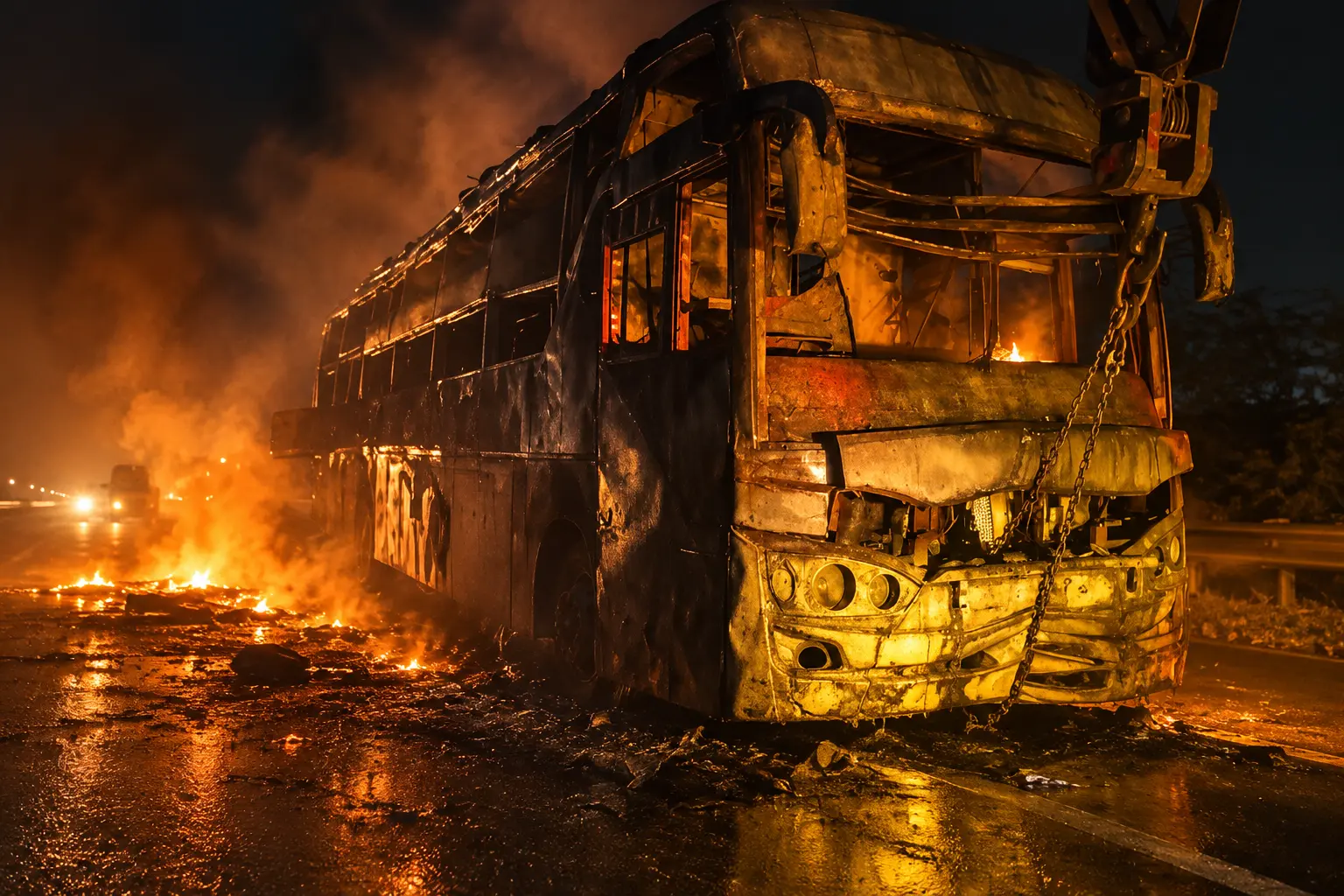
Nine people died when an AC sleeper bus caught fire on the Yamuna Expressway near Greater Noida late on September 23. The Raj Kalpana Travels coach, bearing Bihar registration BR32PA8647, was running from Kashmiri Gate in New Delhi toward Mahoba with around 30 to 35 passengers, most of them asleep.
The FIR says they had already smelled burning from the driver’s cabin. The crew did not stop, and police later arrested both men.
The Crew Smoked While Passengers Smelled Burning
Jewar police registered the case on the complaint of Sunil Kumar, a passenger from Hamirpur, after the coach passed the 33-km mark on the Noida-Agra stretch around 11:30 pm. Passengers told the driver and conductor they could smell burning from the cabin. The complaint says the driver brushed it off as a usual smell on that bus and did not halt to check.
Flames then rose near the driver’s seat. People shouted for the coach to stop. The FIR alleges the driver and conductor first refused, kept smoking bidis and cigarettes in the cabin, laughed when challenged, and threatened riders who objected. Jewar Station House Officer Ajay Kumar Singh said passengers described a small burning smell as the bus reached the expressway and asked the driver to pull over, and that the fire took the vehicle once he finally did.
WHAT THE FIR ALLEGES
- The smell: Riders flagged a burning odour from the driver’s cabin near kilometre 33.
- The delay: The crew did not stop at once to inspect the cabin.
- The smoking: Driver and conductor kept smoking after the warning.
- The threats: They laughed and warned objecting passengers to stay quiet.
- The extinguisher: A unit on board was tried, failed to kill the flames, and was then used to smash a window.
People outside tried to pull riders through the broken pane after voices were heard from inside. Some passengers jumped while the coach was still moving. The driver and conductor left the scene before a police team arrived; both were later detained. Inspector Ajay Kumar Singh is handling the probe. Police have invoked Bharatiya Nyaya Sanhita sections on rash driving, endangering life, criminal intimidation, and culpable homicide not amounting to murder.
Rescue Teams Found Nine Dead in the Aisle
Gautam Buddh Nagar Chief Fire Officer Pradeep Kumar said the fire broke out near the 33-km milestone in the Jewar police station area, close to Dayanatpur village. Senior officers, local police, rescue tenders, and four fire units reached the stretch and put the fire out. Crews then went into the smoke.
Upon entering the bus, it was found that nine persons inside the bus died a tragic death due to burning and suffocation.
Pradeep Kumar, Chief Fire Officer, Gautam Buddh Nagar
He said 20 to 25 people were brought out alive. The nine who did not get out, eight men and one woman, were declared dead at Kailash Hospital in Jewar. ADM Ajit Singh said a short circuit started the blaze. Kumar’s working account is more specific: a spark or blast in the air-conditioning system lit the engine lubricating oil, and the fire then moved fast. He also said the fire began in the engine bay and grew on fuel already in the coach. Those are still field theories, not a closed forensic finding.
Rinki Rajput, travelling from Noida toward Rath, was asleep when someone banged on her berth gate.
I did not pick up any of my belongings. I did not even wear my shoes. I just picked up my phone and came out. There was so much crowd that people were pushing each other. I somehow came out while being pushed around. Someone pulled me out. There was so much smoke that nothing was visible. We were suffocating inside.
Rinki Rajput, passenger
Another rider, seated at the rear, said the fire started toward the front and that there was no clean path out once the cabin filled. “The bus was packed with passengers,” he said, after being shaken awake and told the coach was on fire.
WHAT WE KNOW
- The toll: Nine people died of burns and suffocation inside the coach.
- The crew: Driver and conductor were arrested after first leaving the spot.
- The route: Kashmiri Gate, New Delhi, to Mahoba, Uttar Pradesh, on BR32PA8647.
WHAT IS UNCONFIRMED
- The spark: Whether the first flame was an AC blast, a wiring short, or engine oil catching, still sits with investigators.
- The dead: Jewar police were still identifying all nine on September 24.
- The kit: No public finding yet on whether this coach carried a working fire-detection system or clear emergency exits.
The berths, the smoke, and the time of night did the rest. People who had been sleeping had seconds, in a packed aisle, to find a door or a window they could break.
Why Sleeper Buses Keep Burning at Night
This was not an odd mechanical freak on a new expressway. Night AC sleepers in India have burned in the same way for years: a fault in wiring, the AC pack, or the engine bay, curtains and foam that take flame, a single usable door, and a crew that gets out first. In a written reply in December 2025, the Union government said at least 64 people had died in 45 fires on buses in service over the previous three years.
Road Transport Minister Nitin Gadkari told the Rajya Sabha on February 11, 2026, that India had 49,616 registered sleeper coaches as of February 6, 2026, and 886 accredited bus-body builders. The fleet is large. The inspection culture behind it is not.
SN Dhole, head of the technical secretariat at the Central Institute of Road Transport, has said the codes exist on paper while compliance is largely document-based, and that local body builders still fit parts that cannot take sustained heat and electrical load, including foam that should stay out of a coach. Continuous AC, lights, and charging points run for 14 to 15 hours on these routes. Cheap wiring is a known way for a cabin to go up in minutes once insulation fails.
RECENT SLEEPER BUS FIRES
| Date | Place | Dead | What investigators put on record |
|---|---|---|---|
| May 15, 2025 | Kisan Path, Lucknow | 5 | Spark near the gear; driver and conductor fled; rear passengers trapped |
| October 14, 2025 | Thaiyat, Jaisalmer | 26 | FSL: AC short circuit; roof unit wired to the engine; no FDSS |
| October 24, 2025 | Kurnool, Andhra Pradesh | 20 | Bike dragged under the coach; driver fled; RC listed seating only |
| September 6, 2026 | Shaheed Path, Lucknow | 0 | Driver stopped at once; all 30 people got out |
| September 23, 2026 | Yamuna Expressway, Jewar | 9 | AC spark or oil fire; delayed stop; crew left, then arrested |
The Jaisalmer fire is the closest mechanical cousin. Forensic teams in Jodhpur and Jaipur found no explosives. They traced the start to the roof AC unit, whose wiring ran straight to the engine. Smoke and carbon monoxide filled the cabin; when a window broke, air fed the flames. Greater Noida’s early police account, an AC spark lighting oil in the engine bay, sits in that same family of faults.
A Bihar Plate on a Delhi to Mahoba Run
BR32PA8647 is a Bihar number on a private sleeper working a Delhi-to-Bundelkhand night route. That pattern is common in the long-distance coach trade: a plate from one state, an owner based in another, and a nightly run through a third. It is legal if the permits are real. It also spreads fitness checks across RTOs that may never see the coach on the road where it actually earns money.
Replies under the chief minister’s condolence post on September 24 went straight to that gap. People did not argue about the wording of the grief. They asked why emergency gates are still missing, and they accused local transport offices of clearing coaches for a fee. That is not a proven charge in this FIR. It is the complaint this industry draws every time a sleeper burns, because passengers cannot audit a fitness certificate at 11:30 pm in a bunk.
Sleeper layouts make a late stop costlier than it is in a seater coach. Upper berths, curtains, and a narrow aisle slow a groggy crowd. If the service door is the only one that works, the people furthest from the driver lose. Rinki said many behind her never got out. The nine bodies were found inside after the fire was knocked down, which is the same grim inventory Kurnool and Jaisalmer left behind.
The Ministry Logged These Gaps After Jaisalmer
Gadkari’s February reply did not speak in generalities. On the Jaisalmer-to-Jodhpur coach, the ministry listed faults that local transport officers should have caught at certification.
JAISALMER FINDINGS IN THE MINISTRY REPLY
- Length: The bus was longer than the permitted limit.
- Doors: Emergency doors failed the minimum size rules, and seats blocked the path to them.
- Hatches: One roof hatch was fitted where two were required.
- Cabin: A driver-cabin partition was in place, and a roof luggage carrier had a ladder.
- Fire kit: A Fire Detection and Suppression System was not fitted as the Central Motor Vehicles Rules require.
On the Kurnool-Bengaluru coach, the registration certificate showed “seating capacity” only, a marker of the seat-to-sleeper conversions that keep turning up after fires. The government said it had already sent states an advisory to apply AIS-052 and AIS-119 at registration and at fitness checks under Rule 62.
Those codes are not obscure. AIS-119, the sleeper-coach standard, demands four emergency exits on sleeper coaches, including one emergency door and two escape hatches. It also bars a lower berth over the engine on rear-engine buses, and it points sleeper coaches to fire detection and suppression systems under AIS-135. Interior materials are supposed to meet Indian flammability tests. The Automotive Research Association of India, which runs the standards secretariat, treats mandatory bus body code certification as the gate for coaches of 13 passengers and above.
In January the Centre also said sleeper bodies should come only from accredited makers, and that older coaches should be fitted with fire detection, emergency lighting, exits, hammers, and driver-drowsiness alerts. The Greater Noida FIR does not yet say which of those items BR32PA8647 actually had. The failed extinguisher in the complaint is the one piece of kit the paper names, and it did not work as a fire tool.
Seventeen Days Earlier, Everyone Got Out
On September 6, 17 days before the Yamuna Expressway fire, an AC sleeper running from Gorakhpur to Surat caught fire on Lucknow’s Shaheed Path around 12:30 am with 30 people on board. Driver Rahul Patel told police he heard a bang from the rear, saw flames, stopped, and told the berths to empty. Everyone got out. Luggage burned. Nobody died.
The contrast is ugly because it is so small. One crew stops when the smell or the bang starts. One crew smokes and argues. The May 15 Lucknow fire sits on the other side of that line: the driver jumped without warning, the bus rolled on, the rear exit failed, and five people died, two of them children. Kurnool’s driver got down, saw fire, and ran. Greater Noida’s men, on the FIR’s telling, were told about the smell and still did not treat it as an evacuation.
Hardware still matters. A coach with sealed windows and no hammers will trap people even after a clean stop. A coach with a working alarm and four clear exits gives a late crew less room to fail. The ministry has written both halves of that sentence. The Jewar wreck is what it looks like when neither half arrives in time, on a fast road, with the bunks full.
Compensation Lands Before the Dead Are Named
Uttar Pradesh Chief Minister Yogi Adityanath announced Rs 2 lakh for each bereaved family and Rs 50,000 for each injured passenger, and said he had spoken to families. He posted his condolences on the morning of September 24.
यमुना एक्सप्रेस-वे पर एक बस में दुर्भाग्यपूर्ण अग्नि दुर्घटना में हुई जनहानि अत्यंत दुःखद एवं हृदय विदारक है।
मेरी संवेदनाएं शोकाकुल परिजनों के साथ हैं।
प्रभु श्री राम से प्रार्थना है कि दिवंगत आत्माओं को अपने श्री चरणों में स्थान तथा घायलों को शीघ्र स्वास्थ्य लाभ प्रदान करें।
— Yogi Adityanath (@myogiadityanath) September 24, 2026
The Prime Minister’s Office separately pledged the same sums from the Prime Minister’s National Relief Fund, Rs 2 lakh to the next of kin of each person killed and Rs 50,000 to each injured rider.
Distressed to hear about the loss of lives due to a fire tragedy on a bus in Greater Noida, Uttar Pradesh. Condolences to those who have lost their loved ones. Praying for the swift recovery of the injured.
An ex-gratia of Rs. 2 lakh from PMNRF would be given to the next of kin…
— PMO India (@PMOIndia) September 24, 2026
Those two pots are distinct. Neither one names the nine people still being identified at Jewar, and neither one answers the fitness question the last year of sleeper fires already put on the record. Police have the driver and conductor. The coach is a burnt shell on the Yamuna Expressway. The berths that did not empty are the part of this story that has happened before.

A CubeSat Will Age Whisky That Never Comes Home

A Charity Quote Cost Shia LaBeouf the FKA twigs NDA

Looker Turned a Model’s Body Into Ad Inventory

Infinity Ward Bets a Paid DMZ Will Stick This Time

Disney Sidesteps a Kimmel Renewal as Failla Cites Losses

How to Get Pre Boarding on Southwest – Skip the Line with These Tricks

False AI Intel Nearly Put US Crews on a Chinese Ship

Tim Cook’s $4.6 Trillion Apple Still Runs on One Phone

Dunes Air Sues Nora Fatehi Over Its Luxury Jet

OpenAI Posts a Navier-Stokes Proof Clay Has Not Touched
-
 TRAVEL3 years ago
How to Get Pre Boarding on Southwest – Skip the Line with These Tricks
-
 NEWS1 month ago
False AI Intel Nearly Put US Crews on a Chinese Ship
-
 BUSINESS2 months ago
Tim Cook’s $4.6 Trillion Apple Still Runs on One Phone
-
 ENTERTAINMENT2 months ago
Dunes Air Sues Nora Fatehi Over Its Luxury Jet
-
 NEWS2 months ago
OpenAI Posts a Navier-Stokes Proof Clay Has Not Touched
-

 LIFESTYLE3 years ago
How Often Do You Have to Change a Monkey’s Diaper? The Truth About Pet Monkeys
-

 NEWS2 months ago
Australia Treats Cloud Software Payments as Taxable Royalties
-

 LIFESTYLE3 years ago
How Long Does It Take for Armpit Hair to Grow? The Stages of Hair Growth and How to Shave It