
BUSINESS
The Tata Sons Listing Now Runs Through Shapoorji Pallonji
Tata Trusts say they were not briefed on RBI talks, while Shapoorji Pallonji’s 18.37 percent stake turns the Tata Sons listing into a cash fight.

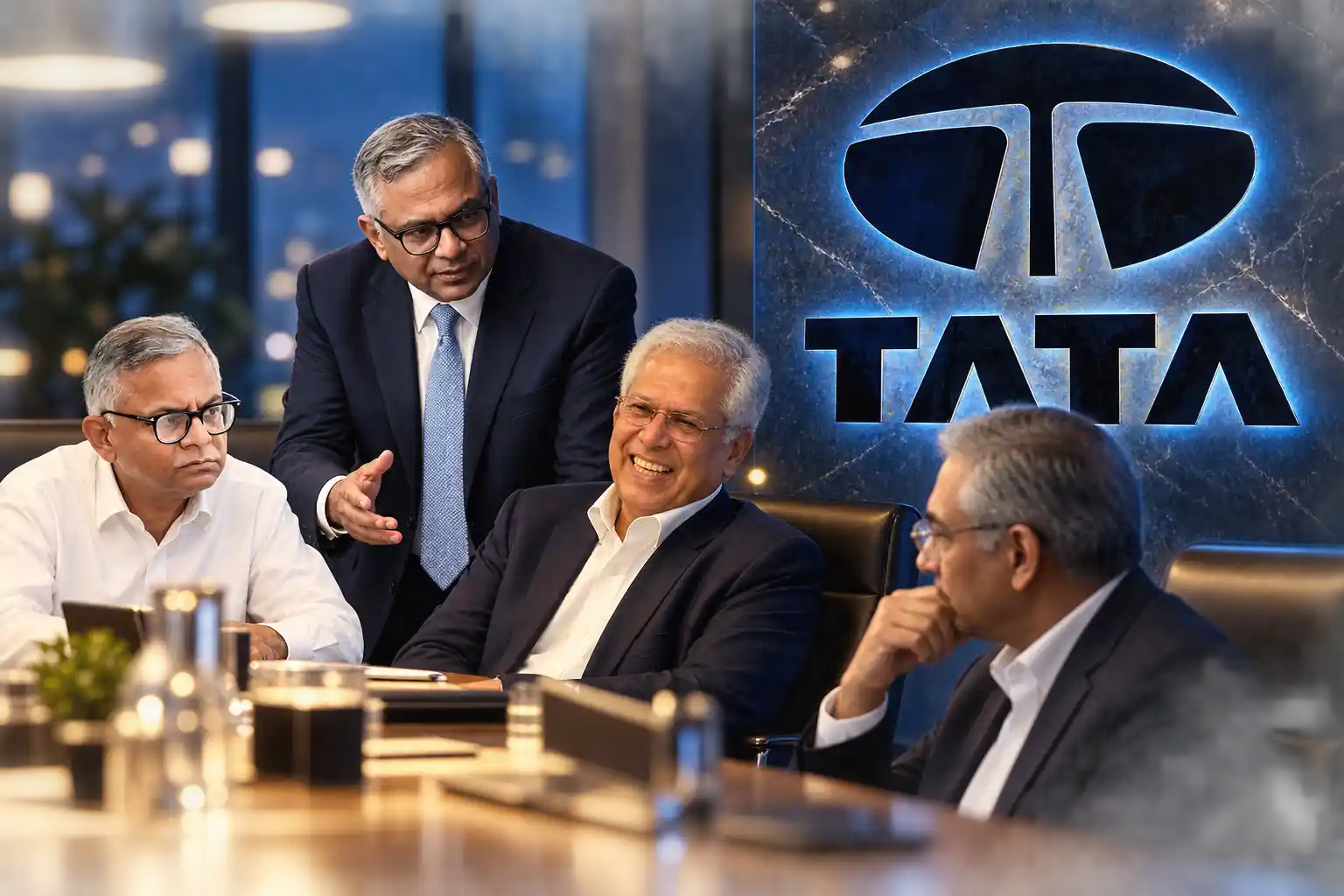
Tata Trusts, holders of about 66 percent of Tata Sons, say they were not kept informed of years of Reserve Bank talks that have now shut the private-company door.
On September 17 the Tata Sons board voted to start a listing and to give executive chairman N Chandrasekaran five more years. The same meeting heard a ₹25,000 crore ($2.6 billion) private buyout aimed at Shapoorji Pallonji, the minority holder that has wanted a market for its 18.37 percent.
Tata Trusts Were Left Out of the RBI Talks
People familiar with the process say the Trusts did not get proper updates on papers sent to the Reserve Bank of India, on hearings, or on the options on the table. Tata Sons and Tata Trusts did not answer a request for comment on that account.
The complaint is about process, not a claim that the Trusts refused to deal with the regulator. They wanted every legal and regulatory route tested that might meet RBI rules without breaking the ownership structure. They had not agreed to a stock-market listing.
Noel Tata, the Trusts chairman, put that gap on the record in the September 17 boardroom. In a statement to directors he said the board had formed no view on what the RBI letter required, or by when, and that it first had to be briefed upon what has passed between the company and the Reserve Bank over two and a half years, including submissions, replies, and options still open.
If the holding company spent years in a closed loop with the regulator, the question inside the group is no longer only why the application failed. It is what was argued, when it was argued, and whether the controlling shareholder was in the room.
The Minority Holder Who Always Wanted a Market
Shapoorji Pallonji sits behind that fight with a stake it cannot easily sell. The group owns 18.37 percent of Tata Sons through Sterling Investments Corporation and Cyrus Investments, and it has been trying to raise cash against that holding.
Noel Tata tabled its proposal at the same September 17 meeting, after talks that also included Chandrasekaran and Shapoor Mistry, the Shapoorji Pallonji Group chairman. The Trusts presented it as a fair path for the minority without a full public listing of Tata Sons.
THE SP GROUP BUYOUT TERMS
- The cash target: A sale of enough Tata Sons shares to yield a gross consideration of Rs. 25,000 crores at the floor value.
- The legal route: Tata Sons would start a selective capital reduction at the National Company Law Tribunal.
- The price rule: Shares would be valued under Rule 11UA of the Income Tax Rules, 1962.
- The timetable: The buyout would run in two tranches over 18 months.
- The funding mix: Noel Tata pointed to internal cash, sales of listed shares, new investors in younger businesses, and offers for sale in some group firms.
The board did not announce that it had approved the deal. Days later Mistry welcomed the RBI outcome and said listing was a social and moral imperative, and that the path forward was clear.
The Tata Trusts reaffirm their position on providing a fair and equitable solution to the SP Group in respect of its Tata Sons holdings.
Read the full statement: https://t.co/wLngO4pAEN pic.twitter.com/sz2KEE3TVH
— Tata Trusts (@tatatrusts) September 17, 2026
A public float would give that 18.37 percent a price and an exit. A private buyout would give cash and leave Tata Sons unlisted. Those are different outcomes for the same shares, and they are why the briefing fight is also a money fight.
2025 Was the Year the Listing Clock Expired
The RBI built the trap in stages. On October 22, 2021 it issued scale-based rules for non-banking financial companies, in force from October 1, 2022, and said an upper-layer firm must list within three years of identification.
On September 30, 2022 Tata Sons was placed in that upper layer as a Core Investment Company. The three-year window ran to September 30, 2025. The company did not list. In 2024 it repaid ₹21,813 crore of debt, turned net cash positive, and on March 28, 2024 asked to give up its CIC registration so it could sit outside the listing rule.
THE RBI CLOCK ON TATA SONS
- October 22, 2021: Issues the scale-based framework for NBFCs, with a three-year listing duty for the upper layer.
- September 30, 2022: Names Tata Sons an upper-layer CIC, starting the original listing window.
- March 28, 2024: Tata Sons applies to surrender its CIC registration after paying down ₹21,813 crore of debt.
- September 30, 2025: The three-year listing deadline passes with the surrender request still pending.
- June 24, 2026: Replaces the old scoring test with a hard asset cut of ₹1,00,000 crore for the upper layer.
- August 6, 2026: Keeps Tata Sons on the upper-layer list for 2026-27, as the only CIC among 17 names, and says the entry is without prejudice to the pending request.
- September 11, 2026: Rejects the surrender and tells Tata Sons to comply at once with upper-layer rules.
Standalone assets were ₹2.01 lakh crore on March 31, 2026, more than twice the new cut. Once a firm is in the upper layer, the RBI keeps the extra rules in place for at least five years even if it later falls below the test.
Another holding company, Shanghvi Finance, paid off its loans and was allowed to drop its registration. Tata Sons did the same debt-pay step and was not. Tata Sons is larger, it is not wholly owned, and 18.37 percent sits with an outside group. Those facts make the “no public funds” case harder to run.
What the September 11 Letter Told Tata Sons
The RBI wrote to Tata Sons on September 11. After looking at the March 28, 2024 application and later letters, it said the request for voluntary surrender of the certificate of registration “cannot be acceded to.” It then told the company to take the steps needed for full compliance with all guidelines that apply to an NBFC in the Upper Layer, immediately.
Noel Tata told the board that the letter does not mention listing, sets no single step, and does not say the company is in breach. He also said the RBI gave no reasons. That is a fair reading of the page he was holding.
It does not mention listing. It prescribes no particular step, and it does not say that the Company is in breach. What its legal effect is, and what it requires of this Company and by when, are questions upon which this Board has formed no view.
Noel N. Tata, Tata Trusts chairman, statement to the Tata Sons board, September 17, 2026
The listing duty still sits in the upper-layer rulebook that the letter told Tata Sons to follow at once. Those are two different texts: the September 11 page, which names compliance, and the 2021 framework, which names a listing. The Trusts want the board to treat that gap as open ground. The company has chosen to treat Upper Layer compliance as a listing path.
On September 15 the RBI put out NBFC FAQs that restated how a CIC is defined: at least 90 percent of net assets in group shares, debt or loans, a minimum asset size of ₹100 crore, and the taking of public funds, plus the 50-50 test on financial assets and financial income. The FAQs did not name Tata Sons. They arrived four days after the rejection.
Noel Tata Opposed, Venu Srinivasan Did Not
The September 17 board asked Chandrasekaran to reverse his August 12 decision not to seek another term when his current term ends on February 20, 2027. He agreed. The board then voted 4-1 to reappoint him as executive chairman for five years after that date, and it voted to move toward a listing in line with the RBI’s direction.
Noel Tata voted against the chair resolution. Venu Srinivasan, the other Tata Trusts nominee and chairman emeritus of TVS Motor, voted for it. The Trusts later said Srinivasan was not barred from voting on listing matters, though questions had been raised about his public support for a listing while the CIC application was still pending.
Tata Sons said the board had resolved by a majority to keep Chandrasekaran. Tata Trusts called the chair vote illegal the same evening, said his August 12 decision had attained finality, and said they had not agreed to a listing. They asked the board to study every option after the RBI letter, then come back with recommendations.
A public split of that kind is itself a cost. Tata has long sold professional governance as part of the brand. Once the Trusts and the holding-company board start arguing in public, that claim is what takes the hit, before any share is priced.
Articles 104B and 121 Return From the Mistry Case
On September 20 the Trusts went further. They said the Articles of Association do not leave board decisions to a head count, and that no decision can be taken unless it has the yes vote of a majority of the directors nominated by the Trusts.
There are two Tata Trusts nominees on the Board of Tata Sons. Majority amongst two is two and not one. On September 17, 2026, one such Director voted against the resolution. Thus, the affirmative support of Tata Trusts Nominee Directors as mandated by the AoA was not given. The condition failed, and so did the resolution.
Tata Trusts, statement dated September 20, 2026
They said a chairman’s casting vote applies only when the full board is tied, not among Trust nominees, and that a 4-1 tally is beside the point. The resolution, they said, was not validly passed, has no legal effect, and is void from the start. They also said there was no deadlock: the board asked a question, and the articles answered no.
The same statement tied the fight to Articles 104B and 121, the nominee and yes-vote rights that were attacked after Cyrus Mistry was removed. Tata Sons had defended those rights in the Supreme Court as the Trusts’ protection as majority owner, and the court had set aside a finding that the articles were oppressive. The Trusts now say the company cannot drop a shield it went to the Supreme Court to keep.
They also rejected the idea that listing is needed to fix governance. Tata Sons, they said, already copies public-company rules in its articles, including independent directors, an audit committee, related-party checks, and an insider-trading code, and has said so in its own annual reports.
Bankers Price a Discount Into a Tata Sons Listing
A listed Tata Sons would be a holding company, not an operating firm. Circulating banker estimates put a possible IPO value in a range of ₹9 lakh crore to ₹12.5 lakh crore, against an underlying book of ₹15-16 lakh crore, of which about ₹12 lakh crore is listed holdings and about ₹4 lakh crore is unlisted. That gap is the usual holding-company discount, plus tax leakage and thin liquidity.
WHO HOLDS TATA SONS
| Holder | Stake | Position on a listing |
|---|---|---|
| Tata Trusts | about 66 percent | Opposed; want other options studied |
| Shapoorji Pallonji Group | 18.37 percent | Supports a listing; also tabled a ₹25,000 crore private sale |
| Seven listed Tata companies | 11.6 percent | Cross-hold shares; no joint public stance |
Those three blocks do not add to 100 percent. The rest sits with other holders. In August a circulating investor note put the Shapoorji Pallonji look-through stake at about ₹2.3 lakh crore. A listed share would give that holding a public price. A private buyout would not.
For the Trusts, a listing would turn a philanthropic controller into the majority owner of a public CIC, with the disclosure that follows. They have said the open question is who is left in the room to speak for the people their grants are meant to reach. For Shapoorji Pallonji, the same listing is the liquid market it has lacked.
The RBI has closed the CIC exit. The Tata Sons board has voted to list and to keep Chandrasekaran. Tata Trusts have called the chair vote void and say they still want options other than a float. Shapoorji Pallonji’s 18.37 percent is the stake that cannot stay illiquid forever, and it is now sitting in the middle of all three fights.
Disclaimer: This article is news reporting and analysis for information only. It is not investment advice, a recommendation to buy or sell any security, or legal advice on the Tata Sons articles, the RBI letter, or any proposed capital reduction. Readers who may act on listing, stake-sale, or board-vote questions should consult a SEBI-registered adviser and a qualified company-law counsel before doing so. Figures, board outcomes, and regulatory statuses reflect the public statements and documents cited here and can change as Tata Sons, Tata Trusts, Shapoorji Pallonji, and the Reserve Bank take further steps.

A CubeSat Will Age Whisky That Never Comes Home

A Charity Quote Cost Shia LaBeouf the FKA twigs NDA

Looker Turned a Model’s Body Into Ad Inventory

Infinity Ward Bets a Paid DMZ Will Stick This Time

Disney Sidesteps a Kimmel Renewal as Failla Cites Losses

How to Get Pre Boarding on Southwest – Skip the Line with These Tricks

False AI Intel Nearly Put US Crews on a Chinese Ship

Tim Cook’s $4.6 Trillion Apple Still Runs on One Phone

Dunes Air Sues Nora Fatehi Over Its Luxury Jet

OpenAI Posts a Navier-Stokes Proof Clay Has Not Touched
-
 TRAVEL3 years ago
How to Get Pre Boarding on Southwest – Skip the Line with These Tricks
-
 NEWS1 month ago
False AI Intel Nearly Put US Crews on a Chinese Ship
-
 BUSINESS2 months ago
Tim Cook’s $4.6 Trillion Apple Still Runs on One Phone
-
 ENTERTAINMENT2 months ago
Dunes Air Sues Nora Fatehi Over Its Luxury Jet
-
 NEWS2 months ago
OpenAI Posts a Navier-Stokes Proof Clay Has Not Touched
-

 LIFESTYLE3 years ago
How Often Do You Have to Change a Monkey’s Diaper? The Truth About Pet Monkeys
-

 NEWS2 months ago
Australia Treats Cloud Software Payments as Taxable Royalties
-

 LIFESTYLE3 years ago
How Long Does It Take for Armpit Hair to Grow? The Stages of Hair Growth and How to Shave It