
NEWS
Rubio Names a Conflict Trump Told the UN He Settled
After Trump told the UN he settled the India-Pakistan war, Marco Rubio said the international system cannot handle that conflict.

Marco Rubio said on September 23 that no working international system can handle a potential India-Pakistan war. A day earlier, Donald Trump told the UN he had already settled that fight among eight wars he claimed to have closed.
India still says the May 2025 stop in fighting came from the two armies, not from Washington. Rubio met India’s external affairs minister in the same city the same day, and the Indian readout was about oil tariffs, not mediators.
Rubio Keeps India-Pakistan on the Open-Crisis List
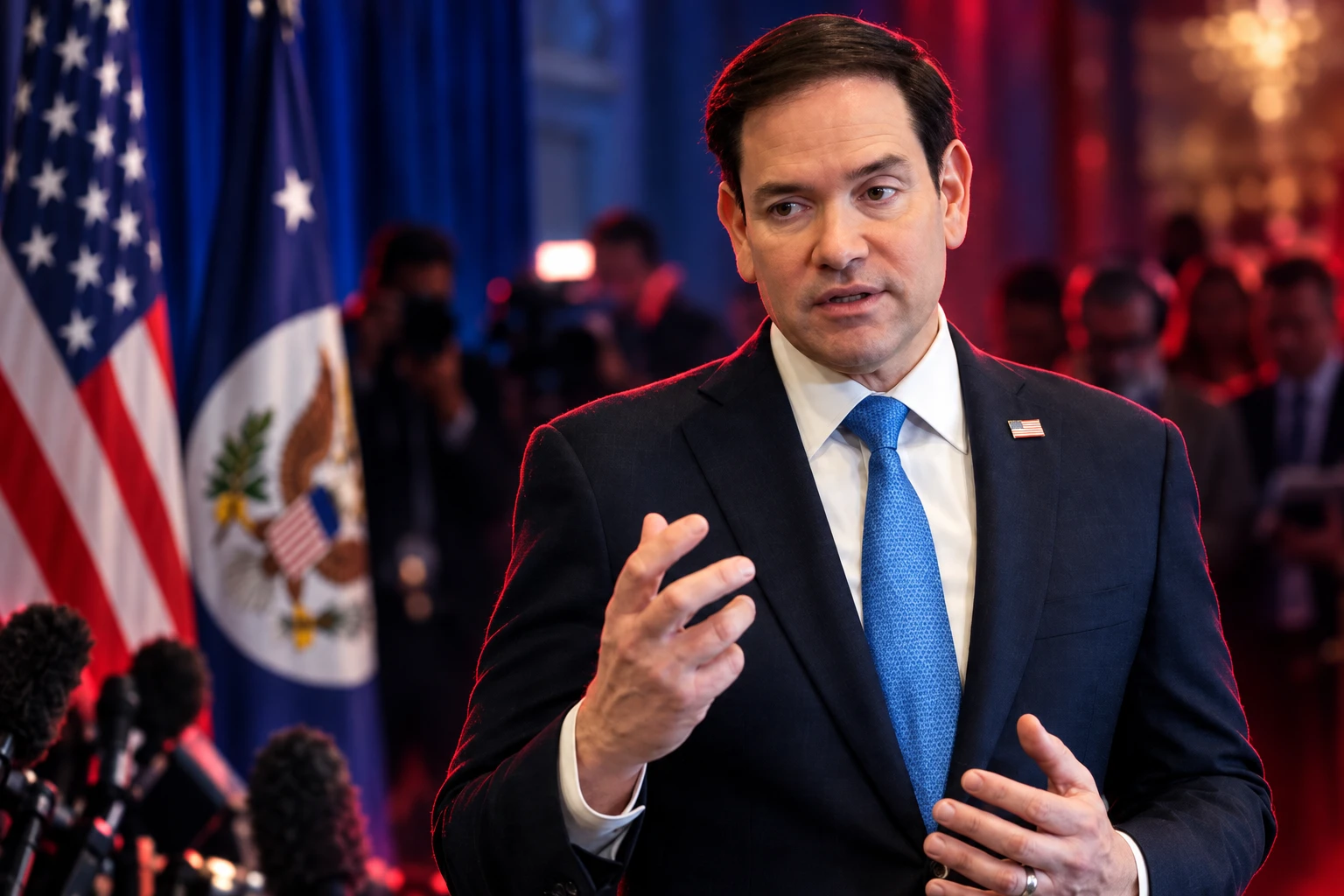
Speaking to reporters at the Palace Hotel during the high-level week of the 81st UN General Assembly, the US secretary of state said leaders in the building agreed the international system is broken. He blamed the system itself. It had, he said, grown past its mandate and its intent, taken on work it should not do, and still could not settle almost any major war.
He still claimed to see a use for the architecture. “We see the utility in the international system. We’re here,” he said, adding that Trump has called the United Nations a body with “tremendous potential” that “it’s not living up to.” He arrived under a State Department note that he would push the UN to return to its core mandate of keeping peace and respecting national sovereignty.
Then he named the tests he says that mandate is failing. A war between Thailand and Cambodia “that occurred.” A “potential conflict between India and Pakistan.” He also pointed to fighting in Sudan, the Congo and Rwanda, and to Iran in the straits, a campaign the White House opened on March 1 under the name Operation Epic Fury. “Right now, we don’t seem to have a functional international system that can address it,” he said.
The India-Pakistan line is the tell. Trump had, the previous afternoon, put “Pakistan and India” on his settlement list. Rubio spoke as if that file were still open, a future war the UN cannot stop, not a closed chapter of American peacemaking. Washington is still treating the pairing as a live crisis, a year after claiming the shooting had been talked down from the Oval Office.
At least as long as President Trump is in office, we will always act in the national interest of our country, not in the interest of the international order. We will never put the international order above the interest of the United States.
Marco Rubio, US Secretary of State, Palace Hotel, New York
He said that was not an attack on the system. In the next breath he said that when the system cannot do the job, nation-states will act for themselves, and the United States will too.
Jaishankar’s Meeting Was About Oil Tariffs
External Affairs Minister S. Jaishankar saw Rubio on the sidelines the same Wednesday. His public note did not mention ceasefires, Kashmir, or a broken UN. “Reiterated India’s interests and concerns with regard to SRIA. Also discussed the Gulf and Ukraine situations,” he wrote.
SRIA is the Lindsey O. Graham Sanctioning Russia and Iran Act, which Trump signed in September. It gives the president power to place tariffs of up to 100% on goods from the largest buyers of Russian oil and gas. India is on that list. New Delhi has said it will protect energy supplies for its people and will take steps to defend its economic interest if Washington uses the new tool against it.
Rubio’s own post after the meeting skipped the sanctions fight. He wrote that the two men were building on the US-India strategic partnership and lining up regional work. The gap in the two notes is the meeting. India came to talk about a tariff stick hanging over its oil bill. The American secretary of state then walked out and used India and Pakistan as his exhibit for a world order that cannot keep the peace.
The May 2025 File New Delhi Closed Itself
The last large India-Pakistan clash began after the April 22, 2025 attack in Pahalgam, in which 26 people were killed. New Delhi blamed militants it said were backed by Pakistan. Islamabad denied the charge. India launched Operation Sindoor on May 7, striking what it called terror camps in Pakistan and in Pakistan-occupied Jammu and Kashmir. The two sides then fought for four days, from May 7 to May 10.
FROM PAHALGAM TO THE CEASEFIRE
- April 22, 2025: Gunmen kill 26 people in Pahalgam. India blames Pakistan-backed militants; Pakistan denies it.
- May 7, 2025: India begins Operation Sindoor against camps in Pakistan and in Pakistan-occupied Jammu and Kashmir.
- May 10, 2025: Pakistan’s director general of military operations calls his Indian counterpart at 3:30 p.m. They agree to stop firing on land, in the air, and at sea from 5 p.m. Trump posts that a “full and immediate” ceasefire followed a “long night” of talks mediated by the United States.
- June 18, 2025: Prime Minister Narendra Modi tells Trump there was no US mediation and no trade talk tied to the truce. Foreign Secretary Vikram Misri says India “has not accepted mediation in the past and will never do.”
- September 16, 2025: Pakistan’s Foreign Minister Ishaq Dar says “India never agreed to any third-party mediation,” even as he describes a Rubio call on May 10 about talks at an independent location that India later refused.
- September 22, 2026: Trump tells the General Assembly he has settled eight wars, among them Pakistan and India, and that Shehbaz Sharif credited him with saving 30 million lives.
- September 23, 2026: Rubio cites a “potential conflict between India and Pakistan” as a job the international system cannot do.
Misri told reporters on May 10 that the Pakistani DGMO, Maj. Gen. Kashif Abdullah, placed the call to India’s Lt. Gen. Rajiv Ghai, and that the two militaries set the 5 p.m. stop themselves. He later told a parliamentary committee there was no American role in working out the halt, and that Trump’s comments had come on social media rather than through official channels. Ministry spokesman Randhir Jaiswal said conversations with Vice President JD Vance and with Rubio that week did not include trade.
Pakistan has at times thanked Washington. Dar’s later account cut the other way on the point India cares about. He said Rubio told him on May 10 that India-Pakistan talks would soon be held at an independent site, and that by July 25 Rubio was saying India insisted the matter was bilateral. That is the record Rubio stepped around in New York: a war Trump still bills as an American settlement, and a capital that would not let him collect the bill.
Thailand and Cambodia Fought After the Peace Deal
Rubio’s other example is not a hypothetical. Thailand and Cambodia fought along their border in 2025, paused, signed a larger deal with Trump in the room, then fought again.
Leaders agreed to a first truce in Putrajaya on July 28, 2025. They signed a fuller joint declaration signed in Kuala Lumpur on October 26, with Trump and Malaysia’s Anwar Ibrahim as witnesses. The text committed both sides to an ASEAN observer team, to pulling heavy weapons back, and to a joint boundary process. Trump has since put “Cambodia and Thailand” on the same eight-war list as India and Pakistan, and has said the UN was not involved.
The October paper did not hold. Clashes resumed, and on December 27 the two defense ministers, Thailand’s Natthaphon Narkphanit and Cambodia’s Tea Seiha, signed a new ceasefire at a border checkpoint, in force from noon. That round of fighting killed more than 100 people and drove more than 500,000 from their homes. The December text again froze troop lines and, after 72 hours of quiet, provided for the return of 18 Cambodian prisoners of war. Rubio welcomed the new halt the same day and told both capitals to honor the Kuala Lumpur terms.
The United States welcomes the announcement from Cambodia and Thailand on reaching a ceasefire following the General Border Committee meeting. We urge both countries to immediately honor this commitment and fully implement the terms of the Kuala Lumpur Peace Accords.
— Secretary Marco Rubio (@SecRubio) December 27, 2025
By February, Cambodian Prime Minister Hun Manet was still saying Thai forces were on Cambodian land and calling the December halt fragile. Rubio now holds that war up as proof the international system cannot do its job. The peacemaking he is pointing to is the kind his own president already claimed as a personal win, then had to bless a second time.
THE TWO CONFLICTS RUBIO NAMED
| Conflict | What Trump claims | What local officials say | Where the file stood |
|---|---|---|---|
| India-Pakistan | US mediated a full ceasefire on May 10, 2025; later listed among eight wars settled | India: the Pakistani DGMO called at 3:30 p.m.; firing stopped at 5 p.m.; no mediator | New Delhi still rejects third-party credit; Rubio now calls a future clash a test the system cannot meet |
| Thailand-Cambodia | Trump witnessed the October 26, 2025 Kuala Lumpur accords | ASEAN and Malaysia hosted; defense ministers signed again on December 27 | December fighting killed more than 100 people after the October deal |
On both files, the American story is that Trump closed a war the UN would have left open. On both files, the local paperwork runs through armies, neighbors, and a second argument about who is allowed to claim the result.
The 66 Organizations Washington Already Left
Rubio’s diagnosis, that the system “broke itself” by growing past its job, is not a new talking point for this administration. It is a policy that has already been carried out in pieces.
WHAT WASHINGTON ALREADY LEFT
- The January memo: On January 7, 2026, Trump ordered a withdrawal from 66 international organizations, split as 35 bodies outside the UN and 31 UN entities, on the ground that they no longer served American interests.
- The early exits: At the start of the term the United States began leaving the World Health Organization and the Paris climate accord. Weeks later it left the UN Human Rights Council and ended funding for UNRWA.
- The standard in New York: The September 18 travel note framed high-level week as a push to put the UN back on peace, security, and sovereignty, and to build on “historic UN reforms” from the past year.
- The eight-war claim: Trump’s Tuesday list named Thailand-Cambodia and Pakistan-India among the settlements he said he reached with relationships, trade, and the threat of tariffs, tools that sit outside the Charter.
On Tuesday he told the General Assembly that while others have talked, I have acted, and that while others have spoken of peace, he has made peace. He also said there is no global government, and that while he is president there will be no global taxes. Rubio’s Wednesday briefing was the operational version of that speech: use the UN when it is useful, ignore it when it is not, and describe the gap as the UN’s failure rather than as a choice the White House has already made.
The hole in that pitch is on Rubio’s own list. One of the crises he says the system cannot handle is the Iran fight Washington launched in March. Another is a “potential” India-Pakistan war that his president had, the day before, described as finished work.
What India Will Not Accept From Mediators
India’s position has not moved with Trump’s lines, or with Rubio’s. It is written the same way in the May 10 briefing, the June 18 call, the parliamentary evidence, and Jaishankar’s silence on Wednesday about any American role in the ceasefire.
INDIA’S MEDIATION RED LINES
- The channel: The stop on May 10 ran through the DGMO hotline, on a call India says Pakistan placed, with effect from 5 p.m. that day.
- The third party: Misri told lawmakers there was no US role in working out the halt, and that contacts with Washington in those days were routine, not mediation.
- The future tense: Modi told Trump that India has not accepted mediation in the past and will never do so, a line New Delhi has used for years on Jammu and Kashmir.
- The trade lever: Jaiswal said trade did not come up with Vance or with Rubio, contradicting Trump’s later account that he offered commerce if the shooting stopped.
Even Dar, who has described American phone calls in May, has said India never agreed to a third-party role. Pakistan can thank Trump. India will not. That split is why Rubio’s “potential conflict” phrasing lands as a policy, not a slip. If last year’s war was an American settlement, the file would be closed. If it was a bilateral military pause that New Delhi will not internationalize, then the next crisis will run through the same hotline, and Washington will again be talking to itself about credit.
America Will Not Rank the UN Above Itself
Rubio said there was “unanimity and consensus” in the hall that the system is broken, and that it needs to be brought back to its “proper focus and its proper role.” He did not describe that role as a court that can bind the United States. He described it as a tool. When the tool fails, he said, governments will act in their national interest. He then named the interest that will win inside his own government for as long as Trump is in office.
That is the doctrine, stated without disguise, a day after the president told the same gathering he had already done the UN’s peace job in eight places. Two of those places were the examples Rubio then used to show the job cannot be done. India, in the same building, was asking about a 100% tariff law and leaving the mediation argument where it has been since May 10, 2025: with the two armies, and off the table for anyone else.
On September 23 Rubio posted about the strategic partnership with India. Jaishankar’s note named sanctions, the Gulf, and Ukraine. Neither man, in public, treated the India-Pakistan file as a war Washington had ended.

A CubeSat Will Age Whisky That Never Comes Home

A Charity Quote Cost Shia LaBeouf the FKA twigs NDA

Looker Turned a Model’s Body Into Ad Inventory

Infinity Ward Bets a Paid DMZ Will Stick This Time

Disney Sidesteps a Kimmel Renewal as Failla Cites Losses

How to Get Pre Boarding on Southwest – Skip the Line with These Tricks

False AI Intel Nearly Put US Crews on a Chinese Ship

Tim Cook’s $4.6 Trillion Apple Still Runs on One Phone

Dunes Air Sues Nora Fatehi Over Its Luxury Jet

OpenAI Posts a Navier-Stokes Proof Clay Has Not Touched
-
 TRAVEL3 years ago
How to Get Pre Boarding on Southwest – Skip the Line with These Tricks
-
 NEWS1 month ago
False AI Intel Nearly Put US Crews on a Chinese Ship
-
 BUSINESS2 months ago
Tim Cook’s $4.6 Trillion Apple Still Runs on One Phone
-
 ENTERTAINMENT2 months ago
Dunes Air Sues Nora Fatehi Over Its Luxury Jet
-
 NEWS2 months ago
OpenAI Posts a Navier-Stokes Proof Clay Has Not Touched
-

 LIFESTYLE3 years ago
How Often Do You Have to Change a Monkey’s Diaper? The Truth About Pet Monkeys
-

 NEWS2 months ago
Australia Treats Cloud Software Payments as Taxable Royalties
-

 LIFESTYLE3 years ago
How Long Does It Take for Armpit Hair to Grow? The Stages of Hair Growth and How to Shave It