
NEWS
YouTube Music Will Let Ask Music Name the Bass Player
YouTube Music is turning Ask Music from mood radio into a credits chat, so bass players, samples, and inspired albums stay inside the app.

YouTube Music will let Ask Music name who played bass on a track, which songs sampled it, and which albums inspired it. The company unveiled the expansion on September 23, 2026, at Made on YouTube, beside a weekly spoken podcast briefing called Your Podcast Lineup. Both are coming soon for YouTube Music and Premium members worldwide.
Ask Music Can Now Name the Bass Player
T. Jay Fowler, senior director of product management for YouTube Music, wrote that listeners found an artist new to them over 450 million new-artist finds in July 2026, and that Ask Music would now help them stay with those finds. The chat already lives in the YouTube Music app. The new pitch is control of the queue and a deeper pass through what Fowler called artist lore, across a catalog of more than 300 million songs.
That catalog is not studio masters only. It includes official recordings, remixes, live cuts, covers, and DJ sets, which is the pile a crate-digger actually wants when a question about one track turns into an hour of listening. YouTube CEO Neal Mohan spent most of his Made on YouTube post on custom homepage feeds, Studio tools, and Live. Music arrived as a short clause about exploring an artist or finding podcasts for a commute.
In the on-stage demo, YouTuber Derrick Gee, a Sydney-based music commentator, asked who played bass on a track, then asked for other songs with that player. He also used the chat to find songs that sampled the record in front of him. Those are the questions people still leave a streaming app to answer.
The Questions That Used to Leave the App
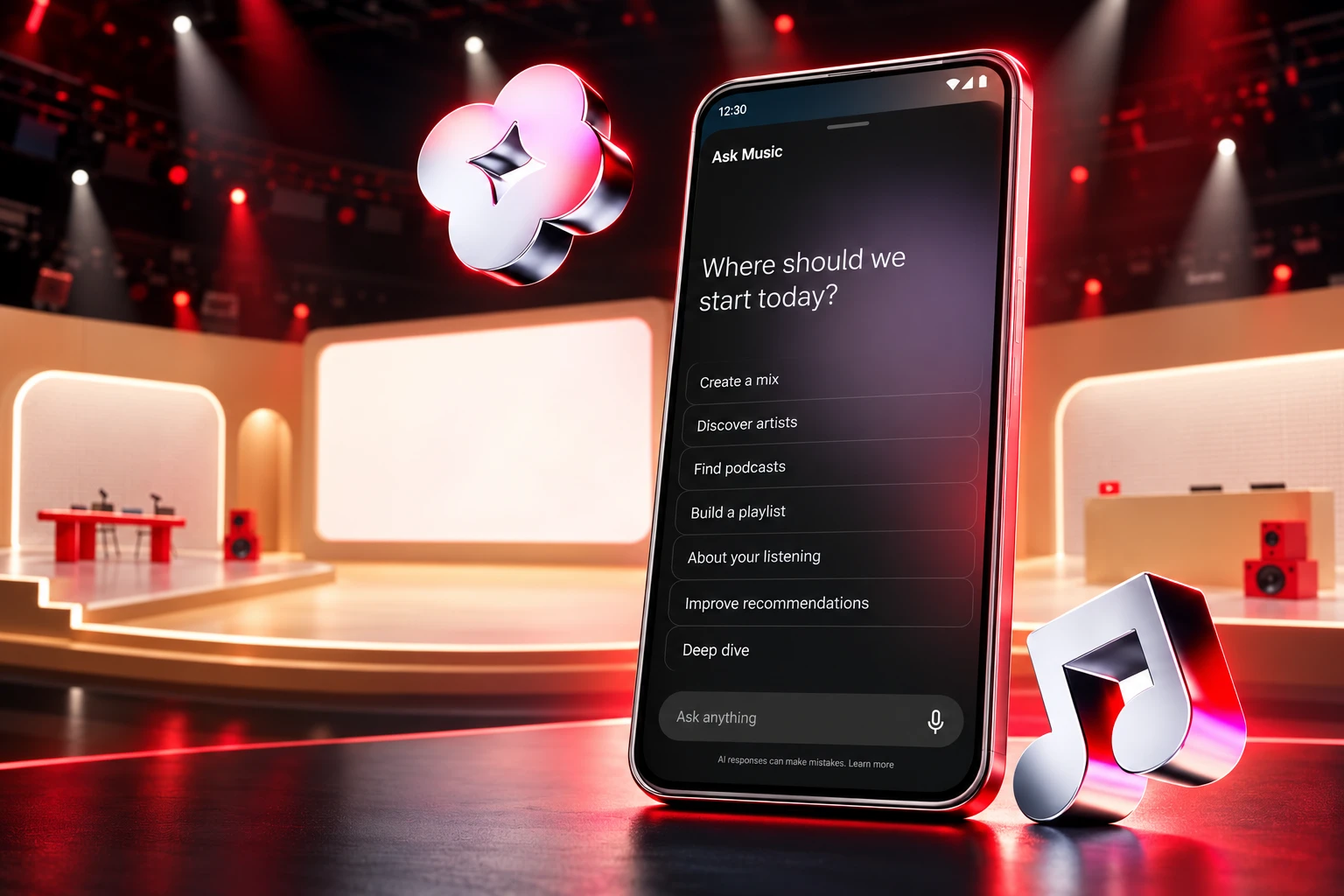
Ask Music is being sold as a friend you type to, not a search box of artist names. Previews of the mobile app put a Gemini spark in the top-right corner, with voice input and chips for Create a mix, Discover artists, and Find podcasts. The sheet can also appear while you edit a playlist or build a mix.
WHAT ASK MUSIC CAN PULL FROM ONE SONG
- The bass player: Name who played the part, then queue other songs that musician is on.
- The sample chain: Find songs that sampled the track you are already playing.
- The inspired mix: Ask for the songs and albums that fed a record, then turn that list into a queue.
- The artist’s shows: Pull podcasts and episodes that feature the person behind the track.
- The queue itself: Change what plays next in plain language instead of hunting title by title.
YouTube’s own help text already says Ask Music can handle factual questions about music and artists, so this is not the first time the bot has been allowed to talk about a song. What changed on September 23 is the job YouTube wants that talk to do: keep the follow-up inside the player until the session is a stack of credits, samples, and related shows.
Credits tools fail in public when they get a name wrong. The help pages warn that quality and accuracy may vary, and that the company may block prompts that hit sensitive topics. A bass credit that sends you to the wrong discography is worse than a blank liner note, and there is no public test set yet for how often the chat nails session players.
Mood Radio Was the Whole Product in 2024
Ask Music did not start as a liner-notes desk. YouTube spent 2024 teaching it to build a station from a feeling.
ASK MUSIC FROM MOOD RADIO TO LINER NOTES
- 2024: YouTube introduces Ask Music as a way to make a custom radio from a mood or activity, with prompts such as songs to help a dog chill out, and limits the first wave to Premium members on Android in the United States, Canada, New Zealand, and Australia.
- April 3, 2025: YouTube CEO Neal Mohan writes that the same chat is on iOS in the YouTube Music app, still framed as personal radio from a description of what you want to hear.
- May 29, 2026: Mohan adds that Ask Music can already fetch personal podcast recommendations, after Premium members watched more than 800 million hours of podcasts in April 2026.
- September 23, 2026: Fowler’s post moves the same chat onto queue control, artist lore, sample hunts, session players, and a weekly spoken podcast guide.
More than two years after the mood-radio launch year, the product YouTube is describing is closer to a music nerd in your pocket than a station you set and ignore. That is a harder job. A rainy-day mix can be wrong and still be pleasant. A wrong bass player is just wrong.
Spotify Already Mapped Samples and Credits
YouTube is walking into a fight Spotify already staged with a graph, not a chat. On November 19, 2025, Spotify said it was expanding song credits beyond topline names and rolling out SongDNA, an interactive view of collaborators, samples, and covers in Now Playing. Samples and covers in that view are samples and covers from WhoSampled, which Spotify said was then part of the company. SongDNA later went live in beta for Premium listeners.
WhoSampled Now Lives Inside Spotify
Producer Mike Dean put the old habit in plain words when Spotify asked artists about the credits push.
Back in the record and CD era, people read liner notes and it was a big thing to do while you listened. We used to listen, read, and dream of being listed one day.
Mike Dean, producer, Spotify for Artists
Dean also said a lot of that information still falls out of metadata when labels deliver a file, which is why assistant engineers and extra producers vanish from streaming credits. A chat that “names the bass player” only works if the underlying credits are complete. YouTube has not said whether Ask Music will read label metadata, scrape its own video interviews, or guess from a language model.
A Chat Instead of a Map
The two products are aimed at the same itch and do not look alike.
HOW THE TWO CREDITS TOOLS DIFFER
| Piece | YouTube Music Ask Music | Spotify SongDNA |
|---|---|---|
| How you open it | Chat sheet in the Music app | Card in Now Playing |
| Samples | Ask for songs that sampled the track (demo) | WhoSampled samples, interpolations, covers |
| People | Who played bass, then that player’s other songs | Writers, producers, collaborators on a map |
| Extra audio | Remixes, live cuts, covers, DJ sets in the same catalog | Covers and sample sources in the graph |
| Who gets it | Premium and Music Premium, coming soon worldwide | Premium, live in beta |
TIDAL already ships interactive credits that let you tap through the people on a track, so neither giant is inventing liner notes. YouTube’s bet is that you would rather ask than tap, and that its mix of live versions and DJ sets gives the answer more places to go. Spotify’s bet is a map you can wander without phrasing a question. Conversational music search is already a streaming-war front. YouTube is not first to the chat window. It is trying to be the one that answers the nerd question without sending you to Genius or a sample wiki.
A Weekly Spoken Preview of New Shows
Your Podcast Lineup is the other half of the announcement, and it is a different product from Ask Music’s existing podcast search. Fowler described it as a personal AI-audio guide that delivers a quick weekly spoken preview of recommended shows, explains why they fit, then jumps into suggested episodes. The pitch is eyes-optional and hands-free, for a commute where you cannot tap a chip.
Ask Music can already take a prompt such as intellectual podcasts about tech and return shows. Mohan’s April 2026 podcast-hours figure is the reason YouTube keeps building here: Premium members are already using the app as radio for talk, not only for songs. Lineup tries to make the next show arrive as a briefing you hear, not a shelf you scroll.
It is also the unproven half. A weekly voice that tells you why you will like a show can feel like a host or like an ad, and YouTube has not said whose voice it uses, how long the briefing runs, or whether hosts can opt out of being summarized. Until the feature ships, that is a product description, not a listening test.
Who Can Use Ask Music Right Now
The new lore tools and Your Podcast Lineup are coming soon to YouTube Music and Premium members worldwide. The Ask Music chat people can open today is still gated, and the help pages are blunt about it.
THE ASK MUSIC SNAPSHOT
- New-artist finds: Over 450 million times in July 2026, per YouTube, a discovery volume the new prompts are meant to extend.
- Catalog in the chat: More than 300 million songs, including remixes, live cuts, covers, and DJ sets.
- Who can talk to it now: YouTube Premium and YouTube Music Premium members, with no ads in the chat.
- What still is not public: Ship date, languages, and how often credit answers are right.
Current Ask Music Premium member rules also limit the live chat to mobile, in Australia, Canada, Ireland, South Korea, Mexico, New Zealand, the United Kingdom, the United States, and Latin American countries except Brazil. The worldwide line in Fowler’s post is the expansion. Until it lands, a lot of paid members still cannot ask who played bass.
The tool uses a large language model. It can pull your current query, recent chat, listening and watch history, and what is on screen, and human reviewers may read disconnected copies of those conversations to improve the product. That is the trade for a bot that knows your top artists well enough to brief you on a bass player you did not search for.
.@youtubemusic users discovered an artist new to them over 450 million times in July 2026. Today at #MadeOnYouTube, we’re making finding your next obsession even easier:
💬 Chat with Ask Music to customize your queue and explore deep artist lore across 300M+ songs
🎧 Catch… pic.twitter.com/657qCOhx4U
— Updates From YouTube (@UpdatesFromYT) September 23, 2026
YouTube’s own post put the 450 million figure above the new buttons, then asked people to chat their way through artist lore and to catch a weekly spoken preview of shows. Fowler closed with crate digging and curating. The features still have to ship before anyone knows whether the bass player’s name is in the file, or whether the briefing sounds like a friend who has actually heard the episode.

A CubeSat Will Age Whisky That Never Comes Home

A Charity Quote Cost Shia LaBeouf the FKA twigs NDA

Looker Turned a Model’s Body Into Ad Inventory

Infinity Ward Bets a Paid DMZ Will Stick This Time

Disney Sidesteps a Kimmel Renewal as Failla Cites Losses

How to Get Pre Boarding on Southwest – Skip the Line with These Tricks

False AI Intel Nearly Put US Crews on a Chinese Ship

Tim Cook’s $4.6 Trillion Apple Still Runs on One Phone

Dunes Air Sues Nora Fatehi Over Its Luxury Jet

OpenAI Posts a Navier-Stokes Proof Clay Has Not Touched
-
 TRAVEL3 years ago
How to Get Pre Boarding on Southwest – Skip the Line with These Tricks
-
 NEWS1 month ago
False AI Intel Nearly Put US Crews on a Chinese Ship
-
 BUSINESS2 months ago
Tim Cook’s $4.6 Trillion Apple Still Runs on One Phone
-
 ENTERTAINMENT2 months ago
Dunes Air Sues Nora Fatehi Over Its Luxury Jet
-
 NEWS2 months ago
OpenAI Posts a Navier-Stokes Proof Clay Has Not Touched
-

 LIFESTYLE3 years ago
How Often Do You Have to Change a Monkey’s Diaper? The Truth About Pet Monkeys
-

 NEWS2 months ago
Australia Treats Cloud Software Payments as Taxable Royalties
-

 LIFESTYLE3 years ago
How Long Does It Take for Armpit Hair to Grow? The Stages of Hair Growth and How to Shave It