
BUSINESS
NSE Lists on BSE as Macquarie Tags It the Dominator
NSE shares listed at Rs 1,800 on rival BSE, a 0.84% premium, as Macquarie called the exchange The Dominator with a Rs 1,965 target.

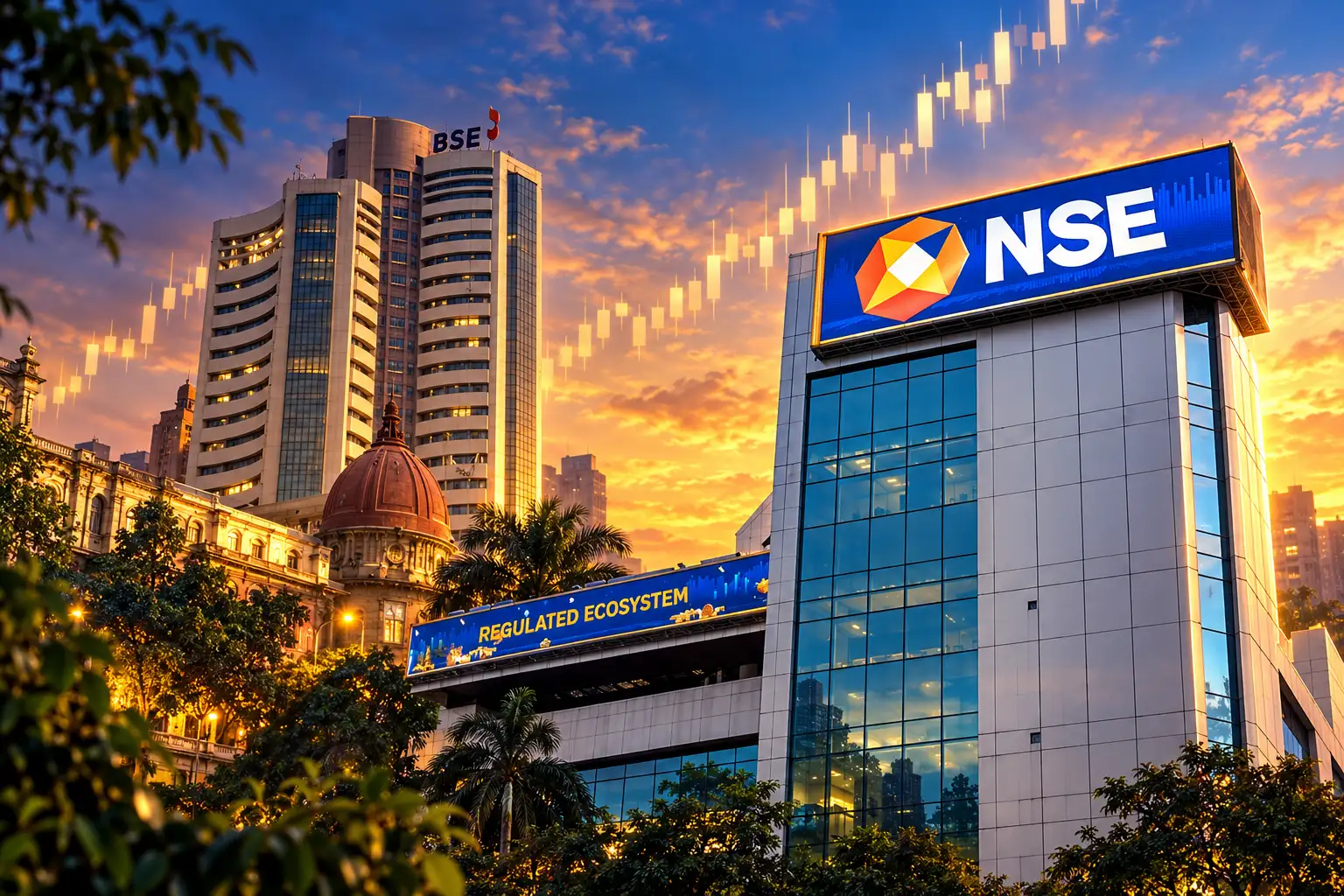
NSE shares listed at Rs 1,800 on BSE on September 24, 2026, a 0.84% premium to the Rs 1,785 issue price. Macquarie initiated coverage at Outperform with a Rs 1,965 target and named the exchange “The Dominator.” The open still sat below a 2.2% grey-market premium, and the stock could not appear on its own order book.
That is the odd print behind the tag. India’s largest exchange borrowed its rival’s tape, while the same research note gave BSE a fatter modelled upside under a different nickname, The Challenger.
A Debut on the Rival’s Board
BSE printed NSE at Rs 1,800, Rs 15 above the issue price. Metropolitan Stock Exchange of India listed the same stock flat at Rs 1,785. In morning trade the shares ran as high as Rs 1,878, a 5.21% gain on the issue price, which lifted market value to about Rs 4.64 lakh crore from Rs 4.42 lakh crore at the issue price and put NSE among India’s 10 most valued firms on that print.
The venue is the story the open price is not. Managing director and CEO Ashishkumar Chauhan told the IPO press conference in Delhi that an exchange is not allowed to supervise trading in its own stock, a rule set around 2016, which is why BSE’s shares have traded only on NSE since 2017.
The stock exchange cannot regulate itself
Ashishkumar Chauhan, MD and CEO, NSE, at the IPO press conference in Delhi
SECC Regulation 45 does bar an exchange from listing itself or on an associated exchange. NSE, launched in the 1990s as the electronic challenger to the older floor, now has its public float priced on that older board. The full-circle listing is a compliance outcome, and it still reads like a joke the market already knew how to tell.
Macquarie Prices the Dominator at 10% Upside
Macquarie’s Rs 1,965 target is about 10% above the Rs 1,785 issue price. The note leans on cash-market and futures control, a full product stack, and cash generation, and it still models only a single-digit-to-low-double-digit move from the IPO band. On the same morning the house initiated BSE at Outperform with a Rs 4,000 target, about 22% above Rs 3,270, and called Asia’s oldest exchange The Challenger after its pivot into index options.
We initiate at Outperform with a Rs 1,965 target price. Entrenched network effects, industry-leading profitability and cash underpin our positive outlook
Macquarie, initiation note, September 2026
MACQUARIE’S FIVE MARKET TAGS
| Company | Tag | Rating | Target (Rs) |
|---|---|---|---|
| NSE | The Dominator | Outperform | 1,965 |
| BSE | The Challenger | Outperform | 4,000 |
| MCX | The Phoenix | Outperform | 3,820 |
| Groww | The Disruptor | Outperform | 260 |
| Angel One | The Transformer | Neutral | 285 |
Emkay Global Financial Services went to Buy with a September 2027 target of Rs 2,050, about 15% above the issue price. Religare stayed Neutral. SAMCO’s Apurva Sheth, head of market perspectives and research, had talked of a Rs 50 to Rs 80 listing premium, a band the Rs 1,800 open did not reach. Niket Shah of Compounding AMC put the long case in one line: if you are bullish on India, you cannot be bearish on NSE. The research split is less bull versus bear than how much of the franchise is already in the price.
Why the Grey Market Overshot the Open
Grey-market talk into listing day pointed to a 2.2% premium, down from about 4% earlier in the week of allotment. The BSE print came in at 0.84%. For a retail lot of eight shares, that first tick was Rs 120 of listing gain, not the pop the unofficial market had been advertising.
THE ISSUE THE OPEN HAD TO CLEAR
- Issue size: 12.64 crore shares raised Rs 22,569 crore in a pure offer for sale, India’s second-largest IPO after Hyundai Motor India’s Rs 27,870 crore issue in 2024.
- Demand: The book was subscribed 5.71 times, with bids of Rs 90,287 crore and more than 38.4 lakh applications.
- Who bid: Qualified institutional buyers took 12.68 times their portion, non-institutional investors 6.55 times, and retail 1.39 times.
- Anchor book: Chauhan said demand ran well ahead of a roughly Rs 6,254 crore anchor allocation, with foreign and domestic institutions both in the queue.
That is a QIB-heavy OFS, not a retail frenzy. The book filled because institutions wanted a slice of the market utility. The tape then opened as if a large, fully priced secondary sale had just hit a liquid board, which is exactly what it was. Abhinav Bharti at JPMorgan said quite a few global investors showed up for an Indian listing for the first time, a comment that explains the 12.68 times QIB figure better than it explains the 0.84% open.
Sellers Took Cash and Left Most of the Stake
NSE issued no new shares, so the exchange itself received none of the Rs 22,569 crore. Twenty institutional holders who owned 36.82% before the sale tendered stock equal to 5.11% of equity and still held 31.71% after allotment. Nine foreign institutions had 15.96% going in; 11 domestic names, 10 of them public-sector entities plus ICICI Lombard, held 20.86%.
HOW THE LARGEST NAMES TRIMMED
| Shareholder | Pre-OFS | Post-OFS |
|---|---|---|
| Aranda Investments | 4.54% | 4.09% |
| Stock Holding Corporation of India | 4.44% | 4.19% |
| SBI Capital Markets | 4.33% | 3.98% |
| Mahagony | 3.73% | 3.61% |
| State Bank of India | 3.23% | 2.58% |
| Crown Capital | 2.07% | 1.83% |
| Canada Pension Plan Investment Board | 1.60% | 1.12% |
| MS Strategic (Mauritius) | 1.20% | 0.76% |
Aranda, Stock Holding, SBI Capital Markets and Mahagony cut only about 7% of their own holdings on average. SBI sold about 20% of its line. CPPIB sold about 30% and MS Strategic about 37%, the more complete exits in a group that otherwise stayed put. Sriram Krishnan, NSE’s chief business development officer, said some large holders pulled back from the sale because they thought the stock was worth more, which is why the offer shrank from 14.89 crore shares to 12.64 crore, a cut of 2.25 crore shares, or about 15%, after eight sellers reduced tickets and one individual, Amit Kumar Lohia, withdrew 25,000 shares. In his words, the issue size came down from 31,500 crores to 22,500 crores.
The public float is thin on purpose. New holders bought a 5.11% slice of a company whose old owners still sit on nearly a third of the equity and clearly did not treat the IPO as a door out.
The Options Book NSE No Longer Owns Alone
Macquarie’s Dominator case is easiest to defend in cash and futures. NSE’s own Economic Policy and Research team, in the July 2026 Market Pulse compiled through June 30, put the three-month rolling options share of 69.4%, against 93.1% in equity cash and 99.7% in equity futures. Currency futures and currency options both printed at 100% on that snapshot. The World Federation of Exchanges still ranked NSE the world’s largest derivatives venue by contracts in FY26, with a 51.3% share of equity futures and options, and third in equity trading by number of trades at 11.4%.
NSE’S THREE-MONTH ROLLING SHARE TO JUNE 2026
- Equity cash: 93.1% of domestic turnover stayed on NSE.
- Equity futures: 99.7% left almost no room for a second tape.
- Equity options: 69.4% on premium turnover, the hole in the monopoly.
- Currency derivatives: 100% in both futures and options on the same rolling window.
Annual figures in the offer papers show how that options hole opened. NSE’s share of equity options premium was 96.9% in FY24, 87.4% in FY25 and 74.71% in FY26. BSE’s options premium share, in Macquarie’s telling, went from almost nothing to more than 25% in three years. YES Securities has said almost all listed equity trading risk in India still funnels through one platform, which remains true for cash and futures and is already less true for the options book that throws off the fees. Macquarie itself assumes modest share losses in cash equities and F&O through FY30, with a 12% revenue CAGR from FY26 to FY30E that it says only matches the market, helped by non-transaction lines and new products.
How the Closing Auction Hits Transaction Fees
The near-term volume problem has a name. SEBI’s 20-minute closing auction from 3:15 pm to 3:35 pm, written in the January 16, 2026 circular, went live on August 3 for cash stocks that have derivatives. The auction sets the official close that now feeds index and stock-futures settlement. Order entry ends at a random second between 3:28 pm and 3:30 pm, the cash price band is 3% either side of a 3:00 pm to 3:15 pm VWAP reference, and equity derivatives keep running until 3:40 pm.
THE CAS CALENDAR
- December 5, 2024: SEBI floats the first public consultation on a closing auction.
- August 22, 2025: A revised design goes out for a second round of comments.
- January 16, 2026: The circular orders a 20-minute session from 3:15 pm and ties derivative settlement to the new close.
- August 3, 2026: CAS starts for F&O stocks, replacing the last-30-minute VWAP close.
- September 3, 2026: After the first month, SEBI says it may change how expiry settlement is calculated, with a consultation paper to follow.
- September 11, 2026: Chairperson Tuhin Kanta Pandey says the auction itself stays.
August turnover in NSE equity derivatives fell to Rs 34.48 lakh crore, the lowest month since November 2023. Jefferies put the drop in average daily options turnover at about 20% month on month in the first CAS month. Bernstein analysts Manas Agrawal and Himank Sangai found that the last 15 minutes, once about 10.1% of NSE cash turnover, shrank to 1.6% to 2.3% as desks stepped back from the auction window. Exchange data showed proprietary traders’ share of equity-derivatives turnover at 54.7% in August, the lowest since December 2022, on notional activity of about Rs 193 trillion a day. Macquarie already assumes near-term pressure on cash equity, derivatives and margin-trade-funding volumes while the market learns the new close. Pandey’s line was blunt: “CAS is here to stay.”
The Multiple Assumes India Keeps Financialising
At the upper IPO band Macquarie has NSE at 22 times FY29E EV/EBITDA and 29.5 times FY29 earnings. It says that is a 65% PE premium to international exchanges, 30 times FY29E against 18 times, and that NSE still delivers around 60% higher growth and returns. At Rs 1,965 the multiple rises to 32.5 times FY29E earnings, which Macquarie calls a 2.5 times PEG, in line with global peers on a growth-adjusted basis. Further re-rating, in the note, needs stronger traction in new products, a higher put-call mix, and wider use of monthly options.
Those are long arguments. They sit on a 13.2 crore unique PAN base, 1,328 trading members, 3,005 listed companies and US$5.01 trillion of listed-entity market value as of June 30, 2026. They also sit on a stock that opened 0.84% up after a 5.71 times book, on a board the issuer does not control, with a 10% official upside next to a 22% target on the Challenger that hosted the debut.
On September 24 the Dominator’s first public price was a BSE print at Rs 1,800.
Frequently Asked Questions
Why Did NSE List Its Shares on BSE?
SECC Regulation 45 lets a recognised exchange list only on another recognised exchange, and only if it meets ownership and governance tests, has three years of continuous trading behind it, and has SEBI’s approval. NSE chose BSE as that other venue, the same way BSE listed only on NSE in 2017, so each exchange’s own stock is supervised by a competitor rather than by its own surveillance desk.
Did NSE Receive Any Money From the IPO?
No. The issue was entirely an offer for sale, so proceeds went to selling shareholders. NSE also reserved 4,33,436 shares for employees at a Rs 170 discount to the Rs 1,785 issue price, a slice worth about Rs 70 crore, which was still secondary stock rather than new capital for the exchange.
What Was the NSE IPO Price Band and Lot Size?
The band was Rs 1,700 to Rs 1,785, and the final issue price was fixed at the top of that band. Retail had to bid in lots of eight shares, so the minimum cheque at Rs 1,785 was Rs 14,280, and the shares opened for subscription on September 17 and closed on September 21 before listing on September 24, 2026.
What Share of Indian Equity Trading Did NSE Hold in FY26?
Offer-document figures for the full financial year put NSE at 92.99% of equity cash, 99.79% of equity futures and 74.71% of equity options premium in FY26, down from 96.9% of options in FY24. Those annual numbers sit beside the later three-month rolling snapshot to June 2026, which is why the options line is the one competitors keep attacking.
Can an Indian Stock Exchange List on Its Own Platform?
No. Regulation 45 of the 2018 SECC rules forbids a recognised exchange from listing on itself or on an associated exchange, and it also says the securities of a recognised clearing corporation shall not be listed on any stock exchange. The point of the ban is to keep listing supervision, membership rules and surveillance from collapsing into one house watching its own share price.
Disclaimer: This article is news reporting and analysis of the NSE listing and published broker research, and it is for information only. It is not investment advice, a recommendation to buy or sell NSE or BSE shares, or an offer of securities. Readers should consult a SEBI-registered investment adviser or their own broker before acting on any price, rating or target mentioned here. Figures, ratings and trading levels reflect the cited filings, exchange data and research notes as of September 24, 2026 and can change with markets, regulation and later revisions.

A CubeSat Will Age Whisky That Never Comes Home

A Charity Quote Cost Shia LaBeouf the FKA twigs NDA

Looker Turned a Model’s Body Into Ad Inventory

Infinity Ward Bets a Paid DMZ Will Stick This Time

Disney Sidesteps a Kimmel Renewal as Failla Cites Losses

How to Get Pre Boarding on Southwest – Skip the Line with These Tricks

False AI Intel Nearly Put US Crews on a Chinese Ship

Tim Cook’s $4.6 Trillion Apple Still Runs on One Phone

Dunes Air Sues Nora Fatehi Over Its Luxury Jet

OpenAI Posts a Navier-Stokes Proof Clay Has Not Touched
-
 TRAVEL3 years ago
How to Get Pre Boarding on Southwest – Skip the Line with These Tricks
-
 NEWS1 month ago
False AI Intel Nearly Put US Crews on a Chinese Ship
-
 BUSINESS2 months ago
Tim Cook’s $4.6 Trillion Apple Still Runs on One Phone
-
 ENTERTAINMENT2 months ago
Dunes Air Sues Nora Fatehi Over Its Luxury Jet
-
 NEWS2 months ago
OpenAI Posts a Navier-Stokes Proof Clay Has Not Touched
-

 LIFESTYLE3 years ago
How Often Do You Have to Change a Monkey’s Diaper? The Truth About Pet Monkeys
-

 NEWS2 months ago
Australia Treats Cloud Software Payments as Taxable Royalties
-

 LIFESTYLE3 years ago
How Long Does It Take for Armpit Hair to Grow? The Stages of Hair Growth and How to Shave It